
Structured Content Models: CMS Architecture for AI
Is your CMS storing content in a way AI can understand, or are you shipping blobs of HTML that force models to guess at structure?


The CMS decision most marketing teams made five years ago is now a GEO decision. A CMS that stores content as unstructured HTML blobs forces AI models to parse and guess. A CMS built around structured content types (articles with typed fields, products with typed attributes, entities with explicit relationships) produces content that AI reads cleanly and cites confidently. The brands with the cleanest AI visibility aren't necessarily writing better content. They're storing it in a shape AI can understand without guesswork.
Why CMS Architecture Matters for AI
AI models extract facts, not prose. When they read your site, they're looking for specific claims, entities, and relationships. The easier it is to find them, the more likely the content gets cited.
Unstructured content: "Our new platform is built for SaaS marketing teams and supports integration with Salesforce and HubSpot, with pricing starting at $299 per month for teams of up to ten users."
Structured content: typed fields for industry (SaaS), function (marketing), integrations ([Salesforce, HubSpot]), startingprice ($299/month), seatlimit (10).
Both say the same thing. The second is trivially extractable. The first requires parsing. Over a thousand pages, that parsing difference compounds into measurable citation-rate differences.
What a Structured Content Model Looks Like
A structured content model defines content types with specific, typed fields instead of one generic "page" type. Three patterns dominate modern headless CMS setups.
- Typed fields for entities. Product, Person, Organization, Event, Service each have explicit schemas with specific fields. Not free-text.
- Explicit relationships. An article has an author (of type Person). A product has a category (of type Category). Relationships are stored as references, not as text mentions.
- Atomic content blocks. Content is composed of reusable blocks (feature list, pricing table, FAQ) rather than one monolithic rich-text field.
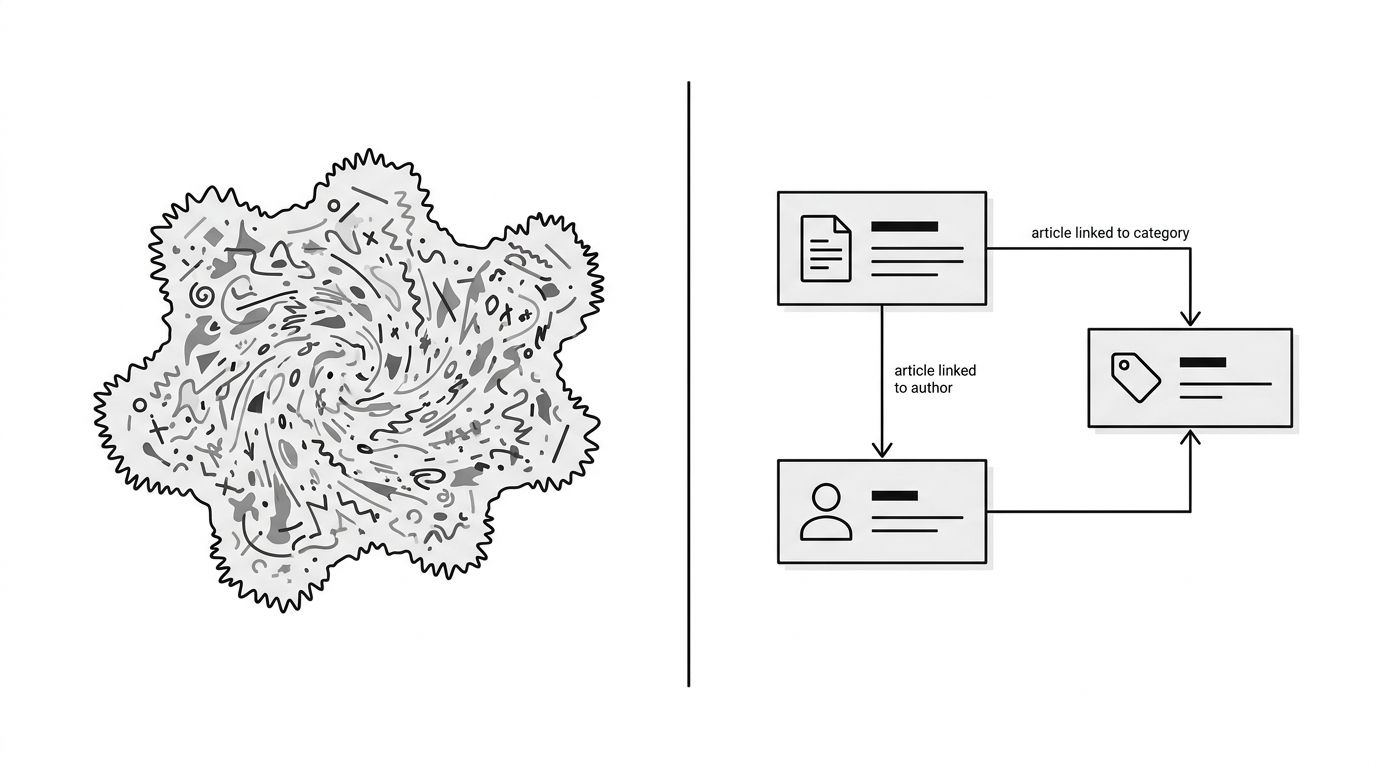
The diagram above shows both approaches. The structured model on the right is what produces clean data for AI, clean API output, and clean downstream applications (like automated schema generation).
How Structured Content Helps AI Visibility
Three mechanisms make the difference.
- Automated structured data generation. Typed content models make JSON-LD schema trivial. Every field in the model maps to a schema.org property. Schema stays accurate because it's generated from the same source of truth as the page.
- Consistent entity representation. A Person type used consistently across articles produces consistent author representation in AI responses. Inconsistent freeform author fields produce the bland averaging problem.
- API exposure for agents. Structured content can be served through APIs that AI agents prefer to scraping HTML. Our agentic AI guide covers why agent-friendly data is becoming a discovery surface.
Which CMS Platforms Support This
Not every CMS handles structured content equally. Broadly:
- Headless CMS (Sanity, Contentful, Strapi, Storyblok, Payload) are built around structured content models. They're the right foundation if you're starting fresh or migrating.
- Traditional CMS (WordPress, Drupal) can support structured content via custom post types, ACF, and plugins, but it's extra work and often inconsistent.
- Site builders (Squarespace, Wix) have limited structured content support. Fine for small sites, limiting for GEO-first brands.
If you're on a traditional CMS, you don't have to migrate. You do have to invest in structuring your content types properly. Our structured data guide covers the markup side. This post is about the storage model underneath.
What to Audit in Your Current CMS
Four questions for your engineering team.
- Are entities stored as typed references or as text? Author name as a string is weak. Author as a reference to a Person entity is strong.
- Is schema generated automatically from content models? If marketers are hand-typing JSON-LD or using a plugin that guesses, schema drift is inevitable.
- Are atomic blocks reusable across content types? A pricing table block reused across 20 product pages beats 20 hand-written tables.
- Is there an API exposing structured content? Agents and AI platforms increasingly prefer APIs. A read-only GraphQL or REST endpoint expands your GEO surface.
What to Do This Quarter
If you're on a headless CMS, audit your content models for typed entities, relationships, and schema-field mapping. Close gaps.
If you're on a traditional CMS, use custom post types and schema plugins (with validation) to approximate structured content. It's compromised but better than nothing.
If you're considering a migration, evaluate CMS options against your GEO roadmap, not just editorial workflow. Our content strategy service can help weight the CMS decision against AI visibility impact. The technical SEO service covers the implementation side.