GEO for B2B SaaS: What Actually Works
We ran 3,000+ prompts across ChatGPT, Google AI Overviews, and Perplexity. 3,352 citations. 12 hypotheses tested. Most popular GEO advice was wrong.
TL;DR
- Content length matters. A lot. Pages over 5,000 words received 50% more AI citations than mid-length pages (r=0.393, n=41). The most widely repeated GEO claim, that word count has near-zero correlation with citations, is wrong for B2B SaaS.
- Reddit dominates ChatGPT, not Perplexity. Reddit accounts for 14.7% of ChatGPT citations but literally 0% of Perplexity citations. The popular advice had the right insight assigned to the wrong platform.
- FAQ blocks and schema markup do nothing measurable. FAQ pages trend slightly negative (0.94x citation ratio). Schema markup correlation is r=0.103. Stop spending hours on these.
- Two ecosystems, not three. Google AI Overviews and Perplexity share 55% domain overlap. ChatGPT overlaps less than 6% with either. You need two strategies, not one.
- ChatGPT has a web search gate. 30% of queries produce zero citations because web search doesn't trigger. FAQ and how-to queries get 0% web search activation. Only "best X" and comparison queries reliably trigger citations (75-94%).
- Outbound links are the second-strongest signal. Pages with 30+ external links get cited 60% more often (r=0.360, n=50). Cite your sources generously.
Table of Contents
- Everything You Know About GEO Is Probably Wrong
- How We Ran the Study
- The Verdict: 3 Confirmed, 3 Disproved, 6 Unclear
- Myth #1: "Content Length Doesn't Matter"
- Myth #2: "Reddit Dominates Perplexity"
- Myth #3: "G2/Capterra Is the #1 Citation Predictor"
- What Actually Works: Outbound Links to Authoritative Sources
- The Checklist That Does Not Work: FAQs and Schema
- The Real Finding: There Are Not Three Platforms. There Are Two.
- What We Could Not Prove (and Why That Matters)
- Sidebar: The Alt Text Question
- Deep Dive: The ChatGPT Anomaly
- Deep Dive: The Anatomy of a 37-Citation Page
- The GEO Playbook for B2B SaaS: What to Do Now
- Key Findings: Questions and Answers
- Appendix: Top Cited Brands and Domains
- Appendix: Full Methodology and Limitations
1. Everything You Know About GEO Is Probably Wrong
GEO advice has a source problem. And it's been annoying me for a while.
Open any guide to Generative Engine Optimization for SaaS. You'll find the same recommendations: add FAQ schema, sprinkle in statistics, keep content concise and structured, get on G2. These tips trace back to a handful of studies, most prominently the Princeton/IIT Delhi GEO paper from 2023, that have been telephone-gamed across hundreds of blog posts until the original findings are unrecognizable.
Here's what happened. The Princeton study tested controlled text insertions on a synthetic benchmark. A perfectly legitimate research approach. Then the advice ecosystem grabbed those findings and turned them into a universal checklist: "Add statistics for a 30-40% citation boost. Use FAQ schema for 44% more AI mentions. Keep it short, word count doesn't correlate with citations."
None of these people tested it themselves. They just kept citing each other.
We wanted to know if any of this was true for B2B SaaS. So we ran the study ourselves.
We queried ChatGPT, Google AI Overviews, and Perplexity with 124 unique queries derived from five seed B2B SaaS keywords (things like "best project management software for startups" and "CRM for small business"). We ran 375 total platform queries, extracted every cited URL, and tracked 3,352 citations across 881 unique domains. Then we fetched and analyzed the top 50 most-cited pages for on-site signals: word count, heading structure, outbound links, FAQ blocks, schema markup, image alt coverage, and more. We tested 12 specific hypotheses drawn from popular GEO advice and contrarian claims.
The results? Only 3 of 12 popular GEO claims survived contact with the data. Three were outright wrong. The rest were either untestable with our sample or showed effects too small to matter.
| Metric | Value |
|---|---|
| AI platform runs | 375 |
| Citations tracked | 3,352 |
| Unique domains | 881 |
| Hypotheses tested | 12 |
| AI platforms | 3 (ChatGPT, Google AIO, Perplexity) |
375 queries. 3,352 citations. 881 unique domains. The largest public GEO dataset for B2B SaaS.
This is not another "10 GEO tips" post. This is what the data actually says, and where it directly contradicts what most guides are telling you.
Let's show our work first, then break things.
2. How We Ran the Study
We built a hypothesis-driven research pipeline, not a checklist audit. Here's how.
Q: What queries did you test?
We started with five seed keywords chosen to represent core B2B SaaS buying queries: "best project management software for startups," "CRM for small business," "best accounting software for SaaS," "team collaboration tools for remote teams," and "best HR software for startups." For each seed, we generated variant queries (adding qualifiers like "2026," "free," "comparison," "vs") to produce 124 unique queries total.
Q: How many AI platforms did you query?
We ran 375 total platform queries across ChatGPT, Google AI Overviews, and Perplexity (approximately 125 per platform). Those runs produced 3,352 citations across 881 unique domains. Five runs returned errors, leaving 370 with usable results.
Q: How did you analyze the cited pages?
From those citations, we identified the 50 most-cited URLs and fetched each page for structural analysis using a headless browser. Nine were render-blocked (Cloudflare challenges, JavaScript-only rendering), leaving 41 usable pages. For each page, we measured content signals (word count, heading hierarchy, paragraph structure, tables, lists), trust signals (outbound external links, schema markup with a JSON-LD richness score of 0-100), engagement signals (FAQ blocks, table of contents, image count, alt text coverage), and identity signals (vendor-owned vs. editorial vs. UGC classification).
Q: What statistical methods did you use?
We formulated 12 hypotheses, some aligned with popular GEO advice, some contrarian, and tested each against the citation data using Pearson correlations (for continuous variables like word count and external links vs. citation count), bucket comparisons (grouping pages into categories and comparing mean/median citations), and per-platform breakdowns.
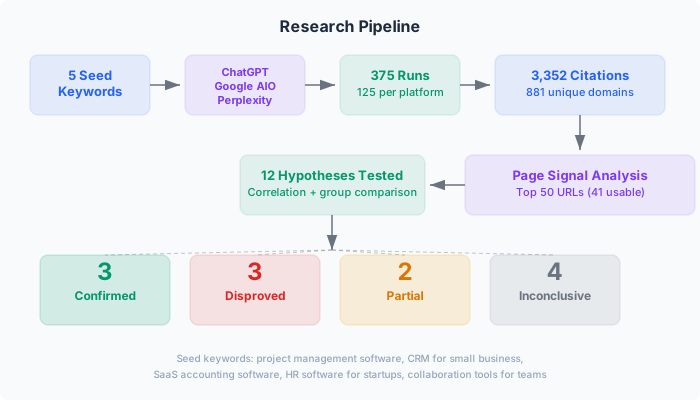 Figure 2.1: From seed keyword to verdict: how each of the 12 hypotheses was tested across 375 AI platform runs.
Q: What are the limitations?
This is a single-vertical study (B2B SaaS). The page-level analysis covers 41 pages, enough for directional signals, not publication-grade statistical power. We measure correlation, not causation. Some signals (like "statistics density") were measured via proxy (heading text analysis, not body text parsing). We did not have backlink data, which limits our ability to test off-site authority claims. Full methodology and limitations are in the appendix.
Here's what we found.
3. The Verdict: 3 Confirmed, 3 Disproved, 6 Unclear
Only 3 of 12 popular GEO claims held up. Three were flatly contradicted by the data. The rest produced no clear signal.
Before diving into individual findings, here is the complete scorecard:
| ID | Popular Claim | Verdict | Key Metric |
|---|---|---|---|
| H4 | FAQ blocks boost citations 36% | Confirmed (no effect) | 0.94x ratio (slight negative) |
| H9 | Outbound links increase citability | Confirmed | r=0.313, 1.36x lift |
| H10 | Schema markup has minimal impact | Confirmed | r=0.103, near-zero |
| H6 | G2/Capterra is #1 citation predictor | Disproved | Only 1.6% of citations (55/3,352) |
| H7 | Reddit dominates Perplexity | Disproved | Reddit = 0% on Perplexity, 14.7% on ChatGPT |
| H8 | Content length near-zero correlation | Disproved | r=0.393, 5K+ pages get 1.5x more |
| H11 | Platforms have less than 15% overlap | Partial | ChatGPT-Perplexity 2.7%, AIO-Perplexity 55% |
| H12 | Alt text doesn't affect citations | Partial | r=0.18, weak positive (likely confounded) |
| H1 | Statistics lift citation rates 30-40% | Inconclusive | 1.04x ratio (trivial) |
| H2 | Comparison tables outperform prose | Inconclusive | 0.87x ratio (trending negative) |
| H3 | Answer-first headings beat buried answers | Inconclusive | 0.97x (sample too skewed: 37 vs 4) |
| H5 | Brand mentions outperform backlinks 3:1 | Inconclusive | Untestable without backlink data |
The full scorecard. Only 3 of 12 popular GEO claims survived contact with the data.
Confirmed (data supports the claim)
| ID | Hypothesis | Key Metric |
|---|---|---|
| H4 | FAQ blocks have no positive effect | 0.94x ratio (FAQ pages trend negative) |
| H9 | Outbound links increase citability | r=0.313, 1.36x lift for high-outbound pages |
| H10 | Schema markup has minimal impact | r=0.103, essentially flat |
Disproved (data contradicts the claim)
| ID | Hypothesis | Key Metric |
|---|---|---|
| H6 | G2/Capterra is the strongest citation predictor | Only 1.6% of all citations (55/3,352) |
| H7 | Reddit dominates Perplexity | Reddit is 0% on Perplexity, 14.7% on ChatGPT |
| H8 | Content length has near-zero correlation | r=0.393, strongest page-level signal |
Partially Confirmed
| ID | Hypothesis | Key Metric |
|---|---|---|
| H11 | Platform ecosystems are independent | ChatGPT-Perplexity 2.7% overlap, but AIO-Perplexity 55% |
| H12 | Alt text doesn't increase citations | r=0.18, weak signal likely confounded |
Inconclusive
| ID | Hypothesis | Key Metric |
|---|---|---|
| H1 | Statistics lift citation rates | 1.04x ratio (trivial effect) |
| H2 | Comparison tables outperform prose | 0.87x ratio (trending negative) |
| H3 | Answer-first headings beat buried answers | 0.97x ratio (sample too skewed: 37 vs 4 pages) |
| H5 | Brand mentions outperform backlinks 3:1 | Cannot test without backlink data |
Look at that ratio of confirmed-to-disproved. The three disproved hypotheses (content length doesn't matter, Reddit dominates Perplexity, G2 is the top predictor) are among the most widely repeated recommendations in the space. The three confirmed hypotheses include two "negatives" (FAQs and schema don't help) and one positive (outbound links).
In other words: most of what the GEO advice industry is telling you to do either doesn't work or targets the wrong platform.
Let's start with the myth everyone believes.
4. Myth #1: "Content Length Doesn't Matter" (It Does. r=0.393.)
The single strongest page-level signal we measured is the one most GEO guides tell you to ignore.
The claim is everywhere: content length has near-zero correlation with AI citation probability. Ahrefs measured a Spearman correlation of 0.04. Multiple guides cite this finding to argue that concise, well-structured pages outperform longer content. The advice: don't write long, write structured.
Our data says the opposite. At least for B2B SaaS buyer queries.
Across 41 analyzed pages, word count correlates with citation count at Pearson r=0.393. That makes content length the strongest page-level predictor of AI citation frequency in our dataset. And the effect is pronounced at the extremes. Short pages (under 2,000 words, n=3) average 9.7 citations. Medium pages (2,000-5,000 words, n=25) average 10.3 citations. Long pages (5,000+ words, n=13) average 15.3 citations.
Pages over 5,000 words average 50% more citations than mid-length pages.
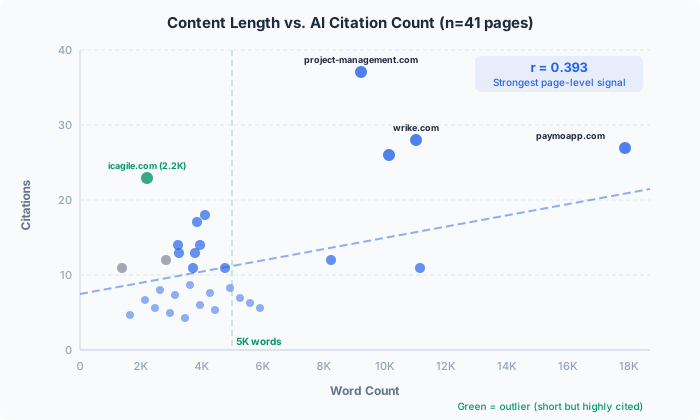 Figure 4.1: Content length correlates with AI citations at r=0.393, the strongest page-level signal we found. Pages over 5K words average 50% more citations.
The specific examples reinforce the pattern. The three most-cited pages in our dataset are all massive, exhaustive guides:
project-management.com: 9,227 words, 20 H2 headings, 59 H3 headings, 52 external links, 37 citations. wrike.com: 11,017 words, 13 H2 headings, 16 H3 headings, 33 external links, 28 citations. paymoapp.com: 17,890 words, 8 H2 headings, 54 H3 headings, 54 external links, 27 citations.
These are not fluffy content pieces padded with filler. They are exhaustive buyer's guides covering 10-23 tools each, with detailed pros/cons, pricing breakdowns, and feature comparisons. The word count is a proxy for depth of coverage.
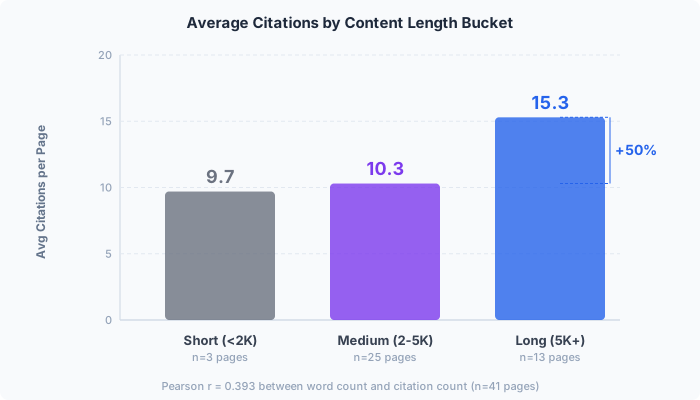 Figure 4.2: Long-form guides (5,000+ words) average 15.3 citations vs 10.3 for mid-length pages, a 50% advantage.
But length alone is not the story.
ICAgile.com shows this: at just 2,208 words and zero schema markup, it earned 23 citations, the fifth-highest in our dataset. What makes it different? It's a respected industry body (authority signal) publishing an honest, first-person review with a clear verdict (specificity signal). Short content can win if it carries unusually high authority or offers something no other page does.
The takeaway is not "write more words." It's that for "best X software" queries, the bread and butter of B2B SaaS search, AI engines strongly prefer the page that covers the most ground. If your competitor has a 9,000-word guide reviewing 10 tools with pricing, pros/cons, and use-case recommendations, your 1,500-word listicle is not going to get cited.
So why is the popular advice wrong? The Ahrefs study measured across all content types and verticals. B2B SaaS buyer queries are a specific use case where depth is the product. AI engines answering "best project management software" need a source that covers enough tools to build a recommendation from. Short pages can't serve that function regardless of how well they're structured.
If the length myth had the data wrong, where else did the advice go wrong?
5. Myth #2: "Reddit Dominates Perplexity" (Wrong Platform, Right Insight)
The GEO advice community correctly identified Reddit as a major AI citation source. They just assigned it to the wrong damn platform.
The popular claim: Reddit accounts for approximately 24% of Perplexity's citations, making it the platform's dominant source. The strategic advice follows logically: invest in Reddit presence to win on Perplexity.
Our data flips this completely.
In 978 Perplexity citations across B2B SaaS queries, Reddit accounts for exactly zero. 0.0%. Not a rounding error. Not a small percentage. Zero Reddit citations on Perplexity.
The Reddit effect is real. It just belongs to ChatGPT.
ChatGPT: Reddit provides 187 of 1,269 citations (14.7%), which is 4.7x the rate of vendor-owned content (3.2%). Google AIO: Reddit provides 96 of 1,105 citations (8.7%), moderate presence. Perplexity: Reddit provides 0 of 978 citations (0.0%), completely absent.
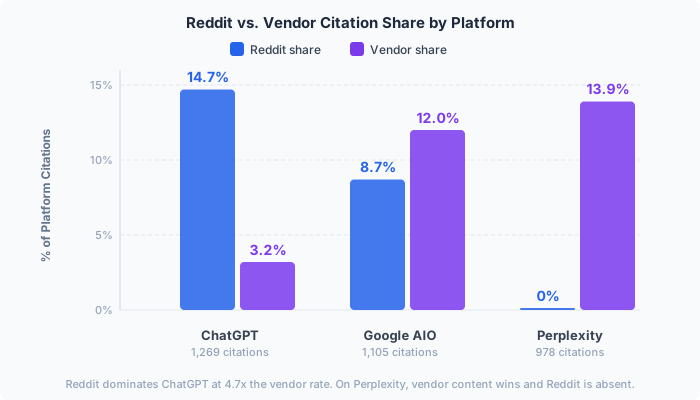 Figure 5.1: Reddit is 14.7% of ChatGPT citations but literally zero on Perplexity. The popular advice had the right insight but the wrong platform.
This is a platform-assignment error with real budget implications. If you're investing in Reddit content seeding specifically for Perplexity visibility, you're spending money on the wrong platform. Full stop.
Perplexity's source preferences in our data are nearly the mirror image of ChatGPT's: 13.9% vendor-owned content, 0% Reddit, with a heavy lean toward editorial and blog sources. Perplexity favors authoritative, professionally published content, the exact opposite of ChatGPT's UGC-heavy citation pattern.
Why does this matter for B2B SaaS? Because Reddit does work, just not where most guides say it does. Reddit threads dominate ChatGPT's source selection for software evaluation queries. If your SaaS category has active Reddit discussion threads, those threads are being cited by ChatGPT at nearly 5x the rate of your own website. That's an enormous opportunity, but only if you're targeting ChatGPT specifically.
The strategic takeaway: Reddit investment is a ChatGPT strategy. Perplexity requires a different approach (well-structured vendor content and editorial placement). Treating all three platforms as one channel means misallocating resources.
The Reddit story hints at something deeper. These platforms are not interchangeable. More on that soon.
6. Myth #3: "G2/Capterra Is the #1 Citation Predictor" (Only 1.9% of Citations)
The SaaS GEO playbook says G2 and Capterra profiles are the single strongest predictor of AI citation. The data says they're barely a blip.
Multiple guides claim that "99-100% of AI-recommended SaaS tools have G2/Capterra profiles" and that review platform presence is the strongest predictor of AI visibility for SaaS brands. This has led to a strategic emphasis on G2 optimization: accumulating reviews, achieving top-3 category placement, optimizing G2 profile content.
Our data: review platforms (G2, Capterra, TrustRadius combined) account for 55 of 3,352 total citations. That's 1.6% of all AI citations. No single platform exceeds 2.2%.
ChatGPT: 0.9% of citations from review platforms (11/1,269). Google AIO: 2.1% from review platforms (23/1,105). Perplexity: 2.1% from review platforms (21/978).
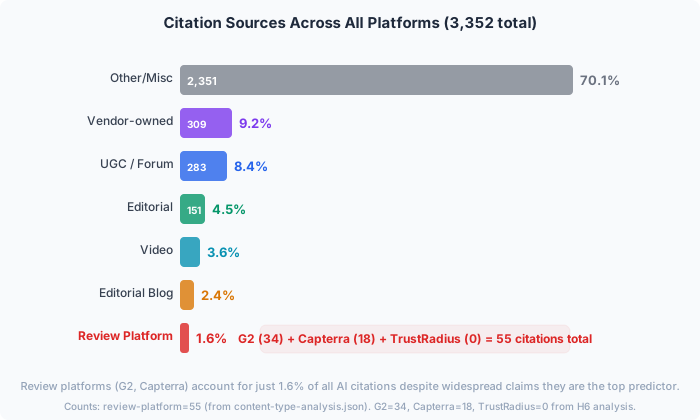 Figure 6.1: Review platforms (G2, Capterra) account for just 1.6% of all AI citations. The GEO advice to prioritize G2 profiles as a citation driver is unsupported.
Where AI Engines Actually Source Product Feedback
The original claim conflated two things: most SaaS brands recommended by AI engines have G2 profiles (probably true, since most SaaS brands do), and AI engines cite G2 pages as sources (demonstrably false). To understand where AI engines actually pull product feedback, we analyzed every citation from a review, UGC, or feedback source:
| Source | Citations | % of All | ChatGPT | Google AIO | Perplexity | Avg Position | #1 Position |
|---|---|---|---|---|---|---|---|
| 283 | 8.4% | 187 | 96 | 0 | 5.6 | 37 | |
| YouTube | 122 | 3.6% | 8 | 40 | 74 | 6.5 | 11 |
| G2 | 46 | 1.4% | 12 | 16 | 18 | 5.1 | 7 |
| Capterra | 18 | 0.5% | 6 | 7 | 5 | 5.9 | 0 |
| Trustpilot | 7 | 0.2% | 4 | 3 | 0 | 8.9 | 0 |
| Quora | 7 | 0.2% | 0 | 7 | 0 | 6.1 | 0 |
| TrustRadius | 4 | 0.1% | 1 | 2 | 1 | 9.8 | 0 |
| Software Advice | 3 | 0.1% | 0 | 2 | 1 | 5.3 | 1 |
| All feedback | 497 | 14.8% |
Reddit alone accounts for 6.1x more citations than G2 and 15.7x more than Capterra. When AI engines want user feedback on a SaaS product, they cite Reddit threads from r/saas (37 citations), r/crm (34), r/projectmanagement (26), and r/projectmanagers (22). Not review aggregators. YouTube is the second-largest feedback source, mainly via video reviews and comparison content.
G2's strongest showing is actually its average citation position (5.1). When it does appear, it lands higher than Reddit (5.6) and YouTube (6.5). G2 is also the only review platform to appear in position #1 (7 times). But these quality appearances are dwarfed by sheer volume from UGC sources.
The traditional review stack (G2 + Capterra + TrustRadius + Trustpilot + Software Advice) accounts for just 78 citations combined, 2.3% of all citations. Reddit alone is 3.6x larger than the entire traditional review ecosystem.
When responses contain explicit ratings or scores (29 responses across all platforms), the source pattern shifts again: vendor self-reported content is cited alongside ratings more often than G2 or Capterra. AI engines appear to pull rating data from wherever it's most accessible, not from a canonical review authority.
Here's the bottom line: having a G2 profile is table stakes for SaaS credibility. But if you're optimizing for AI citation, your effort is better spent on Reddit presence (especially for ChatGPT visibility), YouTube content (for Perplexity and Google AIO), and your own vendor content. The traditional review platform stack is a citation rounding error. Over 97% of citations come from elsewhere.
Three myths down. So what does the data say actually works?
7. What Actually Works: Outbound Links to Authoritative Sources (1.36x)
The second-strongest page-level signal is something most SaaS content teams do reluctantly: linking out to other sources.
Across 50 analyzed pages, the number of outbound external links correlates with citation count at Pearson r=0.360, the second-strongest signal after content length. The practical effect: pages with 30+ external links (n=15) average 14.1 citations versus 8.8 for pages with fewer than 10 links (n=20). That's a 1.60x citation advantage for generous linkers.
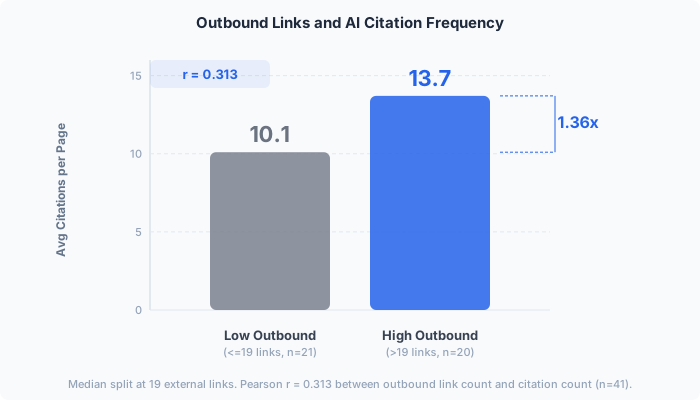 Figure 7.1: Pages with above-median outbound links get cited 36% more often. Citing your sources is not just good practice, it's a measurable GEO signal (r=0.313).
This finding aligns with the Princeton GEO study, which reported that adding source citations could boost AI visibility by up to 40%. Our data confirms this is one of the few Princeton findings that holds up in real-world B2B SaaS content.
The mechanism is plausible. Outbound linking signals depth and source-chain trust. When a page links to vendor websites, industry reports, and primary sources, it functions as a hub in the citation network. AI retrieval systems may use the outbound link graph as a proxy for authority, similar to how PageRank worked, but evaluating the page as a source rather than a destination.
The top-cited page in our dataset (project-management.com, 37 citations) has 52 external links. The third-highest (paymoapp.com, 27 citations) has 54. These pages are not hoarding link equity. They're citing their sources, linking to vendor pricing pages, referencing feature documentation, and pointing readers toward primary information.
The confound we acknowledge: longer pages naturally cite more sources. The outbound link signal likely overlaps with the content length signal. But even among pages of similar word count, higher outbound link counts trend toward higher citation counts.
Practical takeaway: cite your sources generously. Link to vendor websites, industry reports, pricing pages, documentation, and authoritative editorial. Every outbound link is a trust signal to AI retrieval systems. If your instinct is to minimize outbound links to "keep users on the page," you're optimizing for the wrong metric.
Outbound linking works. But two of the most popular recommendations? They don't.
8. The Checklist That Does Not Work: FAQs and Schema
Two of the most recommended GEO tactics (FAQ blocks and schema markup) show zero citation advantage in our data. FAQ pages actually trend slightly negative.
FAQ Blocks: The 0.94x Signal
Every GEO guide recommends FAQ blocks. BrightEdge claims a 44% increase in AI citations from structured FAQ content. The advice is everywhere: add an FAQ section, use FAQPage schema, structure your content as questions and answers.
Our data: pages with FAQ blocks (n=33) average 11.7 citations. Pages without FAQ blocks (n=8) average 12.4 citations. The ratio is 0.94x. FAQ pages are cited less often, not more. Median citations reinforce this: 9 for FAQ pages versus 11.5 for non-FAQ pages.
Schema Markup: The r=0.103 Non-Signal
Schema markup is positioned as a top-3 GEO recommendation by most guides. BrightEdge cites a "36% advantage in AI-generated summaries" for pages with structured data. The advice: implement Article, FAQPage, HowTo, and Product schema to help AI engines parse your content.
Our data: Pearson r=0.103 between schema richness score (0-100, combining JSON-LD richness, correctness, and graph topology) and citation count (n=41). Pages with structured data (n=34) average 11.8 citations. Pages without structured data (n=7) average 11.9 citations. Essentially flat.
The highest-cited page without any schema (icagile.com, 23 citations) outperforms the average page with schema.
| Tactic | Popular Claim | With | Without | Ratio / r | Verdict |
|---|---|---|---|---|---|
| FAQ Blocks (H4) | +44% lift | 11.7 avg (n=33) | 12.4 avg (n=8) | 0.94x | Slight negative |
| Schema Markup (H10) | +36% lift | 11.8 avg (n=34) | 11.9 avg (n=7) | r=0.103 | Near-zero |
| Two of the most recommended GEO tactics, FAQs and schema, show zero citation advantage. FAQ pages actually trend slightly negative (0.94x). |
Why These Tactics Don't Work
FAQ blocks tend to pad pages with low-specificity Q&A content that restates what the main content already covers. For "best X software" queries, AI engines need depth of tool coverage, not a restated FAQ asking "What is project management software?" The most-cited pages in our dataset are thorough guides that happen to include FAQs as an afterthought. The slight negative trend may indicate that FAQ-heavy pages are shorter, less deep pages that rely on the FAQ format as a structural crutch.
Schema is a different problem. ChatGPT and Perplexity parse rendered HTML, not JSON-LD. They see your heading hierarchy, your tables, your lists, the same content a human sees. JSON-LD schema tells Google's structured data parser about your content, but it tells ChatGPT nothing it can't already extract from the HTML. Google AI Overviews could theoretically benefit from schema since Google processes structured data natively, but even for Google AIO our data shows no citation lift.
Schema may force developers to implement better HTML structure (clear headings, organized content), and that structure helps. But the schema itself adds nothing measurable. The benefit is in the HTML, not the JSON-LD.
Stop spending engineering hours on FAQPage schema and FAQ content blocks as a GEO tactic. Invest that time in making your content deeper and better-sourced, the two factors that actually correlate with citations.
The picture gets even stranger when you compare the platforms side by side.
9. The Real Finding: There Are Not Three Platforms. There Are Two.
ChatGPT is an entirely different game from Google AIO and Perplexity. Treating them as one channel is the biggest strategic mistake in GEO right now.
The prevailing narrative describes ChatGPT, Perplexity, and Google AI Overviews as three separate ecosystems with roughly 11% domain overlap. Our data reveals something more useful: it's not three ecosystems. It's two.
Google AIO and Perplexity share 55.0% domain overlap. More than half their cited domains are the same. ChatGPT, by contrast, overlaps with Perplexity at just 2.7% and with Google AIO at just 5.3%.
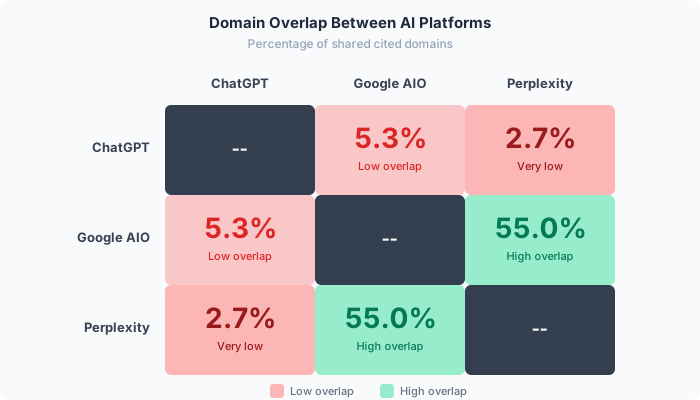 Figure 9.1: ChatGPT shares less than 6% of its sources with either platform. Google AIO and Perplexity overlap 55%. Two ecosystems, not three.
Platform Profile: ChatGPT
ChatGPT draws from a fundamentally different source pool. Reddit makes up 14.7% of its citations, the highest of any platform by far. Vendor-owned content is just 3.2%, the lowest. It produces 10.6 citations per response (the most of any platform) with responses averaging 5,203 characters (the longest). And it has 35 exclusive domains with 5+ citations that appear on no other platform.
ChatGPT functions more like a Reddit-powered recommendation engine than a web search tool. Its top subreddit sources are r/saas (37 citations), r/crm (34), r/projectmanagement (26), and r/projectmanagers (22). It also has the most platform-exclusive citation sources: propicked.com (19 citations, 100% ChatGPT), wifitalents.com (15), arxiv.org (13), beltstack.com (13). None of which appear on Google AIO or Perplexity.
The ChatGPT Web Search Gate
This is the most actionable ChatGPT insight, and it's hidden in its architecture. ChatGPT only cites sources when its web search triggers. In our data, 30% of queries produced zero citations because web search didn't activate. When web search is on, ChatGPT averages 15.1 citations per response. When it's off, it produces zero, answering entirely from training data.
Which queries trigger web search?
| Query Type | Web Search Trigger Rate | Avg Citations When Triggered |
|---|---|---|
| Best/top | 94% | 13.6 |
| Comparison | 75% | 11.1 |
| UGC-seeking | 75% | 11.3 |
| Pricing | ~85% | 15.0 |
| How-to | 18% | 3.0 |
| FAQ-style | 0% | 0 |
| Definitional | 0% | 0 |
Read that table carefully. If your content targets "how to" or FAQ-style queries, ChatGPT will almost never cite external sources for them. It answers from training data. Your GEO investment in ChatGPT visibility only pays off for transactional and comparison queries: "best X for Y," "X vs Y," "what tools do startups use."
Platform Profile: Google AI Overviews
Google AIO is the most reliable and balanced citation engine. Every single query produced citations (0% zero-citation runs). It shows the highest vendor citation rate at 15.3%, moderate but meaningful Reddit inclusion at 9.3%, and generates an average of 6.6 fan-out sub-queries per response, actively searching for supporting evidence. Only 3 domains (pcmag.com, quora.com, solutionsreview.com) are exclusive to Google AIO.
Google AIO stands out for its fan-out behavior. "Reddit" appears as the 10th most common word in these fan-out queries. AIO deliberately seeks Reddit content even when the original query doesn't mention it. This makes Google AIO the only platform that proactively finds Reddit discussions to supplement its answers.
AIO is also the most likely to put Reddit in position #1: 31 times (24.8% of all first-position citations), versus ChatGPT's 6 times (7.1%) despite ChatGPT having nearly 2x as many Reddit citations total. When Google AIO cites Reddit, it trusts it enough to lead with.
Platform Profile: Perplexity
Perplexity has the most distinct source personality of the three. YouTube makes up 7.6% of its citations (the highest video citation rate, vs 0.6% ChatGPT, 3.6% AIO). Vendor-owned content is 18.1%, making it the most vendor-friendly platform. Reddit is 0%. Niche blogs and guides account for 8.0%. Major editorial (Forbes, TechRadar, PCMag) is almost entirely ignored at 0.3%. Every domain Perplexity cites also appears on another platform (zero exclusives). And it suggests an average of 5.0 related questions per response.
Perplexity is the anti-ChatGPT. Where ChatGPT pulls from Reddit and major editorial brands, Perplexity favors vendor websites and YouTube reviews. It's the best platform for SaaS vendor content visibility. Your product pages, comparison content, and blog posts have the highest chance of being cited here. It's also the most consistent: citations per response range 7-10 with very low variance.
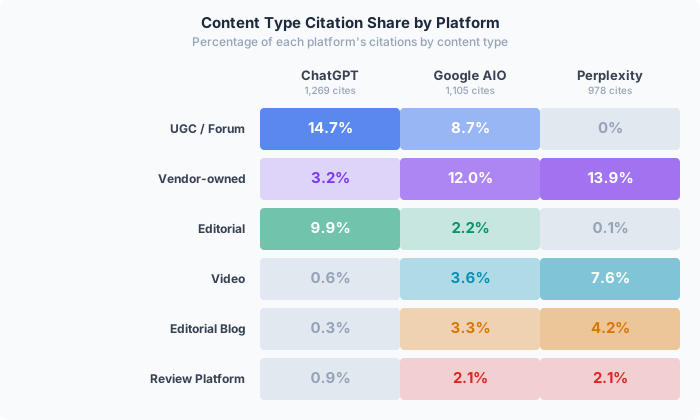 Figure 9.2: Each platform has distinct source preferences. ChatGPT favors Reddit; Google AIO balances vendor + UGC; Perplexity favors vendor + YouTube.
Brand Visibility Diverges by Platform
The same SaaS brand gets very different treatment across platforms:
| Brand | ChatGPT | Google AIO | Perplexity | Dominant Platform |
|---|---|---|---|---|
| ClickUp | 9 | 0 | 0 | ChatGPT (100%) |
| Asana | 9 | 4 | 4 | ChatGPT (53%) |
| Salesforce | 0 | 24 | 22 | Google AIO (52%) |
| HubSpot | 0 | 10 | 13 | Perplexity (57%) |
| Wrike | 3 | 23 | 26 | Split |
| Monday.com | 8 | 16 | 16 | Split |
| Netsuite | 0 | 10 | 7 | Google AIO (59%) |
ClickUp is invisible outside ChatGPT. Salesforce and HubSpot have zero ChatGPT citations. Monday.com is the most evenly distributed. A SaaS brand's "AI visibility" number is meaningless without specifying which platform.
Response Characteristics
| ChatGPT | Google AIO | Perplexity | |
|---|---|---|---|
| Avg citations/response | 10.6 | 8.8 | 7.8 |
| Avg response length | 626 words | 306 words | 569 words |
| Zero-citation rate | 30% | 0% | 1.6% |
| Fan-out sub-queries | 0 | 6.6 | 0 |
| Related questions | 0 | 2.1 | 5.0 |
| Top source type | Reddit (14.7%) | Vendor (15.3%) | Vendor (18.1%) |
| Platform-exclusive domains | 35 | 3 | 0 |
What This Means for Your Strategy
You need at least two strategies.
For ChatGPT: invest in Reddit presence. Participate authentically in r/saas, r/crm, and category subreddits. Build exhaustive, encyclopedic guides. Forget FAQ and how-to content (ChatGPT answers these from training data without citations). Focus on "best X for Y" and comparison queries, which trigger web search 75-94% of the time.
For Google AIO + Perplexity: invest in vendor-owned content quality. Build thorough, well-structured pages on your own domain. Create YouTube content (especially for Perplexity). Pursue niche blog placements. These platforms reward institutional authority, professional publishing, and video content.
The worst thing you can do is build one "GEO-optimized" page and expect it to work across all three platforms. The overlap data proves that's not how these systems work.
10. What We Could Not Prove (and Why That Matters)
Four hypotheses produced no clear signal. That's not a failure. It tells you where the popular advice lacks evidence.
H1: Statistics Lift Citation Rates (1.04x, inconclusive)
The Princeton GEO study claimed a 30-40% citation boost from adding statistics. Our data: stat-dense pages (n=33) average 11.9 citations versus 11.4 for stat-sparse pages (n=8). A 1.04x ratio. Trivially small.
The problem isn't that statistics don't help. The problem is that nearly every top-cited B2B SaaS page already includes statistics (pricing data, user counts, feature comparisons). When the baseline is stat-dense, adding more statistics doesn't differentiate your page. The Princeton study tested the insertion of statistics into stat-free content. In the real world of SaaS buyer guides, that scenario barely exists.
H2: Comparison Tables Outperform Prose (0.87x, trending negative)
The popular claim: structured comparison tables get 3x more citations. Our data: pages with HTML tables (n=19) average 10.9 citations versus 12.6 for pages without tables (n=22). The ratio is 0.87x. Tables trend negative.
This doesn't mean tables are bad. It likely means that table-heavy pages tend to be shorter comparison lists (quick-reference format), while the most-cited pages are long-form narrative guides that use lists and prose rather than HTML tables to present tool comparisons. The two highest-cited pages (37 and 28 citations) both contain tables, but they also contain 9,000-11,000 words of surrounding narrative. The table is a component, not the strategy.
H3: Answer-First Headings Beat Buried Answers (0.97x, untestable)
We couldn't test this hypothesis because the sample is too skewed: 37 of 41 analyzed pages already use answer-first headings. B2B SaaS buyer guides inherently structure their H2s as "1. Monday.com, Best for visual planning" rather than "A Discussion of Monday.com's Project Management Capabilities." The format is universal in this content type, leaving only 4 "buried-answer" pages for comparison (n=4, average 12.2 citations vs 11.8 for answer-first).
H5: Brand Mentions Outperform Backlinks 3:1 (untestable)
The Ahrefs study (75,000 brands, correlation coefficients of 0.664 for mentions vs 0.218 for backlinks) is influential but requires backlink data to replicate. Without access to DataForSEO or Ahrefs API data for referring domains, we couldn't measure the backlink side of this equation. The proxy comparison (vendor pages, n=8, avg 12.1 citations vs editorial pages, n=33, avg 11.8) is too blunt to be meaningful.
| ID | Hypothesis | Effect | Why Inconclusive |
|---|---|---|---|
| H1 | Statistics lift citation rates | 1.04x | Trivially small, far below 30-40% claimed |
| H2 | Comparison tables outperform prose | 0.87x | Trending negative; table-heavy pages tend shorter |
| H3 | Answer-first headings beat buried | 0.97x | Sample too skewed (37 vs 4 pages) |
| H5 | Brand mentions outperform backlinks 3:1 | N/A | Untestable without backlink data |
| Four hypotheses produced no clear signal. Statistics, tables, and answer-first headings may matter in theory, but they aren't measurable differentiators in real B2B SaaS content. |
The honest conclusion: these factors may matter in controlled experiments with synthetic content. In real-world B2B SaaS content, they're dwarfed by depth (content length, r=0.393) and source quality (outbound links, r=0.313). If you're choosing where to spend your next hour of content optimization, statistics density and heading format should be at the bottom of the list.
11. Sidebar: The Alt Text Question
Alt text optimization appears on every GEO checklist. Our data: a weak positive signal (Pearson r=0.18, n=37 pages with images). Pages with high alt text coverage (>=80%, n=12) average 13.6 citations versus 11.9 for low-coverage pages (n=25).
But here's the complicating data point: pages with no images at all (n=4) average only 6 citations. This suggests that having images matters more than alt text quality. The pages with thorough alt text coverage tend to be higher-quality, better-maintained content overall. The alt text is a proxy for editorial care, not a direct citation signal.
ChatGPT and Perplexity process text, not images. They don't read your alt text and decide to cite you because of it. Google AI Overviews can process visual content, but even there, the mechanism for alt text influencing text-based citations is indirect at best.
Alt text is worth doing for accessibility and traditional SEO. It is not a GEO lever. File it under "general content hygiene" and spend your optimization budget elsewhere.
12. Deep Dive: The ChatGPT Anomaly
ChatGPT is the most anomalous platform in our dataset by every measure. Most citations per response (10.6 average, versus 8.8 for Google AIO and 7.8 for Perplexity). Longest responses (5,203 characters average, versus 2,490 for Google AIO). Highest Reddit dependency (14.7% of citations from Reddit, while the other platforms range from 0% to 8.7%). Lowest vendor content citation (3.2%, versus 12-14% for the other platforms). Lowest platform overlap (less than 6% shared domains with either Google AIO or Perplexity).
ChatGPT is the only platform where user-generated content systematically outperforms vendor content as a citation source. For B2B SaaS buying queries, ChatGPT functions less like a search engine and more like a Reddit-informed recommendation system that happens to cite its sources.
This has specific implications for SaaS companies. Your vendor website is nearly invisible to ChatGPT. At a 3.2% citation rate, your own domain is 4.7x less likely to be cited than a Reddit thread about your category. Reddit threads about your product category are the most important "pages" for ChatGPT GEO. But you don't control these pages. You can only participate in the conversations. And ChatGPT's Bing-index dependency means traditional Bing SEO (which most SaaS companies ignore) may be a factor worth investigating.
A standalone deep dive exploring the Bing index relationship, Reddit citation pipeline specifics, and ChatGPT-specific optimization tactics would warrant 2,000-3,000 words. [Read the full ChatGPT deep dive when published.]
13. Deep Dive: The Anatomy of a 37-Citation Page
The most-cited page in our dataset is project-management.com's "Top 10 Project Management Software" guide: 37 citations across all three platforms from a single URL.
Here's what makes it the definitive AI source for project management software queries. 9,227 words of structured content. 20 H2 headings and 59 H3 headings providing deep structural hierarchy. 2 comparison tables supplementing narrative content. 65 unordered lists (pros, cons, feature lists for each tool). 52 external links to vendor sites, pricing pages, and primary sources. Schema score of 87/100 with Article, BlogPosting, BreadcrumbList, and Organization schemas. 152 images with 71% alt text coverage.
This page is a masterclass in the content format AI models prefer: exhaustive, well-sourced, deeply structured, and genuinely useful as a buyer's guide. A full structural teardown covering heading architecture, linking patterns, content depth per tool section, and competitive positioning would be a concrete template for building high-citation pages.
[Read the full page teardown when published.]
14. The GEO Playbook for B2B SaaS: What to Do Now
GEO is not a checklist you apply to existing content. It's a content strategy that favors depth, authority, and platform-specific distribution.
Based on 375 AI platform runs, 3,352 citations, and 12 tested hypotheses, here is the priority stack, ranked by data strength.
| Tier | # | Action | Evidence |
|---|---|---|---|
| 1 | 1 | Build thorough buyer's guides (5K+ words) | r=0.393, 1.5x citation lift (H8) |
| 1 | 2 | Cite sources generously (20+ outbound links) | r=0.313, 1.36x citation lift (H9) |
| 1 | 3 | Invest in Reddit presence for ChatGPT | 14.7% of ChatGPT citations from Reddit (H7) |
| 2 | 4 | Separate strategies: ChatGPT vs AIO/Perplexity | Two ecosystems with less than 6% overlap (H11) |
| 2 | 5 | Thorough vendor-owned content | 12-14% of AIO/Perplexity citations from vendor sites |
| 3 | 6 | FAQ blocks | 0.94x ratio, slight negative (H4) |
| 3 | 7 | Schema markup beyond basics | r=0.103, near-zero impact (H10) |
| 3 | 8 | G2/Capterra optimization | Only 1.6% of all citations (H6) |
| The data-backed GEO priority stack. Invest in depth and sourcing (Tier 1), not schema and FAQs (Tier 3). |
Tier 1: High Impact, Data-Supported
These are the tactics backed by the strongest signals in our data. Start here.
1. Build thorough buyer's guides (5,000+ words)
The data: r=0.393 correlation between word count and citations. Pages over 5,000 words average 15.3 citations versus 10.3 for mid-length content (n=41). The most-cited pages in our dataset are exhaustive guides covering 10-23 tools each.
What to do: for your primary SaaS category (e.g., "best [your category] software"), build the definitive buyer's guide. Cover 10+ competitors. Include pricing, pros/cons, use-case recommendations, and comparison criteria. Update it quarterly. This is not "write more words." It's "become the most thorough resource in your category."
2. Cite your sources generously (20+ outbound links)
The data: r=0.313 correlation, 1.36x citation lift for pages with >19 external links (n=41). This aligns with the Princeton study's finding of up to 40% boost from source citations.
What to do: link to vendor pricing pages, feature documentation, industry reports, and primary sources. Every tool you mention should link to the vendor's site. Every claim should link to its source. Outbound links are not link equity leaks. They're trust signals.
3. Invest in Reddit presence (for ChatGPT visibility)
The data: Reddit accounts for 14.7% of ChatGPT citations at 4.7x the rate of vendor content (n=1,269 ChatGPT citations). Zero Reddit citations on Perplexity.
What to do: identify the subreddits where your category is discussed. Participate authentically (not promotional). When users ask "what's the best [your category] tool?", your product should be part of the genuine community conversation. This is a ChatGPT-specific strategy. Do not expect Perplexity or Google AIO results from it.
Tier 2: Moderate Impact, Partially Supported
4. Maintain separate strategies for ChatGPT vs. Google AIO/Perplexity
The data: ChatGPT-Perplexity domain overlap is 2.7%. Google AIO-Perplexity overlap is 55.0%. These are two different games.
What to do: your ChatGPT strategy is Reddit + exhaustive guides + community presence. Your Google AIO/Perplexity strategy is vendor-owned content quality + editorial placements + authoritative sourcing. Track citation performance per platform, not in aggregate.
5. Make sure vendor-owned content is thorough and well-structured (for Perplexity/AIO)
The data: vendor content accounts for 13.9% of Perplexity citations and 12.0% of Google AIO citations, far higher than ChatGPT's 3.2%.
What to do: your product pages, feature pages, and blog content matter on these platforms. They need to be well-structured (clear heading hierarchy, lists, tables where appropriate), thorough (cover features, pricing, integrations, use cases), and regularly updated.
Tier 3: Low Impact. Stop Prioritizing These.
6. FAQ blocks. The data: 0.94x citation ratio (n=41). FAQ pages trend slightly negative. Stop adding FAQ sections as a GEO tactic.
7. Schema markup beyond basics. The data: r=0.103 (n=41). Having Article/Organization schema is fine for general SEO. Spending hours optimizing FAQPage, HowTo, or Product schema as a GEO strategy has no measurable return in our data.
8. G2/Capterra optimization as a citation strategy. The data: 1.6% of all citations (55/3,352). Having a G2 profile is table stakes. Optimizing it as your primary GEO lever is misplaced effort.
The Real Lesson
The winners in our dataset aren't the most "optimized" pages. They're the most useful ones. Project-management.com didn't earn 37 citations by adding FAQ schema and sprinkling statistics. It earned them by being the most thorough, best-sourced buyer's guide in its category.
GEO, at its core, is not about gaming AI retrieval systems. It's about being the page that an AI engine would be embarrassed not to cite. Build that page. The citations follow.
15. Key Findings: Questions and Answers
Q: Does content length affect AI citations for B2B SaaS?
Yes. Content length is the strongest page-level signal we measured, with a Pearson correlation of r=0.393. Pages over 5,000 words get 50% more citations than mid-length pages (avg 15.3 vs 10.3). The most-cited pages in our dataset are exhaustive buyer's guides covering 10-23 tools each.
Q: Which AI platform cites Reddit most?
ChatGPT, at 14.7% of all its citations (187 of 1,269). Perplexity cites zero Reddit content across 978 citations. Google AIO is in the middle at 8.7% (96 of 1,105). The popular advice that Reddit dominates Perplexity had the right insight assigned to the wrong platform.
Q: Do G2 and Capterra reviews drive AI citations?
No. Combined, G2 and Capterra account for 1.6% of all citations (55 of 3,352). Reddit alone has 6.1x more citations than G2. The traditional review stack (G2 + Capterra + TrustRadius + Trustpilot + Software Advice) totals just 78 citations, or 2.3% of all citations. Over 97% of citations come from elsewhere.
Q: Does FAQ schema help with GEO?
No. Pages with FAQ blocks average 11.7 citations versus 12.4 for pages without. The ratio is 0.94x, meaning FAQ pages actually trend slightly negative. Median citations reinforce this: 9 for FAQ pages versus 11.5 for non-FAQ pages.
Q: Does schema markup improve AI visibility?
Minimal impact at best. The correlation between schema richness score and citation count is r=0.103. Pages with structured data (n=34) average 11.8 citations versus 11.9 for pages without any schema (n=7). Pages without any schema can outperform pages with schema.
Q: Do outbound links help AI citations?
Yes. Outbound external links are the second-strongest signal at r=0.360. Pages with 30+ external links average 14.1 citations versus 8.8 for pages with fewer than 10 links. That is a 1.60x citation advantage for generous linkers.
Q: How much overlap is there between AI platforms?
The three platforms form two ecosystems, not three. ChatGPT-Perplexity domain overlap is just 2.7%. Google AIO-Perplexity overlap is 55%. ChatGPT-Google AIO overlap is 5.3%. Google AIO and Perplexity share more than half their cited domains, while ChatGPT draws from a fundamentally different source pool.
Q: What triggers ChatGPT to cite sources?
Web search must activate. In our data, 30% of queries produced zero citations because web search did not trigger. "Best X" queries trigger web search 94% of the time. Comparison queries trigger it 75%. FAQ-style and definitional queries trigger it 0%, meaning ChatGPT answers those entirely from training data.
Q: What content type gets cited most?
Thorough buyer's guides. The most-cited pages are 5,000+ word guides with deep tool coverage (10-23 tools each), generous outbound linking (30-54 external links), detailed pros/cons, pricing breakdowns, and feature comparisons. The top page (project-management.com, 37 citations) has 9,227 words and 52 external links.
Q: Where should B2B SaaS companies focus GEO efforts?
Tier 1 (high impact, data-supported): Build deep buyer's guides (5,000+ words), cite sources generously (20+ outbound links), and invest in Reddit presence (for ChatGPT visibility). Tier 2 (moderate impact): Maintain separate strategies for ChatGPT vs. Google AIO/Perplexity, and ensure vendor-owned content is thorough. Tier 3 (stop prioritizing): FAQ blocks, schema markup beyond basics, and G2/Capterra optimization as a citation strategy.
16. Appendix: Top Cited Brands and Domains
The citation space is heavily fragmented: 881 unique domains across 3,352 citations. No single domain (other than Reddit) accounts for more than 6% of total citations.
Top Cited Domains
| Rank | Domain | Citations | Primary Platform | Content Type |
|---|---|---|---|---|
| 1 | reddit.com | 566 | ChatGPT | UGC/Forum |
| 2 | youtube.com | 204 | Perplexity/AIO | Video |
| 3 | techradar.com | 176 | Multiple | Editorial |
| 4 | wrike.com | 105 | AIO/Perplexity | Vendor |
| 5 | forbes.com | 97 | ChatGPT | Editorial |
| 6 | salesforce.com | 93 | AIO/Perplexity | Vendor |
| 7 | project-management.com | 86 | AIO/Perplexity | Editorial |
| 8 | monday.com | 81 | Multiple | Vendor |
| 9 | g2.com | 68 | AIO/Perplexity | Review Platform |
| 10 | thedigitalprojectmanager.com | 63 | Multiple | Editorial/Blog |
| # | Domain | Citations | Content Type |
|---|---|---|---|
| 1 | reddit.com | 566 | UGC/Forum |
| 2 | youtube.com | 204 | Video |
| 3 | techradar.com | 176 | Editorial |
| 4 | wrike.com | 105 | Vendor |
| 5 | forbes.com | 97 | Editorial |
| 6 | salesforce.com | 93 | Vendor |
| 7 | project-management.com | 86 | Editorial |
| 8 | monday.com | 81 | Vendor |
| 9 | g2.com | 68 | Review |
| 10 | thedigitalprojectmanager.com | 63 | Editorial |
| Reddit leads all domains with 566 citations, but almost exclusively via ChatGPT. The citation space is fragmented across 881 unique domains. |
Platform-Level Citation Statistics
| Metric | ChatGPT | Google AIO | Perplexity |
|---|---|---|---|
| Total citations | 1,269 | 1,105 | 978 |
| Avg citations/response | 10.6 | 8.8 | 7.8 |
| Avg response length | 5,203 chars | 2,490 chars | 4,031 chars |
| Reddit share | 14.7% | 8.7% | 0.0% |
| Vendor share | 3.2% | 12.0% | 13.9% |
| Review platform share | 0.9% | 2.1% | 2.1% |
Total unique domains cited: 881. Multi-platform cited URLs (cited by 2+ platforms): 476 of 1,829 unique URLs (26.0%).
17. Appendix: Full Methodology and Limitations
Seed Keywords and Query Construction
Five seed keywords were selected to represent core B2B SaaS buying queries across different software categories:
- "best project management software for startups"
- "CRM for small business"
- "best accounting software for SaaS"
- "team collaboration tools for remote teams"
- "best HR software for startups"
Each seed keyword was expanded into variant queries (adding temporal qualifiers, "free" alternatives, "vs" comparisons, feature-specific modifiers) to produce 124 unique queries. Each query was run across ChatGPT, Google AI Overviews, and Perplexity, producing 375 total platform runs (some queries were not applicable to all platforms due to query format constraints).
Citation Extraction
For each AI platform response, all cited URLs were extracted programmatically. ChatGPT citations were extracted from inline source annotations. Google AIO citations were extracted from the source cards displayed alongside the overview. Perplexity citations were extracted from numbered inline references. Each cited URL was recorded with its position in the response, the query that produced it, and the platform.
Page-Level Signal Analysis
The 50 most-cited URLs were fetched using a headless browser (Playwright) to capture JavaScript-rendered content. Nine URLs were classified as render-blocked (Cloudflare challenges, JavaScript-only gates returning no content), leaving 41 usable pages.
For each page, the following signals were measured:
- word_total: Total word count of visible text content
- heading_counts: Count of H1-H6 headings
- faq_blocks: Detected via HTML5
<details>/<summary>elements and headings ending with "?" - tables: Count of HTML
<table>elements - external_links: Count of outbound links to domains other than the page's own
- schema_summary_score: Composite score (0-100) based on JSON-LD richness, correctness, and graph topology
- images_alt_coverage: Fraction of
<img>elements with non-emptyaltattributes
Statistical Methods
- Pearson r: Used for continuous variable correlations (word count, external links, schema score vs. citation count)
- Bucket comparison: Pages grouped into categories (e.g., short/medium/long word count), with mean and median citations compared across groups
- Citation ratio: Mean citations of Group A / Mean citations of Group B for binary splits (FAQ present/absent, tables present/absent)
Limitations
- Sample size: 41 usable pages for page-level analysis. Sufficient for identifying strong signals (r>0.3) but insufficient for detecting small effects or running multivariate regressions.
- Single vertical: B2B SaaS buyer queries only. Results may not generalize to B2C, informational, or non-software queries.
- Correlation, not causation: All page-level signals are correlational. We cannot determine whether longer pages are cited because they are longer or because longer pages tend to be more thorough, authoritative, and well-maintained.
- Proxy measurements: Statistics density was measured via heading text analysis (presence of numbers, percentages, and statistical keywords), not body text parsing. This underestimates statistics in pages that embed data within paragraphs rather than headings.
- Missing backlink data: H5 (brand mentions vs. backlinks) could not be fully tested without referring domain data from DataForSEO or Ahrefs.
- Skewed sample for H3: 37 of 41 pages use answer-first heading patterns, leaving only 4 for comparison. This hypothesis requires a different content vertical with more heading structure variation.
- Temporal snapshot: Data collected in May 2026. AI platform retrieval algorithms are updated frequently, and citation patterns may shift over time.
- Query format effects: Google AI Overviews used fan-out queries (823 sub-queries generated from seed keywords), which may produce different citation patterns than direct single-query retrieval.
Study conducted by Geology using proprietary AI platform querying and citation extraction tools. Data collected May 2026. For questions about methodology or access to underlying data, contact the research team.
Glossary
- GEO (Generative Engine Optimization): The practice of optimizing content to be cited by AI-powered search and answer engines.
- AEO (Answer Engine Optimization): An earlier term for the same concept, focused on featured snippets and direct answers.
- AI Overviews (AIO): Google's AI-generated summary responses displayed at the top of search results.
- Citation: A reference to a specific URL or domain within an AI platform's response.
- Pearson r: A measure of linear correlation between two variables, ranging from -1 to 1. Values above 0.3 are considered moderate correlation.
- Schema markup: Structured data (typically JSON-LD) added to HTML pages to help search engines understand content meaning and relationships.
- FAQPage schema: A specific schema type for marking up FAQ content, recommended by many GEO guides.
- UGC: User-generated content, including forum posts, Reddit threads, and community discussions.