AI Shopping and Brand Safety: Controlling Your Product Narrative
What happens when an AI shopping assistant mischaracterizes your product, and how do you get the narrative corrected before it costs sales?


Brand safety in AI shopping is a new category of risk that most ecommerce teams are underprepared for. When an AI assistant hallucinates a product feature, mischaracterizes a policy, or inflates a negative review into a category-wide warning, the brand can't always see it happening. Users never hit your site. They hear a summarized opinion and either buy or skip. The defensive playbook isn't about blocking AI. It's about making sure the content AI reads is structured, accurate, and fresh enough that AI has no room to guess.
Why AI Shopping Is a New Risk Surface
Traditional brand safety focused on ad adjacency and social media crises. AI shopping is different because the brand exposure happens before the user ever engages with your content. Three failure modes are live right now.
- Feature hallucination. AI says your product does something it doesn't (or doesn't do something it does).
- Policy misrepresentation. Returns, warranty, compatibility, or pricing are stated incorrectly in AI responses.
- Sentiment amplification. One viral negative review or Reddit thread gets treated as representative of the product.
Each one causes lost sales you can't directly attribute. And each one is preventable, but only if you control the content AI is reading.
What AI Shopping Assistants Actually Read
A clear view of the inputs changes where you spend defensive effort.
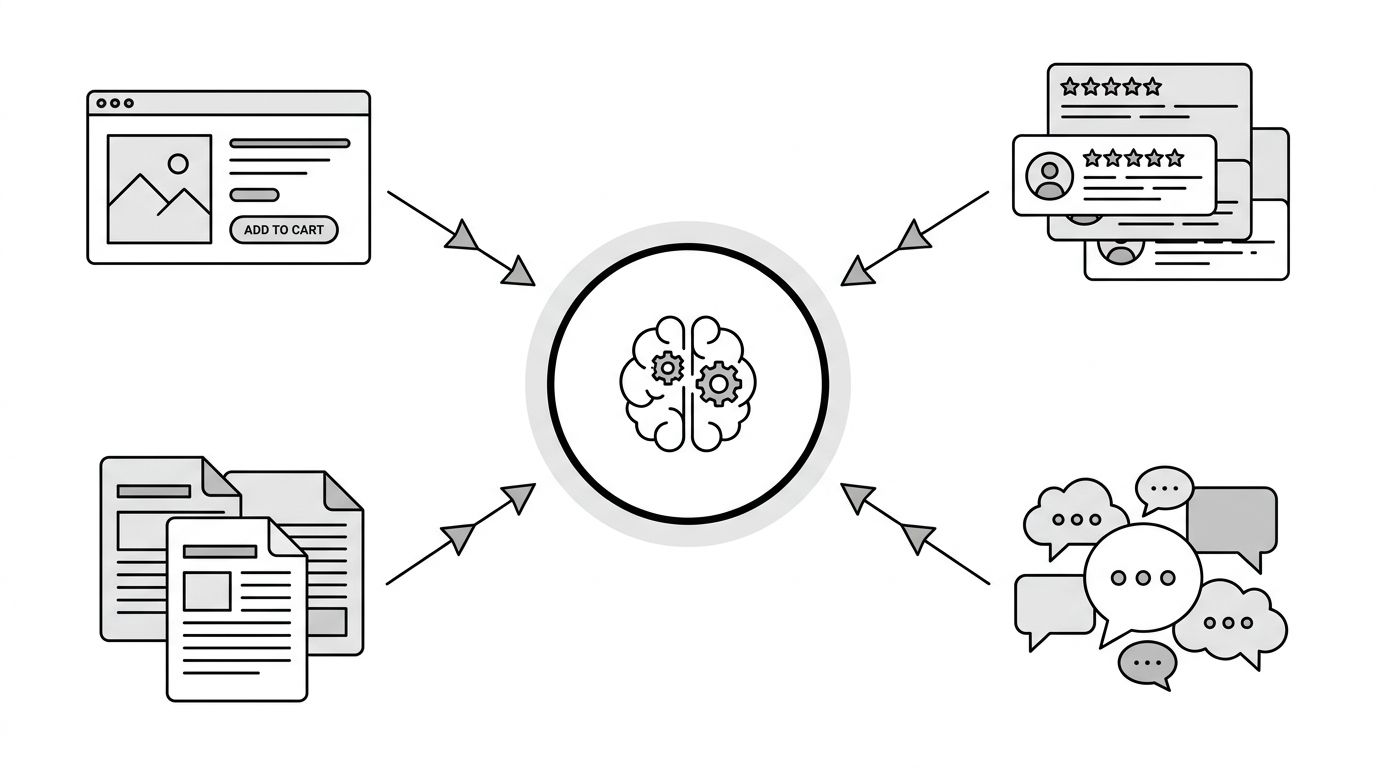
- Your PDP. Product title, description, specification table, schema, FAQ content. Your direct signal.
- Reviews on your site and major review platforms. Amazon, G2, Trustpilot, and category-specific review sites all feed AI responses.
- Third-party articles. Editorial reviews, comparisons, and "best of" lists. Often outrank your PDP on category queries.
- Social and community content. Reddit, X, YouTube videos, and Instagram posts about your product. Increasingly important, especially for consumer brands.
The defensive strategy has to cover all four inputs, not just the ones you own.
Four Defenses That Actually Work
Brand safety in AI shopping is a layered defense problem. No single fix covers every failure mode.
- Fix your PDP first. The single biggest defense. Complete Product schema, accurate specifications, clear policy statements, and FAQ content that preempts common misunderstandings. See our product page optimization guide.
- Monitor external reviews. AI lifts review sentiment heavily. Respond to reviews on Amazon, G2, Trustpilot, and any category-specific platform where your brand appears. Silent brands lose the narrative.
- Address viral negative content. One Reddit thread or YouTube video can anchor AI's representation of your product. Our AI gets brand wrong guide covers the correction playbook.
- Publish comparison content yourself. If you don't compare your product to competitors, third parties will, and the framing won't favor you. A well-structured comparison page on your own site is a defensive asset.
The Correction Workflow
When you spot misrepresentation, move fast. The sooner you correct the source content AI is reading, the sooner the representation updates.
- Identify the likely source. Query AI for the misrepresented claim and ask for sources. Most platforms will surface the page.
- Update or counter the source. If you control it, fix it. If you don't, publish a clear correction on your own site with structured data.
- Re-push the corrected content. Social syndication, newsletter mention, and updated schema all accelerate re-ingestion.
- Track the change. Re-query weekly until AI responses reflect the corrected information.
The cycle usually takes two to eight weeks depending on the platform. Live-retrieval platforms (Perplexity, Google AI Overviews) correct faster than training-set-based platforms (ChatGPT base model).
Who Owns This Work
Brand safety in AI shopping typically falls between ecommerce, PR, and legal. For most brands, the cleanest structure is a small cross-functional standing group meeting monthly. Ecommerce brings the product data. PR handles external content and review response. Legal weighs in on compliance-relevant misrepresentations.
For ecommerce teams that want an audit of current AI brand safety exposure, our ecommerce solution page covers the standing audit approach. Our brand reputation guide has the broader framework for AI brand safety across platforms.