What Happens When AI Gets Your Brand Wrong
What do you do when ChatGPT fabricates pricing, features, or positioning about your brand, and how do you stop AI errors before they spread?


Air Canada's chatbot fabricated a bereavement fare refund policy that did not exist. A passenger relied on it, booked accordingly, and a tribunal held the airline liable. DPD's customer service bot insulted its own company in a conversation that went viral. Google Bard confidently stated a factual error about the James Webb Space Telescope in its public launch demo. These are the visible cases, the ones that made headlines because the error was dramatic enough to notice.
The less visible problem is far larger. AI models generate confident, plausible descriptions of brands every day that are subtly wrong: outdated pricing, discontinued features described as current, competitive positioning that does not reflect your actual market, or a characterization of your product as "best for small teams" when your core customer base is enterprise. These errors do not make headlines. They quietly steer buyers toward competitors before anyone on your team knows it happened.
The standard response is reactive: query ChatGPT about your brand, identify errors, publish corrective content. That playbook is documented in dozens of articles and it works, to a point. But it frames AI brand accuracy as a damage-control problem, something that goes wrong and needs fixing. AI brand accuracy is actually a competitive compounding advantage. The brands that systematically manage their AI representation are building a structural moat that widens over time.
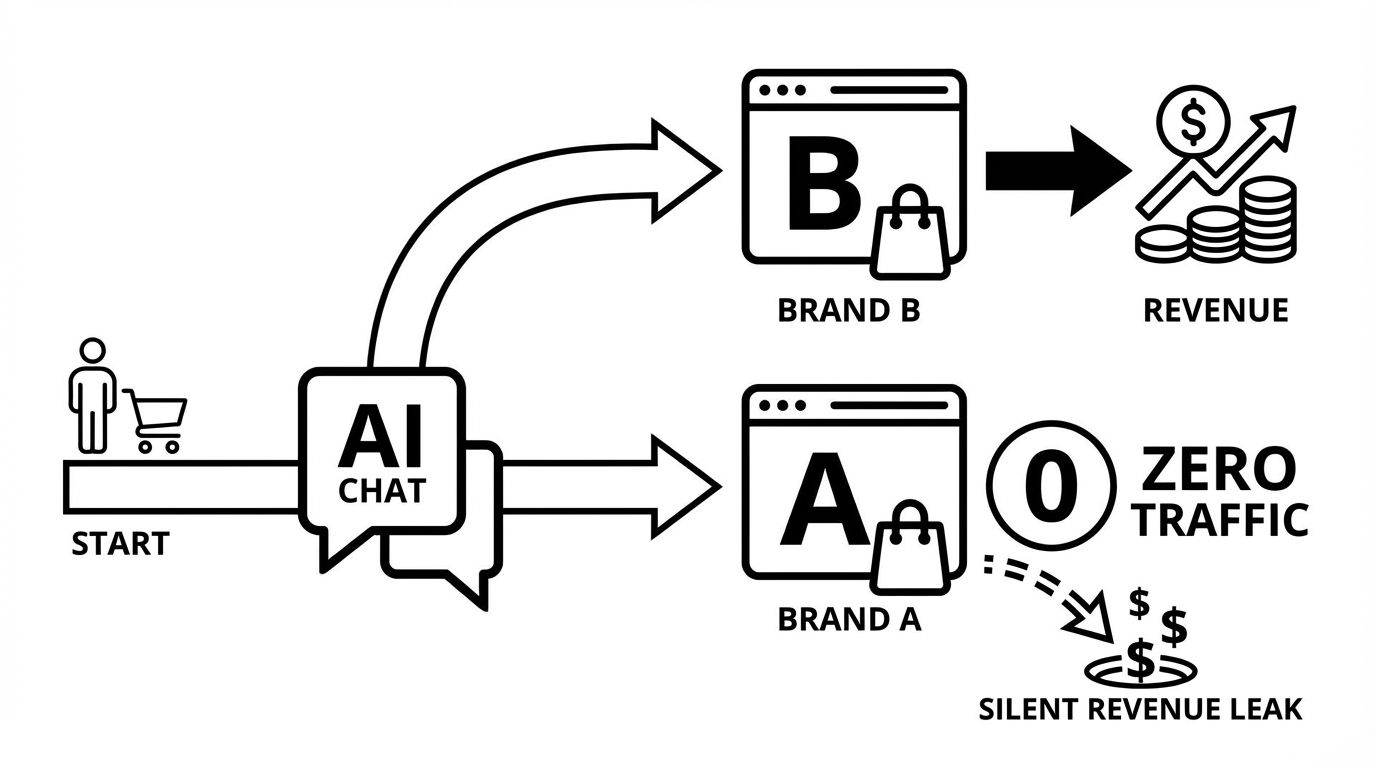
Here is the mechanism. When a buyer asks an AI about your category and the AI describes your competitor accurately and favorably while misrepresenting your brand (or omitting you entirely), the buyer's consideration set is already formed before they visit a single website. That lost opportunity does not show up in your web analytics. It does not appear in your CRM attribution. There is no "AI-influenced non-visit" metric in Google Analytics. The revenue leak is completely silent because the interaction that excluded your brand happened in an AI interface you cannot observe without actively monitoring it.
The flow below shows how this works. The AI diverts buyer consideration to a competitor before any website visit or trackable event occurs, leaving your analytics completely blind to the lost opportunity.
Now compound that over time. Every AI model retrains or updates its retrieval corpus periodically. When it does, it draws from the cumulative signal about your brand across the web. If your competitor has been systematically building accurate, favorable brand signals (publishing precise content, generating positive reviews, earning press that correctly positions their product) while your brand signals are stale or inconsistent, the gap widens with each model update. The AI becomes more confident about your competitor and less confident about you. This is the same compounding dynamic that made early domain authority investments in SEO so valuable in 2012, except the stakes are more binary. In SEO, position three still gets clicks. In AI, if you are not named, you get zero.
The brands that understand this treat AI representation management as a continuous practice, not incident response. They run systematic audits of what every major AI platform says about their brand, not quarterly, but weekly. They track not just whether the AI mentions them, but how it characterizes them: what adjectives it uses, what use cases it associates with their product, what competitors it places them alongside, and whether any factual claims are wrong. Most of those errors fall into a handful of recurring shapes, which we map out in the common patterns of AI misinformation about brands.
When they find errors, they do not just publish corrective blog posts. They address the upstream sources the AI drew from. If the AI says your product does not integrate with Salesforce and it does, the fix is not just updating your own integration page. It is making sure that third-party review sites, comparison articles, and community discussions also reflect the correct information. AI models build their understanding from the consensus across multiple sources. A single corrective page on your domain is not enough to override a signal that appears in five other places. The full correction workflow, from tracing the source of an error to the right fix path for each platform, is documented in our guide to correcting brand misinformation in AI platforms.
The competitive dimension is the part most brands miss. Your competitor's content strategy directly affects your AI representation. If 40 recent, authoritative articles frame Competitor A as the "enterprise-grade" choice and your brand as "best for small teams," that framing becomes the AI's default characterization. It was driven entirely by your competitor's content sprint, not by anything you did or failed to do. Monitoring your own brand is necessary but insufficient. You also need to monitor your competitors' AI representation to understand the competitive context the AI is absorbing.
The brands winning this game started early. Every month of systematic AI representation management builds a thicker layer of accurate, favorable signals that future model updates will draw from. Every month of inaction allows competitors to define your brand's AI narrative by default.
Start with a free AI visibility audit to see exactly how AI platforms currently describe your brand, and where the gaps between AI's version and reality represent your biggest vulnerability.