
A Practical Auto Insurance GEO and AEO Guide (US, 2026)
A 2026 GEO and AEO playbook for US auto insurers: the money pages AI can read, the subreddits and reviews it cites, and the prompts to track.
For auto insurance, the AI answer is mostly decided before a shopper ever reaches your site. When someone asks ChatGPT, Perplexity, or a Google AI Overview which car insurance to buy, two things happen at once. The engine names the same handful of incumbents in almost every answer, and it builds that answer from third-party pages, editorial roundups and Reddit threads, not from your quote page. So the job of generative engine optimization (GEO) and answer engine optimization (AEO) in this category is not to outrank everyone on your own domain. It is to be present and accurate on the specific off-domain surfaces the engines read, and to expose your real facts in a form a machine can quote without getting them wrong.
This guide is the practical version of that idea for the US market: the money pages to build, the communities and video channels that feed AI answers, where to collect reviews, and the exact prompts to track. The numbers come from our own study of 100 US insurance buyer prompts across four engines, plus current search and regulatory data. You can see the full method in the US Insurance AI-Visibility Study.
Why auto insurance is an AI-search battleground
Auto is the most-shopped, most-compared line of insurance, and it is a "your money or your life" (YMYL) topic, so Google and the AI engines hold it to their strictest trust bar. That combination produces a specific pattern: the engines default to the brands they already trust and cite the sources they already trust, and both lists are short.
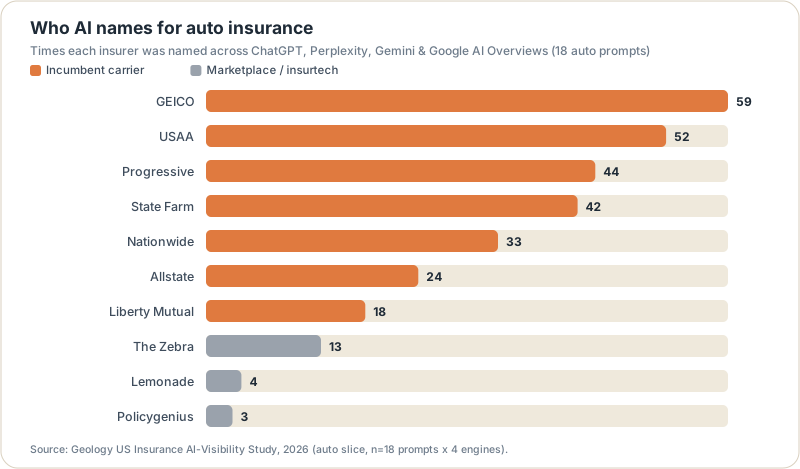
In our study, the four engines named a carrier in nearly every auto answer, and the same incumbents took almost all of the mentions. GEICO, USAA, Progressive, and State Farm led every engine. Insurtechs and standalone marketplaces barely registered. The chart below shows how lopsided the auto results were across ChatGPT, Perplexity, Gemini, and Google AI Overviews.
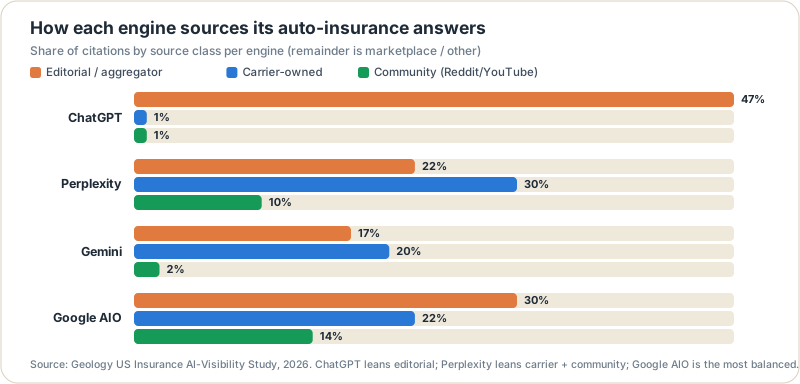
The second fact matters more, because it is the one you can actually change. The engines did not build those answers from carrier websites. They built them from editorial and comparison sites and from community threads. Across the auto prompts, the most-cited domains were Forbes, MoneyGeek, NerdWallet, Bestmoney, Reddit, and Insurify. Carrier-owned pages were a small share of citations. Your quote page is not where the answer is written.
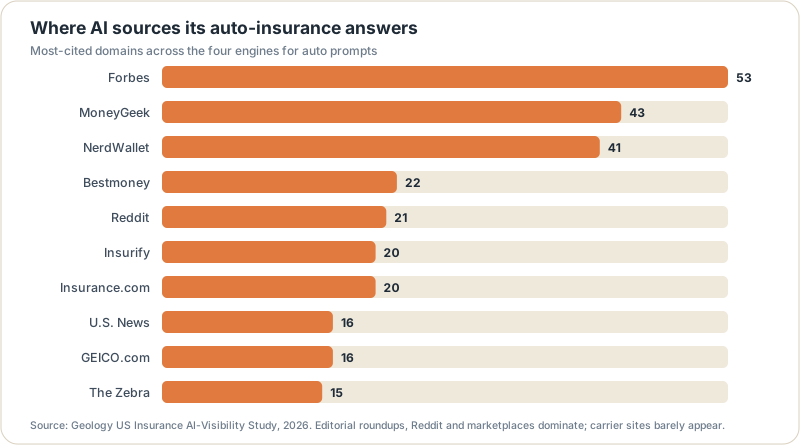
The takeaway for a carrier, broker, or insurtech is direct. Being named is not the goal on its own. Being named accurately is, and getting there means working the third-party surfaces the engines read and making your own facts machine-readable so the number they repeat is your current number, not a stale one from a comparison page. The rest of this guide is how.
On-page: the money pages and facts AI needs to read
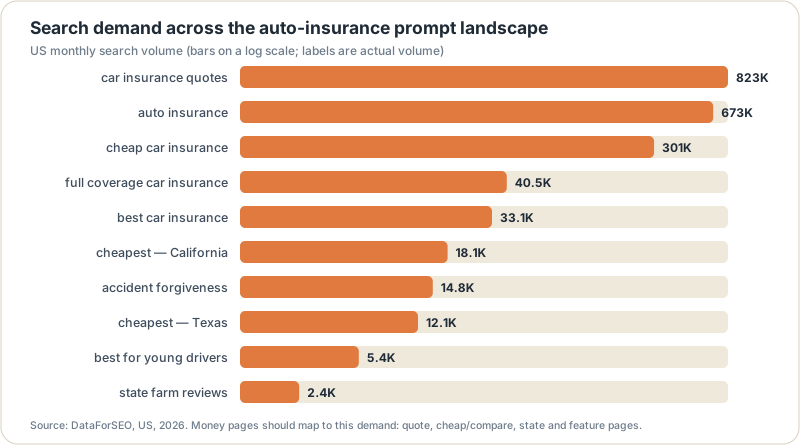
Start with the pages that decide policies, then make the facts on them extractable. Search demand tells you which pages to build first. The gap between a head term like "car insurance quotes" and a long-tail like "best car insurance for young drivers" is three orders of magnitude, so the page priorities are not close.
The money pages
Map your site to the demand and to the way buyers actually ask. Six page types carry the weight:
- Quote page. The highest-intent page and the one most likely to break for AI crawlers (see the technical section). Every optimization here compounds.
- Coverage explainers. One page per coverage: liability, collision, comprehensive, uninsured motorist, personal injury protection, gap, roadside. These are the pages an engine reads to explain what you sell.
- State pages. Auto insurance is priced and regulated by state, so "cheapest car insurance in California" and its siblings are real, high-volume queries. A page per state you write in, carrying that state's minimums and rules, is the single biggest content-scale lever in auto.
- Segment pages. Buyers self-identify: young drivers, teens, seniors, military families, high-risk drivers, drivers after a DUI, drivers with bad credit. Each is a distinct prompt and a distinct page.
- Feature and comparison pages. Full-coverage, accident forgiveness, pay-per-mile and usage-based, new-car replacement. "Accident forgiveness" alone draws roughly 14,800 US searches a month.
- Claims and reviews pages. The trust pages. Buyers and engines both check how you handle claims before they act.
Location and coverage lists AI can parse
State pages are where auto insurance gets its scale, so treat state minimums as structured facts, not prose. Minimums are low, they vary widely, and they are rising. Virginia ended its opt-out and raised limits, New Jersey increased its minimum in January 2026, and California, North Carolina, and Utah all raised theirs in 2025. A page that shows the wrong minimum is both a trust problem and, in your own marketing, a compliance problem.
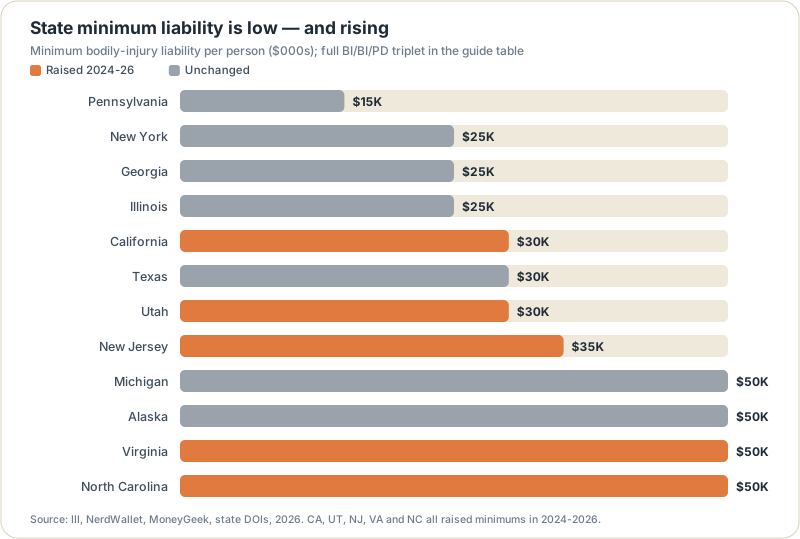
Publish the full requirement per state as a labeled table, not a paragraph an engine has to interpret. Bodily injury per person, bodily injury per accident, property damage, plus whether the state mandates personal injury protection or uninsured-motorist coverage.
| State | Minimum BI/BI/PD ($000s) | Notes |
|---|---|---|
| Pennsylvania | 15 / 30 / 5 | Among the lowest; choice no-fault |
| California | 30 / 60 / 15 | Raised in 2025 |
| Texas | 30 / 60 / 25 | |
| New York | 25 / 50 / 10 | No-fault, PIP required |
| Florida | PIP 10 + PD 10 | No BI mandate for now; no-fault repeal slated for 2027 |
| New Jersey | 35 / 70 / 25 | Raised January 2026 |
| Virginia | 50 / 100 / 25 | Opt-out ended 2024; raised 2025 |
| North Carolina | 50 / 100 / 50 | Highest property-damage floor |
New Hampshire is the one state that does not require liability insurance, though drivers must still prove financial responsibility. Roughly a dozen states run no-fault or add-on personal injury protection. Get these facts current and keep them current, because a minimum that was right at publish is wrong after the next legislative change.
Make the facts machine-readable
Correct facts do not help if the engine cannot read them. Auto quote flows are almost always client-side: the page ships an empty shell, then JavaScript paints in the live quote. A human browser runs that script and sees a premium. Many AI crawlers do not, so they see the empty shell and fill the gap from a comparison marketplace or a cached figure from an old filing.
Fix that in two places. Put the number in server-rendered HTML so a crawler reads it without executing JavaScript, and mark it up with schema the engines parse. One caution that trips up most insurance sites: do not put self-hosted AggregateRating schema about your own company on your own pages. Google ignores it for review stars, and embedding a third-party review widget does not rescue it. Star ratings have to come from off your domain, which is the reviews section below.
The structured data to add, field by field
Schema is how you hand the engine a labeled value instead of prose it has to interpret. For an auto-insurance site, these are the types worth marking up and the specific fields to populate on each.
| Schema type | Use it on | Key fields to populate |
|---|---|---|
| InsuranceAgency / LocalBusiness | Homepage, agency and location pages | name, url, logo, image, telephone, address, areaServed, priceRange, sameAs, openingHoursSpecification |
| Service | Each coverage and line-of-insurance page | name, serviceType, provider, areaServed, description, offers |
| Offer | Quote blocks and pricing modules | price or priceSpecification, priceCurrency, itemOffered, eligibleCustomerType, areaServed |
| FAQPage | Coverage, claims and explainer pages | mainEntity, each Question with name and an acceptedAnswer text |
| Article | Guides and blog posts | headline, author, datePublished, dateModified, publisher, mainEntityOfPage |
| BreadcrumbList | Every deep page | itemListElement, each ListItem with position, name and item |
| Review and AggregateRating | Third-party or product reviews only | author, reviewRating with ratingValue and bestRating, itemReviewed |
| Organization | Site-wide entity reference | name, url, logo, sameAs, contactPoint |
Two rules keep this out of trouble. Mark up Review and AggregateRating only where the review lives on a third party or on a specific product, never as a self-rating of your own company on your own domain. And keep the marked-up figure identical to the one in the server-rendered HTML, because a mismatch between your schema and your visible page is a signal engines learn to distrust.
UGC: Reddit and YouTube feed the answer
The single most useful thing to understand about auto-insurance GEO is how much of the answer comes from user-generated content. Reddit was the most-cited domain in Perplexity's insurance answers and a top-three domain in Google AI Overviews. YouTube fed a large share of Google AI Overview citations too. The engines differ in how they weight these sources, which changes where you should spend effort.
Reddit is where buyers check whether you are worth trusting before they file a claim, and the engines read those threads as sentiment. The priority communities for auto are r/Insurance (around 230,000 members, where licensed agents and adjusters answer), r/car_insurance_help (the small but dedicated auto Q&A sub), the personal-finance communities r/personalfinance, r/Frugal, and r/povertyfinance, plus state and metro subreddits where "cheapest insurance in [state]" threads live, and carrier-specific subs like r/USAA where members post real claim experiences.
One correction worth banking, because it is common bad advice: there is no active r/CarInsurance community. It does not exist. When people say "the car insurance subreddit," they mean r/car_insurance_help or r/Insurance. Do not build a strategy around a subreddit that is not there.
Every one of these communities is strict about self-promotion, so the play is not posting links. It is a disclosed, credible presence: an identified representative who answers questions honestly, corrects factual errors about your coverage or claims, and never astroturfs. Treat a public post the way your compliance team treats any communication, because state advertising rules can reach it. The goal is genuine, accurate sentiment in threads the engines already crawl.
YouTube
Explainer video feeds AI answers, especially on Google. Back the credible, buyer-facing educators rather than carrier ad channels: independent-agent channels like Think Insurance (run by a licensed personal-lines agent) and Shine Insurance, and the Insurance Information Institute's own channel for neutral, citable explainers. A carrier's own YouTube channel is marketing and the engines weight it as such. The win is being referenced, accurately, in the videos buyers and engines treat as objective.
Reviews and ratings: which platform, how, and where
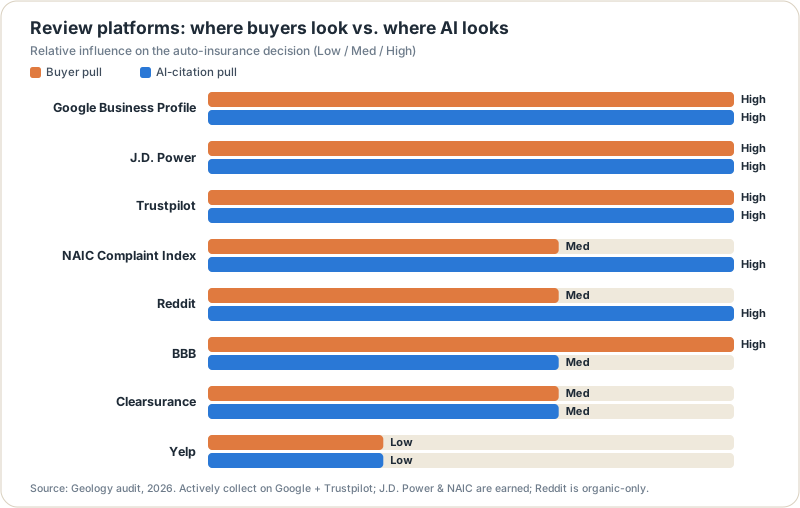
Reviews are the trust layer, and auto-insurance buyers and AI engines read different platforms for different reasons. The question is not "get more reviews," it is which platform, collected how, placed where. The chart below maps each platform by how much it pulls buyers versus how much it pulls AI citations.
Which platform
Concentrate active review collection on Google Business Profile first and Trustpilot second. Both are collectible with compliant invitations, both show ratings natively in search, and both get read by AI engines. Two of the most AI-trusted signals in auto insurance cannot be collected at all: J.D. Power's US Auto Insurance Study and the NAIC Complaint Index. You earn those by operating well, and they generate the independent citations the engines lean on. Maintain BBB and the insurance-specific platform Clearsurance for category coverage, keep ConsumerAffairs in perspective because its pay-to-play model gets discounted by savvy buyers and models alike, and do not solicit on Yelp, which penalizes it.
How to collect reviews without a compliance problem
Three rulebooks apply at once, and the safe path satisfies all three. Ask every customer the same way, at a natural moment, and never condition, gate, or incentivize.
- The FTC rule on reviews (in force since October 2024) bans fake and incentivized reviews, undisclosed insider reviews, and review gating, with penalties per violation. Gating means surveying customers first and routing only the happy ones to Google. Do not do it.
- Platform policies are often stricter than the FTC. Google and Trustpilot both ban incentives and gating and require neutral invitations to all customers. Yelp asks you not to solicit at all.
- State insurance advertising rules govern how you reuse testimonials in your own marketing: they must be genuine, current, accurate to your present practices, and any paid endorsement must be disclosed.
The compliant motion is simple. Send one neutral, platform-neutral request after a policy is issued or a claim is resolved, let the customer rate freely, respond publicly and professionally to the negative ones, and keep records that your process is neutral.
Website versus third-party placement
Here is the rule most sites get wrong. Independent third-party reviews outweigh anything you host about yourself, for both Google and the AI engines, because a self-authored rating cannot be verified. Google will not show review stars for AggregateRating schema about your own company on your own domain, and an embedded review widget does not change that. AI engines treat cross-source agreement as truth: they cite Reddit, the review platforms, and the editorial roundups that quote J.D. Power and NAIC, not your testimonials page.
So split the work. Your own site carries testimonials as human social proof (with the required disclosures) and, more importantly, the accurate, structured, extractable facts the third parties and the engines draw from. The star-earning effort goes off-domain, to Google Business Profile and Trustpilot, where it actually counts.
Prompts to track: branded and unbranded
You cannot improve what you do not watch, and in GEO the unit to watch is the prompt, not the keyword. Track two buckets across ChatGPT, Perplexity, Gemini, Copilot, and Google AI Overviews: unbranded prompts, where you are trying to get named at all, and branded prompts, where you are protecting how you are described.
The unbranded set mirrors how buyers actually ask, which our study captured directly. Track by segment, by coverage feature, by state, and by intent.
| Prompt type | Track these prompts | Why it matters |
|---|---|---|
| Unbranded, by intent | best car insurance, cheapest full coverage car insurance, how to get the cheapest car insurance | The core "which carrier" answer; incumbents own it today |
| Unbranded, by driver segment | best car insurance for young drivers, for teens, for seniors, for military families, for high-risk drivers, after a DUI, for bad credit | Where challengers can win a niche the incumbents ignore |
| Unbranded, by coverage feature | best car insurance with accident forgiveness, best pay-per-mile car insurance, best full coverage for the money, with roadside assistance | Feature-led buyers with clear intent and lower competition |
| Unbranded, by state | cheapest car insurance in California, in Texas, in Florida | High-volume, localized, and mapped to your state pages |
| Branded, reputation | is [brand] good, [brand] reviews, [brand] claims experience | How the engine describes you; catches misinformation |
| Branded, comparison | [brand] vs [competitor], is [brand] cheaper than [competitor] | The head-to-head answer that decides switchers |
| Branded, renewal | should I renew [brand], is [brand] worth it | The retention moment, where sentiment threads surface |
For each prompt, record two things weekly: whether the engine names you (citation share) and whether what it says about your premiums, coverage, and claims is accurate (citation accuracy). A wrong figure quoted in your name is the problem to catch, because it is both a lost sale and, potentially, an advertising-compliance exposure. When you find one, log the prompt, the engine, the wrong detail, and the source it came from, then fix the underlying surface.
The full auto-insurance GEO audit framework
Everything above adds up to one audit. Run it as a scored checklist across nine dimensions, from the machine-readable basics on your own site to the off-domain surfaces that actually write the answer. Score each dimension red, amber, or green, and you have a map of where the work is. The table gives the elements to check and the signal that tells you a dimension is working.
| Dimension | What to check | Working signal |
|---|---|---|
| Crawlability and technical | Server-rendered facts (not JavaScript-only quotes), XML sitemap, robots.txt, llms.txt, crawler access for GPTBot, PerplexityBot and ClaudeBot, page speed, mobile rendering | Crawlers read your premium and coverage without executing JavaScript |
| Structured data | InsuranceAgency, Service and Offer, FAQPage, Article, BreadcrumbList; no self-serving AggregateRating; schema matches visible HTML | Rich results validate and engines read labeled values, not prose |
| On-page content | Quote, coverage, state, segment, feature, claims and reviews pages; current per-state minimums; a page per high-intent prompt | Accurate content exists for every prompt you want to win |
| Off-page presence | Correct listings on The Zebra, Insurify, Policygenius, NerdWallet and Bankrate; accurate editorial mentions | You appear, correctly, on the domains the engines cite |
| Authority and E-E-A-T | Named, credentialed authors; licensed-producer review bylines; clear entity and About signals | Content carries verifiable expertise for a YMYL topic |
| Backlinks | Referring domains from marketplaces, editorial and reputable .org and .gov sources; white-hat only, no PBNs or link schemes | Independent authority the engines vet you by, growing over time |
| Reviews and reputation | Google Business Profile and Trustpilot volume and rating, J.D. Power study result, NAIC complaint index, BBB grade | Third-party ratings the engines trust, collected compliantly |
| UGC and community | Sentiment in r/Insurance, r/car_insurance_help and state subs; credible YouTube references; a disclosed brand presence | Positive, accurate mentions in the threads the engines crawl |
| Prompt monitoring | Weekly citation share and citation accuracy across all five engines, for branded and unbranded prompts | You can see movement and catch a misquote the week it appears |
Work the dimensions in that order the first time through, because the earlier ones are prerequisites: there is no point earning a citation to a page whose premium a crawler cannot read. After the first pass, the last dimension, prompt monitoring, becomes the ongoing loop that tells you where to spend next.
What to do next
The order of operations for auto-insurance GEO follows the way the answer gets built. First, make your own facts current and machine-readable, especially per-state minimums and quote data, so the engine that does cite you quotes you correctly. Second, work the off-domain surfaces that actually write the answer: earn accurate mentions in the editorial and community sources the engines read, and send review collection to Google and Trustpilot. Third, track the branded and unbranded prompts weekly so you can see movement and catch misinformation early.
Incumbents own the default answer today because they have the trust signals and the third-party presence. That is exactly why a focused challenger can win the segments and states they treat as an afterthought. This is the program we run for carriers, brokers, and insurtech on our insurance GEO and SEO page. If you want to see where you stand right now, run a live audit to pull your brand against competitors on the auto prompts that matter, or read how we did this for a broker in the insurance case study.
FAQ
What is the difference between GEO and AEO for auto insurance?
Generative engine optimization (GEO) is the broad practice of getting your brand named and described accurately inside AI-generated answers. Answer engine optimization (AEO) is the narrower work of structuring your content so an engine can extract a specific fact, like a premium or a coverage limit, and repeat it correctly. For auto insurance you need both: GEO to be present on the third-party surfaces the engines read, and AEO to make your own facts machine-readable.
Why does AI keep recommending the same few car insurance companies?
Because auto insurance is a YMYL topic and the engines default to the incumbents they already trust. In our study of 100 US insurance prompts, GEICO, USAA, Progressive, and State Farm led every engine, while insurtechs and marketplaces barely appeared. Challengers rarely win the broad "best car insurance" answer, but they can win specific driver segments and states the incumbents treat as an afterthought.
Which subreddits matter most for auto insurance?
The main ones are r/Insurance, r/car_insurance_help, r/personalfinance, r/Frugal, r/povertyfinance, state and metro subreddits, and carrier-specific subs like r/USAA. There is no active r/CarInsurance community, despite it being commonly suggested. All of these communities are strict about self-promotion, so the only durable approach is a disclosed, genuinely helpful presence.
Where should an auto insurer collect customer reviews?
Actively collect on Google Business Profile first and Trustpilot second, using neutral, non-incentivized invitations sent to every customer. J.D. Power ratings and the NAIC Complaint Index are earned through good operations rather than collected, and they generate the independent citations AI engines trust most. Do not solicit reviews on Yelp, which penalizes it.
Can I put my star rating on my own website for AI to read?
Not as self-hosted review schema. Google ignores AggregateRating structured data about your own company on your own domain, and an embedded review widget does not change that. AI engines weight independent third-party reviews over anything you host about yourself, so the star-earning effort belongs off-domain on platforms like Google Business Profile and Trustpilot.
How do I track whether AI mentions my auto-insurance brand?
Track a fixed set of branded and unbranded prompts weekly across ChatGPT, Perplexity, Gemini, Copilot, and Google AI Overviews, and record two things: whether the engine names you, and whether the premium, coverage, and claims details it states are accurate. A live audit is the fastest way to get a first read across all the engines at once.
How long does it take to show up in AI answers for auto insurance?
It depends on the engine. Retrieval-based engines like Perplexity and Google AI Overviews can reflect new or corrected content within days to weeks once it is crawled. Training-based answers in ChatGPT and Gemini move on the model's release cadence, so those shifts compound over months rather than days.
Do I need a separate page for every state?
For the states you write business in, yes, because auto insurance is priced and regulated per state and "cheapest car insurance in [state]" is how buyers and engines localize. Each state page should carry that state's current minimum limits and rules as structured facts, not a generic paragraph reused across states.
What structured data should an auto-insurance website use?
The core types are InsuranceAgency or LocalBusiness for the entity, Service and Offer for each coverage and its pricing, FAQPage on explainer and claims content, Article on guides, and BreadcrumbList on deep pages. Mark up Review and AggregateRating only for third-party or product reviews, never as a self-rating of your own company on your own domain, which Google ignores for stars.
Should I block AI crawlers like GPTBot from my site?
No. Blocking GPTBot, PerplexityBot, or ClaudeBot stops the engines from reading your correct, current premiums and coverage, which makes it more likely they quote a stale figure from a comparison site instead. Allow the crawlers and focus on being the most accurate, machine-readable source about your own policies.
Is auto-insurance GEO different from traditional SEO?
It shares the same foundation of crawlable, accurate, authoritative content, so most of the work overlaps. The difference is where success is measured and where the answer is assembled: GEO tracks citation share and accuracy inside AI answers, and it leans harder on the third-party surfaces, comparison sites, Reddit and review platforms, that the engines synthesize rather than on your own rankings alone.