
A Practical Health Insurance GEO and AEO Guide (US, 2026)
A 2026 GEO and AEO playbook for US health insurance: the government ratings AI trusts, the subsidy facts to expose, and the prompts to track.
For health insurance, the AI answer is anchored to sources you cannot buy. When someone asks ChatGPT, Perplexity, or a Google AI Overview which health plan to choose, the engine leans on government marketplaces like HealthCare.gov and Medicare.gov, on independent quality ratings like the CMS Star Ratings and NCQA, and on a short list of editorial raters, then names the national carriers those sources rank. So generative engine optimization (GEO) and answer engine optimization (AEO) in this category are less about clever content and more about three things: earning the government and independent ratings the engines trust, being accurate on the marketplace surfaces, and being the credible answer in the one community that matters, all under HIPAA rules most marketers miss.
This guide is the practical version of that idea for the US market: the money pages to build, the ratings that actually move AI answers, the communities and channels that feed them, and the exact prompts to track. The brand and citation data come from a July 2026 audit of live US results, plus current search, coverage, and regulatory data.
Why health insurance is an AI-search battleground
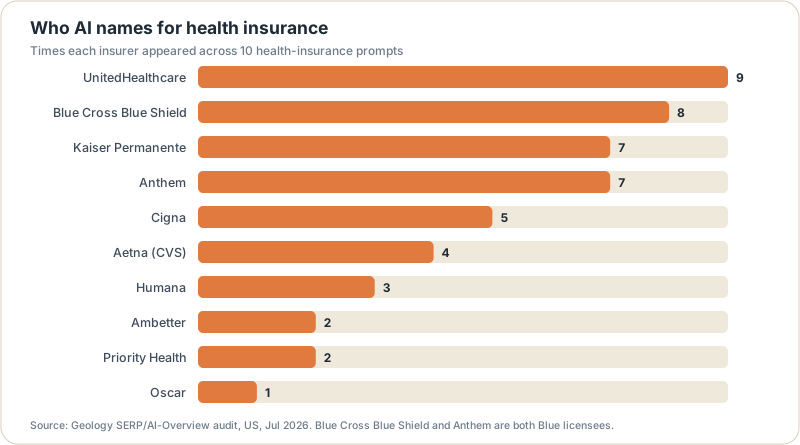
Health insurance is not one market, it is several, and the AI answer reflects the strongest, most trusted sources in each. In our audit of ten US health-insurance prompts, the engines named the national carriers first: UnitedHealthcare in nine of ten, the Blue Cross Blue Shield family in eight, Kaiser Permanente and Anthem in seven each.
The more useful fact is where those answers came from. Health-insurance citations split across three pillars: government and marketplace sources (HealthCare.gov, state exchanges like Covered California, Medicare.gov), carrier-owned pages (UHC.com, Anthem.com, the regional Blues), and editorial raters led by Forbes. Reddit appeared in four of ten prompts, so community consensus is a live factor here too.
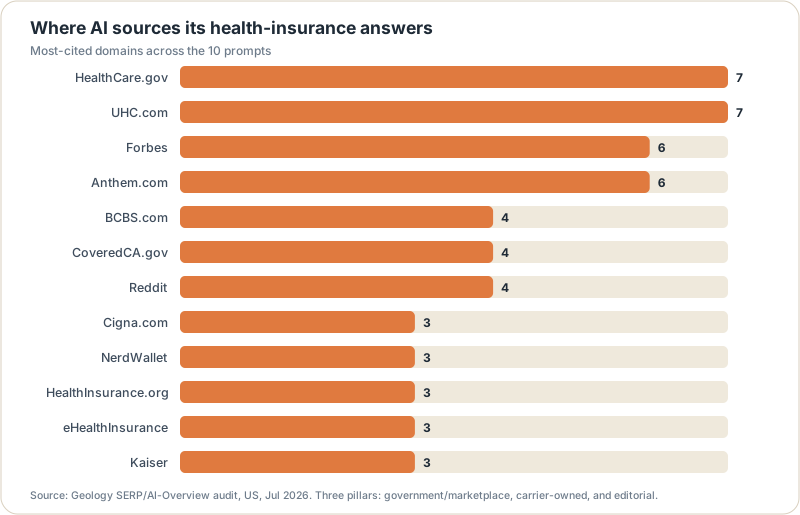
Two facts fall out of this that shape the whole strategy. First, the sources with the most weight, the government marketplaces and the independent ratings, cannot be bought or gamed, so health GEO is won by performing well enough to earn them. Second, editorial raters like KFF and ValuePenguin that dominate policy and statistics queries did not appear for these buyer prompts, so a plan targeting real buyers should prioritize the marketplaces, Forbes, and NerdWallet over policy-wonk citations.
On-page: the money pages and facts AI needs to read
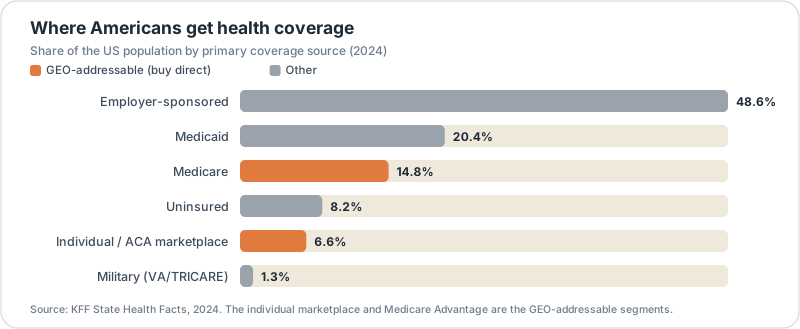
Start by knowing which market you are even competing in. Roughly half of Americans get coverage through an employer, and large shares through Medicaid and Medicare, so the segment a GEO program can actually address is the buy-direct market: the individual ACA marketplace and Medicare Advantage.
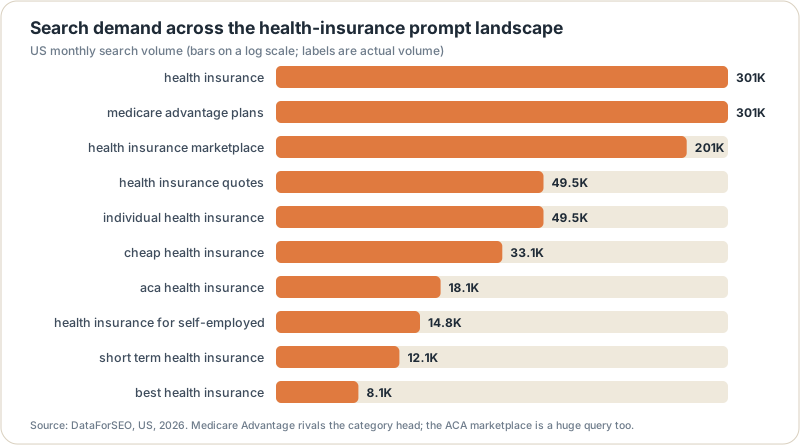
Search demand confirms where the volume sits. Medicare Advantage rivals the category head, and the ACA marketplace is itself a giant query.
The money pages
Build the pages that map to how buyers actually shop each addressable market:
- Plan pages. One per plan, carrying the network type, premium, deductible, and out-of-pocket maximum as labeled facts.
- Metal-tier explainers. Bronze, Silver, Gold, and Platinum pages that explain what each covers and, critically, why Silver is the central tier.
- Medicare pages. Medicare Advantage versus Original Medicare, Medigap, Part D, and the enrollment windows. This is half the search demand and its own vocabulary.
- State-marketplace and county pages. ACA plans and Medicare Advantage are priced and rated locally, so state and county pages carrying local plans and ratings are the biggest content-scale lever.
- Segment pages. Self-employed, families, small business (SHOP and ICHRA), and people managing a chronic condition. Each is a distinct prompt.
- Enrollment and subsidy content. Open-enrollment dates, special enrollment periods, and how premium tax credits work. These are high-intent question pages.
The facts AI has to get right
Two structural facts anchor most health-insurance answers. The first is the metal tiers and their actuarial value, the share of covered costs a plan pays. Silver is central because cost-sharing reductions and the subsidy benchmark both attach to it.
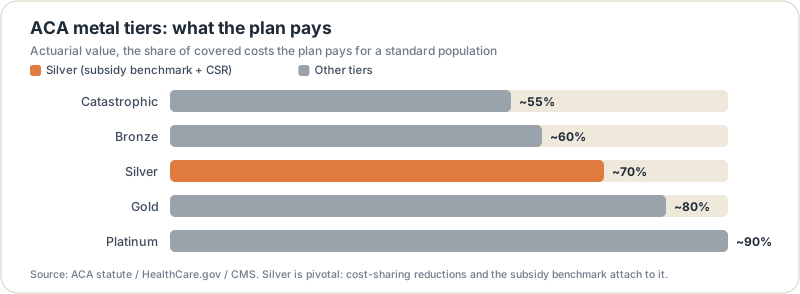
The second is the 2026 enrollment and subsidy rules, which changed. Open enrollment for 2026 coverage runs November 1, 2025 to January 15, 2026 in most states, and Medicare's annual enrollment runs October 15 to December 7. Premium tax credits run from 100 to 400 percent of the federal poverty level, and the subsidy cliff at 400 percent returned on January 1, 2026 after the enhanced credits expired, so income above roughly $62,600 for a single person or $128,600 for a family of four now forfeits the subsidy entirely. Cost-sharing reductions apply only from 100 to 250 percent of poverty and only on a Silver plan. Publish these as current, dated facts, because they are exactly what engines quote and exactly what changes.
Network type is the other fact buyers and engines compare. HMO plans are in-network only and require a referral, PPO plans add out-of-network coverage and drop referrals, EPO plans are in-network only without referrals, and POS plans mix a primary-care gatekeeper with some out-of-network access. Mark these up so an engine reads the plan's type rather than guessing.
The structured data to add, field by field
Schema hands the engine a labeled value instead of prose it has to interpret. For a health-insurance site, these are the types worth marking up and the fields to populate.
| Schema type | Use it on | Key fields to populate |
|---|---|---|
| Organization / InsuranceAgency | Homepage and about pages | name, url, logo, telephone, sameAs, contactPoint, areaServed |
| Product / Offer | Each plan page | name, category (metal tier), offers with price, deductible and network fields |
| FAQPage | Enrollment, subsidy and coverage pages | mainEntity, each Question with name and an acceptedAnswer text |
| Article | Guides, Medicare and explainer content | headline, author, datePublished, dateModified, publisher, mainEntityOfPage |
| BreadcrumbList | Every deep page | itemListElement, each ListItem with position, name and item |
| MedicalWebPage / Dataset | Clinical or ratings content | about, lastReviewed, reviewedBy, or the rating source for plan-quality data |
| Review and AggregateRating | Third-party or specific-plan reviews only | author, reviewRating with ratingValue and bestRating, itemReviewed |
Keep the marked-up figure identical to the visible one, and never self-host an AggregateRating about your own plan. Google ignores it for stars, and an embedded review widget does not change that.
UGC: the one community that matters
Health insurance has a smaller community layer than auto, but it is unusually concentrated. One subreddit does most of the work, and the engines read it.
r/HealthInsurance, with roughly 119,000 members, is the definitive US consumer question-and-answer hub, and its defining feature is that licensed agents and brokers answer through flair-verified accounts. That makes it the single highest-value community for a health-insurance brand, because being the accurate, upvoted answer there is exactly what the engines then cite. Around it sit r/Medicare for the 65-and-over transition, r/personalfinance for HSA and plan-choice math, r/ChronicIllness and disease-specific subs where coverage battles play out, and r/smallbusiness for group plans and ICHRA. Every one bans solicitation, so the only durable play is genuine expert participation, not posting.
YouTube splits sharply by segment. The Medicare-education space is large and concentrated around independent brokers who monetize through free enrollment help: Boomer Benefits, Medicare School, and The Medicare Family each have hundreds of thousands of subscribers. The under-65 ACA space is fragmented with no dominant channel, which is a genuine content gap for an insurer or broker willing to fill it.
Reviews and ratings: the government owns the trust layer
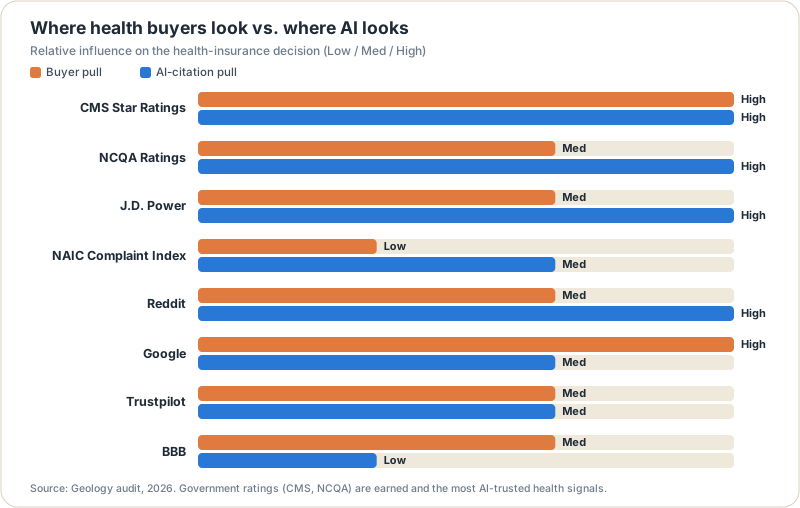
In most insurance lines you collect reviews. In health insurance the ratings that matter most are earned from the government and independent bodies, not gathered, and they carry more weight with both buyers and engines than any review you could solicit.
Which ratings
For Medicare Advantage and Part D, the CMS Star Ratings are the highest authority: a government one-to-five-star quality score published on the official Medicare Plan Finder, tied to bonus payments and a special enrollment period for five-star plans. For commercial and Medicaid plans, the NCQA Health Plan Ratings measure clinical quality and patient experience. J.D. Power's member-satisfaction studies and the NAIC complaint index round out the independent set. All of these are earned by performing on quality, satisfaction, and complaints, and because they cannot be bought, the engines weight them heavily and editorial raters fold them into every "best plan" verdict. Google reviews matter for local agents and brokers, and Trustpilot and BBB provide a secondary consumer-trust layer.
How to collect reviews without a compliance problem
Health insurers carry a rulebook no other vertical does. Under HIPAA, any testimonial that exposes protected health information, a member's name, condition, or even a recognizable context, requires a valid, signed authorization before you publish it, and a generic privacy notice does not suffice. On top of that, CMS Medicare marketing rules and third-party marketing organization requirements govern how agents advertise plans and star ratings, and the FTC's 2024 review rule bans fake, incentivized, and gated reviews across the board. The safe pattern is to solicit reviews without ever asking for or resurfacing clinical detail, disclose any material connection, and never route unhappy members away from public review.
First-party versus third-party
Your own testimonials carry the full HIPAA and FTC burden and are discounted by the engines because they are self-serving. The government and independent ratings are the opposite: independent, unbuyable, and the sources AI trusts most for plan quality. So the highest-return work is operational, moving your CMS, NCQA, J.D. Power, and NAIC numbers, because those are what the engines cite. Use your own site for accurate, extractable plan facts and honest enrollment guidance, and send the trust-building effort to the ratings and the review platforms that can be independently verified.
Prompts to track: branded and unbranded
Track the prompt, not the keyword, across ChatGPT, Perplexity, Gemini, Copilot, and Google AI Overviews. Health buyers ask by market segment, by life event, and by intent, and the branded set is where you protect how the engine describes your plan and its ratings.
| Prompt type | Track these prompts | Why it matters |
|---|---|---|
| Unbranded, by market | best ACA marketplace plans, best Medicare Advantage plans, best health insurance for self-employed | The core "which plan" answer, split by the market you actually sell in |
| Unbranded, by intent | best health insurance, cheapest health insurance, best health insurance companies 2026 | High-volume category prompts the nationals and editorial raters own today |
| Unbranded, by segment | best health insurance for a family, for small business, for a chronic condition | Where a focused plan can win a niche the nationals answer generically |
| Unbranded, by question | how do health insurance subsidies work, Medicare Advantage vs Original Medicare, what is a Silver plan | Question prompts the engines answer from marketplaces and editorial raters |
| Branded, reputation | is [plan] good, [plan] reviews, [plan] star rating | How the engine describes you and repeats your CMS or NCQA rating |
| Branded, comparison | [plan] vs [competitor], is [plan] better than [competitor] | The head-to-head answer that decides switchers during enrollment |
For each prompt, record two things weekly: whether the engine names you, and whether the plan details, ratings, and subsidy facts it states are accurate. A wrong subsidy rule or a stale star rating quoted in your name is both a lost enrollment and a compliance exposure, so log the prompt, the engine, the wrong detail, and the source, then fix that surface.
The full health-insurance GEO audit framework
Everything above adds up to one audit. Run it as a scored checklist across nine dimensions, from the machine-readable basics on your own site to the government ratings and marketplaces that actually write the answer. Score each dimension red, amber, or green and you have a map of where the work is.
| Dimension | What to check | Working signal |
|---|---|---|
| Crawlability and technical | Server-rendered plan facts (not JavaScript-only plan finders), sitemap, robots.txt, llms.txt, crawler access for GPTBot, PerplexityBot and ClaudeBot, page speed | Crawlers read your premiums, networks and ratings without executing JavaScript |
| Structured data | Product and Offer, FAQPage, Article, BreadcrumbList; no self-serving AggregateRating; schema matches visible HTML | Rich results validate and engines read labeled values, not prose |
| On-page content | Plan, metal-tier, Medicare, state and county, segment and enrollment pages; current 2026 subsidy and enrollment facts | Accurate content exists for every prompt you want to win, in your markets |
| Marketplace and directory presence | Accurate representation on HealthCare.gov, state exchanges, Medicare Plan Finder and provider directories | You appear, correctly, on the government surfaces the engines cite |
| Authority and E-E-A-T | Named, licensed authors; flair-verified expertise; clear entity and About signals | Content carries verifiable expertise for a YMYL topic |
| Ratings and reputation | CMS Star Ratings, NCQA, J.D. Power, NAIC complaint index; Google and BBB for local agents | Independent ratings the engines trust, earned through quality and satisfaction |
| Backlinks | Referring domains from editorial raters, .gov and .org health sources; white-hat only | Independent authority the engines vet you by, growing over time |
| UGC and community | Flair-verified presence and accurate sentiment in r/HealthInsurance and r/Medicare; credible YouTube references | Positive, accurate mentions in the threads and videos engines read |
| Prompt monitoring | Weekly citation share and accuracy across all five engines, for branded and unbranded prompts | You can see movement and catch a misquote the week it appears |
Work the dimensions in that order the first time through. Ratings sit high because in health insurance they are the trust layer the engines lean on hardest, and they take the longest to move, so start early.
What to do next
The order of operations for health-insurance GEO follows how the answer gets built. First, be accurate on the government and marketplace surfaces and expose your CMS or NCQA rating as a structured fact, because those are the sources the engines trust most. Second, make your own plan facts current and machine-readable, especially the 2026 subsidy and enrollment rules and network types, so the engine that cites you quotes you correctly. Third, be the flair-verified answer in r/HealthInsurance and win the segment and county prompts the nationals answer generically, and track your branded prompts weekly through the enrollment window.
Government ratings and marketplaces own the default answer today because buyers and engines trust what they cannot buy. That is exactly why a focused plan that genuinely performs can win the markets the nationals treat generically. This is the program we run for carriers, brokers, and insurtech on our insurance GEO and SEO page. If you want to see where you stand right now, run a live audit to pull your brand against competitors on the health prompts that matter, or read how we approached a regulated insurance vertical in the insurance case study.
FAQ
What is the difference between GEO and AEO for health insurance?
Generative engine optimization (GEO) is the broad practice of getting your plan named and described accurately inside AI-generated answers. Answer engine optimization (AEO) is the narrower work of structuring your content so an engine can extract a specific fact, like a metal tier's actuarial value or a subsidy rule, and repeat it correctly. Health insurance needs both, with unusual weight on earning the government and independent ratings the engines trust.
Why does AI keep recommending the same few health insurers?
Because the sources with the most weight, government marketplaces and independent quality ratings, favor the large national carriers that perform well across many markets. In our audit UnitedHealthcare appeared in nine of ten prompts and the Blue Cross Blue Shield family in eight. Challengers rarely win the broad answer, but they can win specific markets, counties, and segments the nationals answer generically.
Which ratings matter most for health insurance AI visibility?
The CMS Star Ratings for Medicare Advantage and Part D, and the NCQA Health Plan Ratings for commercial and Medicaid plans, carry the most weight, followed by J.D. Power satisfaction studies and the NAIC complaint index. They matter because they are independent and cannot be bought, so the engines and the editorial raters both lean on them. You improve them by performing on quality and satisfaction, not by marketing.
Which subreddit matters most for health insurance?
r/HealthInsurance, with roughly 119,000 members, is the single highest-value community because it combines real buyer intent with flair-verified agents who answer authoritatively, and the engines cite it. r/Medicare, r/personalfinance, r/ChronicIllness, and r/smallbusiness matter for their segments. All ban solicitation, so the only durable play is genuine expert participation.
Can I use member testimonials in my health-insurance marketing?
Only with care. Under HIPAA, any testimonial that exposes protected health information, including a member's name, condition, or a recognizable context, requires a valid signed authorization before you publish it, and a generic privacy notice does not satisfy this. CMS Medicare marketing rules and the FTC's 2024 review rule also apply, so solicit reviews without asking for clinical detail and disclose any material connection.
How do 2026 health insurance subsidies work?
For 2026, premium tax credits are available from 100 to 400 percent of the federal poverty level, and the subsidy cliff at 400 percent returned on January 1, 2026 after the enhanced credits expired. That means income above roughly $62,600 for a single person or $128,600 for a family of four forfeits the subsidy. Cost-sharing reductions apply only from 100 to 250 percent of poverty and only on a Silver plan. Verify the current rules before acting, since this is the most volatile fact in the market.
How long does it take to show up in AI answers for health insurance?
It varies by engine. Retrieval-based engines like Perplexity and Google AI Overviews can reflect new content and updated ratings within days to weeks once crawled. Training-based answers in ChatGPT and Gemini move on the model's release cadence, so those shifts compound over months. Ratings themselves move on annual cycles, so start early.
Should I block AI crawlers like GPTBot from my site?
No. Blocking GPTBot, PerplexityBot, or ClaudeBot stops the engines from reading your correct plan, network, and rating details, which makes it more likely they quote a stale figure from another source. Allow the crawlers and focus on being the most accurate, machine-readable source about your own plans.
Why is the Silver metal tier so important?
Silver is the central ACA tier because two things attach to it. Cost-sharing reductions, which lower deductibles and copays for people from 100 to 250 percent of the poverty level, are available only on Silver plans, and the subsidy benchmark is tied to the second-lowest-cost Silver plan in your area. That makes accurate Silver-plan content unusually important for both buyers and engines.
How do I track whether AI recommends my health plan?
Track a fixed set of branded and unbranded prompts weekly across ChatGPT, Perplexity, Gemini, Copilot, and Google AI Overviews, and record whether the engine names you and whether the plan details, ratings, and subsidy facts it states are accurate. A live audit is the fastest way to get a first read across all the engines at once.