
A Practical Life Insurance GEO and AEO Guide (US, 2026)
A 2026 GEO and AEO playbook for US life insurance: the publisher lists AI cites, the financial-strength rating to expose, and the prompts to track.
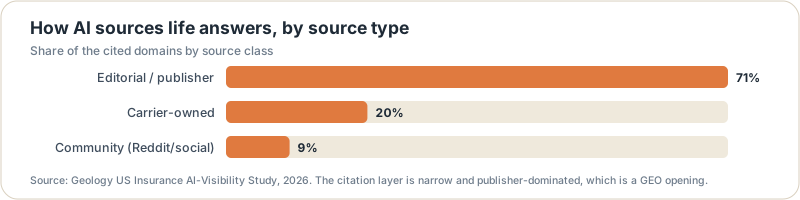
For life insurance, the AI answer is written by a short list of review publishers, and community sentiment barely touches it. When someone asks ChatGPT, Perplexity, or a Google AI Overview which life insurance to buy, the engine leans on NerdWallet, MoneyGeek, Forbes, and U.S. News, then names the old-line mutuals and low-cost term carriers those raters rank. This is the opposite of auto insurance, where Reddit dominates: on commercial "best life insurance" prompts, Reddit and the encyclopedic sources scarcely appear. So generative engine optimization (GEO) and answer engine optimization (AEO) in this category come down to two things: earning a place on the narrow set of publisher "best of" lists, and carrying the one trust signal this vertical is built on, a strong financial-strength rating.
This guide is the practical version of that idea for the US market: the money pages to build, the product facts AI has to get right, the communities that shape sentiment, and the exact prompts to track. The data comes from our 100-prompt US Insurance AI-Visibility Study, a July 2026 audit of live results, and current search and market data.
Why life insurance is an AI-search battleground
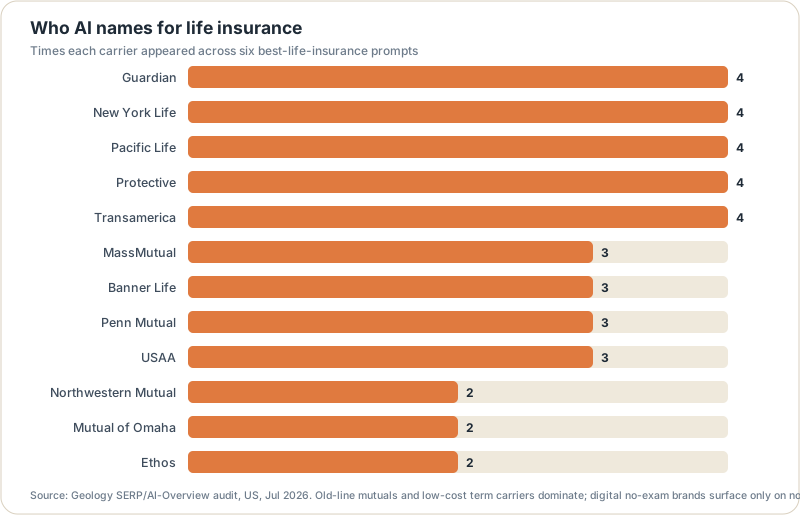
Life insurance is a decades-long promise, so buyers and engines both default to carriers that look like they will be around to pay. In our audit of best-life-insurance prompts, the answers centered on old-line mutuals and established term carriers: Guardian, New York Life, Pacific Life, Protective, and Transamerica led, with MassMutual, Northwestern Mutual, and the low-cost term brands close behind.
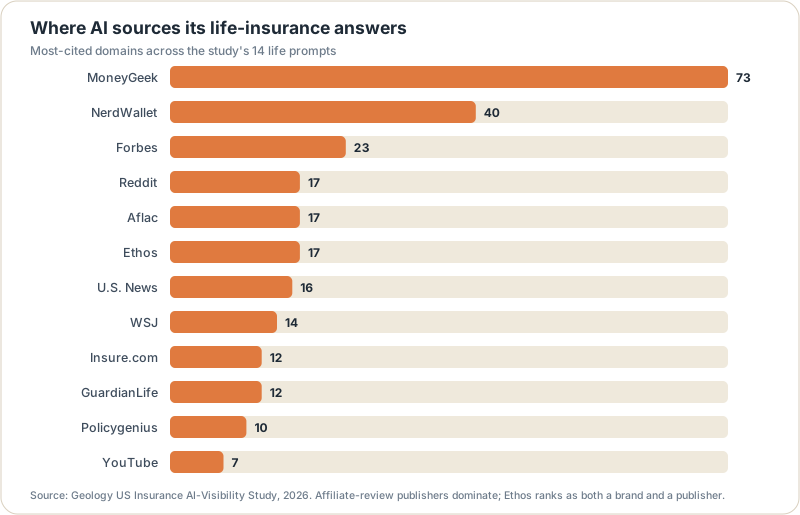
The citation layer is where life insurance differs most from every other line. It is narrow and publisher-dominated. MoneyGeek, NerdWallet, Forbes, and U.S. News supply most of the answer, carrier-owned pages a smaller share, and community sources very little. One brand, Ethos, appears as both a named carrier and a cited publisher, because its own "best of" review pages rank alongside the editorial sites.
The strategic read is encouraging for a challenger. A narrow citation set is a beatable one. If the answer to "best term life insurance" is assembled from a handful of publisher lists, then earning a place on those lists, and building a comparison page structured well enough to be cited directly, moves the answer more reliably than it would in a category with a thousand sources. The rest of this guide is how.
On-page: the money pages and facts AI needs to read
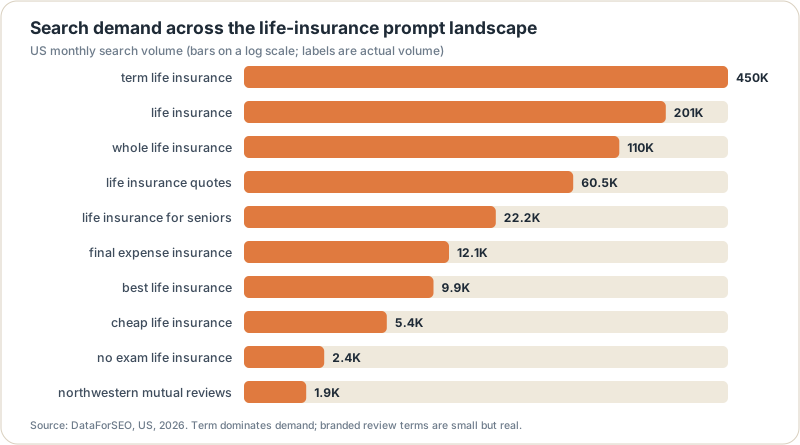
Build the pages that map to how life buyers actually shop, which is by product and by life stage. Search demand is dominated by term, the cheapest and most-bought product, with whole life and the senior and final-expense segments close behind.
The money pages
Structure the site around the products and the life stages that drive the prompts:
- Product pages. One per product: term, whole, universal (UL), indexed universal (IUL), variable universal (VUL), final expense, and no-exam. Each carries the mechanics as labeled facts.
- Quote and compare pages. The transactional core, ideally with the financial-strength rating shown next to each option.
- Segment pages. Seniors, young families, smokers, people over 50, and high-net-worth buyers weighing permanent coverage for estate planning. Each is a distinct prompt.
- Question pages. "How much life insurance do I need," "term versus whole life," and "is no-exam life insurance worth it" are high-volume questions the engines answer from editorial and community sources.
- Underwriting pages. No-exam and simplified-issue explainers, because speed and convenience are a real buyer axis and a place digital-first brands win.
The product facts AI has to get right
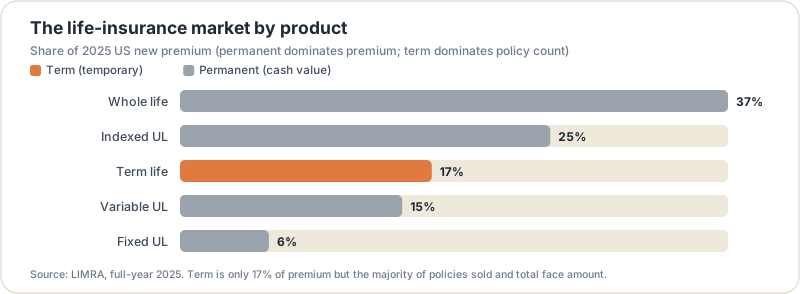
The market splits into term, which is temporary and cheap, and permanent products that build cash value. A fact worth stating carefully, because engines repeat it: permanent products take the large majority of new premium dollars, but term is the majority of policies sold and total coverage, because it costs so little per dollar.
Publish the product mechanics as clean facts: what each product is, typical term lengths and face amounts, whether it builds cash value, the medical-exam versus no-exam paths, and the common riders like accelerated death benefit, waiver of premium, child and spouse riders, and term conversion. The coverage rule of thumb buyers hear, ten to fifteen times income, is worth stating and sourcing too.
The structured data to add, field by field
Schema hands the engine a labeled value instead of prose it has to interpret. For a life-insurance site, these are the types worth marking up and the fields to populate.
| Schema type | Use it on | Key fields to populate |
|---|---|---|
| Organization / FinancialService | Homepage and about pages | name, url, logo, telephone, sameAs, contactPoint, areaServed |
| Product / Offer | Each product page | name, description, category, offers, aggregateRating (third-party only) |
| FAQPage | Product, underwriting and "how much" pages | mainEntity, each Question with name and an acceptedAnswer text |
| Article | Guides, term-versus-whole and explainer content | headline, author, datePublished, dateModified, publisher, mainEntityOfPage |
| BreadcrumbList | Every deep page | itemListElement, each ListItem with position, name and item |
| Rating (financial strength) | Company and product pages | ratingValue and the named rater (AM Best), exposed as a labeled value |
| Review and AggregateRating | Third-party or specific-product reviews only | author, reviewRating with ratingValue and bestRating, itemReviewed |
Keep the marked-up figure identical to the visible one, and never self-host an AggregateRating about your own company. Google ignores it for stars, and an embedded review widget does not change that.
UGC: sentiment lives away from the buying prompts
Life insurance has an active community layer, but it sits in a different place than the commercial prompts, and it leans a specific way. The engines pull it into broader questions even though it barely touches the "best of" answers.
Reddit and the buy-term consensus
The dedicated community is r/lifeinsurance, where consumers and independent agents debate specific policies. Around it sit the large personal-finance communities, r/personalfinance, r/financialindependence, and r/whitecoatinvestor, and they share a strong default view: buy term and invest the difference. In those communities whole life, universal life, and indexed universal life are treated with suspicion and framed as commission-driven, so pro-permanent content posted there is downvoted unless it makes a narrow, well-reasoned estate or business-continuation case. The two subs where permanent-product discussion is genuinely open are r/lifeinsurance and the agent-side r/InsuranceAgent.
The practical takeaway is to be honest about product fit. A brand that acknowledges when term is the right answer earns more credibility, and more citable sentiment, than one that pushes permanent coverage into a community built to debunk it.
YouTube's two camps
Life-insurance video splits into two opposing camps, and the engines read both. On one side are the large fee-only and "buy term" voices led by Ramsey, The Money Guy Show, and Ben Felix. On the other are the whole-life, indexed-universal-life, and "infinite banking" advocates. Knowing which camp a prompt pulls from tells you which content will be cited, and an honest brand can be a credible voice in whichever camp fits its products.
Reviews and ratings: financial strength is the trust layer
In most insurance lines you collect reviews. In life insurance the single most important trust signal is a rating you earn, because the policy is a promise that may be paid decades from now, so the carrier's long-term solvency matters more than in any other consumer line.
Which ratings
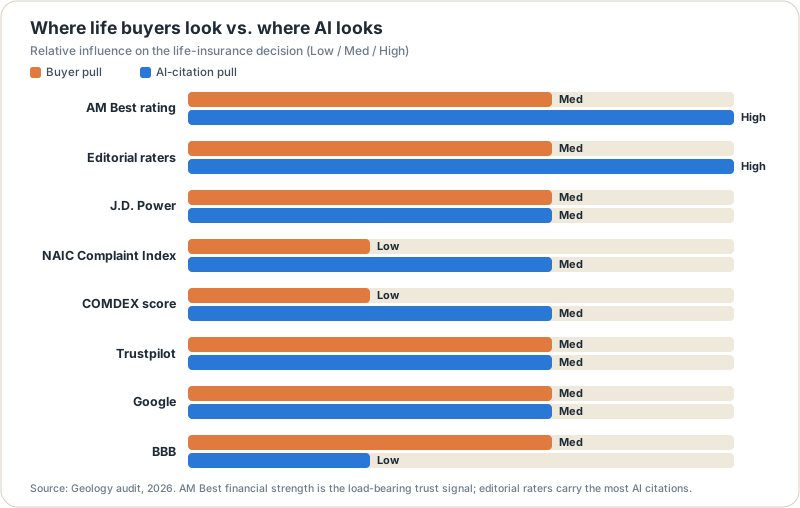
AM Best financial-strength ratings are the anchor: an independent solvency score from A++ down, where buyers are widely advised to stay at A- or higher. The editorial raters that carry the most AI citations, NerdWallet, Investopedia, Policygenius, and Forbes, weight AM Best heavily in their own methodologies, so a strong rating propagates into the answers the engines give. The NAIC complaint index and the J.D. Power life-insurance study round out the independent set, and the COMDEX score, a composite percentile of the major rating agencies, is a shorthand agents and raters use. Google reviews and Trustpilot matter for direct-to-consumer brands and local agents, but they sit below the financial-strength signal.
How to collect reviews without a compliance problem
The FTC's 2024 review rule bans fake, incentivized, and gated reviews and prohibits suppressing negatives, so solicit neutrally from all customers and never route unhappy ones away from public review. Life insurance adds its own wrinkle: pair any rate claim with a note that final rates are subject to underwriting, and if the product is a variable one like variable universal life, or the seller is a registered representative, the SEC marketing rule and FINRA govern testimonials and endorsements, which means disclosing compensation and conflicts and sometimes securing pre-approval.
First-party versus third-party
The highest-return move in life insurance is not collecting reviews at all, it is earning a place on the editorial "best of" lists, because those pages are cited far more than any page you own. Your AM Best rating, exposed as a structured fact, does more than a wall of testimonials, which the engines discount as self-serving. Use your own site for accurate product facts and honest guidance, and send the trust-building effort to the financial-strength rating and the independent raters.
Prompts to track: branded and unbranded
Track the prompt, not the keyword, across ChatGPT, Perplexity, Gemini, Copilot, and Google AI Overviews. Life buyers ask by product, by life stage, and by intent, and the branded set is where you protect how the engine describes your products and your rating.
| Prompt type | Track these prompts | Why it matters |
|---|---|---|
| Unbranded, by product | best term life insurance, best whole life insurance, best no exam life insurance | The core "which product" answer, decided on publisher "best of" lists |
| Unbranded, by intent | best life insurance, cheapest term life insurance, best online life insurance | High-volume category prompts the old-line mutuals and raters own today |
| Unbranded, by life stage | best life insurance for young families, for seniors, for smokers, final expense | Where a focused brand can win a niche the mutuals answer generically |
| Unbranded, by question | how much life insurance do I need, term vs whole life, is no exam worth it | Question prompts the engines answer from editorial and community sources |
| Branded, reputation | is [carrier] good, [carrier] reviews, [carrier] AM Best rating | How the engine describes you and repeats your financial-strength rating |
| Branded, comparison | [carrier] vs [competitor], [product] vs [product] | The head-to-head answer that decides comparison shoppers |
For each prompt, record two things weekly: whether the engine names you, and whether the product details and financial-strength rating it states are accurate. A wrong rating or a stale rate quoted in your name is both a lost sale and a compliance exposure, so log the prompt, the engine, the wrong detail, and the source, then fix that surface.
The full life-insurance GEO audit framework
Everything above adds up to one audit. Run it as a scored checklist across nine dimensions, from the machine-readable basics on your own site to the publisher lists and financial-strength ratings that actually write the answer. Score each dimension red, amber, or green and you have a map of where the work is.
| Dimension | What to check | Working signal |
|---|---|---|
| Crawlability and technical | Server-rendered product and rate facts (not JavaScript-only quote tools), sitemap, robots.txt, llms.txt, crawler access for GPTBot, PerplexityBot and ClaudeBot, page speed | Crawlers read your products, rates and rating without executing JavaScript |
| Structured data | Product and Offer, FAQPage, Article, BreadcrumbList, a financial-strength Rating; no self-serving AggregateRating; schema matches visible HTML | Rich results validate and engines read labeled values, not prose |
| On-page content | Product, quote, segment, question and underwriting pages; the financial-strength rating on every product page | Accurate content exists for every prompt you want to win |
| Publisher-list presence | Inclusion, accurately, on the editorial "best of" lists (NerdWallet, Forbes, Investopedia, Policygenius) that are the citation layer | You appear on the narrow set of pages the engines actually cite |
| Authority and E-E-A-T | Named authors, licensed expertise, clear entity and About signals, financial-strength rating as a trust anchor | Content carries verifiable expertise and long-term credibility |
| Ratings and reputation | AM Best financial strength, NAIC complaint index, J.D. Power, COMDEX; Trustpilot and Google for direct brands | Independent ratings the engines trust, earned through solvency and service |
| Backlinks | Referring domains from editorial raters and reputable finance sources; white-hat only | Independent authority the engines vet you by, growing over time |
| UGC and community | Honest, disclosed presence in r/lifeinsurance and the personal-finance subs; credible YouTube references | Accurate sentiment in the threads and videos engines read |
| Prompt monitoring | Weekly citation share and accuracy across all five engines, for branded and unbranded prompts | You can see movement and catch a misquote the week it appears |
Work the dimensions in that order the first time through. Publisher-list presence and financial-strength ratings sit high because in life insurance they are the trust layer the engines lean on hardest, and both take time to earn, so start early.
What to do next
The order of operations for life-insurance GEO follows how the answer gets built. First, earn and display a strong financial-strength rating, because it is the trust signal the engines and the raters both lean on. Second, make your own product facts current and machine-readable, especially the product mechanics and rates, so the engine that cites you quotes you correctly. Third, earn a place on the publisher "best of" lists in your product niche and be the honest answer in the communities, then track your branded prompts weekly.
Publisher lists and financial-strength ratings own the default answer today because buyers and engines both trust an independent, long-term signal. That is exactly why a focused brand with a strong rating and a genuinely better comparison page can win the products and segments the old-line mutuals treat generically. This is the program we run for carriers, brokers, and insurtech on our insurance GEO and SEO page. If you want to see where you stand right now, run a live audit to pull your brand against competitors on the life prompts that matter, or read how we approached a regulated insurance vertical in the insurance case study.
FAQ
What is the difference between GEO and AEO for life insurance?
Generative engine optimization (GEO) is the broad practice of getting your brand named and described accurately inside AI-generated answers. Answer engine optimization (AEO) is the narrower work of structuring your content so an engine can extract a specific fact, like a financial-strength rating or a term length, and repeat it correctly. Life insurance needs both, with unusual weight on being present on the publisher "best of" lists and carrying a strong rating.
Why does AI recommend old-line mutuals for life insurance?
Because life insurance is a decades-long promise, so buyers and engines both favor carriers that look financially certain to pay. In our audit the answers centered on established mutuals and term carriers like Guardian, New York Life, MassMutual, and Transamerica. Digital-first brands surface mainly on the no-exam and young-family prompts, which is where a challenger can win.
Why does Reddit matter less for life insurance than for auto?
On commercial "best life insurance" prompts the citation layer is dominated by review publishers like NerdWallet, MoneyGeek, and Forbes, and Reddit scarcely appears, unlike auto insurance where Reddit is a top-cited source. Reddit still shapes life-insurance sentiment on broader questions like term versus whole life, but the buying answer is written by publishers, so that is where GEO effort concentrates.
What is the most important trust signal in life insurance?
The AM Best financial-strength rating. Because a policy may be paid decades out, the carrier's long-term solvency matters more than in any other consumer insurance line, and buyers are widely advised to choose carriers rated A- or higher. The editorial raters that AI cites weight AM Best heavily, so a strong rating propagates into AI answers. Show it as a structured fact on every product page.
Which subreddits matter for life insurance?
r/lifeinsurance is the dedicated community, alongside the large personal-finance subs r/personalfinance, r/financialindependence, and r/whitecoatinvestor, plus the agent-side r/InsuranceAgent. These communities share a strong "buy term and invest the difference" view and treat permanent products with suspicion, so honesty about product fit earns more credibility than a sales pitch.
Is term or whole life insurance better for AI to recommend?
It depends on the prompt and the buyer, and the engines answer accordingly. Term dominates by policy count and search demand and is the default recommendation in personal-finance communities, while permanent products take most of the premium and suit estate planning and lifelong needs. A brand earns citations by being honest about which product fits which situation rather than pushing one for every buyer.
How long does it take to show up in AI answers for life insurance?
It varies by engine. Retrieval-based engines like Perplexity and Google AI Overviews can reflect new content and new publisher-list placements within days to weeks once crawled. Training-based answers in ChatGPT and Gemini move on the model's release cadence, so those shifts compound over months. Financial-strength ratings and list placements take longer to earn, so start early.
Should I block AI crawlers like GPTBot from my site?
No. Blocking GPTBot, PerplexityBot, or ClaudeBot stops the engines from reading your correct product, rate, and rating details, which makes it more likely they quote a stale figure from another source. Allow the crawlers and focus on being the most accurate, machine-readable source about your own products.
How do no-exam life insurance brands win in AI answers?
By owning the specific prompts the old-line carriers answer generically. Digital-first brands like Ethos, Ladder, and Bestow surface on the no-exam, young-family, and online prompts because they publish clear, well-structured content for those buyers and earn a place on the publisher lists for them. That focus, plus a solid financial-strength rating, is a repeatable path for any challenger.
How do I track whether AI recommends my life-insurance brand?
Track a fixed set of branded and unbranded prompts weekly across ChatGPT, Perplexity, Gemini, Copilot, and Google AI Overviews, and record whether the engine names you and whether the product details and financial-strength rating it states are accurate. A live audit is the fastest way to get a first read across all the engines at once.