
A Practical Travel Insurance GEO and AEO Guide (US, 2026)
A 2026 GEO and AEO playbook for US travel insurance: the marketplaces and money pages AI reads, the communities it cites, and the prompts to track.
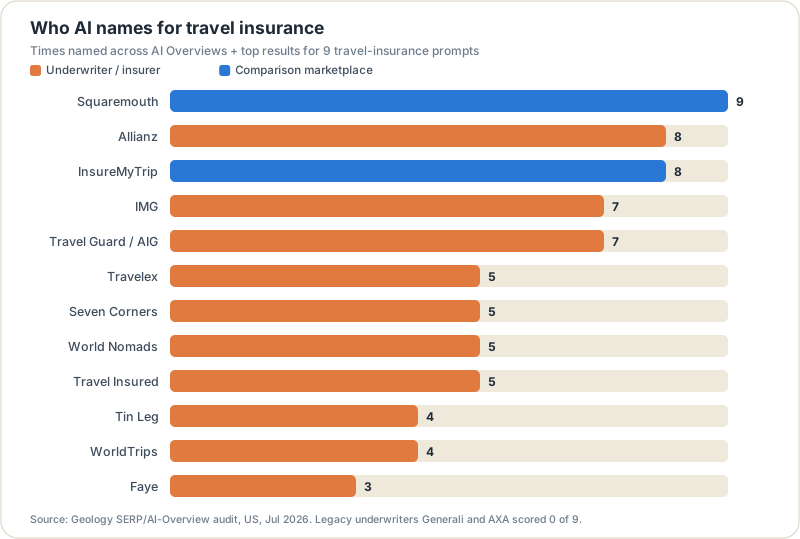
For travel insurance, the AI answer is written on the comparison marketplaces, not on carrier sites. When someone asks ChatGPT, Perplexity, or a Google AI Overview which travel insurance to buy, the engine leans on Squaremouth, InsureMyTrip, and a short list of editorial raters, then names a handful of providers those sources rank. The gap this creates is stark: in our audit of nine US travel-insurance prompts, two large legacy underwriters, Generali and AXA, were named zero times, while a marketplace and a few digital-first brands took almost every answer. So generative engine optimization (GEO) and answer engine optimization (AEO) in this category are not about ranking your own quote page. They are about being accurately present, and well rated, on the third-party surfaces where buyers compare and engines source.
This guide is the practical version of that idea for the US market: the money pages to build, the communities and channels that feed AI answers, where reviews actually come from, and the exact prompts to track. The provider and citation data come from a July 2026 audit of live US AI Overviews and top results, plus current search and coverage data.
Why travel insurance is an AI-search battleground
Travel insurance is a low-frequency, high-anxiety purchase that buyers research right before a trip, and it is dominated by comparison marketplaces that both sell policies and publish the deep content engines trust. That combination produces a specific pattern: the marketplaces get cited as sources and as results, the editorial raters supply the "best of" verdicts, and individual carriers appear only when those third parties name them.
Our audit makes the concentration concrete. Squaremouth appeared in every one of the nine prompts, Allianz and InsureMyTrip in eight, and IMG and Travel Guard in seven. The chart below shows who the engines actually named.
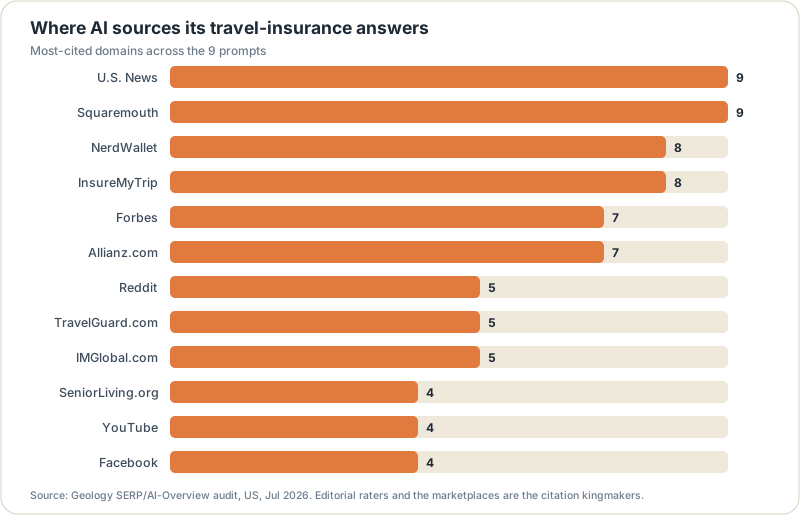
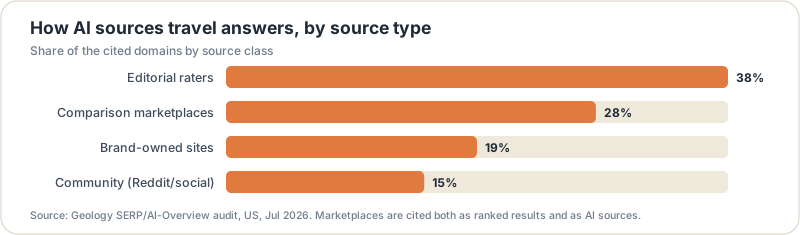
The more useful fact is where those answers came from. U.S. News and Squaremouth were cited in all nine prompts, NerdWallet and InsureMyTrip in eight, Forbes in seven. Carrier-owned domains do earn citations here, Allianz and Travel Guard among them, but they sit below the editorial raters and the marketplaces. Reddit appeared in five of nine, so community proof is a live factor even in this transactional category.
The takeaway for a provider is direct. Generali and AXA are not small companies, yet they were invisible in these answers, which is the clearest possible proof that brand size does not buy AI visibility here. What buys it is accurate presence on the marketplaces and the raters, plus a claims reputation those surfaces reward. The rest of this guide is how.
On-page: the money pages and facts AI needs to read
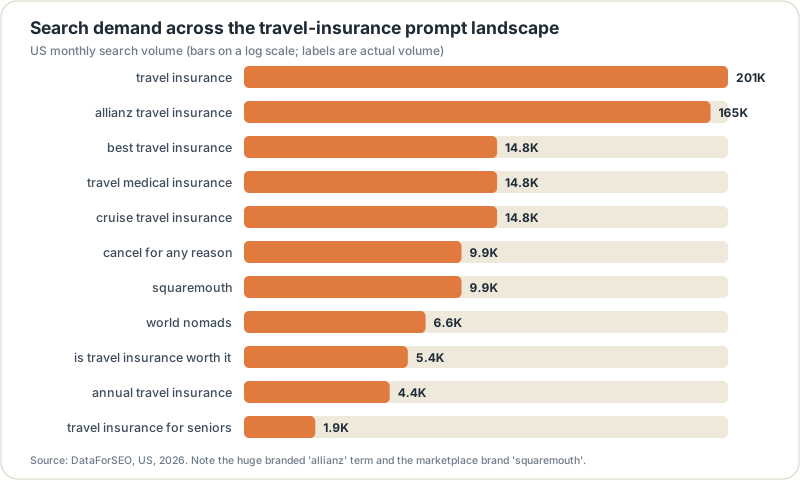
Build the pages that map to how travelers actually shop, then make the facts on them extractable. Search demand is lopsided in an instructive way: the category head and one giant branded term dwarf everything else, which tells you where the volume is and where the specificity is.
The money pages
Travelers self-select by trip type and by coverage question, so structure the site around both:
- Quote and compare pages. The transactional core. If you are a marketplace this is the product; if you are a carrier, it is your plan-detail and get-a-quote flow.
- Coverage explainers. One page per coverage: trip cancellation, trip interruption, emergency medical, emergency evacuation, baggage, travel delay, and the big one buyers search directly, CFAR ("cancel for any reason").
- Trip-type pages. Cruise, senior travelers, family, adventure and sports, study abroad, and visitors to the US. These match real prompts ("best cruise travel insurance" draws roughly 14,800 US searches a month) and are where a focused brand can win.
- Destination and "worth it" content. "Is travel insurance worth it" is a high-volume question the engines answer with editorial and community sources, so it is a content page, not a product page.
- Claims pages. Travel-insurance reputation is built on claims experience, so a clear, honest claims-process page is a trust asset.
Coverage facts AI has to get right
A comprehensive plan bundles the core coverages by default and layers optional upgrades on top. Engines repeat these definitions constantly, especially the CFAR rules, so publish them as clean, labeled facts rather than marketing prose.
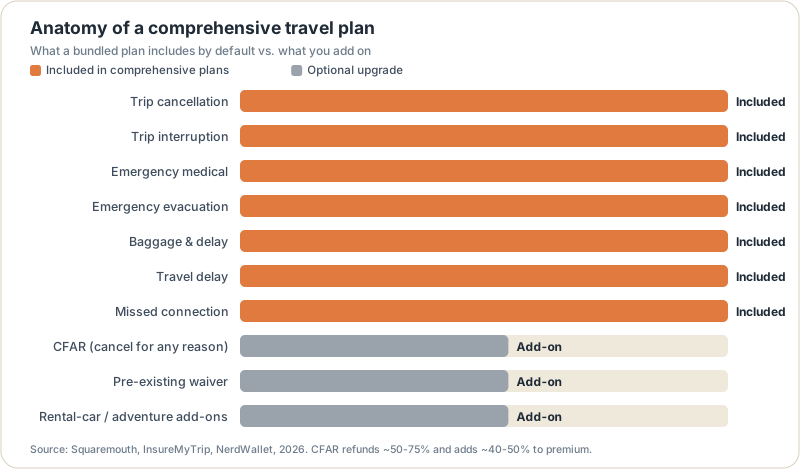
Two facts drive most of the demand and deserve their own accurate pages. First, most US health plans and Medicare do not cover care abroad, and CDC and State Department guidance recommends at least $100,000 in emergency medical and $250,000 in evacuation coverage. Second, CFAR is an optional upgrade with strict rules: it usually must be bought within 14 to 21 days of the initial trip deposit, requires insuring all prepaid nonrefundable costs, must be used at least 48 hours before departure, and reimburses 50 to 75 percent of costs while adding 40 to 50 percent to the premium.
One regulatory note belongs on the site. Travel insurance is regulated by each state, not the federal government, and most states have adopted the NAIC Travel Insurance Model Act, which standardizes definitions and sales practices. Accurate, current coverage language is both the compliant choice and the one engines quote correctly.
The structured data to add, field by field
Schema hands the engine a labeled value instead of prose it has to interpret. For a travel-insurance site, these are the types worth marking up and the fields to populate.
| Schema type | Use it on | Key fields to populate |
|---|---|---|
| InsuranceAgency / Organization | Homepage and about pages | name, url, logo, telephone, sameAs, contactPoint, areaServed |
| Product / Service | Each plan or coverage page | name, description, brand, offers, aggregateRating (third-party only) |
| Offer | Quote and plan-pricing modules | price or priceSpecification, priceCurrency, itemOffered, eligibleCustomerType |
| FAQPage | Coverage, CFAR and claims pages | mainEntity, each Question with name and an acceptedAnswer text |
| Article | Guides, destination and "worth it" content | headline, author, datePublished, dateModified, publisher, mainEntityOfPage |
| BreadcrumbList | Every deep page | itemListElement, each ListItem with position, name and item |
| Review and AggregateRating | Third-party or specific-plan reviews only | author, reviewRating with ratingValue and bestRating, itemReviewed |
Keep the marked-up figure identical to the visible one, and never self-host an AggregateRating about your own company. Google ignores it for stars, and an embedded review widget does not change that.
UGC: where travelers compare notes
Travel insurance has a thinner community layer than auto, but it is real and the engines read it. Reddit was cited in five of our nine prompts, and it splits across a few communities with very different intent.
The dedicated community is r/TravelInsurance_ (with a trailing underscore; the plain handle is inactive, so verify it before you rely on it). Around it sit r/Insurance, where licensed agents explain how claims actually adjudicate, r/travel and r/solotravel for volume (r/solotravel maintains a "Travel Insurance 101" wiki that is a durable, citable reference), r/digitalnomad for long-term medical coverage, and r/churning, where sophisticated buyers weigh whether a credit card's built-in travel protection makes a standalone policy unnecessary. Every one of these bans direct promotion, and Reddit removed public member counts in late 2025, so treat sizes as approximate.
The play is the same as everywhere in GEO: be the genuinely helpful, disclosed answer, not the poster of links. The credit-card question in particular is one an honest brand can own by explaining, accurately, when card coverage is and is not enough.
YouTube
There is no dominant travel-insurance-only channel, which is a content gap. Coverage rides inside two bigger niches: points and credit-card travel, where The Points Guy is the authority on when card protection suffices, and long-term or budget travel, where creators like Nomadic Matt recommend nomad-medical products. Being referenced accurately inside those niches is worth more than a brand channel few people watch.
Reviews: the marketplaces are the review layer
In most insurance lines reviews are a separate trust check. In travel insurance the comparison marketplaces are the review layer, the distribution layer, and the AI-citation layer at the same time, which changes where you invest.
Where influence concentrates
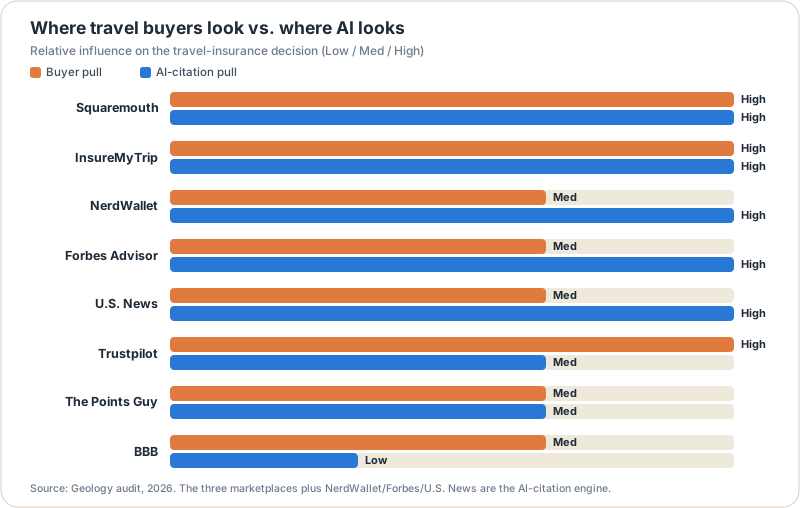
Squaremouth and InsureMyTrip run the actual compare-and-buy flow, publish large libraries of coverage and claims content, and carry tens of thousands of verified reviews. That is exactly what engines pull from for a comparative question. Both also run quality guarantees that cull poorly rated providers: Squaremouth's Zero Complaint Guarantee removes providers that do not resolve legitimate complaints, and InsureMyTrip drops plans below a four-star minimum. So being carried on a marketplace is itself a trust signal, and being dropped is a serious reputational hit. Behind the marketplaces sit the editorial raters, NerdWallet, Forbes Advisor, U.S. News, and the reputation platforms Trustpilot, Google, and BBB.
How to collect reviews without a compliance problem
The rules mirror the rest of insurance. The FTC's 2024 review rule bans fake, incentivized, and gated reviews and prohibits suppressing negatives, with penalties per violation. Google and Trustpilot both require neutral invitations sent to all customers and ban incentives. And because claims reputation attaches to the underwriter, not just the marketplace, the durable move is operational: pay claims fairly and quickly, then let the verified reviews on the marketplaces and Trustpilot reflect it.
First-party versus third-party
A brand's own "we are the best" page is rarely cited for a comparative query, because it cannot be independently verified. The marketplaces and editorial raters can be, so that is where AI sources its answer. Your own site should carry accurate, extractable coverage facts and honest claims content, and a common point of confusion worth pre-empting: the marketplace is not the insurer and cannot pay a claim, which drives a share of the complaints you see. The star-earning effort goes to the marketplaces and Trustpilot, where it counts.
Prompts to track: branded and unbranded
Track the prompt, not the keyword, across ChatGPT, Perplexity, Gemini, Copilot, and Google AI Overviews. Travelers ask by trip type, by coverage, and by intent, and the branded set is where you protect how you are described and catch the invisibility problem Generali and AXA are living.
| Prompt type | Track these prompts | Why it matters |
|---|---|---|
| Unbranded, by intent | best travel insurance, cheapest travel insurance, is travel insurance worth it | The core "which provider" answer; marketplaces and raters own it today |
| Unbranded, by trip type | best cruise travel insurance, best travel insurance for seniors, for a family, for adventure sports | Where a focused brand can win a niche the big underwriters answer generically |
| Unbranded, by coverage | best cancel for any reason travel insurance, best travel medical insurance, best annual multi-trip travel insurance | High-intent, coverage-led buyers with clear needs |
| Unbranded, credit-card angle | is my credit card travel insurance enough, do I need travel insurance if my card covers it | The r/churning question; an honest answer earns trust and citations |
| Branded, reputation | is [brand] good, [brand] reviews, [brand] claims experience | How the engine describes you; catches the Generali and AXA invisibility problem early |
| Branded, comparison | [brand] vs Allianz, [marketplace] vs [marketplace] | The head-to-head answer that decides comparison shoppers |
For each prompt, record two things weekly: whether the engine names you, and whether the coverage, price, and CFAR details it states are accurate. A wrong CFAR rule or medical minimum quoted in your name is both a lost sale and a compliance exposure, so log the prompt, the engine, the wrong detail, and the source it came from, then fix that surface.
The full travel-insurance GEO audit framework
Everything above adds up to one audit. Run it as a scored checklist across nine dimensions, from the machine-readable basics on your own site to the marketplaces and editorial raters that actually write the answer. Score each dimension red, amber, or green and you have a map of where the work is.
| Dimension | What to check | Working signal |
|---|---|---|
| Crawlability and technical | Server-rendered coverage and price facts (not JavaScript-only quotes), sitemap, robots.txt, llms.txt, crawler access for GPTBot, PerplexityBot and ClaudeBot, page speed | Crawlers read your coverage and pricing without executing JavaScript |
| Structured data | Product and Offer, FAQPage, Article, BreadcrumbList; no self-serving AggregateRating; schema matches visible HTML | Rich results validate and engines read labeled values, not prose |
| On-page content | Quote, coverage, trip-type, CFAR, medical and claims pages; current CFAR rules and medical minimums; a page per high-intent prompt | Accurate content exists for every prompt you want to win |
| Marketplace presence | Listed and accurately represented on Squaremouth, InsureMyTrip and TravelInsurance.com; not culled by a complaint guarantee | You are in the compare flow buyers use and the source set AI reads |
| Authority and E-E-A-T | Named authors, clear underwriter and licensing signals, honest claims content | Content carries verifiable expertise for a considered purchase |
| Backlinks | Referring domains from editorial raters, travel media and reputable .org and .gov travel-safety sources; white-hat only | Independent authority the engines vet you by, growing over time |
| Reviews and reputation | Marketplace review volume and rating, Trustpilot and BBB, claims-paying reputation on the underwriter | Third-party ratings the engines trust, earned through claims performance |
| UGC and community | Sentiment in r/TravelInsurance_, r/Insurance and r/solotravel; credible references in points and nomad channels; a disclosed presence | Positive, accurate mentions in the threads and videos engines read |
| Prompt monitoring | Weekly citation share and accuracy across all five engines, for branded and unbranded prompts | You can see movement and catch a misquote the week it appears |
Work the dimensions in that order the first time through. Marketplace presence sits high on the list because in travel insurance it is a prerequisite, not a nice-to-have: the compare flow and the AI source set are the same surface.
What to do next
The order of operations for travel-insurance GEO follows how the answer gets built. First, get listed and accurately represented on the marketplaces and keep a clean complaint record, because that is the compare flow and the AI source set at once. Second, make your own coverage facts current and machine-readable, especially CFAR rules and medical minimums, so the engine that cites you quotes you correctly. Third, win the niche trip-type and coverage prompts with honest, well-structured content, and track your branded prompts weekly so you never discover an invisibility problem too late.
Marketplaces and editorial raters own the default answer today because buyers and engines use the same surfaces to compare. That is exactly why a focused challenger who is well rated on those surfaces can win the trips the big brands treat generically. This is the program we run for carriers, brokers, and insurtech on our insurance GEO and SEO page. If you want to see where you stand right now, run a live audit to pull your brand against competitors on the travel prompts that matter, or read how we approached a regulated insurance vertical in the insurance case study.
FAQ
What is the difference between GEO and AEO for travel insurance?
Generative engine optimization (GEO) is the broad practice of getting your brand named and described accurately inside AI-generated answers. Answer engine optimization (AEO) is the narrower work of structuring your content so an engine can extract a specific fact, like a CFAR rule or a coverage limit, and repeat it correctly. Travel insurance needs both, with an unusual emphasis on being present on the comparison marketplaces the engines source from.
Why does AI mostly recommend marketplaces like Squaremouth for travel insurance?
Because a comparative question is best answered by a source that compares. The marketplaces run the actual side-by-side quote flow and publish large libraries of coverage and claims content, so engines treat them as the reference for "best travel insurance for X." In our audit Squaremouth was named in all nine prompts and cited as a source in all nine.
How can a travel insurer be invisible in AI answers?
Easily. In our July 2026 audit, two large legacy underwriters, Generali and AXA, were named in zero of nine buyer prompts, despite their size. Visibility here comes from accurate presence on the marketplaces and editorial raters and a strong claims reputation, not from brand size or a big ad budget.
Which subreddits matter for travel insurance?
The dedicated community is r/TravelInsurance_ (with a trailing underscore; the plain handle is inactive). Around it, r/Insurance covers claims mechanics, r/travel and r/solotravel provide volume and a citable insurance wiki, r/digitalnomad covers long-term medical, and r/churning debates whether credit-card coverage is enough. All ban direct promotion, so the only durable play is genuine, disclosed help.
Do I need CFAR travel insurance?
It depends on how much cancellation flexibility you want. CFAR is an optional upgrade that refunds 50 to 75 percent of prepaid nonrefundable costs for any reason, but it must usually be bought within 14 to 21 days of your first deposit, requires insuring all nonrefundable costs, and adds 40 to 50 percent to the premium. For travelers who want to cancel for reasons a standard policy would not cover, it can be worth the cost.
Does travel insurance cover medical care abroad?
A comprehensive or travel-medical plan does. This matters because most US health plans and Medicare do not cover care outside the country, so CDC and State Department guidance recommends at least $100,000 in emergency medical coverage and $250,000 in emergency evacuation coverage for international trips.
How long does it take to show up in AI answers for travel insurance?
It varies by engine. Retrieval-based engines like Perplexity and Google AI Overviews can reflect new content and new marketplace listings within days to weeks once crawled. Training-based answers in ChatGPT and Gemini move on the model's release cadence, so those shifts compound over months.
Should I block AI crawlers like GPTBot from my site?
No. Blocking GPTBot, PerplexityBot, or ClaudeBot stops the engines from reading your correct coverage and CFAR details, which makes it more likely they quote a stale figure from another source. Allow the crawlers and focus on being the most accurate, machine-readable source about your own plans.
Is travel insurance regulated the same way in every state?
No. Travel insurance is regulated by each state's Department of Insurance rather than the federal government, though most states have adopted the NAIC Travel Insurance Model Act, which standardizes definitions and sales practices. Keep coverage language accurate and current, because it is both the compliant choice and the version engines quote correctly.
How do I track whether AI recommends my travel-insurance brand?
Track a fixed set of branded and unbranded prompts weekly across ChatGPT, Perplexity, Gemini, Copilot, and Google AI Overviews, and record whether the engine names you and whether the coverage and CFAR details it states are accurate. A live audit is the fastest way to get a first read across all the engines at once.