Content Strategy for AI Engines, Creating Content AI Models Recommend
Why doesn't your content rank in AI answers despite strong SEO, and what kind of content does ChatGPT, Perplexity, and Gemini actually cite?

Your content team published 50 blog posts last quarter. Your domain authority went up. Your organic traffic grew. But when a potential customer asks ChatGPT "What's the best way to improve conversion rates?", your brand isn't mentioned. Not once.
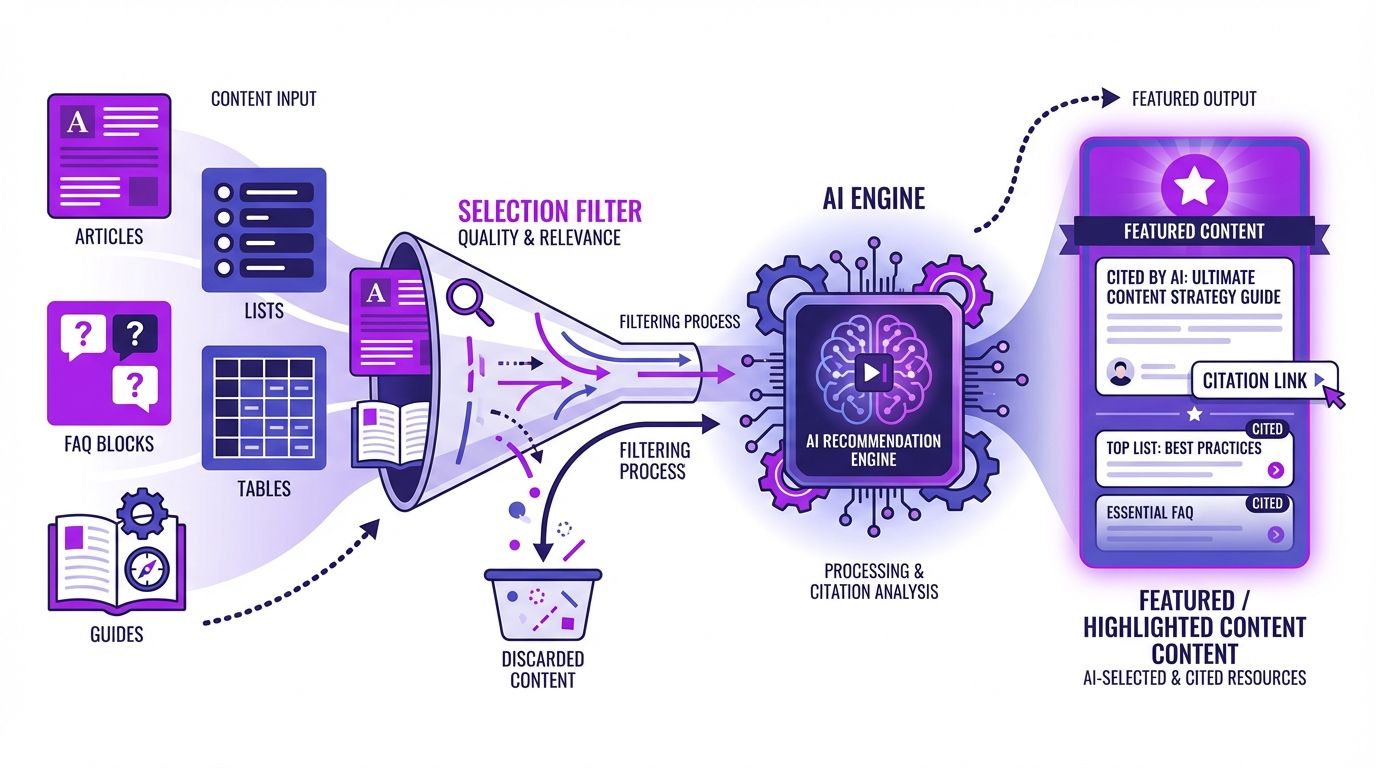
That disconnect is the single biggest gap in most B2B content programs right now. The content strategies that worked for Google's ten blue links don't automatically work for AI-generated answers. AI engines, ChatGPT, Perplexity, Gemini, Copilot, Google AI Overviews, pull from, process, and cite content differently than traditional search engines. And if your content strategy doesn't account for that, you're producing assets that AI models will ignore.
This guide gives you the full framework: how AI models select content to cite, which formats perform best in AI responses, how to build topical authority that AI models trust, and how to structure your content architecture for maximum AI discoverability. Every section includes specific tactics you can put to work this week.
If you want to see where your brand currently stands in AI recommendations, start with a free audit, it takes five minutes and shows you exactly what AI platforms say about you today.
How AI Models Select Content to Cite
Before you can create content that AI models recommend, you need to understand what those models look for when generating a response.
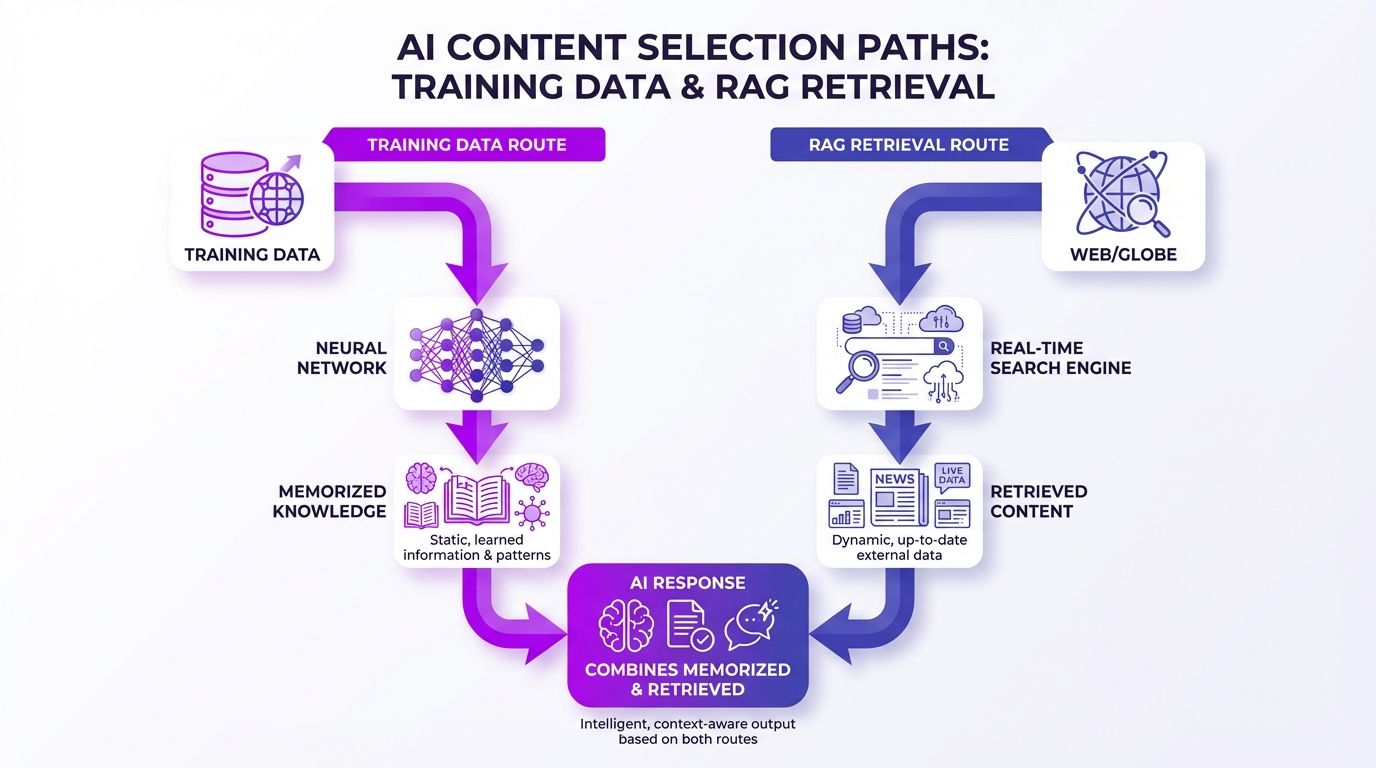
There are two primary mechanisms at play.
Training Data Selection
Large language models like GPT-4 and Gemini are trained on massive datasets scraped from the web. During training, the model learns associations between topics and sources. Brands that appear frequently, consistently, and in authoritative contexts build stronger representations in the model's learned weights.
This means:
- Publishing cadence matters. A brand with 200 well-structured articles across a defined topic area creates a stronger training signal than one with 20 scattered posts.
- Third-party validation amplifies your signal. Reviews, press mentions, analyst reports, and industry citations all feed into the training corpus alongside your own content.
- Recency has diminishing returns in training data. Once a model is trained, it's frozen in time. But the next training run picks up your newer content, so consistency over months and years builds durable presence.
Retrieval-Augmented Generation (RAG)
Many AI platforms don't just rely on training data. Perplexity, Google AI Overviews, and Microsoft Copilot use retrieval-augmented generation (RAG), they search the live web in real time, pull relevant pages, and synthesize answers from what they find.
For RAG-based responses:
- Content must be crawlable and indexable. If search engines can't find your page, neither can RAG systems.
- Freshness matters directly. Unlike static training data, RAG systems prefer recent, updated content.
- Clear, explicit answers get cited. RAG models look for content that directly answers the query, not content that buries the answer under five paragraphs of introduction.
- Structured formatting helps retrieval. Headers, lists, tables, and definition-style content make it easier for the model to extract the specific passage it needs.
Understanding both mechanisms is critical. Your content strategy for AI engines needs to serve both paths: build long-term authority for training data, and create retrieval-friendly content for real-time RAG systems.
Content Formats That Perform Best in AI Responses
Not all content formats are equal in AI-generated answers. AI models have clear preferences, driven by how they process and present information.
We've analyzed thousands of AI responses across ChatGPT, Perplexity, and Gemini to identify which content formats get cited most frequently. Here's what performs best.
Definitions and Concise Explanations
When a user asks "What is X?", AI models look for content that provides a clear, authoritative definition within the first 1-2 sentences of a section. If your content defines a term buried in paragraph six, the model will skip you and cite someone who leads with the answer.
Tactic: For every key term in your domain, create a dedicated section (or page) that opens with a 1-2 sentence definition, followed by supporting detail. Front-load the answer.
Structured Lists and Step-by-Step Guides
AI responses overwhelmingly use list formats. When a user asks "How do I do X?" or "What are the best ways to Y?", models prefer source content that's already structured as numbered steps or bullet points.
- Numbered lists for sequential processes
- Bullet lists for non-sequential options or features
- Comparison lists for "A vs. B" queries
Tactic: Convert your paragraph-heavy how-to content into explicit step-by-step formats. Each step should have a clear heading or bold lead-in and a 1-2 sentence explanation.
Tables and Comparison Matrices
For "best of" and comparison queries, AI models frequently pull from pages that contain comparison tables. A well-structured table with clear column headers gives the model exactly what it needs to generate a comparison response.
Tactic: Add comparison tables to your commercial-intent content. Include your product alongside competitors with objective feature breakdowns. Honest, data-backed comparisons signal authority.
FAQ-Style Question and Answer Pairs
FAQ content maps directly to how users query AI platforms. A question formatted as an H2 or H3, followed by a concise answer, is one of the most retrievable content patterns for both training data and RAG.
Tactic: Build FAQ sections into every major content piece. Use actual questions your audience asks, pull them from sales calls, support tickets, and forum threads, not just keyword tools.
How-To Content with Explicit Outcomes
AI models favor content that states the outcome up front and then delivers the steps. "Here's how to reduce your bounce rate by 30%" is more citable than "Understanding Bounce Rates: A Deep Exploration."
Tactic: Frame every how-to piece around a specific, measurable outcome. Put the outcome in the title and the opening paragraph.
Building Topical Authority That AI Models Trust
AI models don't evaluate content in isolation. They assess whether a source has topical authority, a demonstrated depth and breadth of coverage across a subject area.
A single blog post on "email marketing tips" won't get you cited as an email marketing authority. But 30 interconnected pieces covering email strategy, deliverability, automation, segmentation, A/B testing, and platform comparisons will.
Here's how to build topical authority systematically.
Define Your Authority Domains
Start by identifying 3-5 topic areas where your brand needs to be the recognized expert. These should align with your product's value proposition and your customers' highest-intent queries.
For each authority domain:
- List every subtopic a buyer might research
- Map those subtopics to specific content pieces
- Identify gaps where you have no content (or weak content)
- Prioritize based on query volume and competitive gaps
Publish Depth, Not Just Volume
Topical authority isn't about publishing more. It's about publishing with enough depth that an AI model can confirm your expertise through multiple signals.
- Go specific. "How to Set Up Email Authentication for Improved Deliverability" beats "Email Marketing Best Practices."
- Cover edge cases. The content that addresses niche scenarios within a topic signals deep expertise.
- Update existing content. AI models weigh content freshness. A 2024 post updated with 2026 data sends a stronger signal than an untouched archive.
Earn External Validation
Your own content is only part of the equation. AI models also look at how often other authoritative sources reference your brand.
- Guest posts on industry publications
- Being cited in analyst reports or benchmark studies
- Reviews on trusted third-party platforms
- Mentions in relevant communities, forums, and discussions
Every external mention adds another data point that reinforces your topical authority in model training data.
Geology's GEO optimization services include authority signal analysis, we track how your brand appears across the sources AI models pull from and identify where the gaps are.
Pillar-Cluster Architecture for GEO
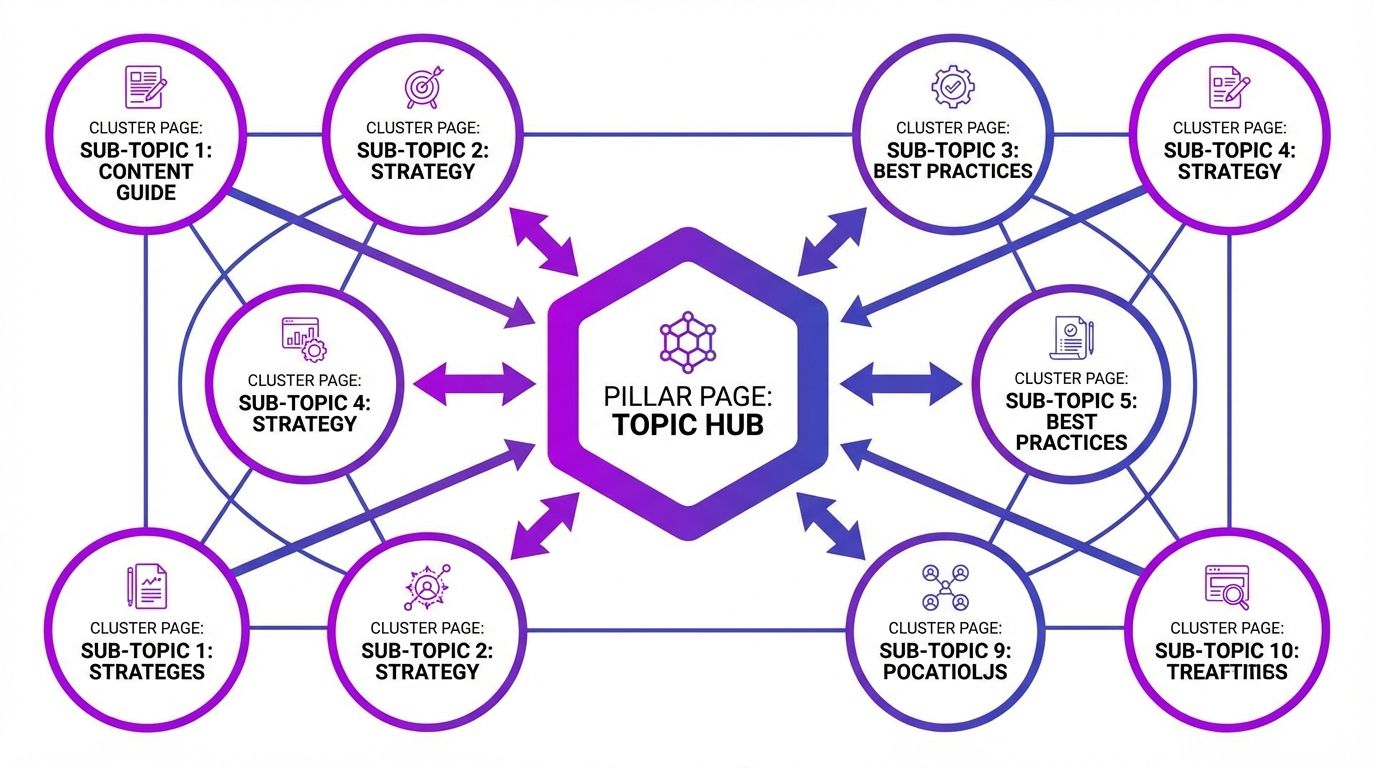
The most effective content structure for AI discoverability is the pillar-cluster model, and it works for a specific reason. AI models are better at recognizing topical authority when your content is organized into clear, interlinked topic hierarchies.
What Pillar-Cluster Means for AI
A pillar page is a high-level, in-depth resource on a broad topic. Cluster pages are focused articles that cover specific subtopics in detail. Internal links connect the cluster pages back to the pillar and to each other.
For AI models, this architecture does three things:
- Signals topic coverage. The model can trace a web of related content, confirming your authority across the full topic area.
- Creates multiple retrieval entry points. Each cluster page can be individually retrieved by RAG systems for specific queries, while the pillar page serves broader queries.
- Reinforces semantic relationships. Internal links with descriptive anchor text help models understand how your content pieces relate to each other.
How to Build Your Pillar-Cluster System
Step 1: Choose your pillar topic. This should be a broad, high-value topic that your audience actively searches for. Example: "Generative Engine Optimization" (like our complete guide to GEO).
Step 2: Map 8-15 cluster topics. Each cluster should cover a distinct subtopic that ties back to the pillar. Make sure no two clusters overlap significantly.
Step 3: Create the pillar page first. Write a thorough guide (3,000+ words) that covers the topic broadly and links out to cluster pages for deeper dives.
Step 4: Build cluster pages systematically. Publish 2-3 cluster pages per week. Each cluster page should:
- Target a specific long-tail query
- Link back to the pillar page
- Link to 1-2 related cluster pages
- Provide a definitive answer within its subtopic
Step 5: Interlink aggressively. Every cluster page links to the pillar. The pillar links to every cluster. Sibling clusters link to each other where the connection is natural. Use descriptive anchor text, not "click here."
Measuring Pillar-Cluster Effectiveness
Track these metrics monthly:
- AI mention rate for pillar-topic queries, is your brand appearing more often?
- Citation diversity, are multiple cluster pages getting cited, or just the pillar?
- Topical coverage score, how many subtopics in your domain have dedicated, updated content?
- Internal link depth, how many clicks from any page to any other page in the cluster?
Geology's content strategy services help you design and execute pillar-cluster architectures specifically optimized for AI discoverability.
Writing Content for RAG Retrieval
If your content can't be easily parsed by a RAG system, it won't get cited, even if it's the best resource on the topic. Here are the specific writing patterns that maximize retrieval.
Lead with the Answer
Every section of every page should open with the key takeaway. AI retrieval systems scan for passages that directly answer the query. If your answer is buried after three paragraphs of context-setting, the model will cite a competitor who gets to the point faster.
Pattern: Question-framed heading → Direct answer in the first sentence → Supporting evidence → Examples.
Use Descriptive Headings
Your H2 and H3 headings serve as retrieval markers. RAG systems use headings to identify relevant sections within a page. A heading like "Key Metrics" tells the model nothing. A heading like "Five Metrics That Predict AI Visibility Performance" tells it exactly what's in that section.
- Match headings to actual user queries where possible
- Include the specific topic in every heading, don't rely on context from the page title
- Use H2 for major topic sections, H3 for specific points within those sections
Write Self-Contained Sections
Each H2 section should make sense on its own, without requiring the reader (or the AI model) to have read everything above it. RAG systems extract individual passages, not full pages. If your section only works in context, it won't get retrieved effectively.
Test: Copy any H2 section out of the page and read it in isolation. Does it still make sense? Does it answer a specific question? If not, add the necessary context.
Include Explicit Data Points
AI models prefer to cite content that includes specific numbers, dates, percentages, and named sources. Vague claims like "many companies have seen improvements" are weaker retrieval candidates than "companies using structured FAQ content saw a 34% increase in AI citation rates."
- Cite your data sources
- Use specific numbers over ranges when possible
- Date your data points so models can assess freshness
Optimize for Featured Passage Length
RAG systems typically extract passages of 50-150 words. Your key answer paragraphs should fall within this range. Too short and there's not enough context. Too long and the model may truncate or skip the passage entirely.
Content Refresh Strategy for AI Model Updates
AI models are retrained periodically. Between training runs, your content's influence on training data is frozen. But each new training cycle is an opportunity, or a risk.
Why Content Freshness Matters
- RAG systems prioritize recent content. A page updated last month outranks a page last updated in 2024 for real-time retrieval.
- New training runs pick up recent content. Content published or updated between training cycles gets incorporated into the next model version.
- Outdated content can hurt you. If your content references outdated stats, deprecated tools, or old pricing, AI models may flag it as unreliable and deprioritize it.
Build a Refresh Calendar
Set up a quarterly content refresh cycle:
- Audit all published content for accuracy, are stats current? Are referenced tools still active? Are recommendations still valid?
- Update high-performing pages first, prioritize content that's already being cited or has strong organic traffic.
- Add new sections to existing content, expanding a 2,000-word piece to 3,000 words with new subtopics and fresh data sends a strong freshness signal.
- Re-publish with updated dates, change the publication date only when substantial updates are made (not for minor edits).
- Track the impact, monitor AI citation rates before and after refreshes to measure the effect.
Align Refreshes with Model Update Cycles
Major AI platforms announce model updates on rough schedules. When a new model version drops:
- Check your existing content against new AI responses, has your visibility changed?
- Identify content that was previously cited but now isn't, it likely needs updating
- Monitor competitor mentions, if they moved up, study what changed in their content
This is where ongoing monitoring with a tool like Geology gives you a decisive advantage. Instead of guessing, you can see exactly how each model update affected your brand's visibility.
What to Do Next
Content strategy for AI engines isn't a one-time project. It's an ongoing program that requires the right structure, consistent execution, and continuous measurement.
Here's where to start:
- Audit your current state. Run a free AI visibility audit to see which AI platforms mention your brand today, which ones don't, and what they're saying.
- Map your topical authority gaps. Identify the topics where you need to be the recognized expert but currently have thin or no coverage.
- Restructure existing content. Apply the formatting and writing patterns from this guide to your top 10 pages, lead with answers, use descriptive headings, add FAQ sections.
- Build your first pillar-cluster. Choose your most important topic area and build a pillar page with 8-10 cluster pages over the next 60 days.
- Set up ongoing monitoring. Track your AI mention rate monthly. Geology's platform automates this across ChatGPT, Perplexity, Gemini, Copilot, and Google AI Overviews.
The brands winning AI visibility right now aren't necessarily the biggest. They're the ones with the most structured, authoritative, and consistently updated content. That's a playing field you can compete on, starting today.