E-Commerce and AI Shopping, Capturing the AI-Driven Buyer
When shoppers ask AI for product recommendations, what makes ChatGPT, Perplexity, or Copilot pick your products over a competitor's?

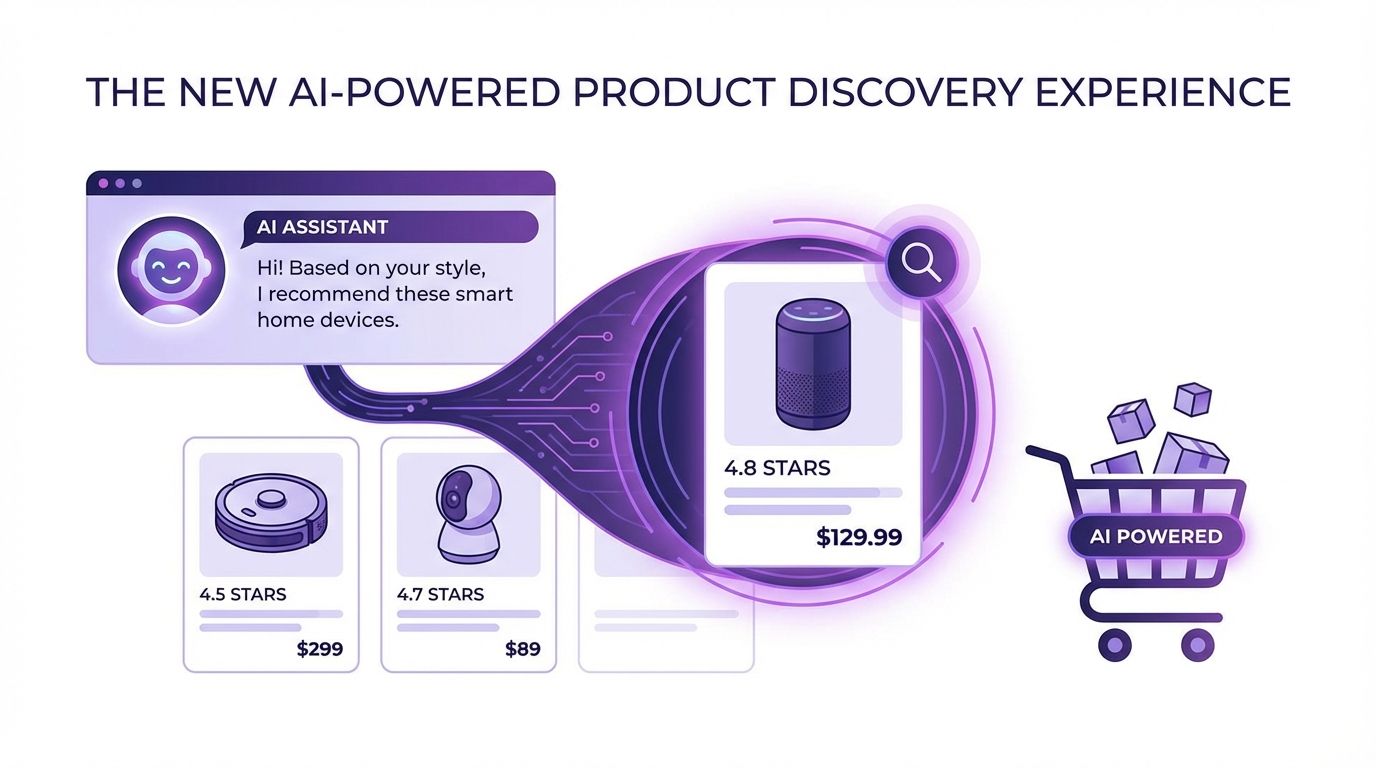
A shopper asks ChatGPT: "What's the best running shoe for flat feet under $150?" The AI names three brands. Yours isn't one of them. That buyer never visits your site, never sees your reviews, never adds your product to cart. The sale is lost before it started, and you didn't even know you were competing.
This is the new reality for e-commerce. AI shopping assistants, ChatGPT, Perplexity, Google AI Overviews, Microsoft Copilot, are becoming the first stop for product research. They don't return ten blue links. They give direct answers with specific product recommendations. And those recommendations are driven by signals most e-commerce brands aren't optimizing for.
This guide breaks down exactly how AI shopping assistants decide which products to recommend, what you need to change on your product pages, how to handle reviews and pricing signals, and how to measure the revenue impact. If you sell products online, this is the playbook for the next era of product discovery.
For a broader primer on how AI-driven shopping behavior works, see our breakdown of the AI shopping journey from question to cart.
How AI Shopping Assistants Rank and Recommend Products
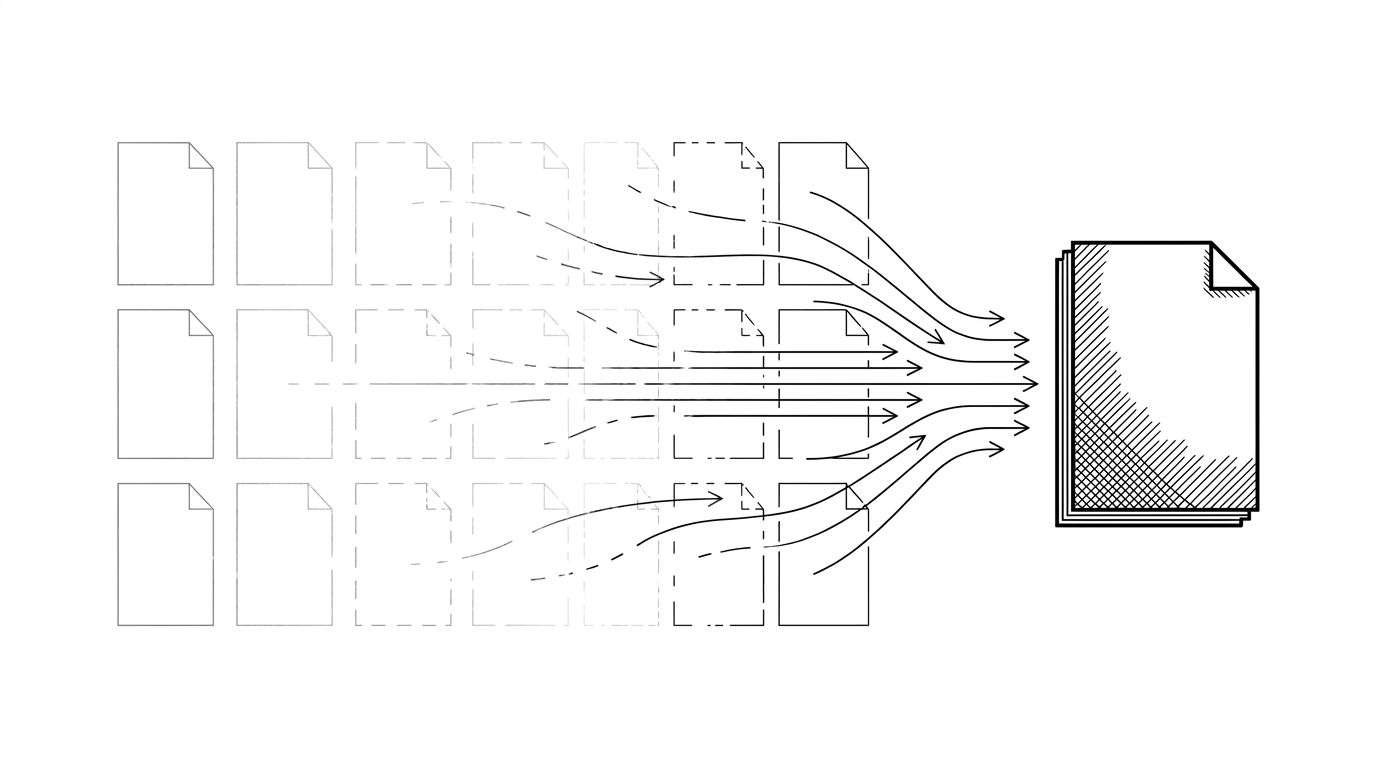
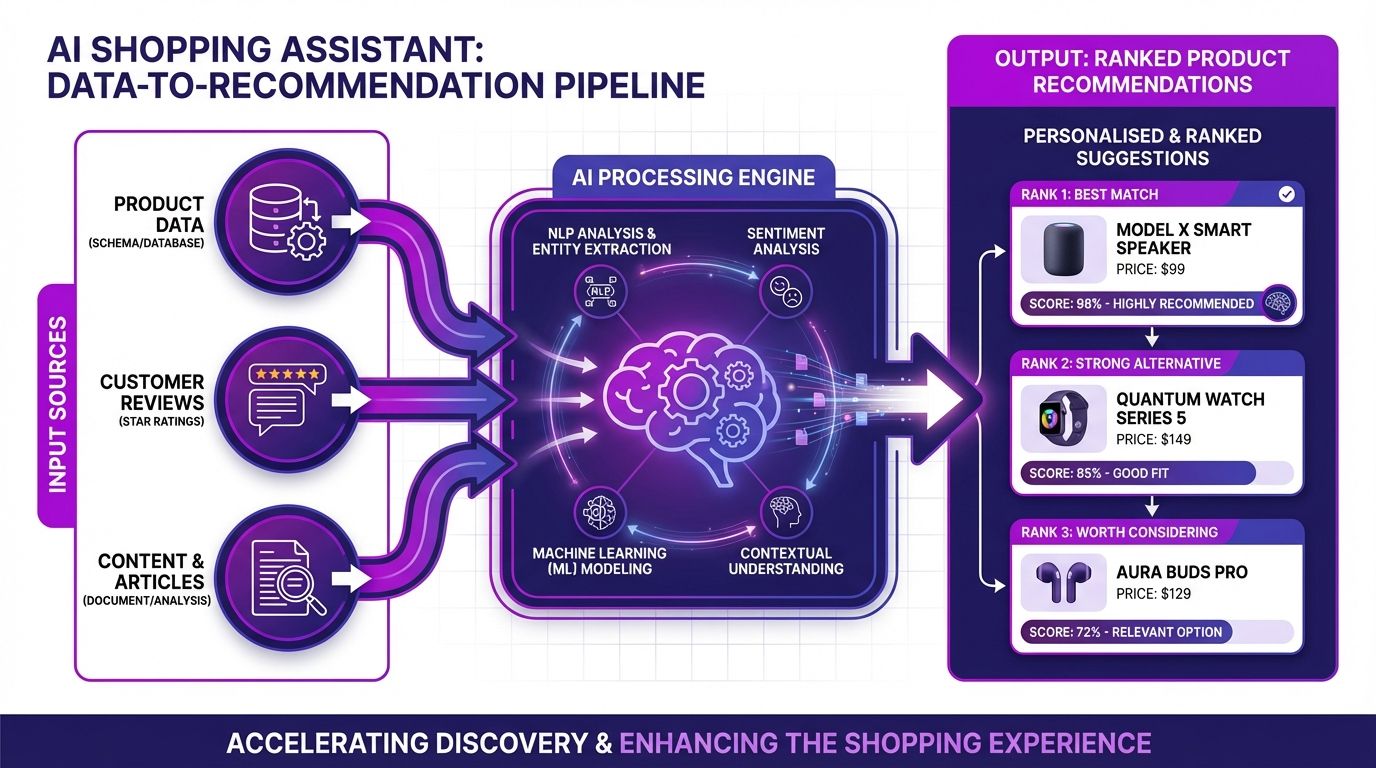
AI shopping assistants don't work like Google Shopping or Amazon's search algorithm. They synthesize information from across the web, your product pages, third-party reviews, comparison articles, forums, structured data, and generate a single, curated answer.
Understanding how they pick winners is the foundation of e-commerce GEO.
The Signals That Drive Product Recommendations
AI models evaluate products across several signal categories:
- Structured product data: Schema markup, clear specifications, consistent naming conventions across your catalog
- Third-party validation: Review volume and sentiment on platforms like G2, Trustpilot, Reddit, and niche review sites
- Content authority: How often your brand and products are mentioned in buying guides, comparison articles, and expert roundups
- Price-value positioning: Whether your product's pricing is clearly stated and competitive within its category
- Recency: Fresh content, recent reviews, and updated product information signal active, trustworthy brands
Platform-Specific Differences
Not all AI platforms weight these signals equally:
- ChatGPT leans heavily on training data, brands with strong historical content signals and widespread mentions get recommended more often
- Perplexity uses real-time web retrieval, making fresh content and crawlable product pages essential
- Google AI Overviews pulls from its existing search index, so traditional SEO signals still carry weight alongside GEO factors
- Microsoft Copilot integrates Bing's index with enterprise context, making it particularly relevant for B2B e-commerce
The takeaway: you can't optimize for just one platform. Your product data and content strategy need to send consistent signals everywhere.
Product Page Optimization for AI Discovery
Your product pages are the single most important asset in AI-driven e-commerce. If an AI assistant can't parse your product data cleanly, your products won't make it into recommendations, regardless of how good they are.
Structured Data Is Non-Negotiable
Product schema markup tells AI models exactly what your product is, what it costs, how it's rated, and whether it's in stock. Without it, you're forcing AI to guess, and AI guesses wrong more often than you'd like.
Every product page needs:
- `Product` schema with name, description, brand, SKU, and GTIN
- `Offer` schema with price, currency, availability, and condition
- `AggregateRating` schema with review count and average score
- `Review` schema for individual product reviews
- `BreadcrumbList` schema for category context
Write Product Descriptions That AI Can Extract
AI models prefer descriptions that are specific, factual, and structured. Vague marketing copy ("Experience ultimate comfort!") gets ignored. Clear specifications and use-case framing get picked up.
What works:
- Lead with the product's primary use case and target user
- Include specific measurements, materials, and technical specs
- State what problems the product solves in plain language
- Compare against common alternatives ("Unlike foam-based options, this uses gel cushioning for all-day support")
What doesn't work:
- Keyword-stuffed descriptions written purely for old-school SEO
- Walls of text without clear structure
- Marketing superlatives without supporting details
- Identical descriptions across product variants
Category Pages Matter Too
AI assistants often respond to category-level queries ("best wireless earbuds for working out") rather than specific product searches. Your category pages need to function as authoritative buying guides, not just product grids.
- Add editorial content to category pages, a short buying guide, key features to compare, and top picks
- Use clear, descriptive H1 and H2 headings that match how people ask questions
- Include internal links to your best-reviewed and best-selling products within each category
For a full breakdown of GEO fundamentals, see our complete guide to Generative Engine Optimization.
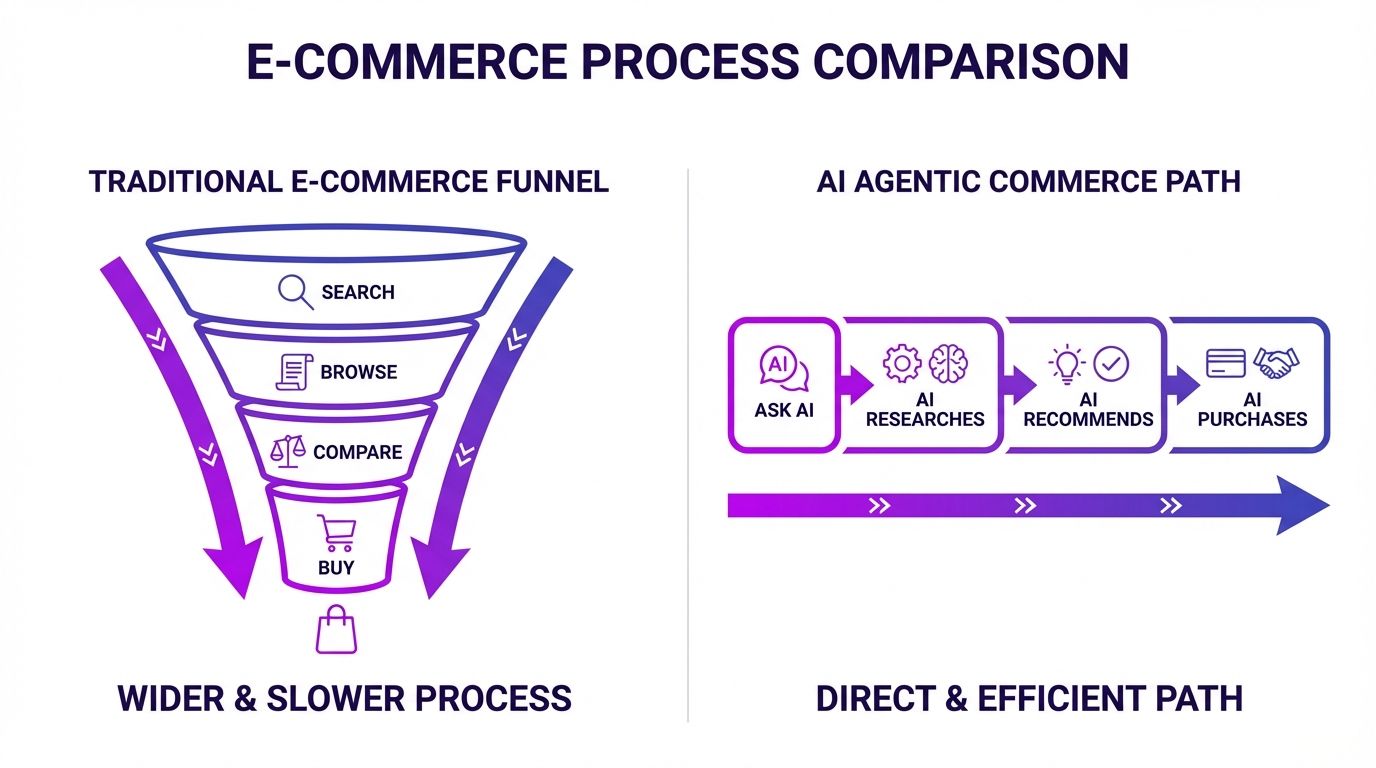
The Rise of Agentic Commerce
Agentic commerce is the next phase of AI shopping, where AI assistants don't just recommend products but actually complete purchases on behalf of users. OpenAI's Operator, Google's shopping integrations, and emerging AI browser agents are moving toward a world where the AI does the buying.
This changes the optimization equation entirely.
What Agentic AI Looks For
When an AI agent is tasked with making a purchase, it evaluates products with machine-like precision:
- Clear pricing with no hidden fees: Agents need unambiguous total costs. Surprise shipping charges or unclear pricing tiers cause agents to abandon your product.
- Frictionless purchase paths: Every extra step, popup, or interstitial between product page and checkout is a barrier. Agents favor stores with clean, fast checkout flows.
- Machine-readable product attributes: Structured data isn't optional, it's how agents compare products across stores in milliseconds.
- Stock availability signals: Real-time inventory data prevents agents from recommending out-of-stock products.
Preparing Your Store for AI Agents
To get ahead of agentic commerce:
- Implement complete product schema with real-time pricing and availability
- Simplify your checkout to minimize steps and eliminate unnecessary friction
- Ensure your site is fully crawlable with no JavaScript-rendered content hidden from bots
- Publish a machine-readable product feed (Google Merchant Center, structured sitemaps)
- Maintain consistent product identifiers (GTINs, MPNs) across all channels
Brands that prepare now will own the agentic commerce channel. Those that wait will watch AI agents route buyers to competitors with cleaner data.
Review Signals and Their Influence on AI Recommendations
Product reviews are the most underestimated GEO signal in e-commerce. AI models treat reviews as a proxy for product quality, reliability, and fit, much like a human shopper would, but at scale.
How AI Models Process Reviews
AI doesn't just count stars. It reads and synthesizes review content across multiple platforms:
- Sentiment analysis: Models evaluate whether reviews express positive, negative, or mixed sentiment about specific product attributes
- Consistency across platforms: A product with 4.5 stars on your site but 3.2 stars on Amazon sends a conflicting signal
- Review recency: Products with recent reviews rank higher than those with reviews from two years ago
- Review specificity: Detailed reviews that mention specific features, use cases, and comparisons carry more weight than "Great product!" one-liners
Building a Review Strategy for AI Visibility
Your review strategy should optimize for both volume and quality:
- Diversify review platforms: Don't concentrate all reviews on your own site. Build presence on Google Reviews, Trustpilot, Reddit, and industry-specific review sites
- Encourage detailed reviews: Post-purchase emails that ask specific questions ("How does it fit?" "What do you use it for?") generate more useful review content than generic "Leave a review" prompts
- Respond to reviews publicly: AI models see your responses. Thoughtful responses to negative reviews signal brand accountability.
- Monitor review sentiment across platforms: Use a tool like Geology to track how AI platforms interpret your review signals and adjust accordingly
The Reddit Factor
Reddit has become a major input source for AI models. Threads like "Best budget headphones 2026 Reddit" generate AI responses that pull directly from Reddit discussions. If your products are getting recommended in relevant subreddits, that signal feeds into AI recommendations.
You can't fake Reddit presence, the community will push back. But you can ensure your products are good enough that real users advocate for them, and you can participate authentically in relevant communities.
Price Comparison Optimization and D2C Strategy
When a shopper asks an AI assistant to compare products, pricing clarity is a decisive factor. AI agents need to extract and compare prices accurately, and ambiguity kills your chances.
Pricing Signals That AI Reads
- Explicit price on the page: If your price requires a configurator, account creation, or "Contact sales" click, AI can't extract it. For consumer products, state the price clearly.
- Price-to-value framing: AI models pick up on content that explains why a product costs what it does. "Premium materials and a 5-year warranty justify the higher price point" gives the model context.
- Sale and discount data: Structured `Offer` schema with `priceValidUntil` helps AI recommend your products during promotional periods.
- Free shipping thresholds: Clearly stated shipping policies reduce total-cost ambiguity.
D2C Brands: The AI Visibility Advantage
Direct-to-consumer brands have a structural advantage in AI shopping, if they play it right. Unlike marketplace sellers who share a product page with competitors, D2C brands control their entire content ecosystem.
Here's how to use that advantage:
- Own your product narrative: Create detailed content about your manufacturing process, materials sourcing, and quality standards. AI models use this to differentiate your brand from commodity alternatives.
- Build comparison content: Publish honest comparisons between your product and alternatives. "Our running shoe vs. Nike Pegasus" content gives AI models the context to recommend you in competitive queries.
- Invest in brand mentions outside your site: Guest posts, expert roundups, and partnerships with content creators build the third-party signals that AI trusts more than self-published claims.
- Use your blog as a buying guide engine: Every product category should have a supporting blog post that answers the top 5-10 questions buyers ask. These posts become source material for AI responses.
Explore how Geology's e-commerce solution helps D2C and multi-channel brands track and improve AI visibility across product categories.
Measuring AI-Driven E-Commerce Revenue
You can't improve what you can't measure. And right now, most e-commerce brands have zero visibility into how much revenue AI shopping assistants drive, or cost them.
The Metrics That Matter
Track these metrics to understand your AI shopping performance:
- AI visibility score: What percentage of relevant product queries mention your brand in AI responses? Track this across ChatGPT, Perplexity, Gemini, and AI Overviews.
- AI sentiment by product: Is the AI characterizing your products positively or surfacing known complaints?
- AI referral traffic: Traffic from AI platforms (identifiable via referral headers and UTM patterns) to your product pages and how it converts.
- Category-level visibility: For each product category you compete in, how often do AI assistants recommend your products versus competitors?
- Share of AI recommendation: Among the brands an AI mentions for a given query, what's your share? Are you mentioned first, last, or not at all?
Attribution Challenges and Workarounds
AI-driven purchases often look like direct traffic or branded search in your analytics. The shopper asks ChatGPT, gets a recommendation, then types your brand name into Google. Your analytics credits Google organic or direct, but the AI made the sale.
To close this attribution gap:
- Track AI-specific referral patterns in your analytics platform. Perplexity and some ChatGPT integrations pass referral data.
- Monitor branded search volume changes alongside AI visibility changes. If branded searches spike after AI visibility improves, the correlation is your signal.
- Use Geology's analytics to connect AI visibility data with revenue outcomes across your product catalog.
- Run controlled tests: Optimize one product category for AI visibility, leave another as a control. Measure the revenue delta over 60-90 days.
What to Do Next
AI shopping assistants are already influencing billions in e-commerce spending. The brands winning in this channel aren't the biggest, they're the ones with the cleanest data, the strongest review signals, and the most AI-readable product content.
Here's your action plan:
- Audit your product schema, ensure every product page has complete, accurate structured data
- Map your AI visibility, find out which product queries mention your brand and which don't
- Fix your review signals, diversify platforms, encourage detailed reviews, respond publicly
- Prepare for agentic commerce, simplify checkout, publish machine-readable product feeds, maintain real-time inventory data
- Measure what matters, track AI referral traffic, visibility scores, and category-level share of recommendation
Start with a free AI visibility audit to see exactly where your products stand across ChatGPT, Perplexity, Gemini, and Google AI Overviews. You'll get a clear picture of which product categories are visible, which are invisible, and what to fix first.