GEO by Industry, Vertical Strategies for AI Visibility
What does AI visibility look like for SaaS, ecommerce, agencies, or local businesses, and how does the GEO playbook change by industry?

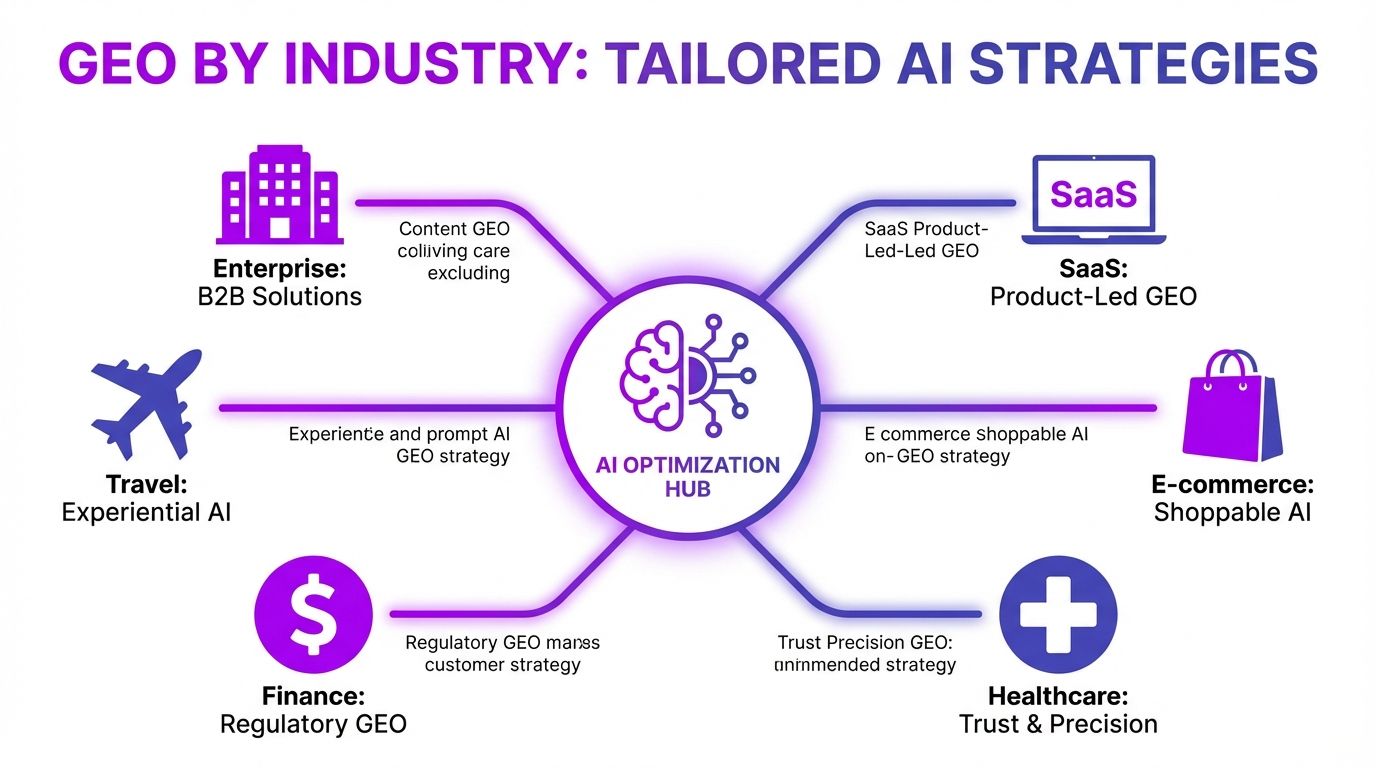
A SaaS company optimizing for AI visibility has almost nothing in common with a local dental practice doing the same. The queries are different. The platforms that matter are different. The content signals that drive recommendations are different. Yet most AI optimization advice treats every business the same, generic checklists that ignore the specifics of how each industry actually gets discovered through AI.
That's a problem. Generative Engine Optimization (GEO) works differently depending on what you sell, who you sell to, and where your buyers go for answers. A B2B enterprise software company needs to show up when procurement teams ask Copilot for vendor comparisons. An e-commerce brand needs to appear when shoppers ask ChatGPT for product recommendations. A startup needs to build brand signals from zero, fast.
This guide breaks down GEO strategies by industry, specific tactics, query types, platform priorities, and content plays that actually move visibility for each vertical. If you've read the complete guide to GEO, consider this the applied version.
SaaS, Winning the Recommendation Layer
SaaS buyers research differently than almost any other segment. They ask AI platforms to compare tools, evaluate features, and shortlist vendors, often before they ever visit your website. When a VP of Marketing asks ChatGPT "What are the best SEO tools for mid-market companies?", the answer typically names three to five products. If yours isn't listed, you've lost a deal you never knew existed.
Query Types That Matter
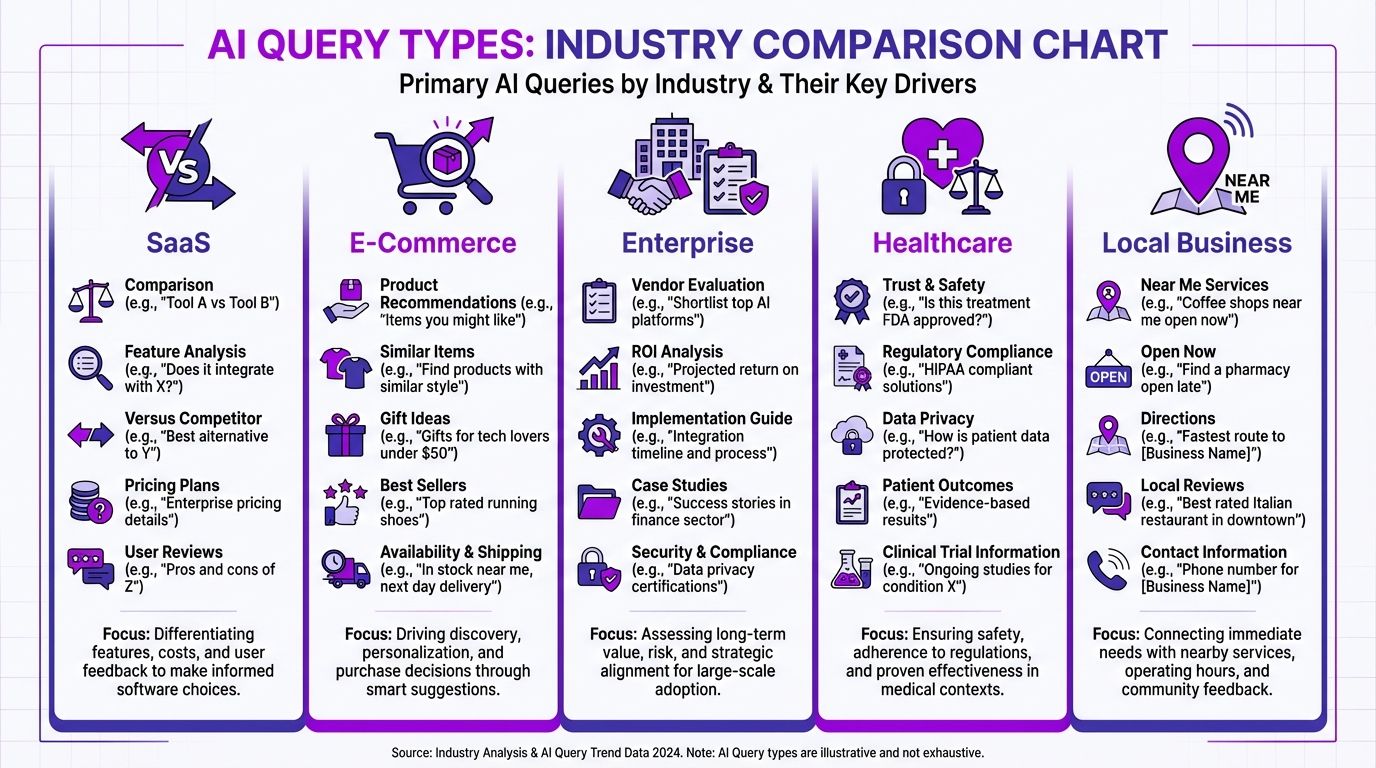
SaaS-related AI queries fall into predictable categories:
- Category comparisons: "Best [category] tools for [company size/industry]"
- Head-to-head evaluations: "[Tool A] vs [Tool B]"
- Use-case specific: "What tool should I use for [specific workflow]?"
- Problem-solution: "How do I [solve X problem] for my team?"
Each of these has different content requirements. Comparison queries need structured feature data. Head-to-head queries need honest positioning content. Use-case queries need detailed workflow documentation.
Tactics for SaaS GEO
- Build structured comparison content on your site, feature matrices, pricing breakdowns, and use-case mappings that AI models can extract cleanly
- Invest in third-party presence on G2, Capterra, and TrustRadius. AI models pull heavily from review aggregators when making software recommendations
- Create integration documentation, every integration partner is a signal that strengthens your relevance for adjacent queries
- Publish benchmark data, original research with specific numbers gets cited by AI models far more than opinion pieces
The platforms that matter most for SaaS are ChatGPT, Perplexity, and Google AI Overviews. Copilot is growing fast in enterprise contexts. Prioritize accordingly.
For a deeper look at how this plays out for software companies, see Geology's SaaS solution.
E-Commerce, Showing Up in the AI Shopping Journey
AI shopping is no longer a concept, it's happening at scale. ChatGPT's shopping features, Perplexity's product recommendations, and Google AI Overviews with product cards are reshaping how consumers discover and evaluate products. The brands that show up in these responses capture demand at the exact moment of intent.
How E-Commerce AI Queries Differ
E-commerce queries are more transactional and product-specific than any other vertical:
- Product discovery: "Best running shoes for flat feet under $150"
- Gift and occasion: "Anniversary gift ideas for someone who loves cooking"
- Replacement and upgrade: "Best alternative to [specific product]"
- Review synthesis: "Is [product] worth the price?"
The key difference: AI models don't just cite brands for e-commerce, they cite specific products, prices, and availability. The data requirements are much more granular.
Tactics for E-Commerce GEO
- Structured product data is non-negotiable, schema markup (Product, Offer, Review, AggregateRating) feeds directly into AI responses. Products without structured data are invisible
- Optimize product descriptions for specificity, "lightweight trail running shoe with 4mm drop and Vibram outsole" beats "great running shoe for outdoor adventures"
- Build review volume and diversity, AI models use review data as a primary signal for product recommendations. More reviews with specific detail means more AI mentions
- Create buying guides and comparison content, "Best [category] for [use case]" pages feed AI recommendation queries directly
- Monitor AI product recommendations weekly, the e-commerce AI space shifts faster than any other vertical
Platforms to watch: ChatGPT (with its shopping integration), Google AI Overviews (product cards), and Perplexity (product research). See how Geology tracks this for retail brands at E-Commerce solutions.
Enterprise, Brand Control at Scale
Enterprise GEO isn't about getting more mentions. It's about controlling how AI platforms represent your brand, ensuring accuracy, and managing reputation across every model that might surface your name.
When a procurement team asks Copilot "Which cloud providers are SOC 2 compliant with FedRAMP authorization?", the answer needs to be accurate. Wrong information in an AI response about your compliance certifications or capabilities isn't just a marketing problem, it's a business risk.
Enterprise-Specific Challenges
- Multi-product complexity: AI models often confuse product lines or attribute features from one product to another
- Accuracy requirements: Compliance claims, certifications, and technical specs must be correct in AI responses
- Stakeholder variety: Different buyers within the same organization ask different types of questions
- Competitive positioning: Enterprise deals are often won or lost based on how AI platforms frame head-to-head comparisons
Tactics for Enterprise GEO
- Audit AI responses for factual accuracy first, before optimizing for visibility, fix any incorrect information AI models are sharing about your brand
- Create authoritative technical content, whitepapers, compliance documentation, and architecture guides that AI models can reference for accurate claims
- Build executive thought leadership, AI models weight content from named executives at known companies when responding to industry-level queries
- Maintain a structured knowledge base, FAQ pages, product documentation, and capability matrices give AI models clean data to extract
- Monitor competitor representation, track how AI platforms position your competitors' products against yours
Enterprise GEO is a long game. The payoff is that once AI models accurately represent your brand, that representation tends to persist and reinforce across model updates. Explore Geology's enterprise approach for how to operationalize this.
Startups, Building AI Visibility from Zero
Startups face a different GEO challenge than established brands. You don't have years of content, thousands of backlinks, or hundreds of reviews feeding AI models. You're starting with a thin signal profile, and AI platforms default to recommending brands they've seen the most data about.
The good news: the GEO playing field isn't as entrenched as traditional SEO. AI models update their training data and retrieval sources more frequently than Google's organic algorithm shifts. A startup that moves fast on the right signals can appear in AI recommendations within months, not years.
Where Startups Should Focus
- Niche down aggressively, you won't beat Salesforce for "best CRM" queries, but you can win "best CRM for freelance consultants" or "best CRM with WhatsApp integration"
- Prioritize review platforms immediately, even 20-30 detailed reviews on G2 or Product Hunt can generate AI mentions. Don't wait for scale
- Publish original data, run a survey, analyze public data, or share your own product usage metrics. Original data gets cited
- Build comparison content early, "How we compare to [established competitor]" pages directly feed the comparison queries where startups can steal visibility
Platform Prioritization for Startups
Focus resources where they'll compound fastest:
- Perplexity, pulls from recent web content more aggressively than other platforms. New content gets indexed faster
- ChatGPT, highest volume, but requires more established signals. Build toward this
- Google AI Overviews, important if organic search is already part of your growth strategy
Startups can't afford to spread thin. Pick two platforms and go deep. Learn more about startup-specific strategies at Geology's startup solutions.
Agencies, Managing GEO Across Multiple Clients
Agencies have a unique GEO challenge: you're not optimizing for one brand, you're optimizing for dozens, each in a different industry with different query patterns and different competitive sets. The framework that works for your SaaS client won't work for your e-commerce client, and neither will work for your local services client.
What Agencies Need to Solve
- Scalable monitoring, tracking AI visibility across 10-50+ client brands, each with their own keyword universe
- Industry-specific playbooks, repeatable frameworks that can be adapted per vertical without starting from scratch each time
- Client reporting, tangible metrics that show GEO progress in terms clients understand
- Competitive intelligence, how each client stacks up against their specific competitors in AI responses
Tactics for Agency-Led GEO
- Build industry templates, create baseline GEO audits and optimization playbooks for your most common client verticals
- Standardize your measurement framework, define consistent KPIs across clients: mention rate, sentiment score, recommendation frequency, share of voice
- Batch similar clients for efficiency, group clients by industry so insights from one can inform strategies for others
- Productize your GEO offering, package AI visibility monitoring and optimization as a distinct service line, not an add-on to SEO
The agencies winning new business right now are the ones who can show prospects their AI visibility data before signing a contract. That's the differentiator. See how agencies use Geology for multi-client GEO at agency solutions.
B2B vs. B2C, How the GEO Playbook Splits
The GEO tactics that work for B2B are fundamentally different from B2C, even within the same industry. The split comes down to query intent, buying cycle length, and how AI platforms source their recommendations.
B2B GEO Characteristics
- Queries are problem-focused: "How do I reduce employee churn in manufacturing?" not "best HR software"
- Longer content performs better: AI models pull from detailed whitepapers, case studies, and research reports when answering B2B queries
- Copilot matters more: Enterprise buyers use Microsoft Copilot in their daily workflow. Being visible there reaches decision-makers in context
- Third-party validation is critical: Analyst reports (Gartner, Forrester), industry publications, and peer reviews carry outsized weight
B2C GEO Characteristics
- Queries are product-focused: "Best wireless earbuds for running", specific, transactional, comparison-driven
- Review volume is the primary signal: Consumer AI recommendations correlate strongly with review count and recency
- ChatGPT dominates: Consumer queries happen primarily on ChatGPT and Google AI Overviews
- Speed matters more: Consumer AI recommendations shift faster based on new product launches, seasonal trends, and viral content
The Tactical Split
| Dimension | B2B | B2C |
|---|---|---|
| Primary content type | Case studies, whitepapers, technical docs | Product pages, reviews, buying guides |
| Key AI platform | Copilot, Perplexity | ChatGPT, Google AI Overviews |
| Review strategy | G2, Gartner Peer Insights | Amazon, Google, Trustpilot |
| Content update cadence | Quarterly | Monthly or faster |
| Winning signal | Authority and depth | Volume and recency |
Healthcare, Finance, and Travel, Regulated and High-Intent Verticals
Some industries have GEO dynamics that don't fit neatly into the B2B/B2C split. Healthcare, financial services, and travel each have unique characteristics that demand specific approaches.
Healthcare
AI platforms are cautious with health-related queries due to liability concerns. This creates both a challenge and an opportunity.
- YMYL (Your Money, Your Life) filtering: AI models apply stricter sourcing standards for health queries. Only content from authoritative, credentialed sources gets cited
- Tactic: credential-forward content, author bylines with MD, PhD, or clinical credentials dramatically increase citation rates in health-related AI responses
- Tactic: structured clinical data, condition-treatment-outcome frameworks, drug interaction tables, and symptom guides in structured formats feed AI health responses
- Focus platforms: Google AI Overviews (dominant for health searches) and Perplexity (growing for second-opinion queries)
Financial Services
Financial queries in AI follow a similar trust pattern to healthcare, but with an added competitive intensity. See how we build financial services and fintech GEO programs around exactly these signals.
- Trust signals are table stakes: FDIC membership, regulatory compliance, and industry certifications must be prominently structured on your site
- Tactic: rate and fee transparency, AI models favor financial content that includes specific, current numbers over vague claims
- Tactic: comparison calculators and tools, interactive content that generates unique outputs is increasingly cited by AI platforms answering "which bank/card/loan is best for..." queries
- Focus queries: "Best [financial product] for [specific situation]", these are high-volume, high-intent, and where AI recommendations directly drive account openings
Travel and Hospitality
Travel is one of the fastest-growing categories for AI-assisted discovery. Users increasingly plan trips, compare destinations, and book through AI conversations.
- Tactic: location-specific structured content, detailed pages for each destination, property, or experience with specific attributes (price range, amenities, best season to visit)
- Tactic: itinerary-style content, AI models frequently recommend brands that publish "3-day itinerary for [destination]" or "best restaurants in [city] for [occasion]" content
- Tactic: freshness signals, travel recommendations change seasonally. Content that includes dates, seasonal pricing, and "updated for [year]" signals gets prioritized
- Focus platforms: ChatGPT (trip planning is one of its most common use cases) and Perplexity (real-time travel research)
Local Businesses, GEO Meets Local Intent
Local businesses might not think GEO applies to them. It does. When someone asks an AI assistant "best Italian restaurant near me" or "top-rated plumber in Austin," AI platforms pull from local data sources to generate answers. The businesses that show up first are the ones with the strongest local signals.
Local GEO Signals
The data sources AI models use for local recommendations:
- Google Business Profile, still the single most important local signal. Complete profiles with photos, hours, services, and regular updates feed into both Google AI Overviews and other AI platforms
- Local review platforms, Yelp, Google Reviews, and industry-specific directories (Healthgrades, Avvo, HomeAdvisor) all contribute to AI local recommendations
- Localized website content, service area pages, location-specific case studies, and local event participation create signals that connect your brand to geographic queries
Tactics for Local GEO
- Optimize your Google Business Profile obsessively, every field, every photo, every update. This is your single highest-ROI local GEO action
- Build location-specific landing pages with unique content, not duplicate pages with city names swapped in. AI models can tell the difference
- Generate reviews with specific detail, "Great plumber" doesn't help. "Fixed our kitchen faucet leak in under an hour, fair pricing" teaches AI models exactly what you do
- List in every relevant local directory, breadth of citations across consistent NAP (name, address, phone) data strengthens your local AI signal
- Create local content regularly, community involvement, local projects, seasonal services. Freshness matters for local AI recommendations
Local GEO and local SEO share many tactics, but local GEO adds the layer of monitoring how AI platforms specifically represent your business in conversational responses.
What to Do Next
Every industry has a different path to AI visibility. But every path starts with the same first step: understanding where you stand right now.
Here's the play:
- Run a free AI visibility audit, see exactly how AI platforms currently represent your brand, which competitors show up instead, and where the gaps are. Start your free audit here.
- Identify your vertical's priority queries, use the industry breakdowns above to map the specific query types that matter for your business
- Pick one platform and go deep, don't spread thin across every AI platform. Focus where your buyers are actually asking questions
- Build the right content signals, the content type that drives AI visibility varies by industry. Match your content strategy to your vertical's requirements
GEO is still early enough that first movers in every vertical are capturing positions that will compound over time. The brands that build AI visibility now, with industry-specific tactics, not generic advice, will own the recommendation layer for their category.
If you're ready to move from strategy to execution, Geology's GEO optimization service builds and implements vertical-specific AI visibility programs for brands across every industry covered in this guide.