GEO for SaaS Companies: Winning AI Recommendations in a Crowded Market
How does a SaaS brand make sure AI platforms include it on the initial shortlist buyers see before they ever visit G2, Capterra, or your site?

A SaaS company's worst nightmare in 2026 is not losing a deal to a competitor's pricing or features. It is losing a deal before the buyer even knows you exist, because the AI that shaped their initial shortlist never mentioned your name. 6sense found that 95% of winning B2B vendors were already on the buyer's initial shortlist. If AI is how that shortlist forms, and your brand is not in the AI's answer, you are statistically eliminated before the evaluation begins.
Most GEO guides for SaaS repeat the same tactical advice: publish authoritative content, earn third-party citations, build review volume on G2 and Capterra, and optimize your structured data. That advice is sound. But it treats AI visibility as a uniform problem. Get mentioned more, and good things happen. The data tells a different story. SaaS brands are often visible at the wrong buying stage, and that misalignment is costing them pipeline they cannot even measure.
The buyer journey in B2B SaaS typically has three AI-mediated stages. The first is category discovery: "what tools exist for [problem]?" The second is evaluation: "how do I choose between [tool type] options?" The third is decision: "compare [Tool A] vs [Tool B] for [specific use case]." Each stage uses different prompts, draws from different source types, and surfaces different brands. A SaaS company can be consistently cited in category discovery queries and completely absent from decision-stage comparisons, which is where the actual shortlisting happens.
The citation benchmark data makes this visible. ChatGPT's citation patterns for SaaS queries heavily favor category-level educational content at the awareness stage: Wikipedia entries, industry analyst reports, and authoritative blog posts that explain what a category is and why it matters. If your brand publishes strong "what is [category]" content, you will appear in awareness queries. But those queries are not where buying decisions happen. Perplexity, by contrast, heavily cites comparison pages, G2 reviews, Reddit threads, and head-to-head analyses. These are exactly the content types that serve decision-stage queries. A SaaS brand that dominates ChatGPT awareness queries but has no presence in Perplexity comparison results is visible in the wrong place at the wrong time.
The chart below shows a common pattern: high AI visibility at the category discovery stage, dropping to near zero at the decision stage where purchase intent is highest.
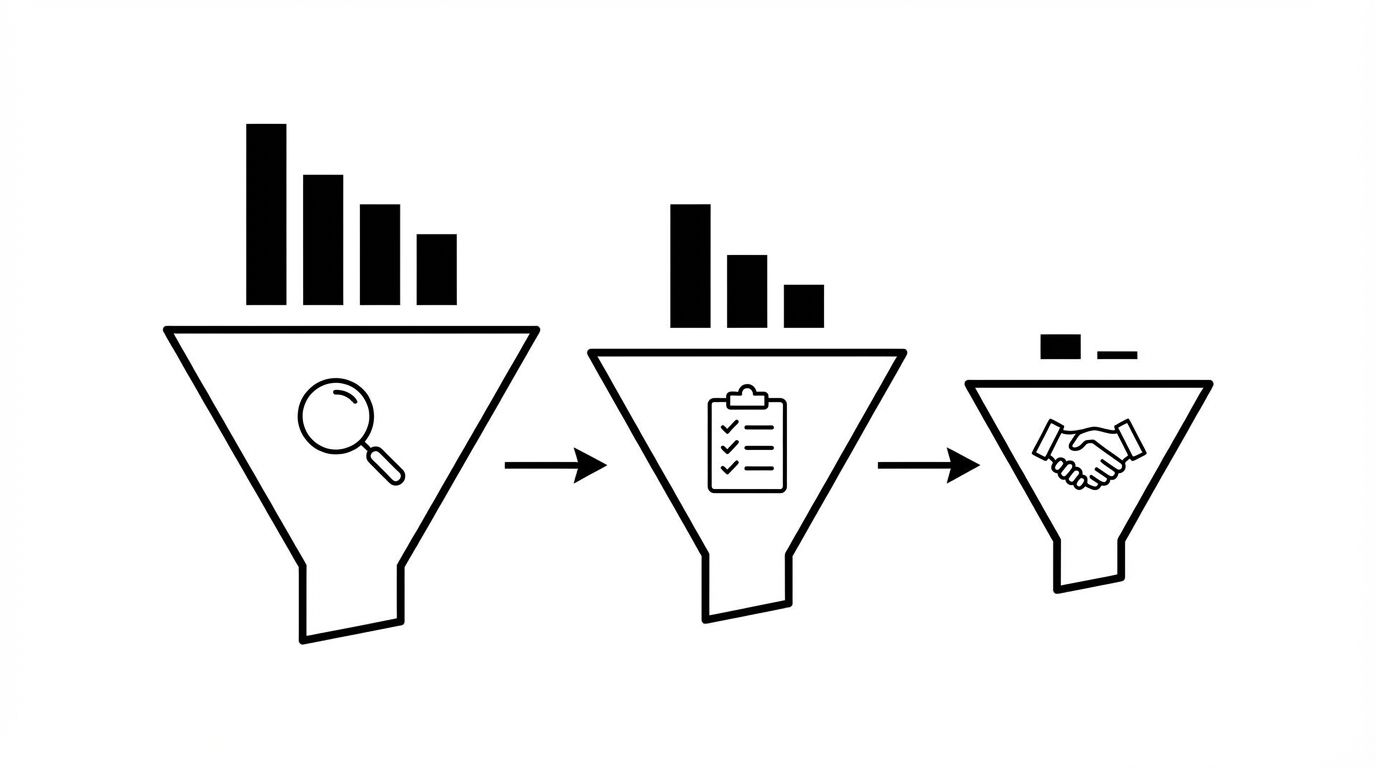
The fix is stage-aware GEO: mapping your content, third-party coverage, and community presence to each buying stage separately and optimizing for the platforms that dominate each stage.
For the awareness stage, the content strategy is straightforward. Publish category-defining content that positions your brand as the expert voice. Guides, frameworks, and educational posts that answer "what is [category]" and "why does [problem] matter." These earn ChatGPT and Google AI Overview citations and put your brand name in front of buyers when they first explore the space. Most SaaS marketing teams are already doing this.
For the evaluation stage, the content needs shift. Buyers at this stage ask "how do I choose" and "what should I look for." Gemini's citation patterns favor structured, brand-owned guides with evaluation criteria, feature breakdowns, and implementation considerations. Publish buyer's guides and evaluation frameworks on your blog. Structure them with comparison tables and clear criteria. The goal is to be cited as the authoritative source on how to evaluate the category, which naturally positions your brand as the expert that understands the space deeply enough to guide the evaluation.
For the decision stage, the strategy moves off your domain. This is where the SaaS-specific challenge is sharpest. Perplexity and ChatGPT answer "Tool A vs Tool B" queries by pulling from G2 reviews, Reddit comparisons, and independent head-to-head articles. Your owned content is secondary. The priority investments are: generating review volume from enterprise customers (not just SMB users) on platforms AI indexes, seeding authentic comparison discussions in communities where your buyers participate, making sure independent analysts and review publishers include your brand in category roundups, and publishing your own comparison pages with specific, factual differentiators against named competitors.
The compounding dynamic matters for SaaS specifically. AI models that recommend your competitor at the decision stage reinforce that recommendation with each model update, because the buyer behavior downstream (clicks, signups, reviews) generates more signal that confirms the recommendation. A SaaS brand that loses the decision-stage visibility race early enters a negative feedback loop where the competitor's momentum becomes self-reinforcing. The earlier you establish decision-stage presence, the harder it becomes for competitors to displace you.
One pattern that works well: identify the exact comparison queries your buyers use ("[your product] vs [competitor]" and "best [category] for [specific use case]") and make sure you have content, reviews, and community presence that specifically addresses those queries. Do not assume that general category content will trickle down to decision-stage visibility. It will not. Each stage requires deliberate investment.
To see where your SaaS brand currently appears across AI buying stages, and where the gaps are, start with a free AI visibility audit. The results will show you which stages you have covered and which ones are silently leaking pipeline to competitors.