
How to Run Your First AI Visibility Audit
How do you audit your brand's visibility across ChatGPT, Perplexity, Gemini, and Google AI Overviews, and what should your first audit uncover?


You can't optimize what you haven't measured. An AI visibility audit is the fastest way to find out whether AI platforms are recommending your brand, ignoring it, or, worse, steering buyers toward your competitors.
Most marketing teams have never systematically checked how ChatGPT, Perplexity, Gemini, or Google AI Overviews talk about their company. The result is a massive blind spot. A 2025 Gartner survey found that fewer than 12% of B2B marketing teams track any form of AI visibility. This tutorial walks you through running your first audit from scratch so you can close that gap today.
If you need background on why this matters, read The Complete Guide to GEO first. If you already understand the stakes and want a full measurement framework, the Measuring AI Visibility playbook goes deeper. This post is the hands-on starting point, the audit you can run this week.
Step 1: Define Your Audit Scope
Before you query a single AI platform, you need to decide what you're measuring and where. A scattershot approach produces noise instead of insights.
Start by answering three questions:
- Which platforms will you audit? At minimum, cover ChatGPT, Perplexity, Google AI Overviews, and Gemini. If your buyers are in the Microsoft ecosystem, add Copilot. Each platform pulls from different data sources and produces different results.
- Which competitors will you benchmark against? Pick 3-5 direct competitors. You need comparison data to contextualize your own performance.
- What query categories matter? Define the types of questions your target buyers actually ask. These fall into three buckets: branded queries (about you by name), category queries ("best [your category] tools"), and problem queries ("how to solve [problem you solve]").
Write these down before moving forward. A clear scope prevents the audit from expanding into an unstructured research project.
Step 2: Build Your Query List
Your audit is only as good as the queries you test. This step is where most first-time auditors either go too narrow (testing five generic questions) or too broad (testing hundreds with no structure).
Aim for 30-50 queries across your three categories:
- Branded queries (5-10): Questions that include your brand name. These test whether AI platforms know about you at all. Examples: "What does [Brand] do?", "Is [Brand] good for [use case]?", "[Brand] vs [Competitor]."
- Category queries (10-20): Questions about your product category without naming any brand. These reveal whether AI platforms associate you with your market. Examples: "Best [category] software for small businesses", "Top [category] tools in 2026", "What [category] solution should I use for [specific need]?"
- Problem queries (10-20): Questions that describe a pain point your product solves, without mentioning any product category. These are the highest-intent queries. Examples: "How do I reduce [specific problem]?", "What's the best way to [desired outcome]?", "Why is [pain point] happening and how do I fix it?"
Keep a spreadsheet with columns for: query text, category, platform, your brand mentioned (yes/no), competitor brands mentioned, sentiment (positive/neutral/negative), and positioning (first mentioned, second, third, or not listed).
Step 3: Run the Audit Across Platforms
Now execute. Open each AI platform and systematically run every query on your list. Record the results in your spreadsheet.
Key rules for consistent results:
- Use fresh sessions or incognito mode to avoid personalization bias
- Run each query verbatim, don't paraphrase or adjust between platforms
- Copy the full AI response for each query so you can analyze it later
- Note the date and time of each query (AI responses change frequently)
- If a platform gives different responses on retry, run the query three times and record the most common result
This is the most time-consuming step. For 40 queries across 4 platforms, expect 2-3 hours of work. It's manual, but it's the baseline you need before investing in automation.
What to watch for during the audit:
- Queries where competitors appear but you don't
- Queries where you're mentioned with negative or neutral sentiment while competitors get positive framing
- Patterns in which platforms are strongest or weakest for your brand
- Whether AI platforms accurately describe what your product does
Step 4: Analyze Your Results
Raw data becomes useful when you turn it into metrics. Calculate three numbers from your audit spreadsheet:
- Mention rate, The percentage of queries where your brand appeared in the response. Calculate this per platform and overall. If you ran 40 queries on ChatGPT and your brand appeared in 8 responses, your ChatGPT mention rate is 20%.
- Sentiment ratio, Of the queries where you were mentioned, what percentage were positive vs. neutral vs. negative? A 70% positive / 20% neutral / 10% negative split is a solid starting point. Anything below 50% positive needs immediate attention.
- Competitive gap, For each competitor, calculate their mention rate and compare it to yours. If your top competitor has a 45% mention rate and you have a 15% mention rate, that 30-point gap is your primary target.
Look for patterns across platforms. You may find that Perplexity mentions you frequently but ChatGPT doesn't, that tells you something about the content sources each platform favors. Or you may find that your mention rate is high for branded queries but near zero for category queries, that signals a brand awareness problem in AI training data.
Red flags that demand immediate action:
- Mention rate below 10% across all platforms
- Negative sentiment in more than 20% of your mentions
- Competitors mentioned 3x or more often than you in category queries
- AI platforms describing your product incorrectly or outdating your positioning
Step 5: Build Your Action Plan
An audit without a follow-up plan is just an expensive research exercise. Convert your findings into specific, prioritized actions.
Priority 1, Fix inaccuracies. If AI platforms are describing your brand incorrectly, that's the most urgent problem. Update your website content, structured data, and third-party profiles to provide accurate, consistent information that AI models can pull from.
Priority 2, Close the biggest competitive gaps. Identify the 2-3 query categories where your competitor gap is largest. These represent the highest-value optimization targets. For tactical guidance on optimizing for specific platforms, see the SEO audit service page for a professional assessment.
Priority 3, Amplify what's working. If certain platforms or query types already show strong results, double down. Create more content that reinforces those signals.
Priority 4, Establish a monitoring cadence. AI responses change as models update. Run this audit monthly at minimum, or use a monitoring platform like Geology to track changes automatically. For a deeper look at the metrics that matter most, see AI visibility metrics.
Set a 30-day checkpoint to re-run a subset of your queries and measure whether your actions are moving the needle.
Start Your Audit Now
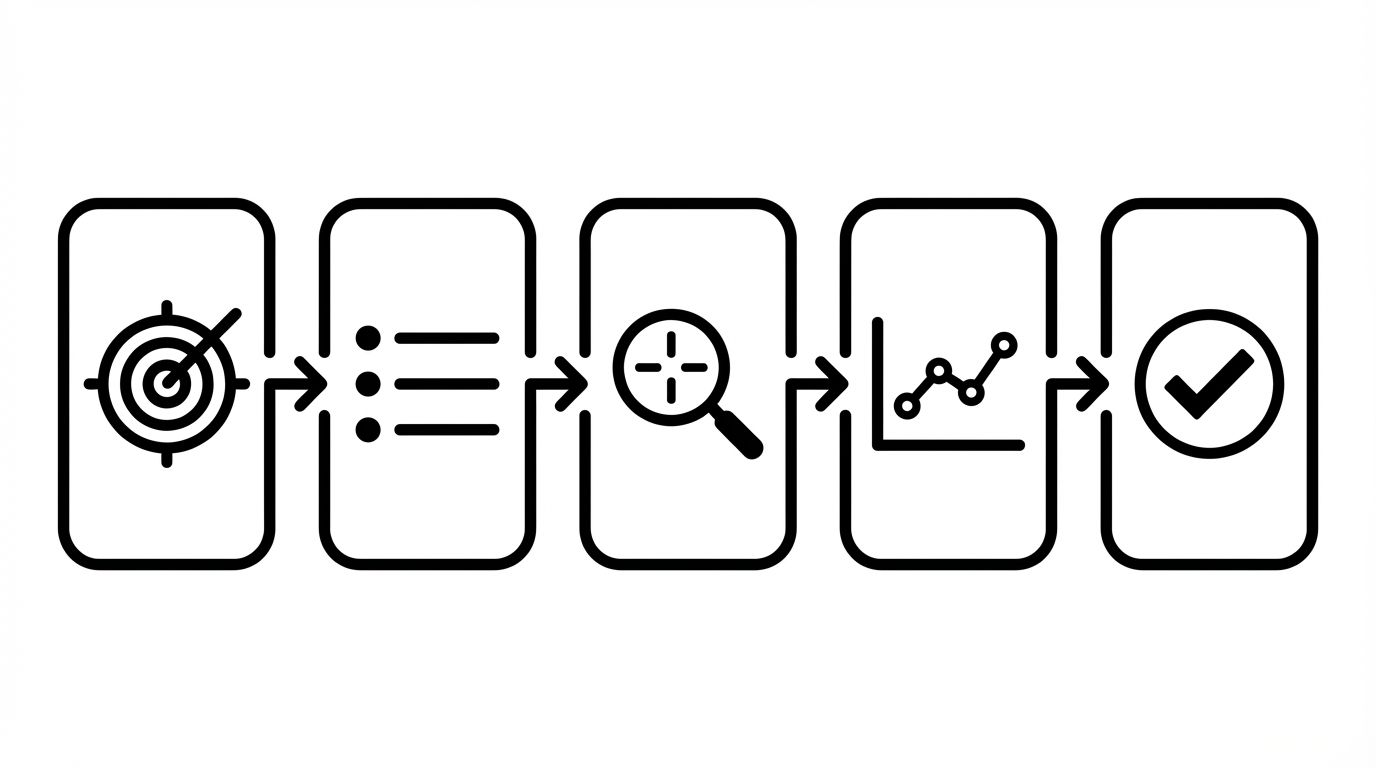
You don't need a perfect process to start. You need a baseline. The five steps above, scope, query list, execution, analysis, action plan, give you a structured way to get that baseline in a single afternoon.
The brands winning in AI visibility right now aren't waiting for the perfect tool or the perfect moment. They're measuring, iterating, and building advantages that compound with every model update.
If you want to skip the manual spreadsheet work and get a thorough AI visibility assessment in minutes, run a free audit with Geology. You'll get your mention rates, sentiment scores, and competitive gaps across every major AI platform, with specific recommendations for what to fix first.