GEO for Enterprise: Managing Brand Presence Across AI Platforms
Why do AI platforms describe enterprise brands inconsistently across answers, and how do you govern brand presence across every major AI engine?


Enterprise brands rarely have a content problem when it comes to GEO for enterprise AI visibility. They have thousands of pages, decades of press coverage, and deep third-party review profiles. Yet when you query ChatGPT, Perplexity, or Gemini about these brands, the answers are often fragmented, contradictory, or outdated. One AI describes the company as a mid-market solution. Another attributes a discontinued product line as a core offering. A third positions the brand accurately for one division but ignores the flagship business unit entirely.
The root cause is not missing content. It is missing governance. Enterprise GEO failures are governance problems disguised as visibility problems. Most large organizations have siloed teams producing content independently, inconsistent terminology across divisions, and zero centralized monitoring of how AI platforms synthesize all of that into a single brand narrative. The brand message AI models learn is whatever emerges from that chaos.
Why Enterprise Brands Get Fragmented AI Representation
Large organizations create content at scale across multiple teams: product marketing, corporate communications, regional offices, individual business units, and partner channels. Each team optimizes for its own audience and objectives. The result is a sprawl of signals that AI models ingest without any awareness of organizational hierarchy or brand architecture.
Consider how this plays out in practice:
- Product marketing publishes feature-focused content using technical terminology specific to one product line
- Corporate communications uses broad positioning language that emphasizes the parent brand
- Regional teams adapt messaging for local markets, sometimes repositioning the brand entirely
- Partner channels describe the product in their own terms, often inaccurately or with outdated information
AI models treat all of these signals with roughly equal weight. They do not know that the regional team's positioning is an adaptation, not the canonical brand message. They do not know that the partner's feature description refers to a version that was deprecated two years ago. The AI synthesizes everything into a blended answer that reflects the average of all signals, not the intended brand positioning.
Gartner's 2025 research on brand consistency found that enterprises with more than five distinct content-producing teams had 3x the rate of brand message inconsistency in AI-generated descriptions compared to companies with centralized content operations.
The Governance Gap in Enterprise GEO
The diagram below illustrates how centralized governance connects distributed teams to a unified AI brand signal, replacing fragmented outputs with coordinated messaging.
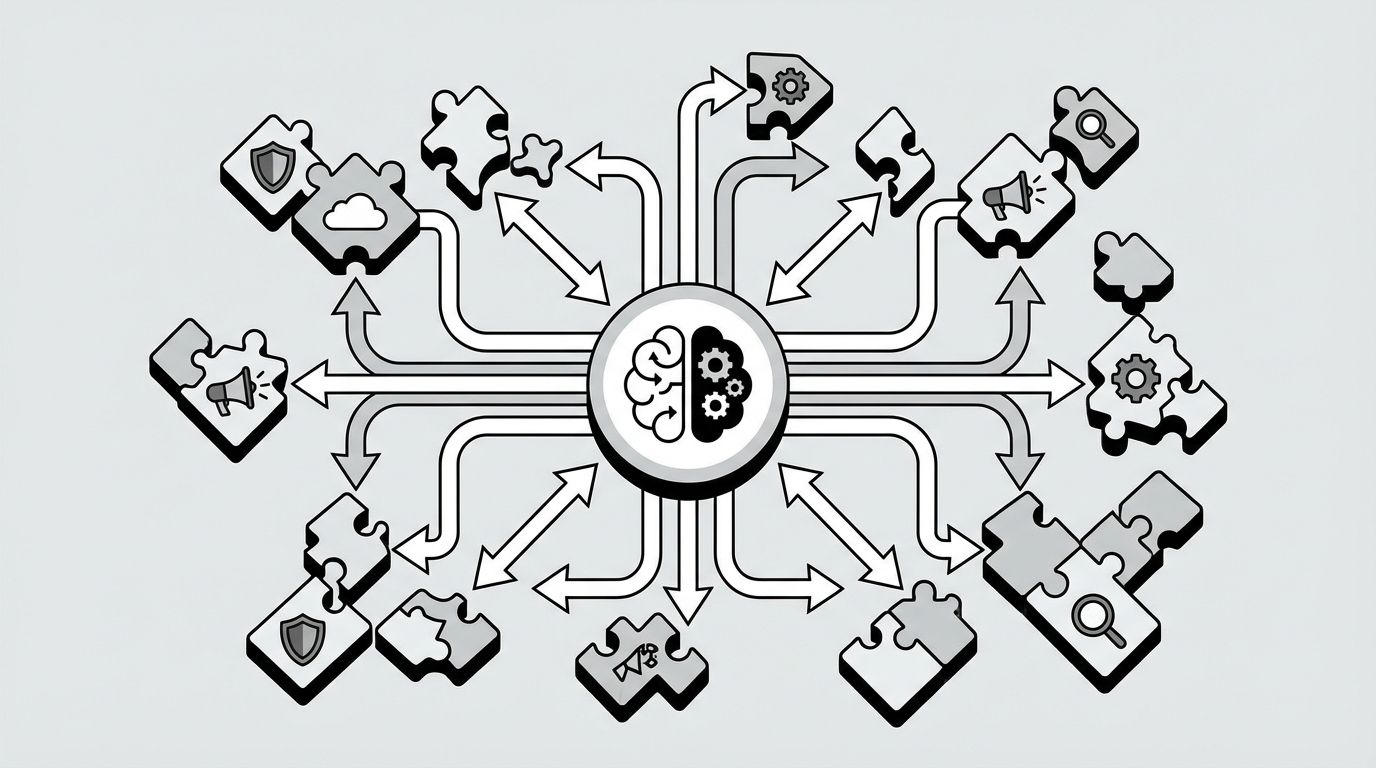
Traditional brand governance focuses on visual identity (logos, colors, fonts) and messaging guidelines (approved copy, positioning statements). These controls were built for human audiences who consume content one piece at a time. AI platforms consume everything simultaneously and synthesize it. Brand governance for AI requires a different layer.
AI-specific brand governance must address:
- Terminology consistency -- every team must use the same product names, category descriptors, and positioning language that you want AI to learn
- Fact accuracy across sources -- pricing, features, integrations, and use cases must be current and consistent everywhere AI models can find them
- Competitive framing -- if one division positions against Competitor A and another against Competitor B, the AI's competitive context for your brand becomes incoherent
- Deprecation hygiene -- old content about discontinued products or outdated capabilities must be archived or updated, not left as active signal
Without these controls, the enterprise is effectively training AI models on an uncoordinated dataset. The output will reflect that disorder.
Building an Enterprise GEO Program
An effective enterprise GEO program has three layers: monitoring, alignment, and optimization.
Monitoring: Know What AI Says About You
The first step is systematic, ongoing auditing of what every major AI platform says about your brand. This is not a one-time project. AI responses shift as models update, new content enters training data, and competitor signals change. Enterprise monitoring should cover:
- Brand queries -- "What does [Brand] do?" and "Tell me about [Brand]'s [product]"
- Category queries -- "Best [category] for [use case]" and "Compare [category] solutions"
- Competitive queries -- "[Your brand] vs [Competitor]" across ChatGPT, Perplexity, Gemini, Copilot, and Google AI Overviews
- Sentiment tracking -- how AI characterizes your brand (adjectives, associations, perceived strengths and weaknesses)
A Forrester survey from late 2025 found that only 12% of enterprise marketing teams actively monitored their brand's representation across AI platforms, despite 68% reporting that buyers referenced AI-generated information during sales conversations. The monitoring gap is enormous.
Alignment: Unify the Signal
Once you know what AI is saying, the next step is tracing inaccuracies or fragmentation back to their source. Every AI error has an upstream cause: outdated content, inconsistent terminology, or contradictory positioning across divisions. The alignment work involves:
- Content audits across all publishing teams to identify terminology conflicts and outdated claims
- A canonical brand fact sheet that serves as the single source of truth for AI-relevant brand attributes: product names, category positioning, key differentiators, integrations, and pricing tiers
- Cross-functional review processes where new content is checked against the canonical fact sheet before publication
This is where the governance dimension becomes critical. Alignment is not a marketing project. It requires coordination across product, sales, legal, regional teams, and partner channels. Without executive sponsorship and clear ownership, alignment efforts stall at the first cross-team boundary.
Optimization: Shape the AI Narrative
With monitoring and alignment in place, optimization is the ongoing work of strengthening the signals AI models draw from. This includes publishing content that AI models cite, earning third-party coverage that reinforces your intended positioning, and addressing competitor content that may be redefining your category or your brand's place in it.
Enterprise optimization also means managing the volume and recency of signals. AI models weight recent, authoritative content more heavily. An enterprise that published strong positioning content in 2024 but has gone quiet in 2026 will lose ground to competitors producing fresh signal. The cadence of content production matters as much as the content itself.
The Cost of Inaction
When AI gets your brand wrong at the enterprise level, the impact multiplies across every buyer interaction that touches AI. A Bain & Company analysis estimated that by 2026, AI-influenced touchpoints would affect 40% of B2B enterprise purchase decisions. If your AI representation is fragmented or inaccurate across those touchpoints, the revenue impact compounds silently because the lost opportunities never enter your pipeline.
The compounding dynamic is especially punishing for enterprises. Every model update that reinforces a competitor's accurate positioning while your brand signal remains fragmented widens the gap. Early movers in enterprise GEO governance are building structural advantages that will take laggards years to close.
Start with a free AI visibility audit to see how AI platforms currently represent your brand across divisions, products, and competitive contexts. The results will show you exactly where governance gaps are costing you visibility.