How to Calculate Generative Engine Optimization ROI in 2026
How do you model the ROI of AI visibility when most clicks never get attributed, and what framework turns GEO spend into a pipeline number?

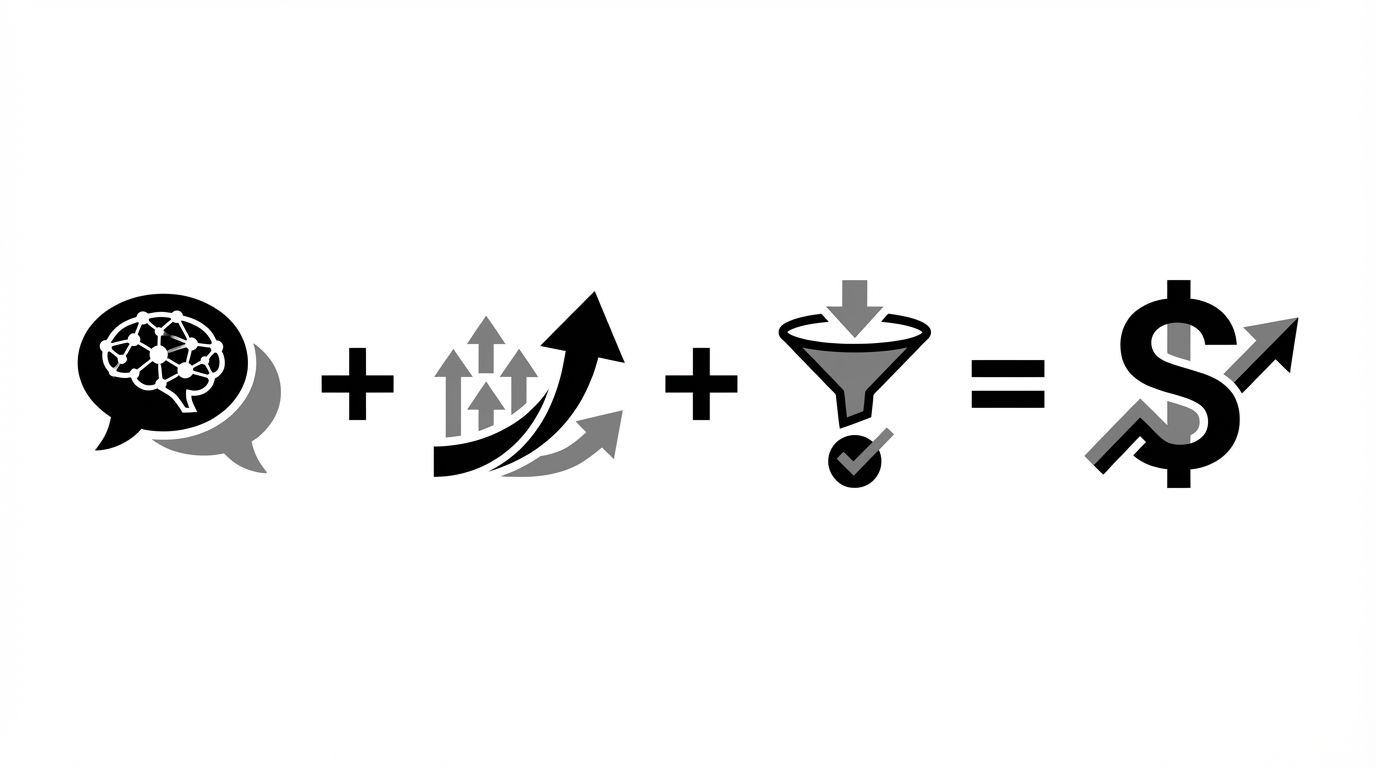
Most marketing leaders skip GEO investment because they can't model the return, and the frameworks they use for SEO or paid ads don't translate. Here's the framework that does: GEO ROI = (AI-attributed pipeline value - GEO investment) / GEO investment. The trick is quantifying AI-attributed pipeline, which requires tracking three things most brands ignore: AI referral traffic, AI-influenced brand searches, and AI mention-to-conversion paths. Once you measure those, GEO shows 3-5x ROI within six months for mid-market B2B brands, because the cost of producing AI-optimized content is low relative to the pipeline it generates when an AI platform recommends you by name to a buyer in-market.
The GEO ROI Formula
Traditional ROI calculations for marketing channels follow a simple model: spend X, generate Y in revenue, divide. GEO requires an adapted version because AI visibility drives revenue through indirect attribution. An AI recommendation doesn't always produce an immediate click, but it seeds brand awareness that converts downstream.
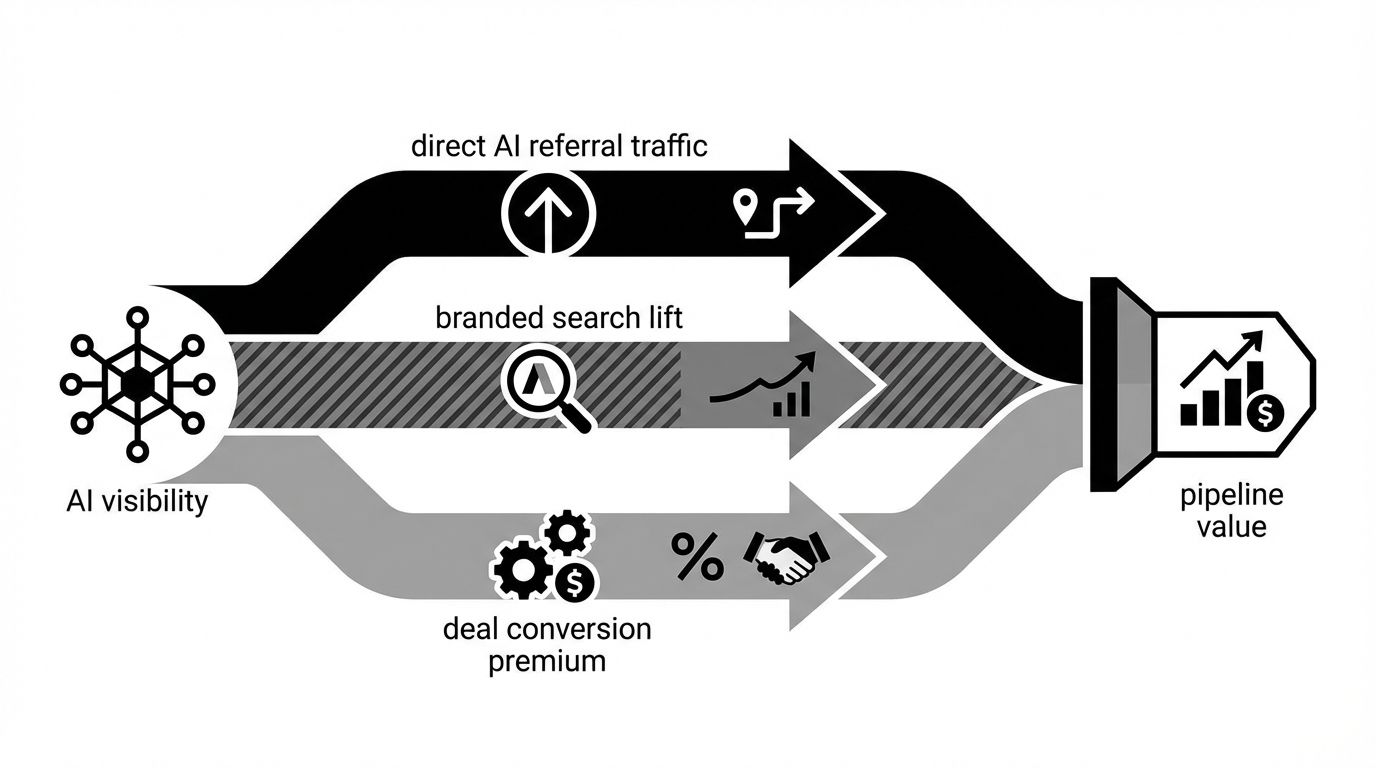
The full formula has three components:
- AI referral traffic value. Direct visits from ChatGPT, Perplexity, and other AI platforms, multiplied by your standard traffic-to-revenue conversion rate.
- AI-influenced brand search lift. The increase in branded search volume attributable to AI mentions (measured as branded search growth minus baseline growth rate).
- AI mention conversion premium. The higher close rate on deals where the buyer was exposed to AI recommendations mentioning your brand (requires CRM tagging).
Add these three revenue components. Subtract your total GEO investment (content creation, technical optimization, citation building, tools). That's your ROI.
The diagram below breaks down the three revenue attribution paths from AI visibility to pipeline value.
Measuring AI Referral Traffic
AI platforms that send traffic to your site appear in analytics: `chatgpt.com`, `perplexity.ai`, `copilot.microsoft.com`. Track these as a dedicated channel and apply your standard visitor-to-revenue conversion rate.
AI referral traffic is typically 2-8% of total traffic for B2B brands, but it converts at a higher rate because AI users arrive with stronger purchase intent. Our traffic tracking guide covers the full technical setup.
Measuring AI-Influenced Brand Search Lift
When AI platforms recommend your brand, some users search for your brand name on Google rather than clicking the AI link. This brand search lift gets attributed to branded SEO unless you measure the correlation.
Establish your baseline branded search growth rate using 6 months of pre-GEO data. After launching GEO, track monthly branded search volume and subtract the baseline. The excess is your AI-influenced lift. Conservative estimates show 15-30% of branded search lift is attributable to AI mentions.
Measuring Deal Conversion Premium
When buyers encounter your brand through an AI recommendation, they convert at higher rates because the AI served as an implicit endorsement. Track this by adding "AI assistant" as an option in your "How did you hear about us?" forms and tagging AI-influenced deals in your CRM. Early data shows a 12-25% higher close rate on AI-influenced deals versus cold outbound or paid advertising.
What GEO Actually Costs
GEO investment breaks down into four categories:
- Content optimization. Restructuring and creating AI-optimized content: $2,000-$8,000/month.
- Technical optimization. Schema markup, crawler access, architecture: $1,000-$3,000 one-time plus $500-$1,000/month.
- Citation building. Editorial mentions and expert citations: $1,500-$5,000/month.
- Monitoring. AI visibility tracking across platforms: $500-$2,000/month (or use Geology).
Total for a mid-market brand: $4,000-$15,000/month versus $20,000-$100,000/month for paid search.
Running the Numbers: A Worked Example
Take a B2B SaaS company with a $50,000 average deal size and $10,000/month GEO investment:
- AI referral traffic: 200 visitors/month at 2% demo conversion and 25% close rate = $50,000/month
- Brand search lift: 15% increase, 10% AI-attributable = $25,000/month
- Conversion premium: AI-influenced deals close 20% higher = $16,667/month
- Total AI-attributed revenue: $91,667/month against $10,000 spend = 817% ROI
Even at half these rates, GEO delivers strong positive ROI.
Plug in your numbers: a GEO ROI calculator
You don't need a spreadsheet template to run your own GEO ROI. You need seven inputs and the formula from earlier in this post. Pull each number from a system you already have: analytics for traffic, your CRM for conversion and deal size, and your finance team for spend.
Here are the input variables to gather:
| Input variable | What it means | Where to find it |
|---|---|---|
| AI referral visitors per month | Monthly visits from ChatGPT, Perplexity, Copilot, and similar | Analytics, filtered to AI referrers |
| Visitor-to-deal conversion | Share of those visitors that become closed deals | CRM, demo rate times close rate |
| Average deal size | Revenue per closed deal | CRM or finance |
| Branded-search lift percent | Extra branded search volume above your baseline | Search Console, post-GEO minus baseline |
| AI-attributable percent | Share of that lift you credit to AI mentions | Conservative estimate, 10 to 30 percent |
| Deal conversion premium percent | How much higher AI-influenced deals close versus cold | CRM, tagged AI-influenced deals |
| Monthly GEO spend | Total content, technical, citation, and tooling cost | Finance or vendor invoices |
Now walk the formula in three steps, then subtract spend.
Step one, referral revenue. Multiply AI referral visitors by your visitor-to-deal conversion, then by average deal size. That is the direct pipeline from AI clicks.
Step two, branded-search revenue. Take your branded-search lift, keep only the AI-attributable share, convert those extra branded visitors at your normal branded conversion rate, and multiply by average deal size.
Step three, premium revenue. Look at the deals that came in through AI-influenced paths, apply the conversion premium percent to what that cohort would have produced at your baseline close rate, and count the difference.
Add the three. Subtract monthly GEO spend. Divide the result by spend. That number, times 100, is your monthly ROI percent.
Here is a second worked example, deliberately more modest than the SaaS case above so you can see the floor. Take a professional services firm with a $20,000 average deal size and $6,000 per month GEO spend:
- AI referral traffic: 120 visitors per month at 1.5% visitor-to-deal conversion and a $20,000 deal size = $36,000 per month
- Brand search lift: a smaller 8% lift with 10% AI-attributable, adding roughly $8,000 per month in attributed pipeline
- Conversion premium: AI-influenced deals close about 12% higher, worth roughly $5,000 per month
- Total AI-attributed revenue: about $49,000 per month against $6,000 spend, which is roughly 717% ROI
Smaller deal size, less traffic, more conservative attribution, and the math still clears comfortably. That is the point of running your own numbers: the inputs change by company, the structure does not.
GEO ROI benchmarks by industry
Payback is not the same across sectors, because deal size, sales cycle, and how buyers research all differ. Use these as rough orientation, not promises, and replace them with your own inputs as soon as you have 90 days of data. For a fuller breakdown of how the math shifts per vertical, see our guide to GEO ROI by industry.
| Industry | Why ROI behaves this way | Typical payback feel |
|---|---|---|
| B2B SaaS | High deal value, fast research cycles, buyers ask AI before booking demos | Fastest, often within the first few months |
| Professional services | High deal value but longer trust-building, fewer monthly deals | Strong, slightly slower to read clearly |
| E-commerce | Lower per-order value offset by high volume and quick conversions | Driven by referral volume more than premium |
| Regulated and finance | Conservative buyers, compliance-gated content, long cycles | Slower start, durable long-term returns |
Two patterns hold across all four. Higher deal values make the conversion premium component matter more, and higher volume makes the referral component matter more. SaaS and professional services lean on the first, e-commerce leans on the second, and regulated and finance sectors trade a slower start for compounding returns once their AI-optimized content earns trust.
Evaluating the ROI of a GEO agency or service
If you are buying GEO rather than running it in-house, the ROI question shifts. You are no longer just measuring the channel, you are measuring whether a vendor's work moved it. Three things separate a service worth paying for from one selling activity reports.
Ask the right questions before you sign. What AI platforms do they track, and how often? How do they attribute results to their work versus your existing momentum? Will they set a pre-engagement baseline for AI mentions, referral traffic, and branded search before they start, so there is something to measure against? A vendor that cannot describe a baseline cannot prove a lift.
Attribute results to their work, not the calendar. Hold the agency to the same three-component model in this post: referral traffic from AI, branded-search lift above your established baseline, and the conversion premium on AI-influenced deals. If a metric moved but your baseline was already trending up, credit the trend, not the vendor. Good partners welcome this because it makes their real wins legible.
Expect a fair reporting cadence. Monthly reporting on AI mentions and referral traffic is reasonable, since those respond quickly. Pipeline and conversion-premium effects need a quarter or more to read cleanly, so a quarterly business review is the right place to judge revenue impact. Be wary of weekly dashboards that imply revenue swings GEO cannot produce that fast. If you want the work and the measurement under one roof, that is what our GEO optimization service is built to deliver.
Payback period and sensitivity
Break-even is the month your cumulative AI-attributed pipeline passes your cumulative GEO spend. For most mid-market B2B brands that track all three components, that lands inside the first six months, because content costs are front-loaded while attributed pipeline keeps accruing after the work is done.
The honest part of any ROI model is the sensitivity check: what happens when reality comes in below the example. Take the SaaS case earlier, then halve the optimistic inputs and watch where it lands.
Cut referral traffic in half, from 200 visitors to 100, and the direct referral component drops from $50,000 to $25,000 per month. Cut the close rate in half on top of that, and that component falls again, to roughly $12,500. Even with both levers halved and the brand-search and premium components scaled down to match, total AI-attributed revenue still clears the $10,000 monthly spend by a wide margin. The ROI multiple shrinks, but it stays positive.
That asymmetry is why GEO survives conservative assumptions. The cost line is small and fixed. The revenue line can be cut substantially and still cover it. When you run your own numbers, halve your inputs on purpose and confirm the result is still positive before you commit budget. If it clears at half, you have a safe floor.
What to Do Next
Start tracking AI referral traffic today. It requires zero budget, just a filter in your analytics platform. Then add the "How did you hear about us?" question to your intake forms. These two steps take less than an hour and give you the baseline data to calculate your own GEO ROI within 90 days.
The urgency went up in May 2026 when AI Mode became Google's default search experience. For the traffic patterns to model into your ROI math, see what the May 2026 core update changed.
For a deeper look at what GEO delivers for different company types, read our insurance case study for real-world ROI data from a regulated industry that many marketers assume is too conservative for AI optimization.