GEO vs SEO, What Changed and What Didn't
Does GEO replace SEO or work alongside it, and where does each one apply when your brand competes for both search rankings and AI mentions?

The debate is framed wrong. Most articles pit GEO vs SEO as a cage match, one wins, one dies. That framing sells clicks, but it doesn't reflect reality. Generative Engine Optimization didn't replace search engine optimization. It extended the playing field.
If your brand ranks well on Google but gets zero mentions when someone asks ChatGPT for a recommendation, you have a visibility gap. If you're optimizing for AI responses but your site can't pass a basic technical SEO audit, you're building on sand. The brands pulling ahead in 2026 aren't choosing between GEO and SEO, they're running both, and they understand where each one applies.
This post breaks down what actually changed, what stayed the same, and how to build a strategy that covers both.
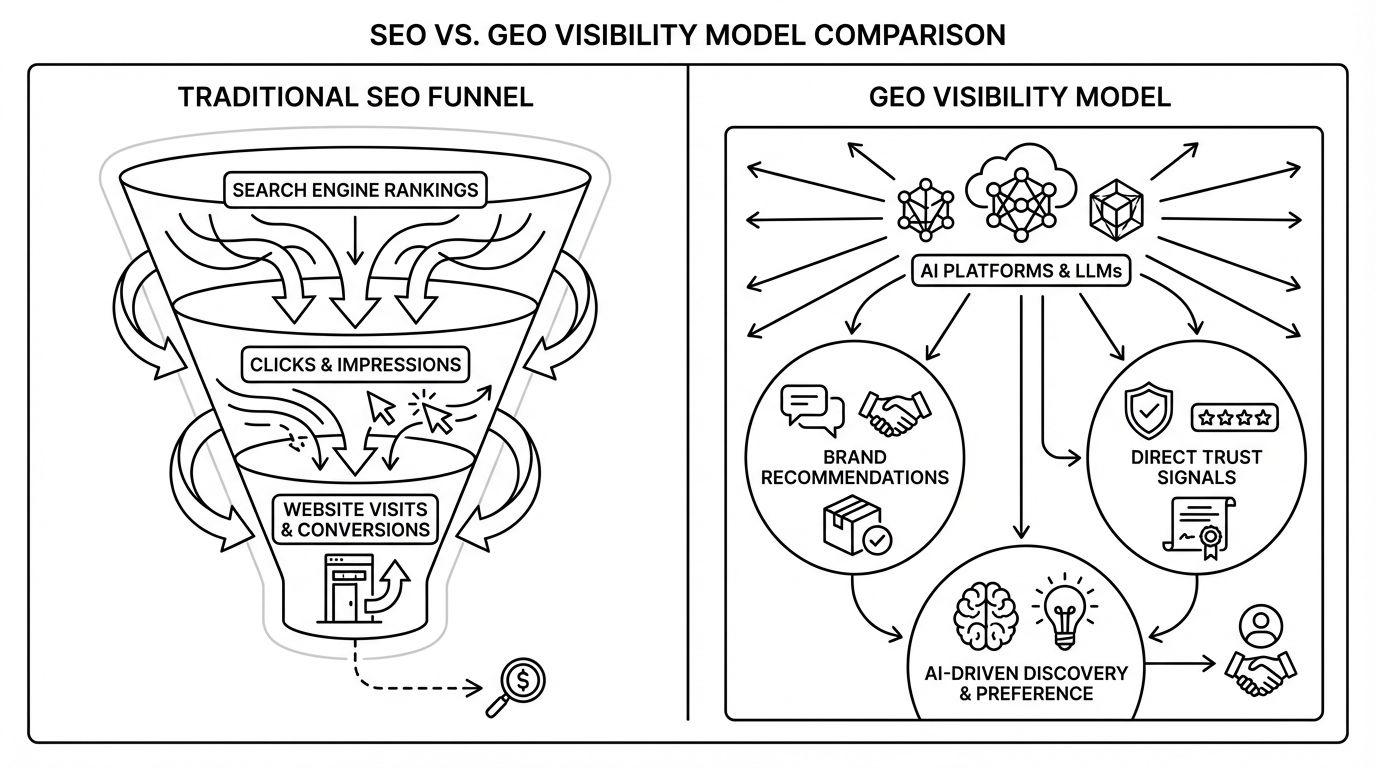
The Core Difference: Rankings vs. Recommendations
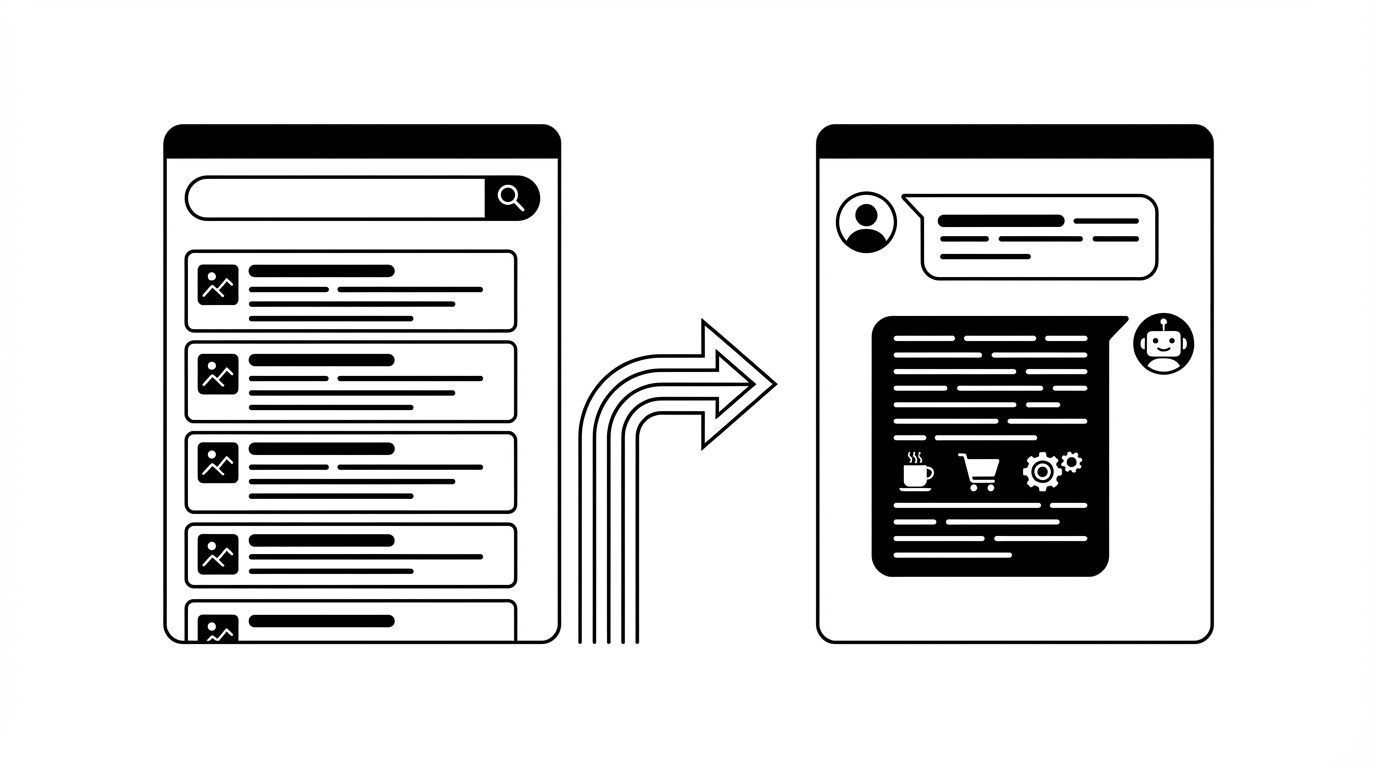
SEO optimizes your content to rank in a list of ten blue links. Success means appearing on page one, ideally in positions one through three. Users scan, click, and land on your site.
GEO optimizes your brand to be mentioned in AI-generated responses. There is no list. There is no page two. The AI either names your brand or it doesn't.
Here's where that difference plays out:
- SEO gives you a position. You rank #3 for "best project management software." Users see you alongside nine other results and choose.
- GEO gives you a recommendation. ChatGPT says "For mid-size teams, consider Asana, Monday.com, and [your brand]." Users trust the AI's judgment and shortlist accordingly.
- SEO traffic is click-driven. Users visit your site to evaluate you.
- GEO influence is trust-driven. Users arrive already predisposed to buy because an AI endorsed you.
The mechanics are different. The intent signals are different. But the foundation, authoritative, well-structured content, is shared.
What Stayed the Same
Here's what most "GEO is the new SEO" takes miss: roughly 70% of the work that makes you visible to AI models is the same work that makes you rank in search engines. The fundamentals didn't change. The outputs did.
- Content authority still wins. Google's E-E-A-T framework rewards expertise, experience, authoritativeness, and trust. AI models trained on web data reinforce the same signals. Thin content loses in both channels.
- Technical health is non-negotiable. Crawlability, site speed, structured data, clean URL architecture, these matter for Googlebot and for the retrieval systems that power Perplexity, Google AI Overviews, and Copilot. A site that AI crawlers can't parse won't surface in AI answers. Run a free SEO audit if you haven't checked your technical baseline recently.
- Structured data compounds. Schema markup helps search engines understand your content. It also helps AI retrieval systems categorize and surface your brand accurately. Brands with clean structured data appear in AI responses 2-3x more often than those without.
- Backlinks signal trust. Third-party citations, press coverage, reviews, industry mentions, build domain authority for SEO and brand authority for GEO. AI models weigh external validation heavily when deciding which brands to recommend.
- Content freshness matters. Stale pages get deprioritized by search algorithms and by RAG-based AI systems that pull from the live web.
If you've been doing SEO well, you have a head start on GEO. The complete guide to GEO covers how to build on that foundation.
What Actually Changed
The changes are real, but they're additive, not replacements. GEO introduces new surfaces, new metrics, and new optimization levers that didn't exist in a search-only world.
- New surfaces to monitor. SEO tracks Google (and maybe Bing). GEO tracks ChatGPT, Perplexity, Gemini, Copilot, and Google AI Overviews, five platforms with different architectures, different data sources, and different response patterns. You need visibility data across all of them.
- New metrics to measure. Rankings and click-through rates don't capture GEO performance. You need to track mention rate (how often your brand appears in relevant AI responses), sentiment (how positively you're characterized), and positioning (whether you're mentioned first, last, or as an afterthought). These are the KPIs that matter in AI visibility measurement.
- New content formats to optimize. AI models favor content that directly answers questions, provides structured comparisons, and includes verifiable claims. Long-form content that buries the answer under 500 words of preamble performs worse in AI retrieval than concise, structured content that leads with the answer.
- New competitive dynamics. In SEO, you compete for ten spots on page one. In GEO, you compete for two to four brand mentions in a single AI response. The bar is higher, and the winner-take-most effect is stronger.
- Speed of impact. SEO changes can take weeks or months to reflect in rankings. Some GEO optimizations, particularly for RAG-based platforms like Perplexity, can impact AI responses within days as content gets indexed and retrieved.
For a deeper dive into the technical implementation, see the technical GEO guide. The narrower comparison -- where the infrastructure work itself diverges -- is in technical GEO vs technical SEO.
Why You Need Both, Not One or the Other
Dropping SEO for GEO is like dropping email marketing because social media exists. Different channels, overlapping audiences, compounding returns when used together.
Here's the practical case for running both:
- SEO feeds GEO. The content that ranks well in search creates the web presence that AI models learn from. Strong organic rankings increase the probability that retrieval-based AI systems pull your content as a source.
- GEO reinforces SEO. When an AI platform cites your page as a source, that drives referral traffic and signals relevance, which can improve your search rankings. Perplexity alone drives measurable referral traffic to cited sources.
- Coverage gaps cost revenue. A brand visible in search but invisible in AI responses loses the 200+ million weekly ChatGPT users who never open Google. A brand visible in AI responses but invisible in search loses the billions of traditional search queries that still happen daily.
- Shared infrastructure. Technical SEO improvements (structured data, site speed, crawlability) benefit both channels simultaneously. One investment, two returns.
The question isn't "GEO or SEO?" It's "How do I allocate effort across both to maximize total visibility?" Geology's GEO optimization service and SEO audit are designed to work together for exactly this reason.
How to Build a Combined GEO + SEO Strategy
Stop treating these as separate workstreams. Here's a practical framework:
- Audit both channels. Run a technical SEO audit and an AI visibility audit side by side. Identify where you're strong, where you're invisible, and where competitors are beating you. Start with a free audit to benchmark your current state.
- Fix the foundation first. If your site has technical SEO issues, broken structured data, poor crawlability, slow load times, fix those before investing in GEO-specific tactics. A weak technical foundation undermines both channels.
- Create content that serves both. Write authoritative, well-structured content that answers specific questions directly. Use clear headings, include verifiable data points, and structure comparisons in formats that both search engines and AI retrieval systems can parse.
- Monitor AI visibility continuously. Track your brand's mention rate, sentiment, and positioning across all five major AI platforms. Look for gaps, queries where competitors get mentioned and you don't.
- Iterate based on data. Use AI visibility data to identify content gaps, then create targeted content to fill them. Measure the impact on both AI mentions and search rankings. Double down on what works.
What Happens If You Ignore One
Brands that invest in SEO but ignore GEO will watch their total addressable visibility shrink as more users shift to AI-first discovery. The data is clear: AI platform usage is growing 40-60% year-over-year while traditional search growth has plateaued.
Brands that chase GEO but neglect SEO will struggle to build the content authority and technical foundation that AI models rely on. Without strong web presence, there's nothing for AI systems to learn from or retrieve.
The compounding effect works both ways. Invest in both, and each channel amplifies the other. Neglect either one, and you leave revenue on the table.
The bottom line: GEO didn't replace SEO. It raised the bar for what thorough digital visibility requires. The brands that win are the ones that bridge the gap between search and AI, and that's exactly what Geology is built to help you do.
Run a free AI visibility audit to see where your brand stands across both search engines and AI platforms.