Competitor Analysis in AI, How to Benchmark Your Brand
Are competitors winning the AI mentions that should be yours, and how do you benchmark your brand's AI visibility against theirs across platforms?


Your competitors are showing up in AI responses. The question is whether they're showing up instead of you, and by how much.
AI competitor benchmarking is the practice of systematically tracking how rival brands appear across AI platforms like ChatGPT, Perplexity, Gemini, and Google AI Overviews, then comparing that performance to your own. Unlike traditional competitive analysis where you compare keyword rankings or ad spend, AI benchmarking measures something far more binary: when a buyer asks an AI for recommendations in your category, whose name comes out of its mouth?
If you already track your own AI visibility metrics, you're ahead of most teams. But measuring yourself in isolation misses half the picture. Competitive context turns raw numbers into strategic decisions.
This tutorial walks you through how to build an AI competitor benchmarking program, from identifying who to track to setting up dashboards that surface the gaps and opportunities your team can act on.
Step 1: Identify Your AI Competitors
Your AI competitors aren't necessarily your traditional market competitors. The brands that appear in AI recommendations for your category may include players you've never considered threats.
Start by mapping three groups:
- Direct competitors, brands you already compete with in sales conversations and comparison shopping
- AI-emergent competitors, brands that rarely appear in traditional search but show up frequently in AI responses (often because they have strong structured data or authoritative content)
- Adjacent competitors, brands from related categories that AI platforms pull in when answering broad queries
To identify AI-emergent competitors, run 20-30 category queries across ChatGPT, Perplexity, and Gemini. Note every brand that appears. You'll likely find 2-3 names you didn't expect.
Prioritize ruthlessly. Track 3-5 competitors maximum. More than that dilutes focus and makes dashboards noisy. Pick the ones that either win deals against you most often or appear in AI responses most frequently, ideally both.
Step 2: Define Your Benchmarking Metrics
You need a consistent framework to compare your AI presence against competitors. Five metrics give you a complete competitive picture:
- Mention rate, the percentage of relevant AI queries where each brand appears. This is your top-line competitive metric.
- Positioning index, when multiple brands appear in one response, who gets mentioned first? First position captures disproportionate attention.
- Sentiment differential, are AI platforms describing your competitor more favorably than you? Track positive, neutral, and negative framing for each brand.
- Platform coverage, which AI platforms favor which brands? A competitor might dominate ChatGPT but be invisible on Perplexity.
- Citation authority, how often does the AI cite each brand's own content as a source? This indicates how much the AI trusts each brand's content.
For a deeper dive into these individual metrics and how to calculate them, see AI Visibility Metrics.
These five metrics give you both a snapshot and a trend line. Any single data point is interesting. The trend over 4-8 weeks is actionable.
Step 3: Build Your Query Set
The queries you test determine the quality of your benchmarking data. A weak query set produces misleading comparisons.
Structure your queries into three tiers:
- Category queries, broad questions about your product category ("best project management tools for remote teams," "top CRM platforms for mid-market companies"). These reveal who owns the category narrative.
- Problem queries, questions framed around pain points your product solves ("how to reduce customer churn," "how to improve engineering team velocity"). These show which brands AI associates with specific problems.
- Comparison queries, direct head-to-head prompts ("Brand A vs Brand B," "alternatives to [Competitor]"). These reveal how AI positions you in direct matchups.
Build at least 30 queries per tier. Run each query across all major AI platforms (ChatGPT, Perplexity, Gemini, Copilot, Google AI Overviews). Record which brands appear, their position, and the sentiment of each mention.
Repeat monthly at minimum. AI models update their training data and retrieval sources regularly, so your competitive position shifts more often than you'd expect.
Step 4: Set Up Competitive Tracking
Manual query testing gives you an initial baseline. Sustained benchmarking requires automation.
Here's what an effective competitive tracking setup looks like:
- Automate query execution, use a platform like Geology that runs your query set across all AI platforms on a scheduled basis and logs every brand mention automatically.
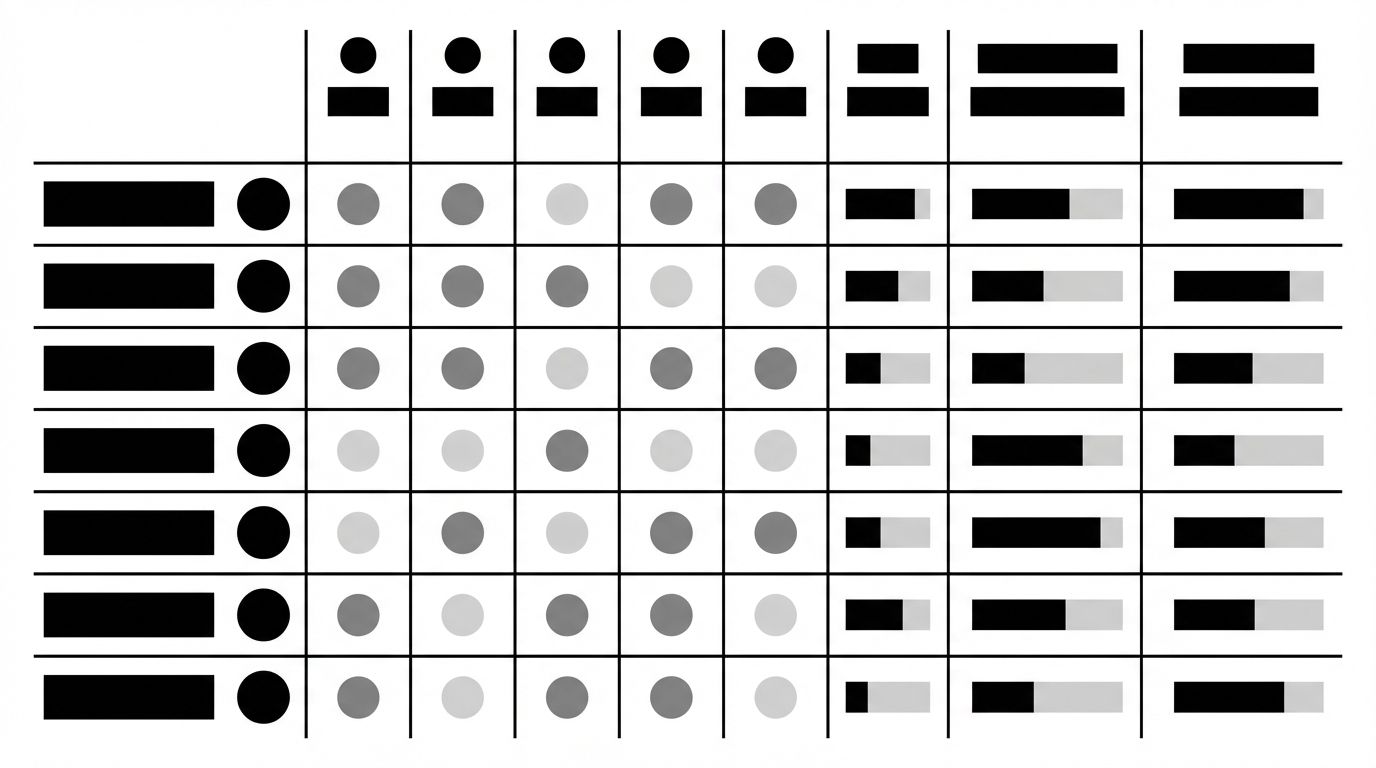
- Build comparison dashboards, track your metrics side by side with each competitor. The most useful view is a trend chart showing mention rate over time for you versus your top 3 competitors.
- Set up alerts, configure notifications for significant competitive shifts: a competitor's mention rate jumping more than 10% in a week, your positioning dropping from first to third, or a new brand entering the top results for your category queries.
- Segment by platform, don't average across AI platforms. A competitor who dominates Perplexity but is absent from ChatGPT requires a different response than one who's strong everywhere.
The goal is a system that surfaces competitive changes fast enough for you to respond. If you're only reviewing competitive data monthly, you're reacting too slowly. Weekly reviews with daily alerting is the benchmark.
Step 5: Turn Benchmarking Into Action
Data without action is just trivia. Every competitive insight should map to a specific response.
Use this decision framework:
- Competitor mention rate is higher than yours, audit their content. What sources does the AI cite when recommending them? Identify the content formats and topics driving their visibility, then build better versions. See the GEO ROI guide for how to prioritize these investments.
- Competitor appears first in multi-brand responses, focus on your positioning index. This often comes down to how authoritative and well-structured your content is. Review your structured data, improve your knowledge panel signals, and ensure your brand's key differentiators are clearly articulated in indexable content.
- Competitor has better sentiment, read the actual AI responses carefully. What language does the AI use to describe them versus you? Often, negative sentiment traces back to a specific review site, forum thread, or comparison article that the AI is drawing from. Address the source.
- New competitor appearing in your category, don't panic. Track for 4 weeks. If their presence is consistent, analyze what they're doing right and adapt.
The most valuable output of competitive benchmarking isn't a report. It's a prioritized list of content and optimization actions ranked by competitive impact.
Start Benchmarking Today
Most brands discover their biggest competitive blind spots within the first week of structured AI benchmarking. The brands that are winning in AI right now aren't necessarily better, they're just more visible because they've optimized for how AI models discover and recommend.
You can start in the next five minutes. Run a free AI visibility audit to see how your brand stacks up against competitors across ChatGPT, Perplexity, Gemini, and more. It takes less than two minutes and gives you the baseline you need to start benchmarking.