AI-Generated Search Results: The Death of Traditional SERP Rankings
Are traditional SERP rankings actually dying, and which types of queries have already shifted to AI-generated answers beyond the point of recovery?

The SERP is not dying uniformly. It is fracturing by query type, and the parts that are gone are not coming back. Informational and comparison queries (the ones that used to drive affiliate traffic, educational blog clicks, and top-of-funnel B2B leads) are now answered inside ChatGPT, Gemini, and Google's AI Overviews before any blue link gets a click. Transactional and navigational queries still flow through the traditional SERP largely unchanged. If your content strategy is still optimizing for a ten-blue-links world across all query types, you are already losing ground on roughly 40% of your historical traffic surface.
Which Queries Have Already Shifted
Think of the SERP as four distinct markets.
- Definitional and educational queries ("what is GEO", "how does prompt caching work"). Mostly answered by AI. Click-through on informational results dropped 20 to 35% year over year where Google AI Overviews appears.
- Comparison and evaluation queries ("best CRM for small business", "Stripe vs Adyen"). Heavily AI-answered. Users stop at the AI response.
- Transactional queries ("buy Sony WH-1000XM6", "book flight to Lisbon"). Still dominated by traditional results.
- Navigational queries ("Stripe login", "Atlassian pricing"). Unchanged. Users want the page, not an summary.
The implication: the queries that still convert in the traditional SERP are the bottom of the funnel. The top of the funnel now belongs to AI retrieval. Our GEO vs SEO comparison walks through how the techniques overlap.
Why This Break Is Structural
Every few years the SEO industry worries about a format shift and the format comes back. Featured snippets did not kill SERPs. Instant Answers did not. AI is different because the economic incentives point in one direction.
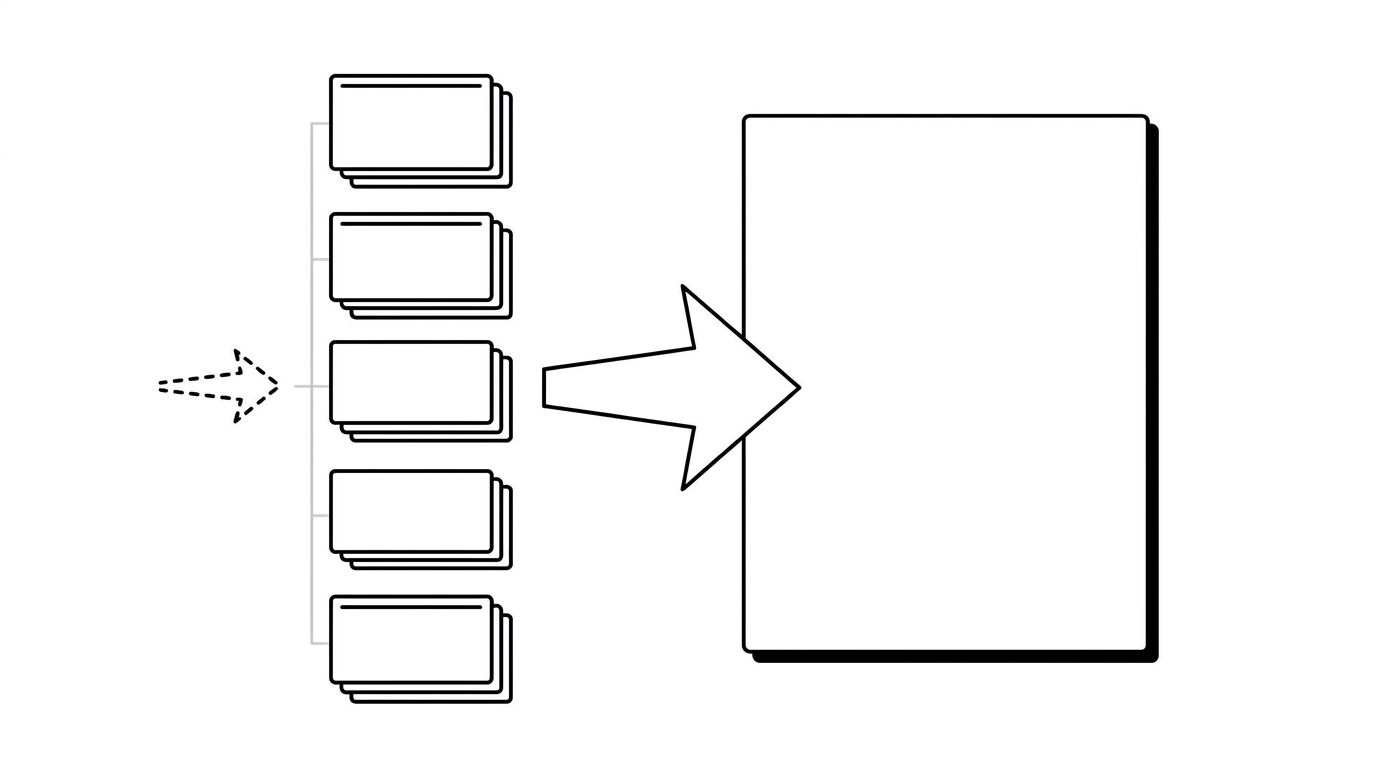
The diagram above captures the shift. Google, Microsoft, and every AI search startup are competing on answer quality, not link quality. Showing the best answer immediately wins the user. Sending the user to a third-party site to read the same answer loses them. The business model of search has changed.
Two numbers make it concrete. Gartner projected a 25% decline in traditional search engine volume by 2026, driven by AI assistant adoption. SimilarWeb's education and reference publishers are reporting 18 to 30% year-over-year traffic declines, with the steepest drops on definitional queries.
What Dies, What Survives
Content built for traditional rankings falls into three buckets.
Dying fast. Generic "what is X" posts, listicles that summarize public knowledge, glossary pages, beginner guides. AI generates these without citing anyone. The ones that survive have a distinct opinion, original data, or expert framing AI has to cite.
Stable for now. Product pages, service pages, pricing, branded content, transactional commerce. These sit in query categories AI has not meaningfully eaten.
Growing. Deep technical content with original data and opinionated analysis. Ironically, content AI wants to cite is growing in traffic, because a citation in an AI response now functions like a featured snippet used to. Our piece on how AI models choose brands covers the citation mechanics.
The New Content Strategy Math
Three moves separate teams that adapt from teams chasing the old game.
- Shift informational content toward citation-worthy. Instead of writing "what is GEO," publish "mention rate benchmarks from 200 brands." AI has to cite specific data. It does not have to cite generic explanations.
- Double down on transactional intent. If 40% of your old traffic surface is drying up, commit harder to the surface that still converts. Product, pricing, and comparison pages.
- Build for AI retrieval, not just Google ranking. Structured data, named entities, dense facts, FAQ schema. Our technical GEO guide covers implementation.
Teams still treating AI visibility as a side project while spending 80% of content budget on informational blog posts are optimizing for a shrinking format.
What the SEO Industry Gets Wrong
Most "death of SEO" takes are overstated. Transactional search is bigger than five years ago. The real shift is subtler: traditional search is becoming a bottom-funnel channel only. The top of the funnel, where brands used to earn discovery through informational content, is migrating to AI.
If you run an SEO program, you are now responsible for two distinct surfaces: the blue-link SERP (becoming more commercial) and AI-generated answers (where visibility is earned through different signals). Running both with one playbook is how teams lose both.
Where to Start
Audit your top traffic-driving content from two years ago. Sort by query type. If more than 30% came from informational queries, you are carrying stranded assets. Decide which pieces to rebuild as citation-worthy source content and which to deprecate.
Run a free AI visibility audit to see where your brand stands today.