How AI Models Choose Which Brands to Mention
What decides whether ChatGPT, Perplexity, Gemini, or Copilot mentions your brand, and how can you influence the signals each AI model looks at?


Every time someone asks ChatGPT for a product recommendation, queries Perplexity for a vendor comparison, or triggers a Google AI Overview, an AI model decides which brands to surface, and which to ignore. Understanding how AI models choose brands is the foundation of Generative Engine Optimization (GEO), and it varies significantly across platforms. If your brand isn't appearing in these responses, you're invisible to a growing share of your market.
We've previously covered how ChatGPT specifically handles brand recommendations. This guide expands that lens across all five major AI platforms, ChatGPT, Perplexity, Gemini, Copilot, and Google AI Overviews, so you can build a cross-platform brand selection strategy. For deeper context on the GEO discipline itself, see the complete guide to GEO.
The Five Signals AI Models Evaluate
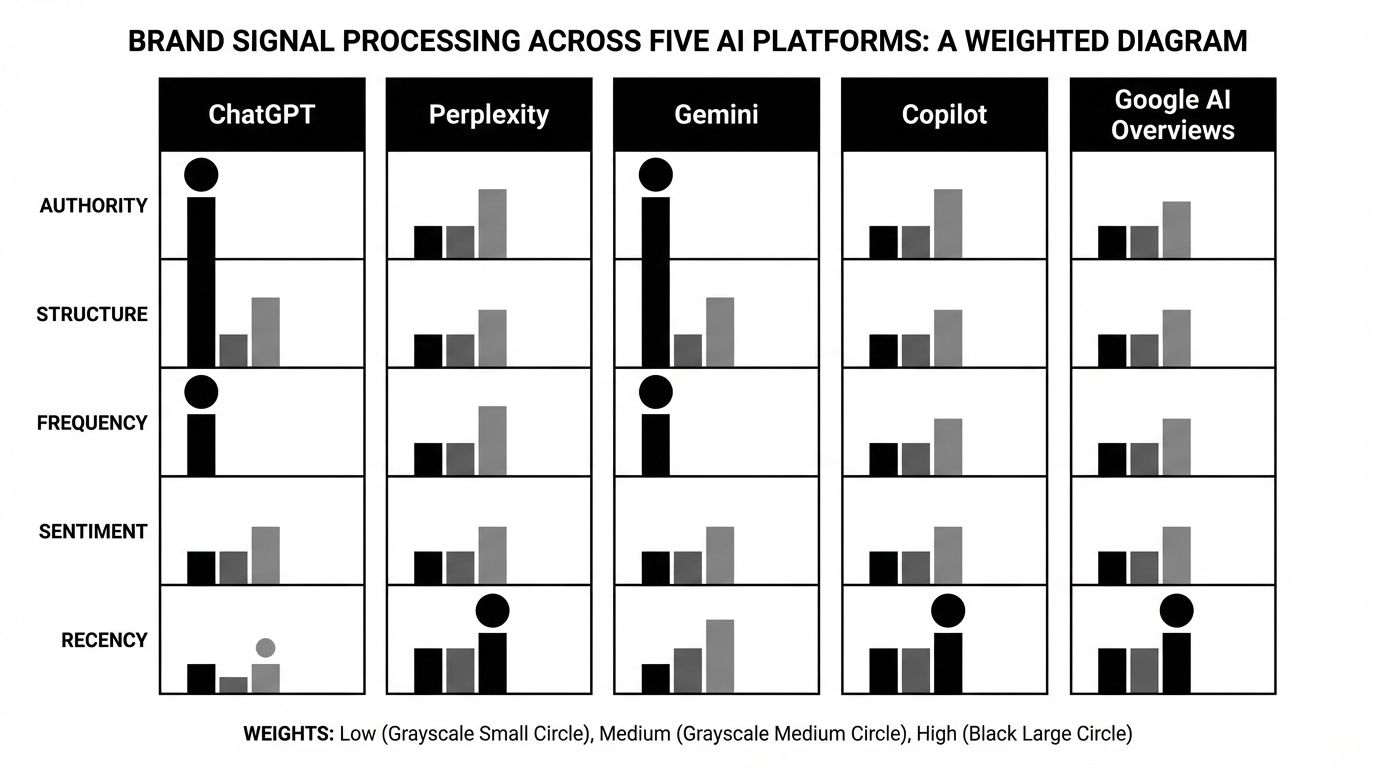
Despite their architectural differences, every major AI platform weighs a common set of brand signals when deciding what to recommend. The weight each signal carries varies by platform, but the signal categories are consistent.
- Source authority: How trustworthy and authoritative are the sources that mention your brand? Models trained on web data or retrieval-augmented with live search results favor brands cited by high-authority publications, review sites, and industry sources.
- Content structure: Is your brand information presented in a way models can parse? Structured data, clean HTML, FAQ schemas, and well-organized content all increase extractability.
- Mention frequency and consistency: How often does your brand appear across the web in relevant contexts? Isolated mentions carry less weight than consistent, corroborated references.
- Sentiment and positioning: Models don't just count mentions, they evaluate sentiment. Brands with consistently positive, specific endorsements outperform those with mixed or generic coverage.
- Recency: For platforms with retrieval capabilities (Perplexity, Google AI Overviews, Copilot), recently published or updated content carries more weight than stale pages.
The brands that rank highest across AI platforms aren't necessarily the biggest. They're the ones with the most structured, authoritative, and consistent presence across these five dimensions.
How Each Platform Selects Brands
Not all AI platforms work the same way. Their architectures determine how they access information, which directly affects which brands get surfaced.
ChatGPT (OpenAI)
ChatGPT relies primarily on its training data, a snapshot of the web, books, and other text corpora up to its knowledge cutoff. When a user asks "What's the best CRM for small businesses?", ChatGPT draws on patterns it learned during training. Brands that appear frequently, authoritatively, and positively in training data get recommended.
- Training data dominance means historical content weight is high
- No real-time retrieval in standard mode (browsing mode changes this)
- Brand associations are "baked in", changing them requires sustained content shifts over time
Perplexity
Perplexity operates as an answer engine with live retrieval. It searches the web in real time, synthesizes results, and cites its sources. This makes it the most transparent platform for brand selection.
- Live search means your current web presence matters most
- Source citations are visible, so you can trace exactly why a brand was mentioned
- High-authority, recently updated pages with clear brand positioning get prioritized
- SEO fundamentals (page speed, crawlability, structured data) directly impact visibility
Google Gemini
Gemini combines Google's massive training corpus with access to Google Search results. It blends parametric knowledge (what it learned in training) with retrieval-augmented generation.
- Leverages Google's search index, so traditional SEO signals still matter
- Brand Knowledge Panels and structured data feed directly into responses
- Reviews, ratings, and Google Business Profile data influence brand selection
- Tends to favor brands with strong Google ecosystem presence
Microsoft Copilot
Copilot is powered by OpenAI models but augmented with Bing search retrieval. It pulls live results from Bing's index and synthesizes them with its base knowledge.
- Bing index optimization matters, Bing Webmaster Tools, IndexNow protocol
- Favors brands with strong presence on Microsoft-adjacent platforms (LinkedIn, GitHub for tech)
- Combines training data patterns with real-time search results
- Enterprise-focused queries tend to surface brands with strong B2B content
Google AI Overviews
AI Overviews appear directly in Google Search results, synthesizing information from top-ranking pages for a given query. This is the most search-dependent AI surface.
- Directly tied to Google Search rankings, if you don't rank, you don't appear
- Featured snippets and structured data strongly influence inclusion
- E-E-A-T signals (Experience, Expertise, Authoritativeness, Trustworthiness) are critical
- Local and vertical search signals apply for relevant queries
Why Cross-Platform Visibility Matters
Most brands focus their AI optimization on a single platform, usually ChatGPT. That's a mistake. Our data shows that brand recommendations are inconsistent across platforms up to 68% of the time. A brand that ChatGPT recommends for a given query might be completely absent from Perplexity's response for the same question.
- Users don't stick to one AI platform. A B2B buyer might use Copilot at work, Perplexity for research, and ChatGPT on mobile.
- Each platform's selection mechanism creates different blind spots. A brand strong in training data (ChatGPT) but weak in live search results (Perplexity) has a fragmented presence.
- Competitors who optimize across all five platforms capture the users you're missing on any single one.
Cross-platform GEO optimization isn't about doing five different things. It's about building a unified brand presence that satisfies the common signals all platforms evaluate, then tuning for each platform's specific mechanics.
The Brand Selection Gap: What Gets You Excluded
Understanding what gets brands included is only half the equation. Equally important is knowing what gets you excluded from AI responses.
- Thin or generic content: If your website describes your product in vague, undifferentiated terms, models have no reason to select you over a competitor with specific, detailed positioning.
- Conflicting information: Inconsistent brand descriptions, outdated product pages, and contradictory claims across sources confuse models and reduce recommendation confidence.
- Low source authority: If the only mentions of your brand come from your own website and low-authority directories, models treat you as unverified.
- Missing structured data: Without schema markup, FAQ structures, and clear content hierarchy, models struggle to extract and attribute information to your brand.
- No recent activity: For retrieval-based platforms, a brand with no new content or mentions in the past 6 months looks dormant.
Fixing these exclusion factors often produces faster results than trying to boost inclusion signals from scratch. For the technical implementation details, see our technical GEO guide.
How to Audit Your Cross-Platform Brand Presence
You can't optimize what you don't measure. A systematic audit across all five platforms reveals where your brand stands, and where the gaps are.
- Query mapping: Identify the 10-20 high-intent queries your target buyers ask AI platforms. Include product category queries, comparison queries, and problem-solution queries.
- Platform-by-platform testing: Run each query across ChatGPT, Perplexity, Gemini, Copilot, and Google AI Overviews. Record whether your brand appears, in what position, and with what sentiment.
- Competitor benchmarking: Note which competitors appear where you don't. Analyze their content and source profiles to understand why. See our guide on measuring AI visibility for detailed metrics frameworks.
- Signal gap analysis: For each platform where you're absent, identify which of the five brand signals (authority, structure, frequency, sentiment, recency) is weakest.
- Prioritize by platform traffic: Focus optimization efforts on the platforms your specific audience uses most. B2B buyers index toward Copilot and Perplexity; consumers skew toward ChatGPT and Google AI Overviews.
This process takes significant effort to do manually. Run a free AI visibility audit to get an automated cross-platform snapshot of your brand's current standing across all five AI platforms, and see exactly where you're being selected, ignored, or outranked.