The Complete Guide to Generative Engine Optimization (GEO)
How do you get your brand mentioned by ChatGPT, Perplexity, Gemini, and Copilot when AI platforms generate answers for your customers?


When a potential customer asks ChatGPT to recommend a project management tool, your brand either shows up in the answer or it doesn't. There is no page two. No "below the fold." You're mentioned, or you're invisible.
That reality is reshaping how companies think about digital visibility. Generative Engine Optimization (GEO) is the practice of optimizing your brand's presence across AI-powered platforms, ChatGPT, Perplexity, Gemini, Microsoft Copilot, and Google AI Overviews, so that when AI models generate responses, your brand is part of the conversation.
This guide covers everything you need to know: what GEO is, why it matters, how it differs from traditional SEO, the framework for building a GEO strategy, and the specific tactics that move the needle. Whether you're a marketing leader at a SaaS company, an agency serving multiple clients, or a startup building brand presence from scratch, this is the resource you'll keep coming back to.
Why GEO Matters Right Now
The shift from search engines to AI platforms isn't theoretical, it's already happening. Consider the numbers:
- Over 200 million people use ChatGPT weekly as of early 2026
- Perplexity processes more than 100 million queries per month, growing 10x year-over-year
- Google AI Overviews now appear in nearly 40% of search results, pushing traditional organic links below the fold
- Microsoft Copilot is embedded across the entire Microsoft 365 suite, reaching hundreds of millions of enterprise users
When someone asks an AI assistant "What's the best CRM for small businesses?" or "Which insurance providers cover telehealth?", the AI doesn't return a list of ten blue links. It gives a direct answer, usually mentioning two to four brands by name.
If your brand isn't one of them, you've lost that customer before they even knew you existed.
Google settled the timeline question in May 2026 by making AI Mode its default search experience and shipping a core update that favors primary sources. Our May 2026 core update breakdown covers what changed and how to respond.
The compounding problem: AI models learn from the content ecosystem. Brands that establish strong signals now get reinforced in future model training. Brands that wait fall further behind with every model update. Early movers in GEO don't just win today's queries, they build durable advantages that compound over time.
What GEO Actually Is
Generative Engine Optimization is the systematic process of influencing how AI models perceive, evaluate, and recommend your brand. It sits at the intersection of content strategy, technical optimization, and brand authority building.
Here's what GEO is not:
- It's not prompt stuffing or keyword hacking
- It's not gaming AI systems with fake reviews or manufactured mentions
- It's not a replacement for SEO, it's an expansion of your visibility strategy
GEO is a data-driven discipline focused on three measurable outcomes:
- Visibility, Is your brand mentioned in AI responses to relevant queries?
- Sentiment, When mentioned, is the characterization positive, neutral, or negative?
- Positioning, Where does your brand appear relative to competitors in the response?
These three metrics form the foundation of any GEO program. Without measuring them, you're optimizing blind.
What Is GEO in Plain English?
SEO works like filing a book so the library catalog points readers to it. GEO works like briefing an expert witness: the AI reads everything it can find about your category, then gives the buyer one spoken answer, and your job is to make sure the record it reads names you accurately.
Take a buyer who types "Which payroll tool works for a 40-person company in Texas?" into ChatGPT. The model does four things before it answers:
- Decides whether it needs fresh sources, and if so, runs a web search.
- Reads the pages it retrieves, which are usually review sites, comparison posts and vendor pages.
- Matches the brands in those pages against what it already knows about each one.
- Writes a short answer that names two to four tools and explains why.
Your brand gets named when it is easy to find at step one, easy to quote at step two and easy to recognise at step three. Recognition depends on entity clarity: one consistent company name, one stated category and the same differentiators on your site, your profiles and the third-party pages that describe you. A brand that calls itself a "platform" on its homepage, a "service" on G2 and an "agency" on LinkedIn gives the model three weak signals instead of one strong one.
Speed is the other plain-English difference. Search rankings tend to move over weeks. Answers from retrieval-based engines can change within days when the pages they read change, which works in both directions: a fresh comparison post can add you to an answer quickly, and a stale one can drop you just as fast.
How AI Models Decide Which Brands to Mention
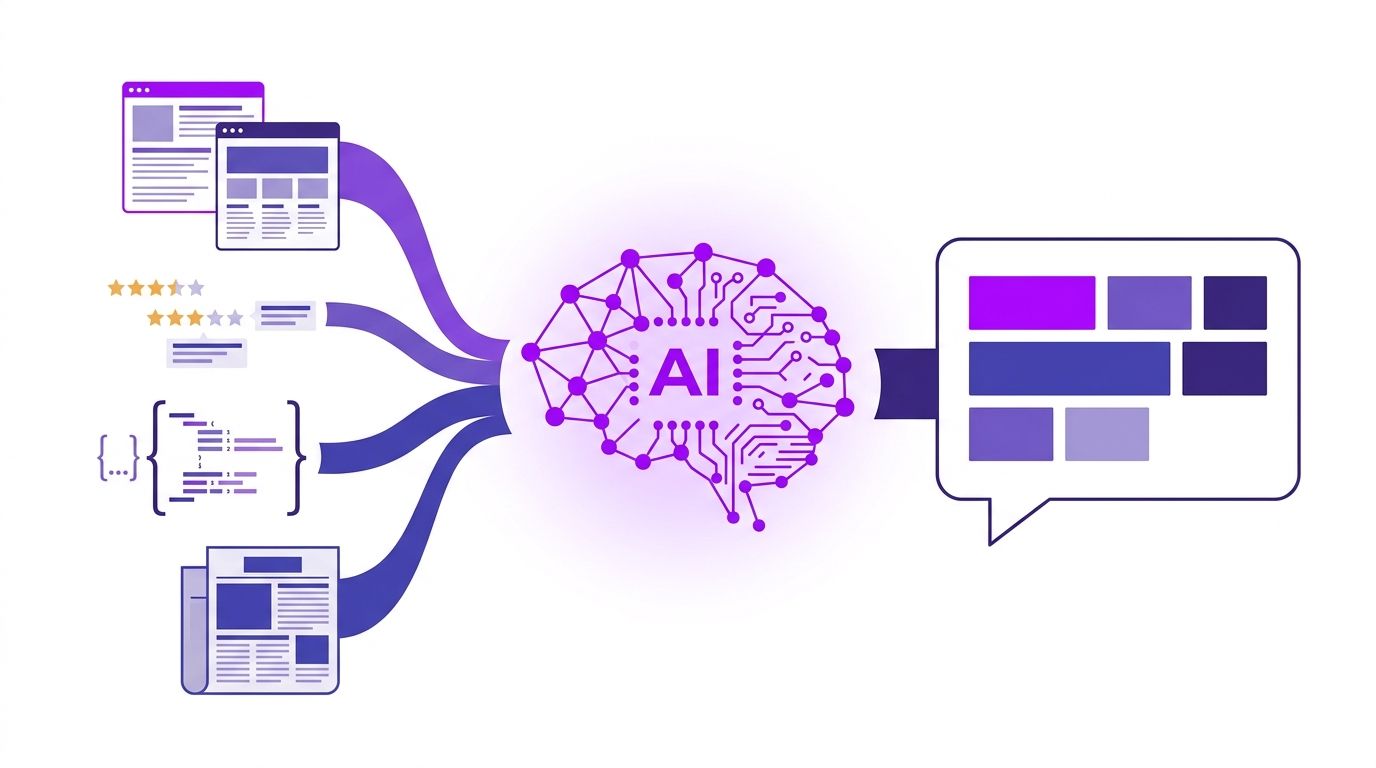
Understanding how AI models choose brands is the first step toward influencing those choices. While each platform has its own architecture, the signals they rely on overlap significantly.
Training Data Signals
Large language models learn from massive datasets that include web content, published articles, reviews, forums, documentation, and structured data. Brands that appear frequently, consistently, and authoritatively across these sources have a stronger "signal" in the model's learned representations.
What this means for you:
- Content volume and consistency matter, sporadic publishing creates weak signals
- Authoritative third-party mentions (reviews, press coverage, industry analysis) carry more weight than self-published content alone
- Structured data (schema markup, knowledge panels, well-organized documentation) helps models categorize and retrieve your brand accurately
Retrieval-Augmented Generation (RAG) Signals
Many AI platforms don't rely solely on training data. Perplexity, Google AI Overviews, and Copilot use retrieval-augmented generation, they search the live web in real time, retrieve relevant pages, and synthesize answers from those sources.
What this means for you:
- Your website's indexability and crawlability directly affect whether AI platforms can find and cite your content
- Content freshness matters, outdated pages get deprioritized
- Clear, well-structured content with explicit answers to common questions is more likely to be retrieved and quoted
- Being cited as a source in AI responses drives measurable referral traffic back to your site
Brand Authority Signals
AI models assess brand authority through a combination of factors:
- Consistency, Does your brand messaging stay coherent across channels?
- Specificity, Do you provide concrete data, case studies, and verifiable claims?
- Topical relevance, Are you publishing deep content within your domain, or thin content across many topics?
- Third-party validation, Are other credible sources referencing your brand?
Brands that score high on all four dimensions tend to be recommended more frequently and more favorably.
GEO vs SEO, What Changed and What Didn't
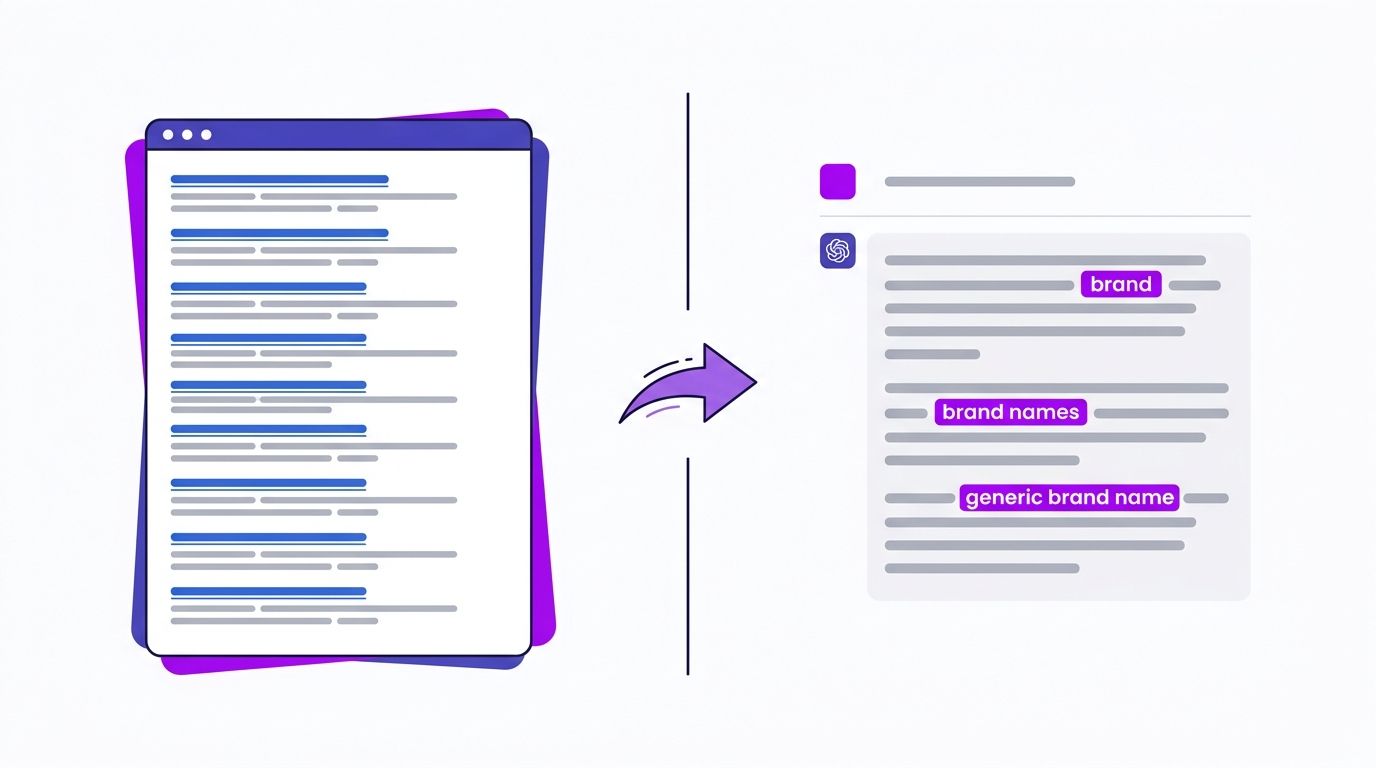
GEO doesn't replace SEO. It builds on the same foundation and extends it to a new set of platforms.
What Stayed the Same
- Quality content wins. AI platforms prioritize the same kind of content that ranks well in search, well-researched, well-structured, and useful.
- Technical fundamentals matter. Site speed, mobile responsiveness, structured data, and clean architecture help both search engines and AI crawlers.
- Authority is earned, not manufactured. Backlinks, brand mentions, and topical expertise still signal credibility.
What Changed
- Output format, SEO delivers a ranked list of links. GEO delivers a direct text response with inline brand mentions.
- Ranking visibility, SEO means position 1–10 on a results page. GEO means mentioned or not mentioned, binary.
- Optimization target, SEO targets Google's ranking algorithm. GEO targets multiple AI models with distinct architectures.
- Content consumption, With SEO, users click through and read your page. With GEO, AI synthesizes your content into its answer.
- Measurement, SEO tracks rankings, CTR, and organic traffic. GEO tracks brand mention rate, sentiment, and citation frequency.
- Competitive dynamics, SEO has 10 spots on page one. GEO has 2–4 brands mentioned per response.
The biggest shift is the binary nature of AI visibility. In traditional search, ranking eighth still gets you some traffic. In an AI response, if you're not one of the brands mentioned, you get nothing.
How Is Gemini Reshaping Search Behavior and Brand Discovery?
Gemini changes brand discovery because Google put it inside products people already use every day. Most people who meet Gemini never open a chatbot. They see it in a Google results page, in Gmail, on an Android phone or in Chrome. Google runs AI Overviews and AI Mode on Gemini models, and Alphabet reported more than 2 billion monthly AI Overviews users in July 2025 and more than 650 million monthly Gemini app users in October 2025. For a US buyer, the first AI answer about your category is more likely to come from Gemini than from any other model.
That reach changes how people search in four ways you can plan for:
- Queries get longer and more conversational. In AI Mode a buyer asks a full question, then follows up ("which of those work for a 20-person team?") without starting over. Google says AI Mode splits each question into many sub-searches, a technique it calls query fan-out, so one prompt can pull from pages that rank for a dozen related queries.
- The answer arrives before the click. An AI Overview names brands and summarizes their strengths above the organic results. Buyers who already have a shortlist from that summary click fewer links, and the brands left out of it never get considered.
- Google's own data sources carry more weight. Gemini grounds its answers in Google Search, the Knowledge Graph, Google Business Profile, Merchant Center product feeds and YouTube. A wrong address in your Business Profile or a stale product feed shows up in the answer.
- Personal context enters the result. With a user's permission, Gemini can draw on Gmail, Calendar and past chats. Two buyers asking the same question can get different shortlists, which makes broad prompt tracking more useful than spot checks.
What this means in practice: Gemini rewards the brands Google already understands well. Start with the inputs Google controls. Keep your Google Business Profile and Merchant Center data accurate, add Organization and Product schema, and publish YouTube videos with full transcripts for the questions your buyers ask. Then check your robots.txt. The `Google-Extended` token controls whether Google can use your content to train Gemini and ground answers in the Gemini app, while AI Overviews in Search still follow the regular Googlebot rules. A blanket block on `Google-Extended` removes you from one Gemini surface and leaves the other untouched. Our AI crawler checker shows which AI bots your robots.txt allows.

The GEO Framework: Five Pillars of Optimization
A complete GEO optimization strategy rests on five pillars. Each pillar addresses a different aspect of how AI models discover, evaluate, and surface your brand.
Pillar 1: Content Authority
Content is the raw material AI models consume. Building content authority means creating a deep, consistent body of work that establishes your brand as the definitive source on your topic.
Tactics:
- Publish thorough, long-form content on your core topics, pillar guides, detailed tutorials, and data-driven analyses
- Answer questions explicitly. AI models look for clear, direct answers. Don't bury the lead.
- Use structured headings (H2, H3) that map to the questions your audience asks
- Update content regularly. Stale content gets deprioritized by retrieval systems.
- Build topical clusters, a pillar page supported by related subtopic posts that interlink
Your content strategy should map directly to the queries your target audience is asking AI platforms.
Pillar 2: Structured Data and Technical Signals
AI platforms that use retrieval (Perplexity, AI Overviews, Copilot) need to parse your content accurately. Structured data makes this easier.
Tactics:
- Implement schema markup, Organization, Product, FAQ, HowTo, Article, and Review schemas give AI crawlers explicit metadata
- Maintain a clean site architecture with logical URL structures and internal linking
- Optimize for crawlability, ensure your robots.txt and meta tags allow AI crawlers access
- Use descriptive, keyword-rich alt text on images
- Keep page load times under 2 seconds, slow pages get dropped from retrieval results
Pillar 3: Brand Signal Amplification
AI models don't just read your website. They synthesize information from across the web. Amplifying your brand signal means ensuring your brand appears consistently and positively in the sources AI models trust.
Tactics:
- Earn third-party coverage, press mentions, industry reports, analyst write-ups
- Build a presence on review platforms relevant to your industry (G2, Capterra, Trustpilot, industry-specific sites)
- Contribute expert content to authoritative publications in your space
- Maintain consistent NAP (Name, Address, Phone) across all directories and listings
- Monitor and respond to reviews, sentiment on third-party platforms directly influences how AI models characterize your brand
Pillar 4: Multi-Platform Optimization
Each AI platform has its own architecture, data sources, and retrieval methods. A one-size-fits-all approach leaves gaps.
Key platforms and their nuances:
- ChatGPT, Relies heavily on training data plus web browsing. Brand mentions in high-authority content during training windows have outsized impact.
- Perplexity, Real-time retrieval focused. Content that ranks well in traditional search tends to get cited. Strong source attribution means your brand gets credit.
- Google AI Overviews, Pulls from Google's own index. SEO fundamentals (ranking, featured snippets, knowledge panels) directly influence inclusion.
- Gemini, Deeply integrated with Google's ecosystem. YouTube content, Google Business Profile, and structured data all feed into Gemini's responses.
- Microsoft Copilot, Uses Bing's index plus enterprise data. LinkedIn content and Microsoft ecosystem presence matter more here than on other platforms.
Optimizing for one platform while ignoring others means leaving visibility on the table.
Pillar 5: Measurement and Iteration
You can't improve what you can't measure. GEO requires ongoing monitoring of how your brand appears across AI platforms, with regular optimization cycles based on real data.
What to measure:
- Brand mention rate, What percentage of relevant queries result in your brand being mentioned?
- Sentiment analysis, When mentioned, is the characterization positive, neutral, or negative?
- Competitor benchmarking, How does your mention rate compare to key competitors?
- Citation tracking, Are AI platforms linking back to your content as a source?
- Query coverage, Which relevant queries trigger a mention, and which don't?
This is where most companies hit a wall. Manually checking AI platforms for your brand across hundreds of relevant queries doesn't scale. That's exactly the problem Geology's platform solves, automated monitoring across all major AI platforms with actionable analytics on visibility, sentiment, and competitive positioning.
Building Your GEO Strategy: A Step-by-Step Approach
Here's a practical roadmap for launching a GEO program, whether you're starting from scratch or adding GEO to an existing SEO operation.
Step 1: Audit Your Current AI Visibility
Before optimizing, you need a baseline. Run a free AI visibility audit to understand:
- Which AI platforms currently mention your brand
- What queries trigger (or don't trigger) brand mentions
- How your visibility compares to competitors
- What sentiment AI models associate with your brand
This baseline tells you where you stand and where the biggest opportunities are.
Step 2: Map Your Target Queries
Identify the queries your ideal customers are asking AI platforms. These fall into categories:
- Category queries, "What are the best [category] tools?"
- Problem queries, "How do I solve [problem]?"
- Comparison queries, "[Your brand] vs [competitor]"
- Recommendation queries, "What [product type] should I use for [use case]?"
Prioritize queries by business impact and current gap (queries where competitors are mentioned but you're not).
Step 3: Strengthen Your Content Foundation
Review your existing content against your target query map. Identify gaps where you have no content addressing a high-priority query. Then:
- Create or update pillar content for your top 5–10 target queries
- Ensure every piece explicitly answers the question in the first 200 words
- Add structured data markup (FAQ, HowTo, or Article schema as appropriate)
- Build internal links between related content pieces
Step 4: Amplify Your Brand Signals
Content alone isn't enough. Strengthen your external brand signals:
- Audit your presence on relevant review platforms, fill gaps and encourage reviews
- Identify opportunities for third-party coverage and expert contributions
- Ensure brand information is consistent across all web properties
- Build relationships with industry publications and analysts
Step 5: Monitor, Measure, and Iterate
Set up ongoing monitoring to track your AI visibility across platforms. Review the data monthly and adjust your strategy:
- Double down on content topics where you're gaining traction
- Address queries where competitors are mentioned but you're not
- Respond to negative sentiment with targeted content and review management
- Test new content formats and structures to see what AI platforms prefer
GEO for Different Business Types
GEO strategy varies by business model. Here's how the approach differs across segments.
SaaS Companies
For SaaS, the primary battleground is category queries, "What's the best [category] software?" AI recommendations in this space often determine which products make a buyer's shortlist before they ever visit a comparison site.
Focus areas:
- Deep product comparison content that positions your product favorably
- Integration documentation and use-case guides that expand your topical footprint
- Customer success stories with specific metrics that AI models can cite
- Active presence on SaaS review platforms (G2, Capterra) with recent, positive reviews
E-Commerce Brands
AI shopping assistants are reshaping the purchase journey. When someone asks "What's the best running shoe for flat feet?", the AI's answer can send thousands of buyers directly to a product page, or to your competitor.
Focus areas:
- Product content with specific, structured attributes (price, features, specifications)
- Expert-driven buying guides that establish authority in your product category
- Review generation strategy across platforms AI models pull from
- Rich product schema markup with detailed specifications
Enterprise Organizations
Enterprise GEO is about brand control. When a CTO asks Copilot about vendors in your space, the response shapes procurement decisions.
Focus areas:
- Thought leadership content from named executives and subject matter experts
- Analyst relations and industry report inclusion
- Thorough documentation and knowledge base content
- LinkedIn and Microsoft ecosystem presence (critical for Copilot visibility)
Agencies
Agencies need to deliver GEO results across multiple clients, which means scalable processes and measurement.
Focus areas:
- Standardized GEO audit and reporting workflows
- Multi-client monitoring dashboards
- Cross-industry expertise in content optimization
- Client education on why GEO matters alongside SEO
Common GEO Mistakes to Avoid
As GEO matures, we're seeing the same mistakes repeated across companies:
- Treating GEO as a one-time project. AI models update continuously. GEO requires ongoing optimization, not a set-it-and-forget-it approach.
- Ignoring platforms beyond ChatGPT. ChatGPT gets the headlines, but Perplexity, AI Overviews, Gemini, and Copilot collectively reach more users for many query types.
- Optimizing only your own website. AI models synthesize information from many sources. Your third-party presence (reviews, mentions, citations) often carries more weight than your homepage.
- Publishing thin content at scale. Volume without depth creates weak signals. One thorough, authoritative guide outperforms ten shallow posts.
- Neglecting measurement. Without tracking actual AI responses for your target queries, you're guessing. Data beats intuition in GEO just as it does in SEO.
- Copying your SEO playbook unchanged. GEO shares fundamentals with SEO but requires different tactics for different platforms. What ranks in Google doesn't automatically get mentioned in ChatGPT.
Which GEO Myths Send Teams the Wrong Way?
The mistakes above come from habit. These come from advice that circulates in vendor pitches and LinkedIn threads, and each one costs teams months.
"Schema markup is enough"
Schema helps engines parse a page. It does not make a thin page worth citing. Engines also weigh depth, source authority, agreement with other sources and freshness, so treat schema as formatting that sits on top of strong content. Add it after the page answers the question better than its competitors.
"Optimize for ChatGPT and the rest follow"
Each engine retrieves differently. Perplexity searches the live web on almost every query and cites sources inline. Google AI Overviews draw on Google's own ranking signals. ChatGPT mixes what the model already knows with web search when it decides it needs one. Gemini and Copilot each lean on their parent company's index. Track a fixed prompt set on every engine your buyers use, because a brand can lead on one and be absent on another.
"Results show up overnight"
Retrieval-based answers can change within days of a page being crawled, but only when the page clears the engine's quality bar. What a model knows without searching changes only when the vendor trains a new version, on a schedule nobody outside the company controls. Plan in quarters, and judge early progress on the retrieval-based engines first.
"You can't influence what AI says about you"
AI answers come from identifiable sources. When you fix the facts on your own pages, correct the review profiles and directory listings that disagree with them, and earn coverage on the sites engines cite in your category, the answers change. You influence the inputs; the engine still writes the output. Our guide to correcting brand misinformation on AI platforms covers the repair process step by step.
"GEO only works for big brands"
Engines pick sources by relevance and authority on the specific question, and niche specialists often win narrow prompts outright because their pages go deeper than a market leader's category page. Size helps with broad prompts like "best CRM". It matters far less for "best CRM for independent insurance agencies", which is where most buying research happens.
GEO Glossary: Terms You'll See in AI Visibility Reports
GEO reports borrow words from SEO, paid media and machine learning, and teams often use the same word for different numbers. Agree on these definitions before you compare reports from two tools or two agencies.
| Term | What it means |
|---|---|
| Prompt share | The percentage of tracked prompts in a category where an AI answer names your brand |
| Share of voice (AI) | Your brand's mentions as a share of all brand mentions across the tracked prompts, measured against named competitors |
| Mention position | Where your brand appears inside an answer; first in a recommendation list counts for more than a passing reference |
| Citation | A source link the engine attaches to its answer, which can point to your site or to a third party that mentions you |
| Citation rate | The share of answers that cite at least one page from your domain |
| Sentiment score | How positively or negatively an engine describes your brand, tracked per platform and per prompt over time |
| Visibility gap | The difference between your prompt share and your top competitor's on the same prompt set |
| Zero-click answer | An AI response that settles the question without the user visiting any website |
| Query fan-out | An engine splitting one question into several background searches and combining the results into one answer |
| Grounding | An engine tying its answer to retrieved sources instead of relying only on what the model learned in training |
| Hallucination | A false statement an engine makes about your brand, such as a wrong price, a discontinued product or a feature you never offered |
| Bot access policy | The robots.txt rules that decide which AI crawlers (GPTBot, ClaudeBot, PerplexityBot, Google-Extended) can read your pages |
| llms.txt | A plain-text file at your site root that lists the pages you want AI systems to read first |
| AI referral | A visit that arrives from a link inside an AI answer, identified by referrers such as chatgpt.com or perplexity.ai |
| AI-attributed conversion | A signup, demo request or purchase from a visitor whose first touch was an AI answer |
Prompt share and citation rate measure different things. A brand can appear in most answers with no citation, which means the engine knows the brand but sends no traffic. The reverse also happens: an engine cites your blog post as a source while recommending a competitor. Track both, and treat a high prompt share with a low citation rate as a signal to publish pages worth linking to.
What to Do Next
GEO is not a future concern, it's a current competitive advantage. Every day your brand isn't visible in AI responses is a day your competitors are building signal and capturing demand you'll never see.
Here's where to start:
- Run a free audit. See exactly where your brand stands across AI platforms with Geology's free AI visibility audit. You'll get a baseline on visibility, sentiment, and competitive positioning in minutes.
- Prioritize your gaps. Focus on the highest-value queries where you're not being mentioned but competitors are. These represent immediate revenue opportunities.
- Build your content foundation. Create or update content for your top priority queries, following the five-pillar framework outlined above.
- Set up monitoring. GEO is an ongoing program. Track your progress across platforms and iterate based on real data. Geology's platform automates this across ChatGPT, Perplexity, Gemini, Copilot, and Google AI Overviews.
The brands that invest in GEO now will own the AI conversation in their categories. The ones that wait will spend years trying to catch up.
Your customers are already asking AI for recommendations. The only question is whether your brand is part of the answer.