Building a Business Case for GEO: The Executive Pitch Deck
How do you frame GEO so a skeptical CFO funds it, and which three numbers turn a marketing pitch into a commitment leadership will back?


If your CFO rejects your GEO proposal, the problem is usually the framing, not GEO. Most internal decks pitch AI visibility as a marketing experiment, which puts it in the same budget fight as ad tests. The decks that get signed pitch GEO as insurance against a channel shift already happening, with three numbers finance can defend: the share of your category's discovery traffic moving to AI, the displacement cost of being absent from those answers, and the compounding penalty of waiting. Treat this as a CFO pitch, not a CMO one.
The Frame That Gets Budget
Executives buy shifts, not tactics. Open with the shift (users moving from search to AI) and treat GEO as the response. Decks that open with "what is GEO" concede the argument. The room knows AI exists. Their question is whether your brand needs a budget line for it this fiscal year.
The three slides that do the work:
- The shift: what percent of your category's informational queries now happen on AI platforms, with a source. Cite SparkToro, Similarweb, or Gartner directly.
- Your position: where your brand appears across ChatGPT, Perplexity, Gemini, and Copilot for your ten most valuable queries, side-by-side with competitor mention rates.
- The cost of staying still: projected revenue displacement over 12 and 24 months if your mention rate stays flat while AI query volume compounds.
Our guide on calculating GEO ROI has the formulas for slide three.
The Numbers a CFO Will Actually Check
Finance teams do not trust marketing ROI claims by default. Assume skepticism and pre-answer the questions.
Lead with displacement cost, not pipeline. Displacement cost is the revenue you are not capturing because an AI assistant recommends a competitor instead of you. It compounds from observable market share shifts, not attribution assumptions. Example math:
- 8% of your category's informational queries happen on AI platforms today
- That share is growing 6 to 10 points per year
- Your brand appears in 12% of AI responses for category queries; your top competitor appears in 41%
- Your addressable volume, applied to the gap, yields a per-year displacement estimate
Present that number with assumptions and sensitivity. Hand the CFO the spreadsheet. The category is new enough that finance has no competing internal model yet, which is your advantage if you lead with rigor.
What to Put on Each Slide
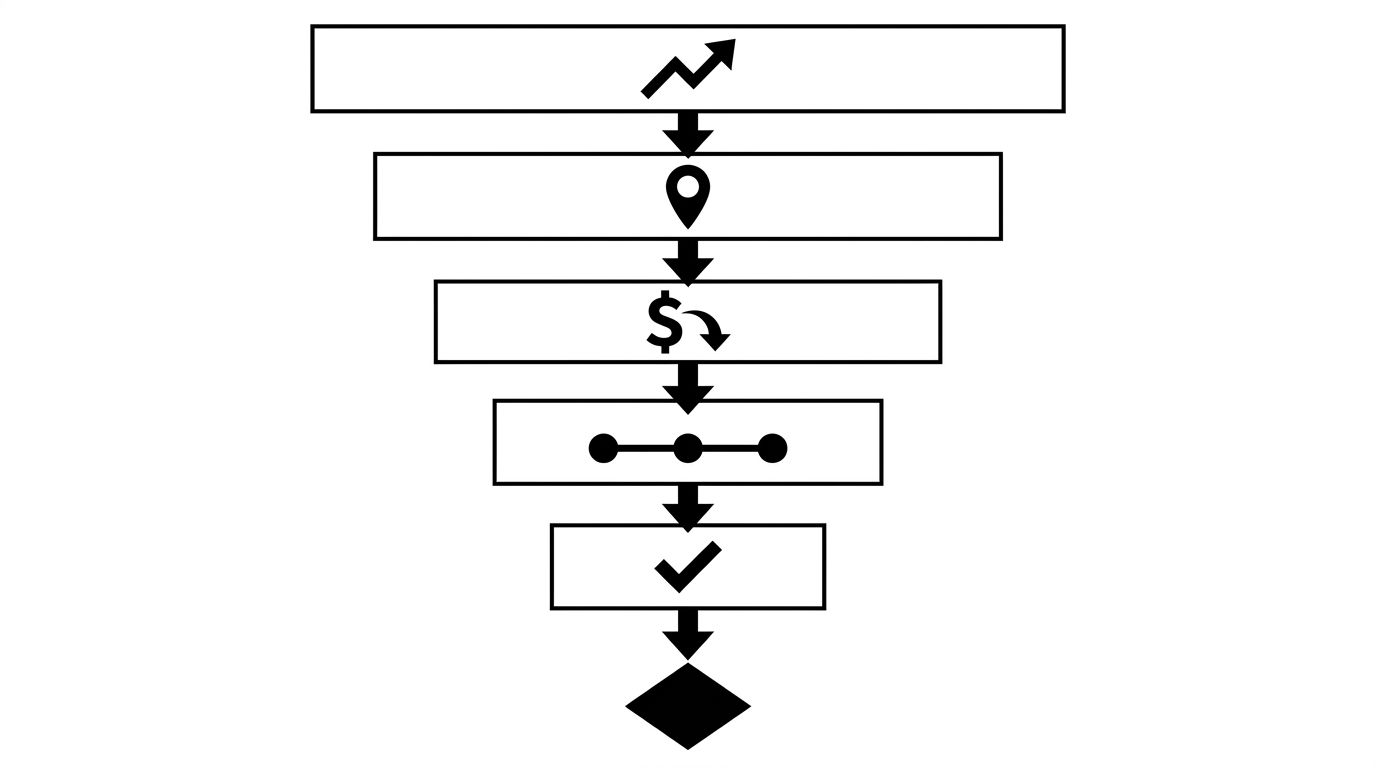
The five layers are the shape of a GEO business case. Most decks weaken at layer four, where marketers want tactics and executives want commitments.
Shift: market share of AI queries and growth rate, category-specific.
Position: your mention rate vs top three competitors across four platforms, for ten queries.
Displacement: dollar cost of staying flat over 12 and 24 months, assumptions visible.
Plan: 90-day, 6-month, and 12-month milestones tied to mention rate goals, not activities. "Reach 25% mention rate on top 20 queries by month six" is a commitment. "Publish 30 blog posts" is an activity.
Ask: headcount or vendor spend with a measurement cadence.
Our piece on AI visibility metrics has the definitions you will need in the plan slide.
Objection Handling You Need Ready
Three pushback categories, one-line answers to each.
- "Can't we just wait and see?" No. Mention rates for established brands compound. Competitors who start six months before you compound against you.
- "How is this different from SEO?" SEO optimizes for ten blue links. GEO optimizes for a single answer. Different surface, overlapping techniques. Our GEO vs SEO comparison is the follow-up read.
- "What's the attribution story?" Treat GEO like brand advertising for the first two quarters: measure mention rate and sentiment directly. Bring pipeline attribution online after you have a baseline.
The Deck Structure That Closes
Executives skim. The version that gets approved is usually 9 to 12 slides. Order:
- Title and one-line framing
- The market shift (data)
- Where you stand today
- Where your competitors stand (gap)
- Displacement cost
- The plan (90-day, 6-month, 12-month)
- The ask (budget, headcount, timeline)
- Measurement cadence
- Risks and mitigations
- Appendix
Hand a CFO this structure and the argument is defensible on first read.
Where to Start
Run a baseline audit before the pitch, not after. Walk in with a screenshot of your actual mention rate on ChatGPT, Perplexity, and Gemini for your ten most valuable queries, and your deck lands. Walk in with generic industry data, and you get asked to come back with specifics.
For a worked example, review the insurance case study of how a regulated vertical framed its business case, or explore our GEO optimization service.