Category Pages and AI Discovery: Beyond Individual Products
When AI shopping assistants answer 'best [category]' queries, what are they actually reading, and why do most category pages get skipped?

Category pages are the quietest miss in AI-era ecommerce. Brands pour budget into product pages and forget that AI assistants answer a huge share of shopping queries at the category level. "Best running shoes for wide feet," "top CRM for startups," "most sustainable skincare brands." These queries don't land on a PDP. They land on a response synthesized from category-level content. If your category pages are generic grids with two lines of copy, AI skips them and recommends whoever wrote something substantive about the category instead.
The Category Query Has Its Own Behavior
Product queries are specific ("does the Dyson V15 work on pet hair"). Category queries are comparative ("what's the best cordless vacuum for pet hair"). Those two queries require completely different content strategies, and AI models treat them differently.
- Product queries get answered from PDPs, reviews, and spec tables.
- Category queries get answered from editorial category content, comparison articles, and category pages that include decision frameworks.
The category query is where editorial-style content beats commerce templates, and where most ecommerce sites are invisible.
Why Most Category Pages Fail
Three patterns kill AI visibility on category pages. They're all fixable in a week.
- Product grids with thin copy. A grid of 40 products with a two-sentence intro teaches AI nothing about the category. The page is optimized for users who already filtered to a result, not for users (or AI) trying to decide what to buy.
- No comparative framework. AI models lift explicit comparisons: "X is better for beginners, Y is better for power users." Category pages that don't include a framework get summarized out.
- Duplicate boilerplate. Templated category pages where only the product list and H1 change look like noise to retrieval models. They lose to purpose-written content every time.
What AI-Ready Category Pages Look Like
The shape of a category page that earns AI citations looks more like a buyer's guide than a product listing. That doesn't mean abandoning commerce. It means adding the editorial layer that AI can extract.
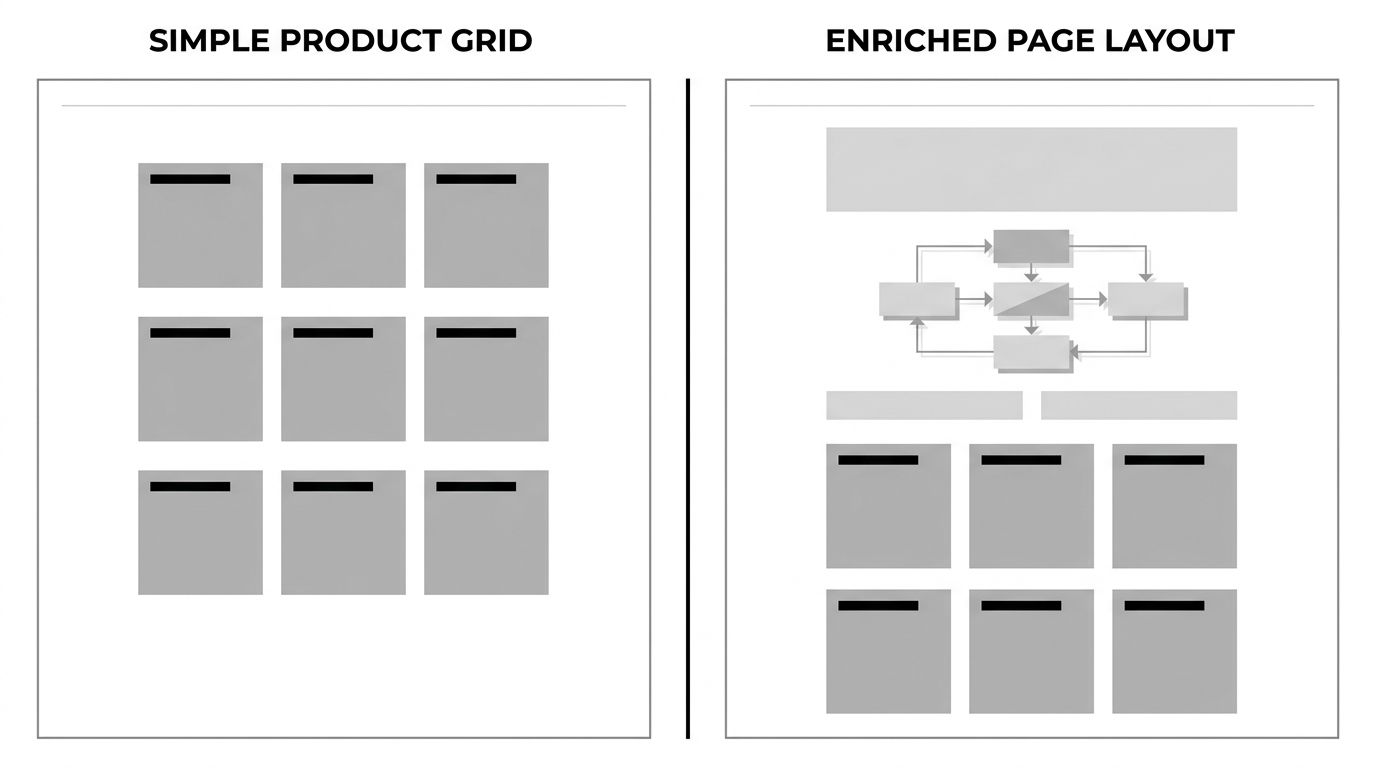
The layout on the right is what wins. Intro paragraph with a clear definition. A decision framework (3 to 5 factors). Named subsegments with a lead recommendation per segment. Then the product grid.
Six Changes That Move the Needle
Apply these across your top 10 category pages and measure impact over 60 days.
- Write a 150-word intro that defines the category, names the main buyer types, and includes the exact phrasing of the most common buyer question.
- Add a decision framework. "If you need X, choose A. If you need Y, choose B." Explicit, comparative, extractable.
- Name subsegments. "Best for beginners, best for wide feet, best for trail running." AI queries cluster around these subsegments.
- Include a recommendation per subsegment. Your own product if honest, otherwise the best fit. Recommendation-free content gets less cited than content that names winners.
- Add FAQ content with the three to five questions buyers actually ask at category decision stage.
- Implement CollectionPage and ItemList schema with breadcrumbs and category relationships. See the structured data guide for the specific fields.
Where Category Pages Fit in a Larger Strategy
Category pages shouldn't stand alone. They work best as part of a pillar-cluster content architecture where the category page links to the individual product pages and to supporting decision-help content.
Our pillar-cluster architecture guide covers the structure. The product page optimization guide covers the PDP side. Both layers need to work together.
For ecommerce brands that want an assessment of their category page coverage against AI queries, our ecommerce solution page outlines how we approach category-level audits.
What to Do This Quarter
Pick your top 10 category pages by revenue. Run each one through the six changes above. Track AI mention rate and citation rate on category-level queries before and after. Expect three to five percentage point share-of-voice gains on well-optimized categories within 60 days.