GEO for Startups: Building AI Visibility From Zero
Startups can't outspend incumbents on SEO, so how do you build AI visibility from zero and get ChatGPT, Perplexity, or Gemini to mention your brand first?


Startups have spent a decade accepting a brutal truth about SEO: you cannot compete with established brands on domain authority, backlink volume, or content library size. It takes years to build the signal that Google rewards. But GEO for startups operates on different rules entirely. AI models do not rank pages. They synthesize answers from content they judge to be deeply relevant, specific, and authoritative on a narrow topic. A startup with 20 precisely targeted articles on a focused niche can outperform a Fortune 500 company with 10,000 pages of broad content in AI recommendations, and it can happen in weeks, not years.
This is the structural advantage most startups miss. AI models weight topic authority differently than search engines weight domain authority. Google's algorithm rewards accumulated signals over time: backlinks, domain age, traffic volume. AI models like ChatGPT, Perplexity, and Gemini evaluate whether a source demonstrates deep, specific expertise on the exact question being asked. A startup that owns a narrow topic completely can earn AI citations before it earns a single page-one Google ranking.
Why the Playing Field Is Different for AI Visibility
The incumbency advantage that dominates traditional search barely exists in AI-mediated discovery. Here is why.
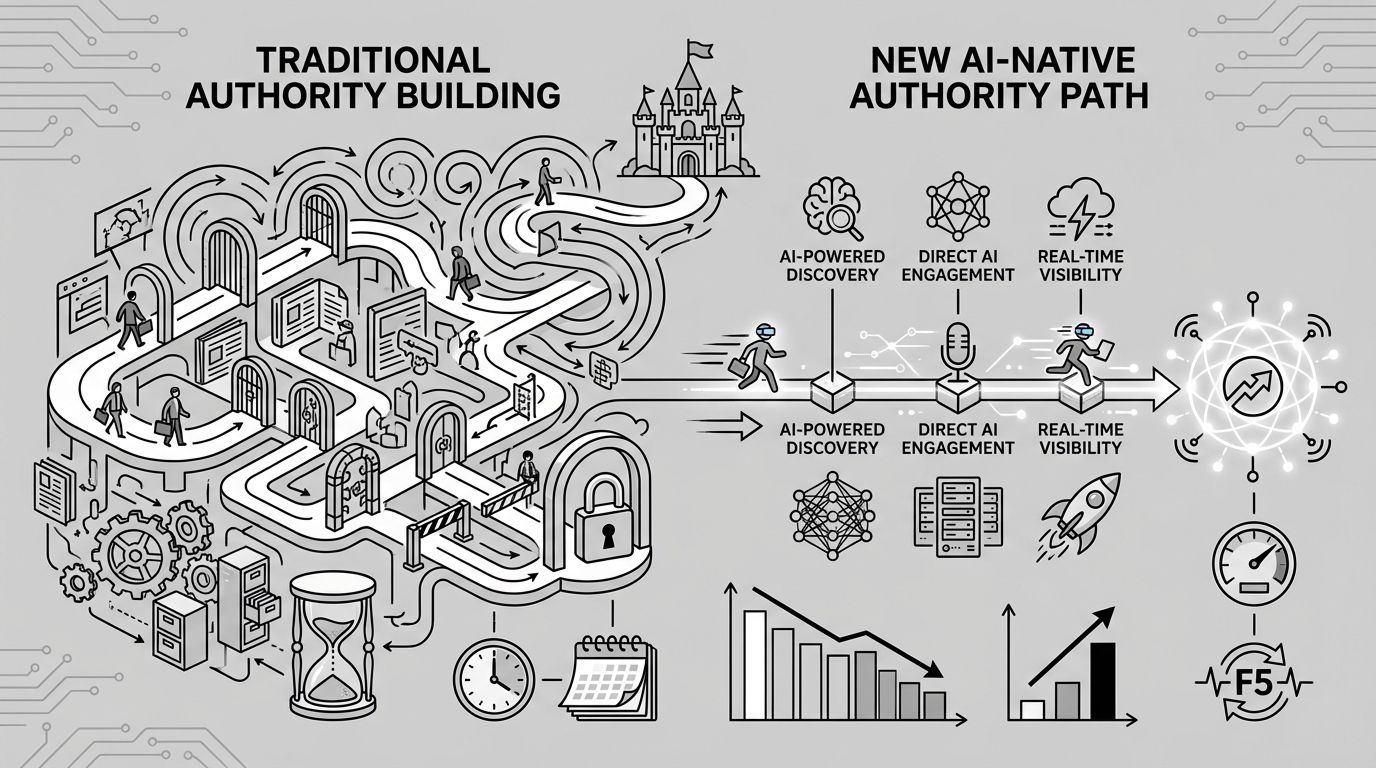
Search engines use signals that accumulate over years: backlinks from authoritative domains, consistent traffic patterns, domain age, and content volume. A startup cannot manufacture these overnight. AI models use a different evaluation framework:
- Topical depth over breadth. AI models favor sources that cover a specific topic thoroughly rather than sources that cover many topics superficially. A startup's natural focus is an advantage here.
- Recency matters more. AI training data and retrieval systems favor recent, up-to-date content. Startups publishing fresh perspectives on emerging topics compete on equal footing with incumbents whose content may be years old.
- Third-party validation is accessible. AI models weigh mentions in forums, reviews, and independent publications. A startup can earn Reddit threads, Product Hunt reviews, and niche community mentions far faster than it can earn enterprise-grade backlinks.
- Structured specificity wins. AI responses pull from content that directly answers specific questions. Startups that write precisely targeted content for specific use cases get cited over large brands with generic category pages.
The diagram below contrasts these two authority models and shows why the AI-native path favors focused, early-stage companies.
None of this means startups automatically win. It means the barriers are different, and they favor exactly what startups are good at: moving fast, focusing narrowly, and creating content with real expertise on a specific problem.
The Narrow Topic Strategy
The fastest path to AI visibility for a startup is to own a topic that is too specific for large competitors to bother with, but valuable enough that buyers ask AI about it.
Here is how to identify your topic:
- Map your expertise to buyer questions. What specific problems does your product solve? What questions do your early customers ask before they buy? These are the queries AI platforms answer.
- Check AI responses for your topic. Search ChatGPT, Perplexity, and Gemini for the questions your buyers ask. If the current answers are generic, incomplete, or cite outdated sources, you have an opening.
- Audit competitor depth. Large competitors may have a page that mentions your topic, but do they have five deeply researched articles that cover every angle? Usually not. Depth beats breadth in AI citations.
A B2B startup selling API monitoring tools, for example, should not try to compete for "best developer tools." Instead, target "how to monitor API latency for microservices" or "API error rate benchmarking for fintech." A startup with three authoritative articles on those specific queries will outperform a tool aggregator with a surface-level listicle.
Building Your First AI Visibility Foundation
Start with a focused content sprint. Ten to fifteen pieces of deeply specific content, published within a few weeks, can establish topical authority that AI models recognize fast.
Your content foundation should include:
- 3-5 definitive guides on your core topic, each covering a distinct angle that buyers research before purchasing
- 2-3 data-backed analyses using your own product data or original research, AI models heavily favor content with original data points
- 2-3 comparison pieces that help buyers understand how AI models choose between options in your category
- Community-seeded content, answers on Reddit, Stack Overflow, or niche forums that build the third-party signal AI models trust
Publish your definitive guides first. They become the foundation AI models associate with your brand. Then publish data-backed content that demonstrates original expertise. Finally, build community presence that creates the third-party citations AI models use to validate authority.
Measuring Progress Without Vanity Metrics
Startups waste time tracking metrics that do not map to AI visibility. Page views and organic traffic are SEO metrics. For GEO, you need different indicators:
- Brand mention rate, How often does your brand appear in AI responses for your target queries? Track this weekly across ChatGPT, Perplexity, Gemini, and Google AI Overviews.
- Citation frequency, When AI models cite sources in their answers, how often is your content among them? Perplexity shows citations explicitly; other platforms require monitoring tools.
- Competitor displacement, Are you appearing in queries where previously only established brands were mentioned? This is the clearest signal of growing topic authority.
- Query coverage, What percentage of your target buyer queries return AI responses that mention your brand? Expanding this coverage is the primary GEO goal.
Track these with a platform built for AI visibility metrics. Manual checking does not scale once you are monitoring more than a handful of queries.
Move Fast, Stay Focused
Startups that treat GEO as a scaled-down version of enterprise SEO will fail. The advantage is not in doing less of what big companies do. It is in doing something fundamentally different: building deep, specific authority on a narrow topic faster than incumbents can react.
Pick your topic. Audit your AI visibility. Build a focused content foundation. Monitor your visibility weekly. The compounding effect of AI recommendations means the startup that establishes topic authority first becomes increasingly difficult to displace.
Run a free AI visibility audit to see where your startup stands across AI platforms today. The window for early-mover advantage is still open, but it narrows with every competitor that figures this out.