SaaS Marketing: In-House vs Agency in 2026
Should a SaaS team build marketing in-house or hire an agency, and why does the usual cost-versus-control debate point you to the wrong answer?

The SaaS in-house vs agency decision is almost always argued on cost and control, and that framing leads you to the wrong answer. The variable that actually decides it in 2026 is research depth: whether whoever owns your marketing can run the category-specific research that AI-answer visibility now demands. An in-house team owns your product context and moves fast, but rarely runs the citation-graph research that decides whether ChatGPT and Google AI Overviews name you. A typical agency has breadth but runs the same playbook on every client. So the honest answer is rarely all-in-house or all-agency. It is a split: own the narrative and the product story in-house, and contract the research-first execution for the work that needs category-level investigation. This piece is how to draw that line for your stage.
The real question isn't cost or control
Cost and control are the wrong axes because they assume the work is interchangeable, that an in-house marketer and an agency are two ways to buy the same output and you are just picking the cheaper or the more controllable one. They are not buying the same thing.
The question that matters is which parts of your marketing depend on deep knowledge of your product and which depend on deep knowledge of how your category gets discovered. Those are different kinds of expertise, and almost no single hire or single agency has both at a high level. Frame the decision around that split and the answer gets clearer. Frame it around budget and you optimize for the wrong thing and end up with a generalist who is mediocre at both.
What in-house SaaS teams are good at, and where they stall
In-house teams win on context. They sit in the standups, hear the sales objections, watch the product roadmap change, and know why a feature exists and who it is for. That context is hard to transfer and it is exactly what makes positioning, messaging, product marketing, and launch narrative work. Nobody briefs an agency into that depth quickly.
They also win on speed and ownership. An in-house marketer can ship a positioning change the day after a competitor moves. They care about the outcome because it is their job, not a retainer line.
Where they stall is breadth and currency. A small in-house team cannot be expert at technical SEO, link earning, paid media, lifecycle, and AI visibility at once, so something gets done at an amateur level. And they rarely have time to keep up with how discovery is changing. Running the research loop that maps your category's buyer prompts and the sources AI engines cite is a real, ongoing job, and an in-house generalist juggling five channels almost never gets to it. That is the gap that quietly costs you presence in AI answers.
What agencies are good at, and the playbook trap
A good agency brings specialists you cannot justify hiring full-time and pattern recognition from working across many accounts. They have seen what works in dozens of categories, and they can staff a discipline deeply on day one instead of after a year of hiring.
The trap is that a lot of agencies sell a playbook. They run the same checklist whether you sell developer tooling to platform engineers or compliance software to general counsel. The checklist is not wrong, it is just generic, and generic loses in AI answers, because the engines build category-specific shortlists from category-specific sources. The Reddit threads, review categories, and editorial that decide a DevOps shortlist look nothing like the ones that decide a fintech shortlist. An agency that ignores that difference is doing competent work pointed at the wrong targets. We dug into this trade-off, including when to buy software instead, in GEO software versus agency.
So "hire an agency" is not one decision. It is a decision plus a screen: hire execution, but screen hard for one that researches your category rather than applying a template. The screen is the whole game, and it is the subject of our guide to choosing a B2B SaaS SEO agency.
The GEO wildcard: why AI visibility tilts the decision
Here is what changed the math. Buyers now ask AI engines to compare tools and build shortlists, and the answer is assembled from comparison pages, review sites, and community threads the engine cites. Winning that surface, generative engine optimization, is not a channel you can run on intuition. It needs the research loop: map the prompts your buyers actually type, reverse-engineer which sources the engines cite for your category today, and aim the work there.
That loop is the single capability most in-house SaaS teams lack and most need. It is specialized, it changes as the engines change, and it does not fit in the margins of a generalist's week. It is also the work a research-first partner is built to do. So the rise of AI search pushes the decision toward a split rather than a binary: keep the product-context work close, and contract the category-research work to someone who runs it as their main job rather than their sixth priority.
The hybrid split that actually works
For most SaaS companies past the earliest stage, the answer is not in-house or agency. It is deciding which work lives where.
Keep in-house the work that depends on product and customer context:
- Positioning, messaging, and narrative
- Product marketing and launches
- Lifecycle and onboarding content that needs product knowledge
- Brand voice and the final say on anything customer-facing
Contract out the work that depends on category-discovery expertise and specialist depth:
- The AI-visibility research loop and citation-share measurement
- Comparison, alternatives, and integration pages built from that research
- Technical SEO and the link and citation earning that moves AI answers
- Paid media when it needs a dedicated specialist
The principle is simple. Own what only you can know. Contract what someone who works across many categories knows better than you can, and what needs a research process you will not run consistently in-house. That split is the default. The next question is how it shifts as you grow.
Decide by stage
The right balance moves with company stage, headcount, and how much of your pipeline now runs through AI-assisted discovery.
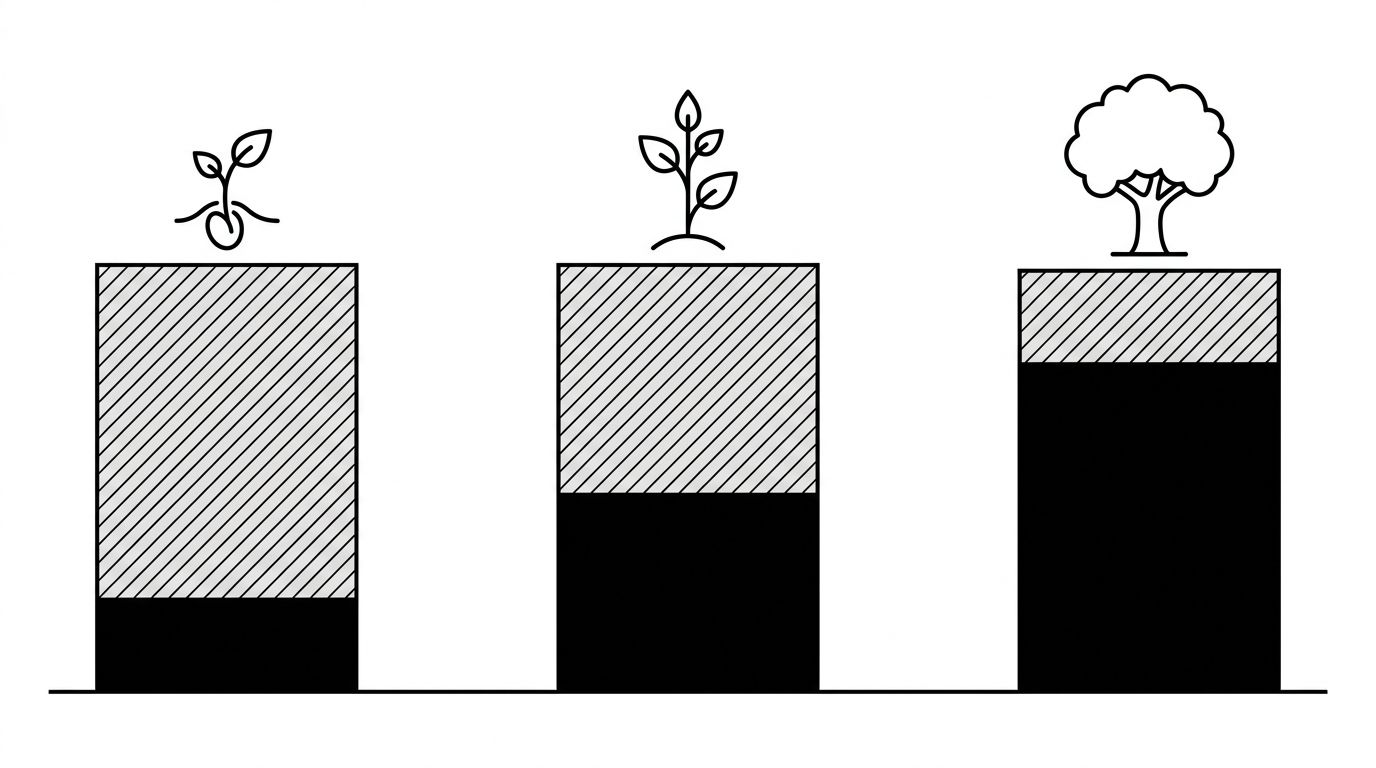
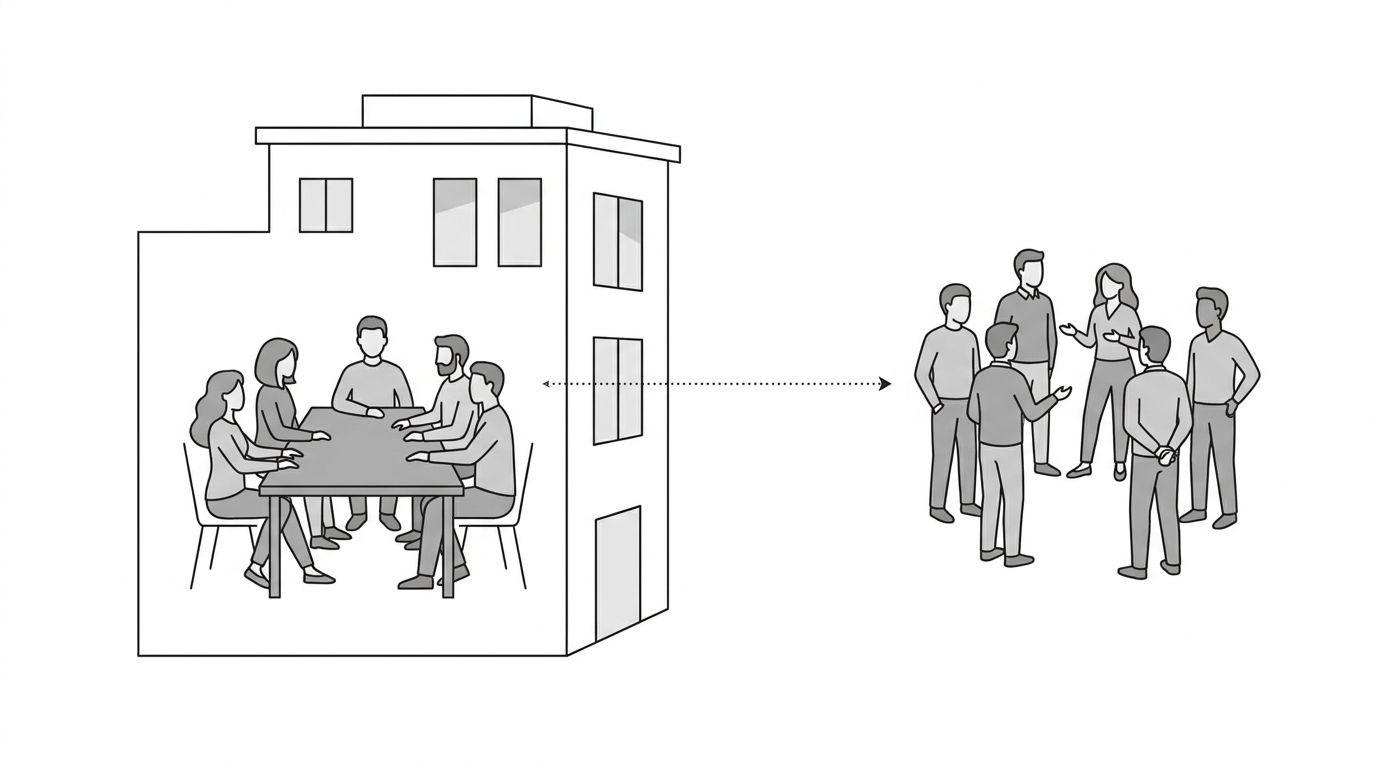
The diagram above maps the rough progression. In detail:
- Seed and early stage. You cannot afford a full team and you need range. Hire one strong generalist or a founder-led marketing motion in-house for narrative and product marketing, and contract a research-first partner or fractional specialist for SEO, AI visibility, and the technical foundation. Do not hire five specialists you cannot keep busy.
- Growth stage. Build the in-house core: product marketing, content, and demand gen that need your context daily. Keep contracting the specialist and research-heavy work, especially the AI-visibility loop, where an outside team stays current in a way a stretched in-house hire cannot.
- Scale stage. You can staff specialists in-house and many companies do. Even then, the research-first GEO work is often worth keeping with a partner, because it benefits from cross-category pattern recognition and from a team whose only job is tracking how the engines change. Bring it in-house only when you can dedicate a person to it, not as one more plate for an existing team to spin.
Across all three, the constant is the same: the AI-visibility research is the piece most likely to be neglected in-house and most likely to decide whether buyers find you in AI answers. Treat it as the work to protect, wherever it lives.
What to do next
Before you decide who owns what, get a read on the gap. A free audit shows whether the AI engines name you when buyers ask about your category, and which competitors and sources get cited instead, in about fifteen minutes. If you are absent there, you have found the work that does not fit in a generalist's week, and the strongest argument for contracting the research-first piece rather than hoping an in-house hire gets to it. For how that work maps to a SaaS program, see our SaaS solutions and SaaS SEO services, and the results behind it in our SaaS case study.