
How to Optimize Your Brand for Microsoft Copilot
Microsoft Copilot lives inside Outlook, Teams, and Edge, so how do you get your brand into the AI answers B2B buyers already use every workday?


Microsoft Copilot sits inside the tools your B2B buyers already use every day, Outlook, Teams, Word, Excel, and Edge. When a procurement manager asks Copilot to compare vendors or a marketing director asks it to summarize competitive options, the brands that show up in those responses influence real purchasing decisions. If you haven't taken steps to optimize your brand for Copilot, you're invisible inside the one AI assistant that lives in your buyer's daily workflow.
Here's what makes Copilot different from every other AI platform: it pulls primarily from Bing's search index and LinkedIn data, not from the broader training corpora that power ChatGPT or Gemini. That means brands that neglect Bing SEO and LinkedIn thought leadership are missing from the AI platform most embedded in enterprise environments. According to Microsoft's 2025 Work Trend Index, over 75% of Fortune 500 companies now have active Copilot licenses, and those users generate millions of brand-related queries weekly.
We covered how to optimize your brand for ChatGPT in a separate guide. This post focuses on Copilot's unique data sources and what you need to do differently.
Why Copilot Matters More Than You Think for B2B
Most GEO strategies focus on ChatGPT and Google AI Overviews because they have the largest consumer user bases. But Copilot occupies a different position in the buyer journey, it's embedded in workplace productivity tools, which means it influences decisions at the point of work, not the point of search.
Key factors that set Copilot apart:
- Enterprise integration: Copilot accesses internal documents, emails, and organizational data alongside web results. When an employee asks "what tools should we consider for [category]," Copilot blends internal context with external web data from Bing.
- Bing-first retrieval: Copilot's web grounding relies on Bing's index. Brands that rank well on Google but have poor Bing visibility may not appear in Copilot responses at all.
- LinkedIn signal weighting: Microsoft owns LinkedIn, and Copilot pulls from LinkedIn profiles, company pages, and published articles. Your LinkedIn presence directly feeds Copilot's understanding of your brand authority.
- Decision-point proximity: A user asking Copilot a question inside a spreadsheet or email is closer to a purchasing decision than someone browsing ChatGPT out of curiosity. Copilot mentions carry disproportionate conversion weight.
Optimize Your Bing Presence
Since Copilot's web grounding runs through Bing, your Bing SEO strategy is your Copilot optimization strategy. Here's where to focus:
- Submit your site to Bing Webmaster Tools, Verify ownership, submit your XML sitemap, and monitor your Bing-specific indexing status. Many brands discover that pages indexed on Google are missing from Bing's index entirely.
- Use IndexNow for rapid indexing, Bing supports the IndexNow protocol, which pushes new and updated content to Bing within minutes instead of waiting for a crawl. Implement IndexNow and push every important page update.
- Optimize for Bing's ranking factors, Bing places heavier weight on exact-match keywords in page titles, social signals, and multimedia content than Google does. Review your top pages and ensure titles contain your target terms precisely.
- Ensure structured data is Bing-compatible, While Google and Bing both support JSON-LD, Bing's crawler is stricter about schema compliance. Validate your structured data using Bing's markup validator, not just Google's Rich Results Test.
Run a free AI visibility audit to see whether your brand currently appears in Copilot responses for your target queries. Most brands that rank on page one of Google are surprised to find gaps in their Bing and Copilot visibility.
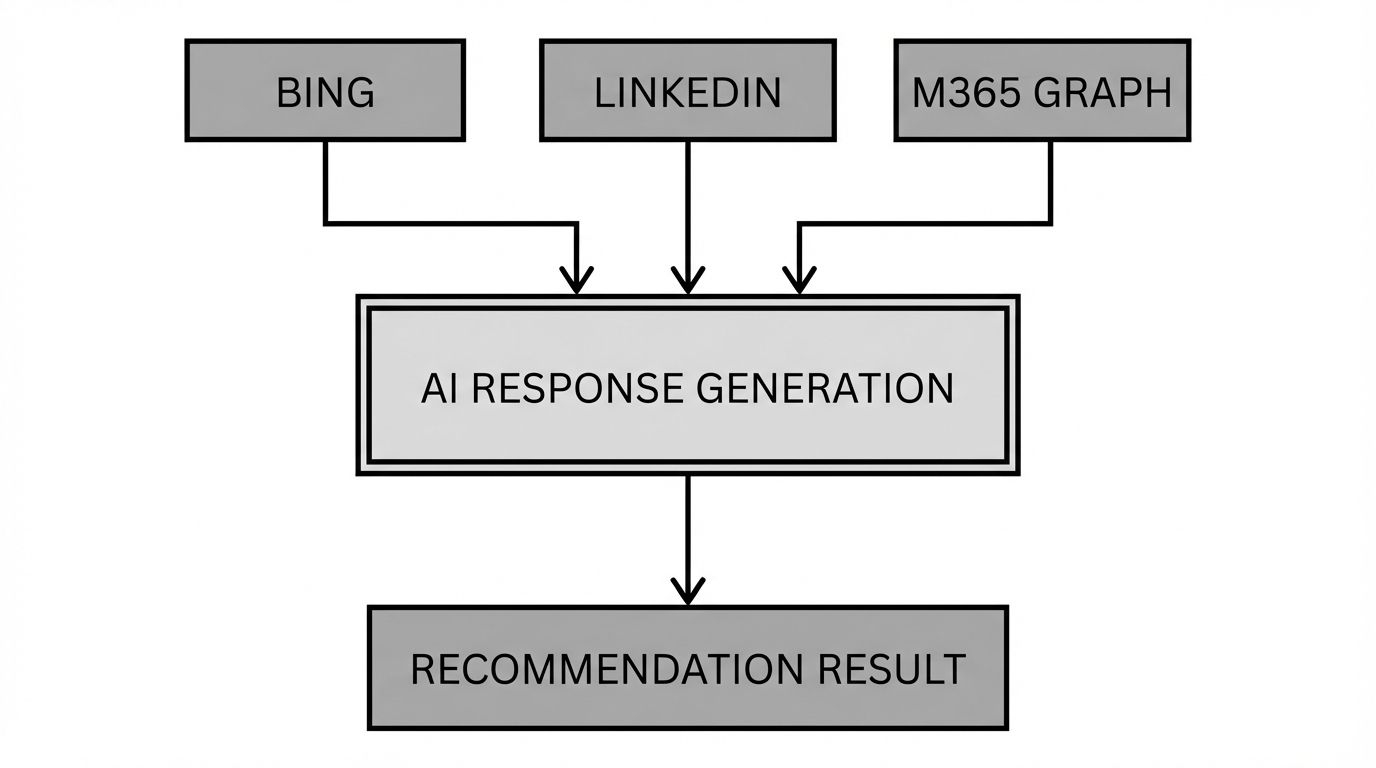
The diagram below illustrates how Copilot pulls from Bing, LinkedIn, and Microsoft Graph to assemble brand recommendations.
Build LinkedIn Authority That Feeds Copilot
LinkedIn isn't just a networking platform in the context of Copilot, it's a primary data source. When Copilot evaluates brand authority for B2B queries, it factors in LinkedIn signals that other AI platforms ignore entirely.
Actions that move the needle:
- Optimize your company page, Complete every section, publish weekly updates, and ensure your tagline and description contain the category terms your buyers search for.
- Publish long-form articles on LinkedIn, Copilot indexes LinkedIn articles as authoritative content. Write pieces that position your brand as a category leader, not sales pitches, but substantive analysis and original data.
- Encourage executive thought leadership, Individual profiles with large followings and consistent publishing histories signal brand authority. Your CEO, CTO, and VP of Marketing should each publish at least twice a month on topics related to your product category.
- Collect recommendations and endorsements, LinkedIn recommendations contribute to entity-level authority signals. Customers who recommend your team members on LinkedIn are indirectly strengthening your Copilot visibility.
Brands that AI models choose to mention tend to have strong signals across multiple platforms. For Copilot specifically, LinkedIn is the differentiating factor that most competitors overlook.
Structure Content for Copilot Extraction
Copilot's response generation follows patterns similar to other AI platforms, but with Bing-specific nuances. Your content needs to be structured for easy extraction.
- Lead every page with a clear, direct answer, Copilot pulls from the first 150-200 words of a page more frequently than from deeper content. Put your value proposition and key claims up front.
- Use FAQ schema on product and category pages, Copilot frequently formats responses as Q&A. Pages with `FAQPage` structured data align directly with Copilot's preferred output format.
- Create Bing-optimized comparison content, "Best [category] tools," "[Your brand] vs. [competitor]," and "[category] for [industry]" are high-frequency Copilot query patterns. Publish factual, balanced comparisons that include specific data.
- Maintain content freshness, Bing rewards recently updated content more aggressively than Google. Add last-modified dates, update statistics quarterly, and republish key pages with new data.
For a broader view of how content structure impacts AI visibility across all platforms, see our guide on AI platform optimization.
What to Do Next
Copilot's position inside the Microsoft 365 ecosystem gives it unique influence over B2B purchasing decisions. The brands that treat Bing SEO and LinkedIn authority as core GEO priorities, not afterthoughts, will capture disproportionate visibility where it matters most.
Start by auditing your current Bing index coverage and LinkedIn authority signals. Then run a free AI visibility audit to benchmark your Copilot presence against competitors. The gap between where you are and where you should be is almost certainly larger than you expect.