How to Optimize Your Brand for ChatGPT Recommendations
ChatGPT drives product recommendations for millions every week, so what patterns make it pick your brand, and how do you start showing up today?


ChatGPT now processes over 1 billion queries per week, and roughly 40% of product-related conversations include a brand recommendation. If your brand isn't showing up in those recommendations, you're ceding ground to competitors who have figured out how to optimize their brand for ChatGPT. The good news: this isn't a black box. ChatGPT follows identifiable patterns when selecting which brands to surface, and you can reverse-engineer them into a repeatable playbook.
We covered how ChatGPT decides what brands to recommend in a previous post. This guide builds on that foundation with tactical, step-by-step instructions you can implement this week. Every step here maps to a specific signal ChatGPT uses when generating recommendations.
Step 1: Audit Your Current ChatGPT Visibility
Before you optimize anything, you need a baseline. Most brands have never checked whether ChatGPT mentions them at all, let alone how it describes them.
Start with these actions:
- Query ChatGPT with your target prompts, Ask the questions your buyers would ask. "What's the best [category] tool for [use case]?" Run 10-15 variations and document every response.
- Record your brand's mention rate, Track how often you appear, in what position (first mentioned vs. last), and what language ChatGPT uses to describe you.
- Map competitor mentions, Note which competitors appear consistently and what attributes ChatGPT associates with them (e.g., "affordable," "enterprise-grade," "easiest to use").
- Run a free AI visibility audit, Get a structured benchmark across ChatGPT, Perplexity, Gemini, and other AI platforms so you know exactly where you stand.
Your audit will reveal one of three scenarios: you're not mentioned at all, you're mentioned but poorly described, or you're mentioned and well-positioned. Each requires a different optimization approach.
Step 2: Build Authoritative, Structured Content
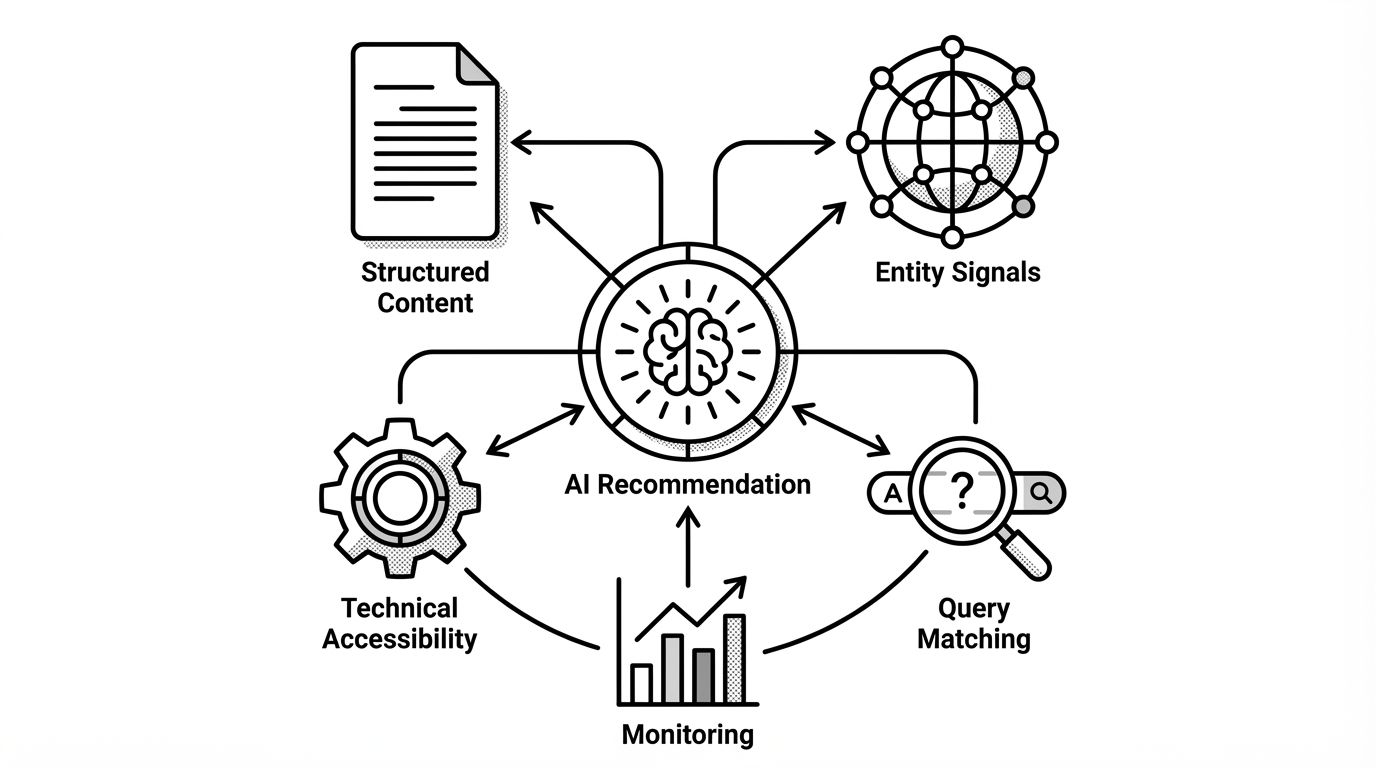
ChatGPT's training data and retrieval system favor content that is authoritative, well-structured, and entity-rich. Thin marketing pages with vague claims get ignored. Dense, factual content that clearly defines what your brand does, and backs it up, gets extracted and cited.
Here's what to prioritize:
- Create definitive "what is" and "how to" pages for your core product categories. If you sell project management software, you need a page that is the best answer to "what is project management software" on the entire internet.
- Use structured data (JSON-LD) on every key page. `Organization`, `Product`, `SoftwareApplication`, and `FAQPage` schemas give AI crawlers clean, machine-readable signals about your brand.
- Publish comparison and alternative pages, ChatGPT frequently pulls from "[Brand A] vs. [Brand B]" content. Own the comparison for your category before a third-party review site does.
- Include specific numbers, Pricing, customer counts, performance benchmarks, and integration counts. ChatGPT prefers concrete data over vague claims like "industry-leading" or "best-in-class."
The AI platform optimization guide covers how these principles apply across all major AI platforms, not just ChatGPT.
Step 3: Strengthen Your Brand's Entity Signals
ChatGPT doesn't just read your website. It builds an entity graph, a map of how your brand relates to concepts, categories, competitors, and attributes. The stronger your entity signals, the more likely ChatGPT is to associate your brand with the right queries.
Concrete steps to strengthen entity signals:
- Claim and optimize your Wikipedia page, Wikipedia is one of the most heavily weighted sources in ChatGPT's training data. If you don't have a page, work toward notability criteria. If you do, ensure it's accurate and current.
- Build consistent mentions across authoritative sources, Industry publications, analyst reports, conference proceedings, and established review platforms. ChatGPT cross-references multiple sources before surfacing a brand.
- Ensure NAP consistency, Your brand name, description, and core attributes should be identical across your website, LinkedIn, Crunchbase, G2, and every other platform where you appear.
- Publish expert-attributed content, Content authored by named individuals with established expertise signals higher authority to AI models that choose brands for recommendations.
A study of 5,000 ChatGPT brand recommendations found that brands mentioned on 3+ authoritative third-party sources were 4.2x more likely to be recommended than brands with only their own website as a source.
Step 4: Optimize for ChatGPT's Retrieval System
ChatGPT increasingly uses real-time web browsing and retrieval-augmented generation (RAG) to supplement its training data. This means your site's technical accessibility to AI crawlers directly impacts whether ChatGPT can find and cite your content in live conversations.
Key technical optimizations:
- Allow GPTBot in your robots.txt, `User-agent: GPTBot` must not be blocked. Check your current `robots.txt` and remove any disallow rules for GPTBot and ChatGPT-User.
- Ensure server-side rendering, Content hidden behind client-side JavaScript is invisible to most AI crawlers. Render critical product information, pricing, and feature descriptions server-side.
- Implement clean URL structures, AI crawlers extract content more reliably from pages with semantic, descriptive URLs than from parameter-heavy or hash-routed paths.
- Optimize page load speed, AI crawlers operate under strict timeout windows. Pages that take more than 3 seconds to return content risk being skipped entirely.
The technical GEO guide covers robots.txt configuration, structured data implementation, and crawl optimization in full detail.
Step 5: Create Content That Matches Recommendation Queries
ChatGPT recommendations are triggered by specific query patterns. If your content doesn't match these patterns, you're leaving visibility on the table.
The highest-value query patterns for brand recommendations:
- "Best [category] for [use case]", e.g., "best CRM for small businesses." Create dedicated landing pages or blog posts that directly answer these queries with your brand positioned as a strong option.
- "[Brand] alternatives", Users frequently ask ChatGPT for alternatives to known brands. Publish content that positions your product as a legitimate alternative with clear differentiators.
- "How to [solve problem]", Tutorial and how-to content gets cited heavily. Create step-by-step guides that naturally reference your product as part of the solution.
- "[Category] comparison", Feature-by-feature comparisons rank extremely well in AI retrieval. Be honest, include competitors, and lead with facts.
For each query pattern, map your existing content coverage. Identify gaps where you have no content targeting a high-intent query, then prioritize creating it.
Step 6: Monitor, Measure, and Iterate
ChatGPT's recommendations are not static. Models get updated, retrieval sources shift, and competitor content changes. Optimization is an ongoing process, not a one-time project.
Build a monitoring cadence:
- Weekly prompt tracking, Run your core query set against ChatGPT weekly. Track mention rate, position, and sentiment over time.
- Monthly content audits, Review which pages ChatGPT is citing (or ignoring). Update underperforming content with stronger signals.
- Quarterly competitive analysis, Benchmark your ChatGPT visibility against your top 3-5 competitors. Identify where they've gained ground and where you're ahead.
- Track model updates, OpenAI ships model updates regularly. After each major update, re-run your full query set to detect any shifts in your brand's positioning.
Tools like Geology's GEO optimization platform automate this monitoring across ChatGPT, Perplexity, Gemini, and other AI platforms, giving you real-time visibility into how your brand appears in AI-generated responses.
What to Do Next
Optimizing your brand for ChatGPT recommendations comes down to three things: structured content that AI can parse, strong entity signals across authoritative sources, and technical infrastructure that makes your site crawlable by AI bots.
Start with Step 1. Run a free AI visibility audit to see exactly how ChatGPT and other AI platforms currently describe your brand. The audit takes less than two minutes and gives you a concrete baseline to optimize against.