
AI Compliance for Regulated Industries: Healthcare, Finance, and Legal
In healthcare, finance, and legal, how do you keep AI from sourcing answers about your brand from outdated or non-compliant public content?

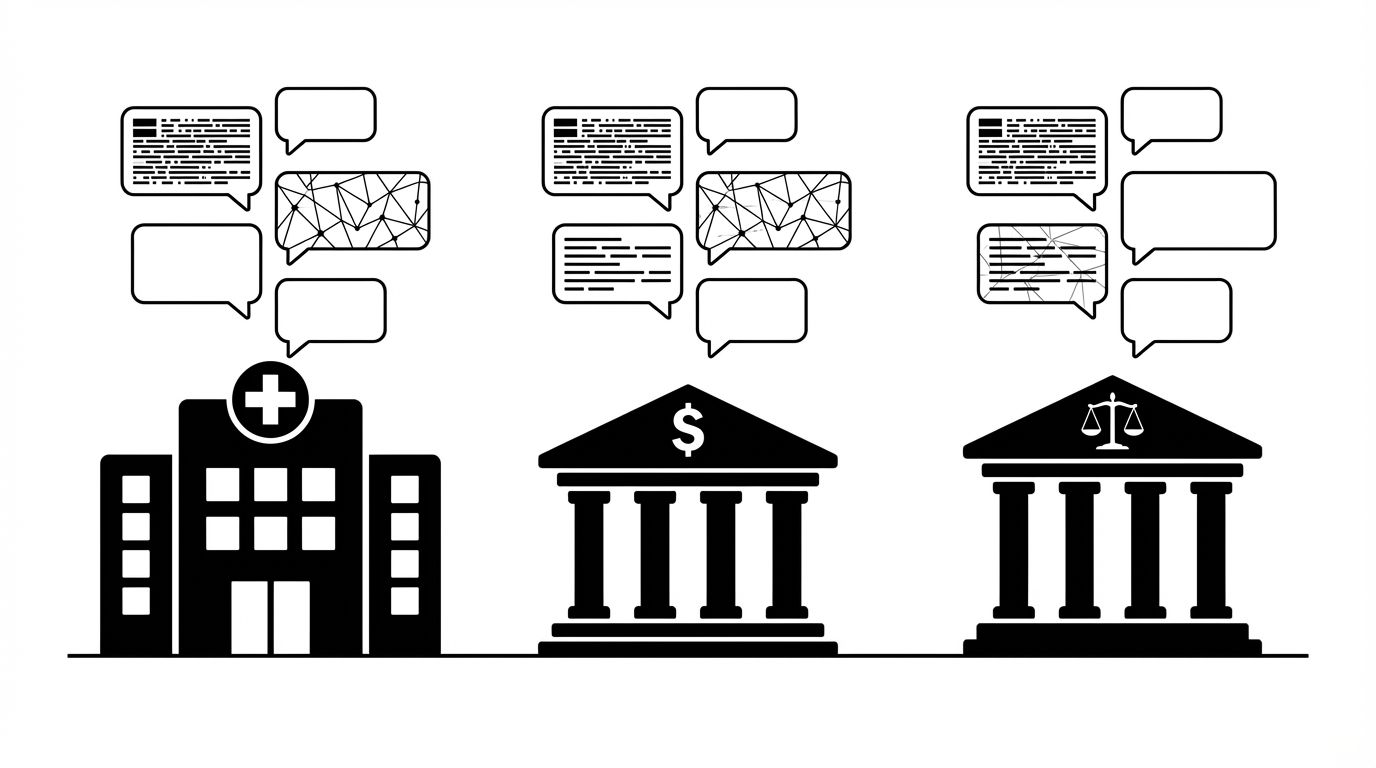
When a patient asks ChatGPT about treatment options for a chronic condition, the AI generates a confident, detailed answer. If the patient's hospital system is not represented in that answer, the AI does not stay silent. It fills the gap with information from whatever sources it does have: anonymous health forums, outdated medical blogs, or aggregator sites that may not reflect current clinical evidence. The hospital's absence is not neutral. It is a transfer of medical authority to whoever happened to publish content the AI could find.
The same dynamic plays out in financial services. When a consumer asks an AI about FDIC insurance protections during a banking scare, and the AI draws its answer from a 2009 blog post because no current bank has published structured, machine-readable content on the topic, the resulting misinformation has real consequences. In legal services, an AI confidently describing the wrong statute of limitations or fabricating case citations (as ChatGPT did in the Avianca Airlines case) can lead people to make decisions based on hallucinated legal guidance.
Every article about AI and regulated industries covers these risks from one angle: the danger of AI getting things wrong and the liability that creates. That framing is important. But it misses a more consequential point. For regulated brands, AI invisibility is itself a compliance and patient-safety risk. The absence of authoritative, accurate information from trusted healthcare, financial, and legal institutions does not create a vacuum. It creates a space that lower-authority sources fill, and the resulting misinformation is foreseeable and, increasingly, preventable.
This inverts the compliance conversation. The current regulatory focus (HIPAA requirements for healthcare organizations using AI internally, FINRA guidelines for broker-dealers deploying generative AI tools, the EU AI Act's risk classifications) addresses how regulated entities use AI as a tool. None of it addresses the downstream harm that occurs when regulated entities fail to make sure their information is represented in AI systems that millions of people consult daily. A Mount Sinai study found that AI chatbots routinely propagate medical misinformation when trusted institutional sources are absent from their training and retrieval data. A RankOS analysis found that fewer than 18% of financial services brands appear in AI-generated answers about their own categories.
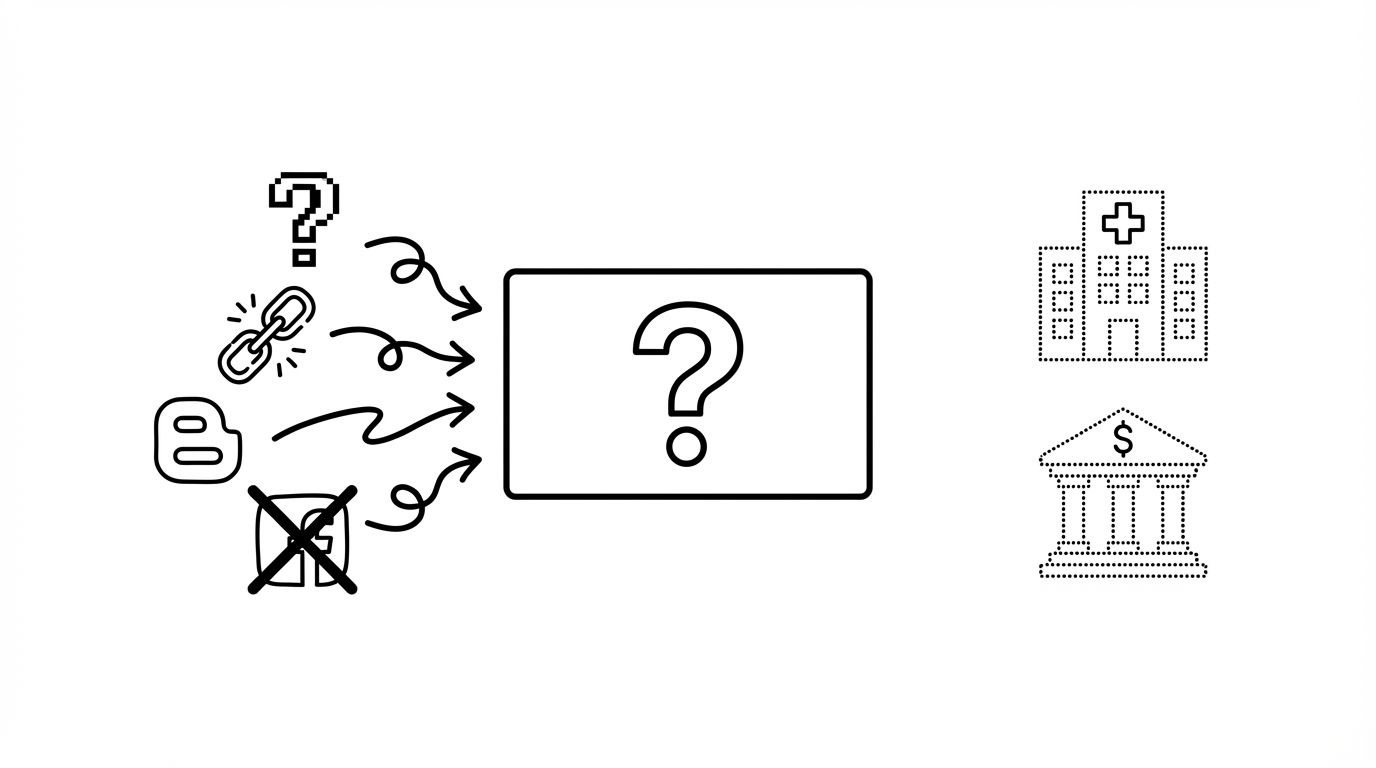
The diagram below illustrates the authority vacuum this creates. When trusted institutions are absent, unverified sources fill the gap, and the AI presents that lower-quality information with the same confidence it would give to an authoritative source.
Some legal scholars are beginning to call this a duty-to-be-visible: the idea that regulated organizations may have an obligation to ensure accurate representation in AI systems, because their absence creates foreseeable consumer harm. No formal regulatory guidance has codified this yet. But the direction is clear. As AI becomes a primary information channel for health, financial, and legal questions, regulators will increasingly ask why authoritative institutions allowed their expertise to be absent from the answers.
For healthcare organizations, this means treating AI visibility as a patient-safety initiative, not just a marketing channel. When 67% of AI-generated medical advice ignores trusted healthcare brands (according to Precis), the gap is a clinical information quality problem. Health systems need to publish structured, machine-readable content about their specialties, treatment approaches, and clinical expertise in formats that AI models can index and cite. FAQ sections with direct answers to common patient questions. Condition-specific guides written at appropriate reading levels. Provider directories with structured data that AI can extract. The goal is not traffic. It is making sure that when a patient consults an AI, the answer reflects current clinical evidence from credible institutions.
For financial services, the imperative is similar but the signals differ. Financial institutions operate under strict advertising and disclosure requirements, which has historically made their marketing teams cautious about publishing content at scale. That caution, while understandable, has created the exact visibility gap that makes AI answers about financial topics unreliable. Banks, insurers, and fintechs need to publish structured, compliant content that AI can cite: product comparison data, regulatory explainers, fee disclosures, and protection information in machine-readable formats. This is the core of how we approach financial services and insurance marketing, where compliant structure is the citation signal. FINRA's recent guidance on generative AI use by broker-dealers focuses on internal AI governance, but the external-facing visibility gap is where the consumer harm actually occurs.
For legal services, the stakes are uniquely high because AI-generated legal information can directly influence decisions with irreversible consequences. Law firms and legal aid organizations need to make sure their expertise is represented in AI responses about common legal questions: employment rights, immigration processes, landlord-tenant disputes, contract basics. The alternative is that AI continues to generate answers from outdated or jurisdiction-incorrect sources, and the people most harmed are those with the fewest resources to verify the AI's output.
The compliance framework for AI visibility in regulated industries is still forming. But the smart institutions are not waiting for regulators to tell them to act. They are building their AI content infrastructure now, not because it drives leads, but because it is the responsible thing to do. And because early movers will establish the citation patterns that AI models default to as the regulatory picture solidifies.
Start by understanding how AI currently represents your organization. Run a free AI visibility audit to see what major AI platforms say about your brand, your services, and the health, financial, or legal topics your expertise covers. The gap between what the AI says and what is clinically, financially, or legally accurate is your compliance risk surface.
Deeper into AI compliance for regulated industries
Each regulated category has its own operating constraints, and the playbooks differ enough that a single post cannot do them justice. The links below go deeper on the day-to-day decisions marketing and compliance teams face.
Finance marketers running AI content under FINRA and SEC advertising rules will get the most from compliance risks of generative AI for finance marketing, which separates the outbound review surface from the AI-generated answers no one is monitoring.
Hospital and wellness teams trying to figure out what HIPAA actually restricts versus what their legal team thinks it restricts should read healthcare brands and AI Overviews: what HIPAA changes. The short version is that the safe move is publishing more structured clinical content, not less.
Carriers and brokers working under state Department of Insurance scrutiny will find the practitioner playbook in insurance brand reputation in AI: regulator-safe practices, which walks through the three signals AI models weigh most for insurance brands. On the commercial side, our GEO for insurance carriers work operationalizes those signals for carriers, brokers, and insurtech.
For teams operating across the EU, the EU AI Act and brand visibility covers how transparency and output safeguard rules reshape what ChatGPT, Gemini, and Copilot say about your category in European markets.
If you are looking for the trust signals AI models rely on when every regulated competitor sounds the same, GEO for financial services breaks down what moves a recommendation in a category where the marketing language is hedged across the board.
Healthcare and wellness brands competing against the CDC, NIH, and Mayo Clinic in AI answers should read GEO for healthcare and wellness brands, which covers the credentialing, schema, and editorial signals retrieval systems actually look for.
For an applied example of how a regulated brand earned AI citations under a real compliance constraint, the insurance case study shows the before-and-after of a carrier that rebuilt its content footprint to be both DOI-safe and AI-citable.