The First-Mover Advantage in GEO: Why Early Investment Compounds
Why does early GEO investment compound in retrieval weights, and what does waiting a single quarter actually cost a brand in a contested category?


Most "first-mover advantage" arguments in marketing are lazy. This one is not. In GEO, early movers get a structural reinforcement loop that compounds against late entrants: once an AI model associates your brand with a category, its own citation behavior trains future retrieval on that association, and your brand becomes the default answer. A competitor cited three months before you accumulates a lead that compounds in retrieval weights. The right question is not "should we do GEO?" but "what does waiting one more quarter cost?" For most brands in contested categories, the answer sits in the low hundreds of thousands per quarter.
Why This Compounding Is Real, Not a Marketing Line
Three mechanics drive the loop, and they stack.
Retrieval reinforcement. When a model selects your content to ground an answer, that citation feeds future retrieval weights. Perplexity's citation graph, ChatGPT's browse memory, and Gemini's knowledge graph all use prior citations as ranking inputs. Getting cited once makes the next citation more likely.
Training data accumulation. GPTBot, ClaudeBot, and Google-Extended capture content for the next model version. A brand that shipped AI-ready content in 2025 shows up in 2026 training corpora. Latecomers wait for the next cycle.
User behavior locks in. Once a buyer hears the same three brand names for "best analytics tools for SaaS," those names become the mental default.
Combined, the effect is multiplicative. Our piece on AI visibility and market share correlation has the share-shift data.
The Timing Window That Actually Matters
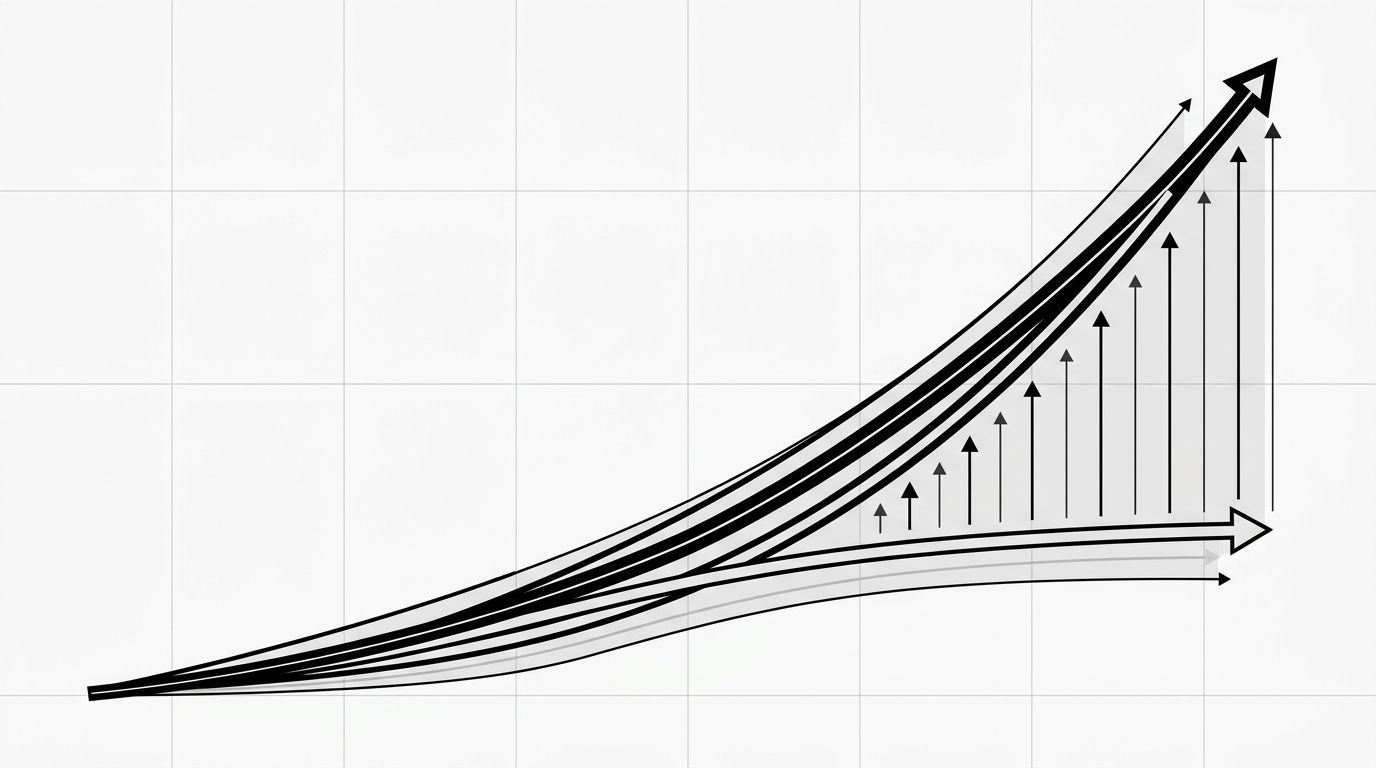
The divergence above is the shape of GEO compounding. Two brands start at equal mention rates at time zero. Brand A invests in Q1. Brand B waits until Q4. By Q8, the gap is typically 3 to 5x the mention rate, because every quarter A was cited reinforced the next quarter's citations.
- Quarters 1 to 2: early-mover advantage looks modest, mention rates 10 to 20% higher.
- Quarters 3 to 4: gap widens to 40 to 60%, driven by retrieval reinforcement.
- Quarters 5+: the late entrant needs 1.5x to 2x the investment the early mover made to close the gap.
This is not theoretical. SaaS brands that started GEO programs in early 2025 are now cited 2 to 4x more than competitors who started late 2025, for comparable category queries.
The Category Window Is Narrower Than You Think
Not every category has the same window. Two factors determine how quickly it closes.
- Query volume maturity: high-volume categories (CRM, project management, enterprise security) see AI citation patterns stabilize within 12 to 18 months. After that, reordering the leaderboard takes much more investment.
- Content supply: categories with fewer authoritative sources reach AI saturation faster. Niche B2B verticals often close in 6 to 9 months.
If your category has fewer than a dozen well-known brands, you are in a 6 to 9 month window. In CRM or marketing automation, you are likely past the easiest wins, and the play becomes targeted query displacement. Our GEO for SaaS guide covers those tactics.
Why Late Entrants Overspend to Catch Up
Closing a compounded gap is nonlinear for three reasons.
First, the early mover's content is already embedded in retrieval indexes. Displacing it means publishing better content and earning authority signals that override the existing association, which pulls PR, backlinks, and original research into the budget on top of content.
Second, AI models apply a recency discount, but slowly. Older cited content holds position for months, so a Q1 lead keeps paying off through Q4 even without new publishing.
Third, training data is baked in until the next model update. Miss the GPT-5 training window and you wait a year for GPT-6.
The Calculation That Should Be on the Slide
If you are building a business case (see building a business case for GEO), the cost of waiting is calculable:
- Current AI query volume for your category
- Projected AI query growth over the waiting period
- Competitor mention rate growth over the same window
- Displacement cost = (your gap vs competitor) x addressable volume x conversion value
For mid-market brands in competitive categories, this lands between $150K and $800K per quarter of delay. That is the figure the CFO should see.
Where to Start This Quarter
Do three things well, not everything.
- Audit baseline mention rate across ChatGPT, Perplexity, Gemini, and Copilot for your top 20 queries
- Identify the five queries where a competitor leads you by 20+ points, those are your targets
- Invest in content, schema, and citation-earning PR for those five queries specifically
For startups, the first-mover play is different: our GEO for startups guide breaks it down. To see an early-mover play run in a regulated vertical, review our insurance case study.