The Rise of AI-Native Brands: Companies Built for AI Discovery
What structural choices are AI-native startups making that let them dominate AI recommendations from day one, and which are worth copying?


A new cohort of companies shows up in AI answers faster than any traditional brand, and it is not because they spend more on content. They design every public artifact as retrievable training data from the first commit. Docs, pricing page, changelog, founder's Substack, podcast transcripts, public roadmap. Each of these is an entity signal a language model can ingest, attribute, and recall. Bolt, Cursor, Linear, and Val.town did not win AI mentions by being louder. They won by making themselves easy for a model to describe accurately. If your 2026 content strategy still starts with a blog, you are behind companies that started with structured, attributable, machine-readable everything.
What "AI-Native" Actually Means
AI-native does not mean "uses AI in the product." It means the company's discoverability surface is built for LLM ingestion first, human browsing second. Four structural choices define the category.
Machine-readable by default. Docs in Markdown served as plain text, pricing in tables rather than image banners, changelogs as RSS, APIs with OpenAPI specs. Content designed to be parsed.
Founder-legible authorship. A named human voice, usually the founder or an engineer, writing under their real name. Pseudonymous content is a handicap.
Public by default. Public changelog, roadmap, incident history, Discord. AI models train on what they access.
Explicit entity framing. Homepage says what the product is in ten words. The "about" page names the people, funding, offices. AI models latch onto clear entity descriptions and use them verbatim.
Our piece on thought leadership AI models recognize covers authorship, and structured data for AI visibility covers the markup.
The Structural Bet These Companies Are Making
AI-native brands play a different long game than legacy SaaS.
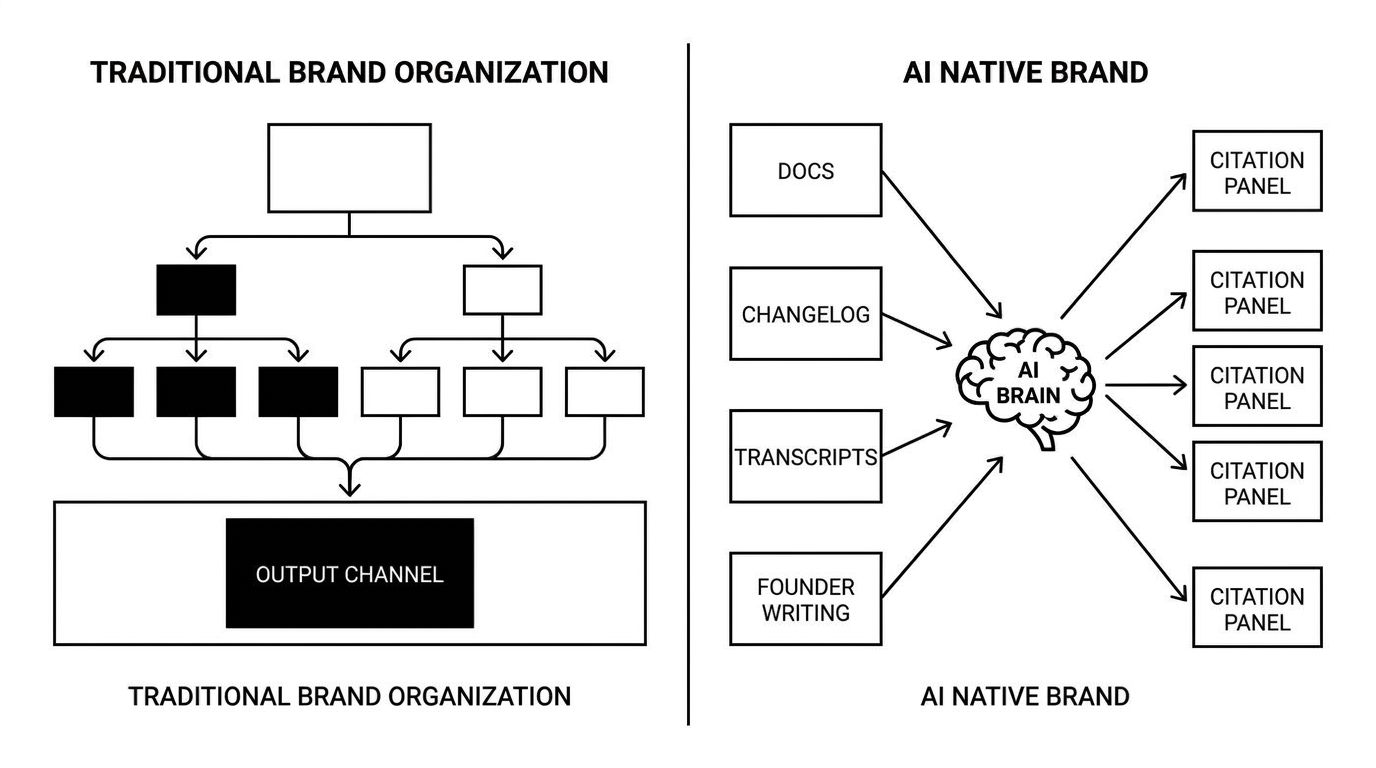
The diagram shows what changed. In a traditional brand, marketing owns the content surface. In an AI-native brand, every public function produces retrievable content. Marketing coordinates, not gatekeeps.
The bet: over five years, the brands AI platforms cite confidently will be the ones easiest to cite. Volume matters less than ingestibility, attributability, and coherence across surfaces. Linear's docs read the same as Linear's blog as Linear's founder's Twitter. ChatGPT picks up on that consistency and cites the brand as a known entity.
Three Playbook Moves Worth Copying
Most brands cannot rebuild from scratch. They can copy the moves that drive the effect.
- Publish docs as the primary content surface. Long, detailed, entity-dense, plain-language docs outperform blog posts for AI citation on technical queries.
- Operate a public changelog. Versioned, dated, plain-text. AI models use changelogs to understand product evolution and cite them for "what does X do" queries.
- Name a human voice. Pick one founder or principal engineer and publish under their name consistently. Our piece on topic authority and AI trust explains why.
Brands adopting these three moves often see mention rate on ChatGPT and Perplexity rise 30 to 60% within two quarters, without increasing content output.
The Startup Advantage, and Why It Disappears
Startups get to build AI-native from scratch. Enterprises retrofit. That sounds like a permanent advantage but is not.
The window where AI-native startups outrank incumbents is roughly their category's AI saturation curve. In new categories (AI agents, dev tools for LLMs, RAG infrastructure), startups dominate for 18 to 24 months before incumbents catch up. In mature categories (CRM, marketing automation), AI-native startups struggle because incumbents have content predating AI.
For founders: AI-native is a moat only if you move fast. For incumbents: legacy content is an asset if you convert it to AI-readable formats quickly. Our first-mover advantage in GEO covers the compounding mechanics.
What Enterprises Should Copy Right Now
Large brands do not need to become startups to adopt the playbook. Three moves port cleanly.
- Open up the docs. Move product documentation out of gated PDFs into public plain-text HTML. This alone moves mention rate more than most content programs.
- Start a public changelog. Dated, plain-text, named-feature updates AI models can parse.
- Publish under named authors. Kill the "team" byline. Credit a specific person and link to their profile.
These are structural decisions marketing can push for. Enterprises that run this as a 90-day initiative see the retrieval lift before the content team finishes its quarterly plan.
Where to Start
Audit your public surface. How much of your brand lives in formats a language model ingests without friction (plain-text HTML, structured data, named authors, public docs)? If less than half, you are leaving AI visibility on the table regardless of how much content you publish.
For the strategy layer, explore our GEO optimization service.