How to Build a GEO Strategy from Scratch in 2026
How do you move from chasing GEO tactics to a real strategy, so AI visibility compounds across content, signals, and every major platform?

Most brands approach generative engine optimization the same way they approached SEO in 2010. They chase individual tactics without a unifying framework. Add some schema here, publish a FAQ there, hope for the best. The brands winning AI visibility right now do something different: they build a GEO strategy as a system, where content authority, structured data, and cross-platform monitoring reinforce each other in a loop. If you treat GEO as a checklist of one-off fixes, you will keep losing ground to competitors who treat it as an operating model.
This guide walks you through that system end to end: the four-layer framework, a concrete how-to for each layer, a worked example that runs one brand through the whole thing, a 90-day roadmap, an annotated template, the mistakes that quietly sink most programs, and how the approach shifts across ChatGPT, Perplexity, Gemini, and Google AI Overviews. By the end you should be able to write your own plan on one page and start executing it the same week.
Why Tactics Without Strategy Fail
A common pattern plays out across industries. A marketing team reads that FAQ schema improves AI citations, so they add FAQ blocks to fifty pages in a week. Mentions tick up briefly, then flatline. Why? Because AI models do not recommend brands based on a single signal. They weigh topical authority, citation consistency across sources, and sentiment patterns over time.
- Isolated schema markup gets ignored when surrounding content lacks depth
- A single optimized page cannot outweigh dozens of thin, unfocused pages
- Sporadic content bursts signal inconsistency, not authority
The lesson: individual tactics work only inside a strategic framework that compounds.
There is a second reason tactic piles fail, and it is harder to spot. Without a baseline and a monitoring loop, you cannot tell which tactic moved the number, so you keep doing all of them forever. Strategy is partly about what you do and partly about knowing what to stop. The four layers below give you both.
The Four Layers of a GEO Strategy
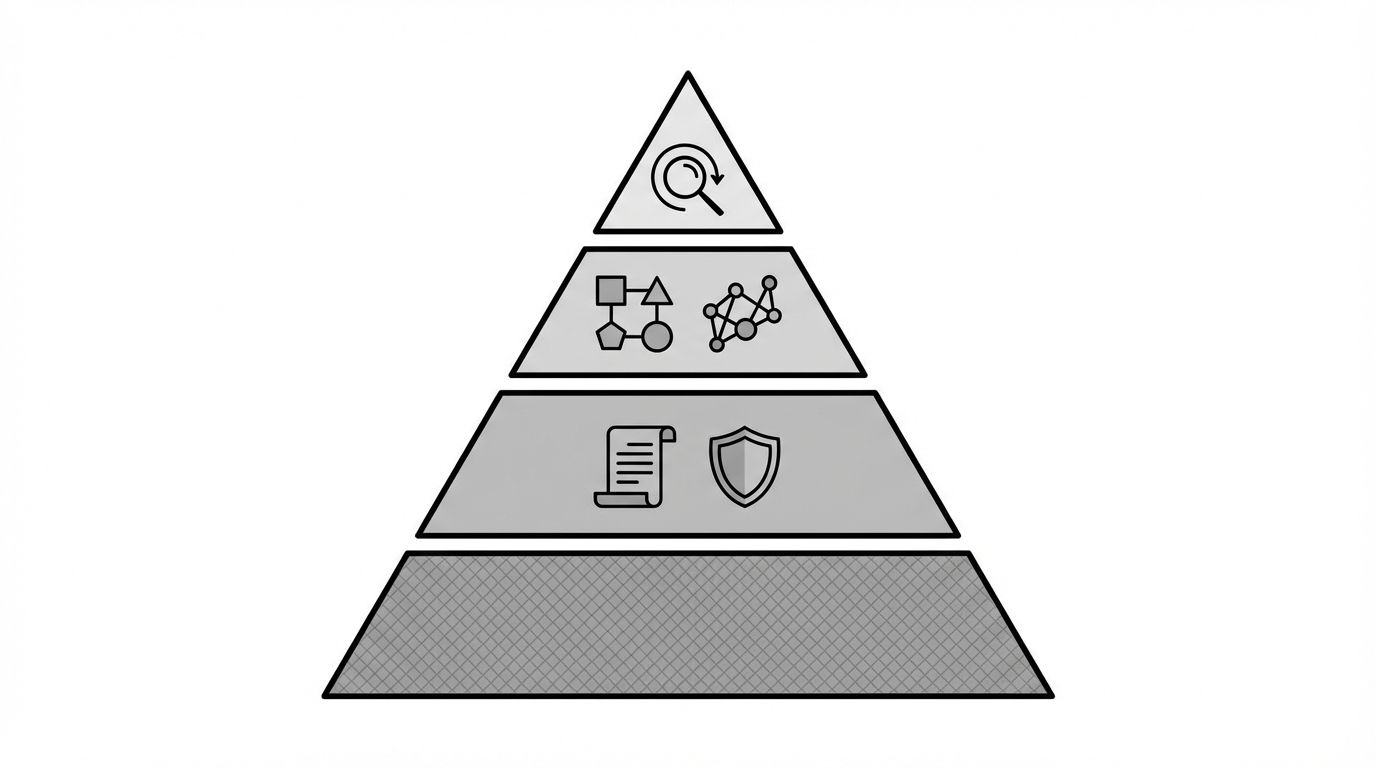
Think of a working GEO strategy as four layers, each building on the one below.
The diagram below maps these four layers and how they connect.

Read the layers bottom to top. Each one assumes the one below it is in place. You cannot judge content authority gains without a baseline, and structured signals do nothing for pages with no depth behind them. Skip a layer and the ones above it stop returning anything you can measure.
Layer 1: Foundation (Audit and Baseline)
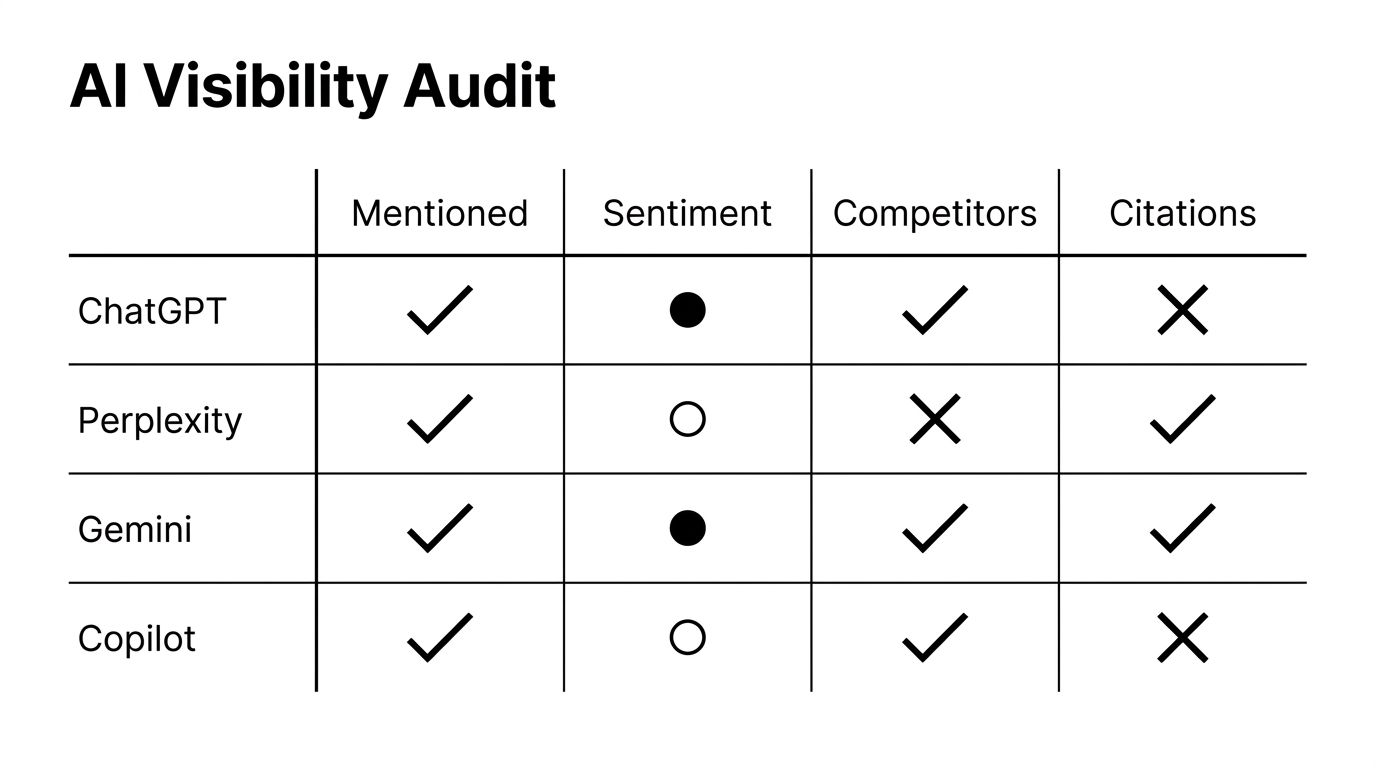
Before you optimize anything, you need to know where you stand. Run an AI visibility audit across ChatGPT, Perplexity, Gemini, and Copilot for your core brand queries. Document:
- Which platforms mention your brand and in what context
- Which competitors appear where you do not
- What sentiment AI models associate with your brand
- Which sources AI platforms cite when discussing your category
This baseline becomes your measurement anchor. Without it, you cannot tell whether future efforts are working.
The baseline below shows the kind of grid you are building: each AI platform against whether your brand is mentioned and how it is characterized.
Here is the how-to, in order, so you can run it this week. First, write down the prompts your buyers would type, not the ones you wish they typed. Mix three kinds: category prompts ("best tools for X"), problem prompts ("how do I fix Y"), and direct-brand prompts ("is [your brand] any good"). Aim for a working set, say 20 prompts, weighted toward the category and problem buckets, because that is where you are either present or invisible.
Second, run every prompt on each platform and capture the full response, not a summary. Note three things per response: whether you appear, which competitors appear, and which URLs the model cites. Citations matter as much as mentions, because they tell you which sources the model trusts in your category, and those sources are your real competition for attention.
Third, score sentiment in three buckets, positive, neutral, negative, and write one line of evidence for each, the exact phrase the model used. "Neutral, listed with no descriptor" is a different problem from "negative, described as expensive for what you get," and they need different fixes.
Fourth, turn the grid into a single baseline number you will defend for 90 days. Mention rate is the cleanest one: out of 20 category and problem prompts, in how many does your brand appear at all. Record it, date it, and resist adding more metrics until you have moved this one.
Layer 2: Content Authority
AI models recommend brands they consider topically authoritative. Building that authority requires depth, not breadth. Pick three to five topics where your brand has real depth and build dense content clusters around them.
- Each cluster needs a thorough pillar page plus five to eight supporting articles
- Supporting articles should link back to the pillar and to each other
- Every piece must add a specific, non-obvious insight, not restate what already exists online
- Publish consistently, not in bursts. Weekly cadence beats monthly dumps
Your content strategy should prioritize topics where you can credibly out-depth every competitor.
The diagram below shows the shape you are aiming for: one pillar page at the center, supporting articles linked around it and to each other.
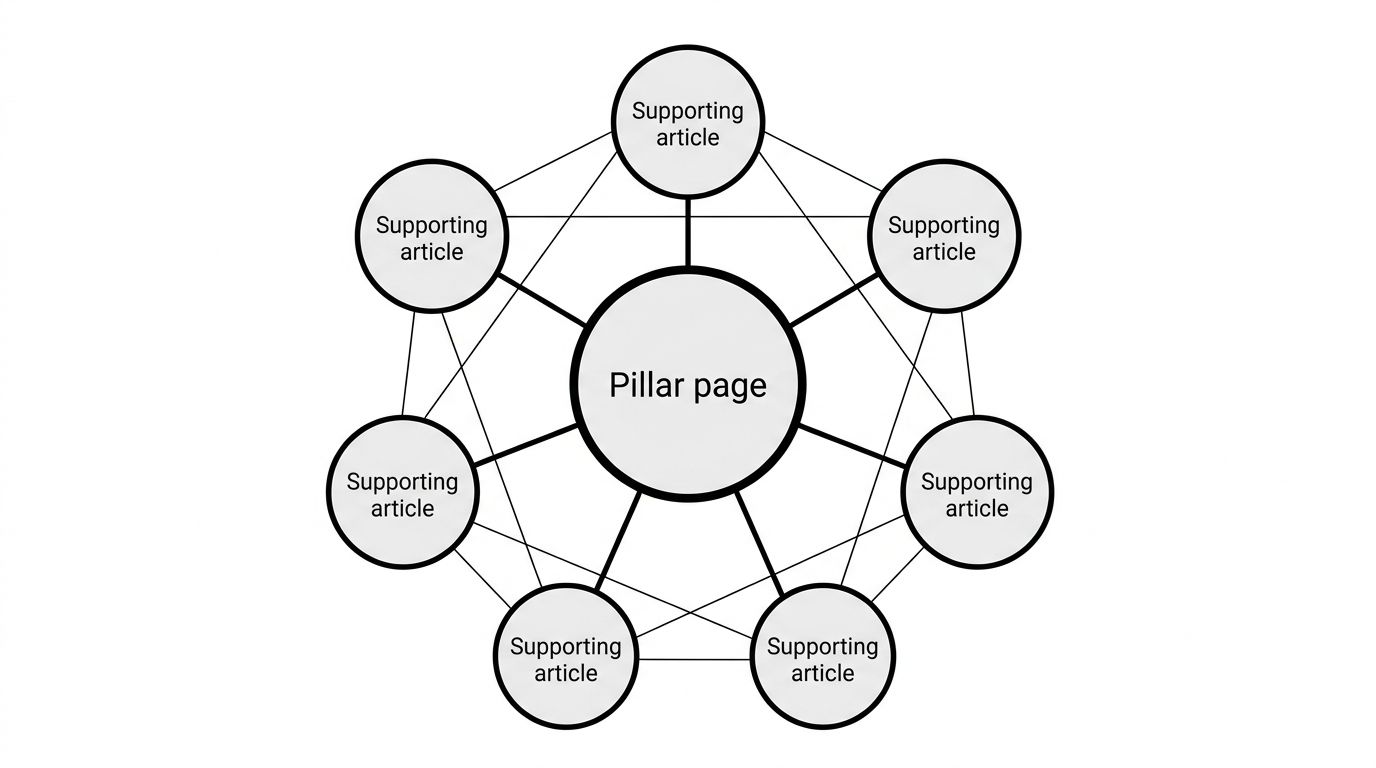
Walk it in this order. Start by choosing the cluster topic from your Layer 1 grid, not from a keyword tool. Pick the category where a competitor shows up and you do not, and where you have genuine first-hand depth: real customer data, a strong opinion, a process nobody else publishes. If you cannot say something only you can say, pick a different cluster.
Next, write the pillar page as the definitive answer to the broad question, then map five to eight supporting articles that each answer one narrow sub-question the pillar raises but does not fully resolve. The pillar links down to every supporting article, each supporting article links back up to the pillar and sideways to two or three siblings. That link pattern tells a model these pages belong together and that you cover the topic, not just one slice of it.
Then enforce the insight rule on every piece. Before you publish, ask what a reader walks away knowing that they could not have gotten from page one of an existing search. If the answer is "nothing new," the page weakens the cluster instead of strengthening it. AI models are good at spotting restated consensus, and restated consensus does not get cited.
Last, set a cadence you can hold for a quarter and hold it. Two solid pieces a week beats eight in one week and silence after. Consistency reads as ongoing authority. A burst followed by a gap reads as a campaign that ended.
Layer 3: Structured Signals
Once your content foundation is solid, add the structured signals that help AI models parse and cite your information.
- Schema markup: FAQ, HowTo, Article, and Organization schemas on relevant pages
- Entity consistency: Your brand name, descriptions, and category associations should be identical across your site, third-party profiles, and data sources
- Citation-worthy formatting: Clear definitions, numbered steps, and comparison tables that AI models can extract directly
- Internal linking that reinforces topical clusters
The illustration below shows the signals you are adding and how schema, entity consistency, and citation-ready formatting feed into how a model reads you.
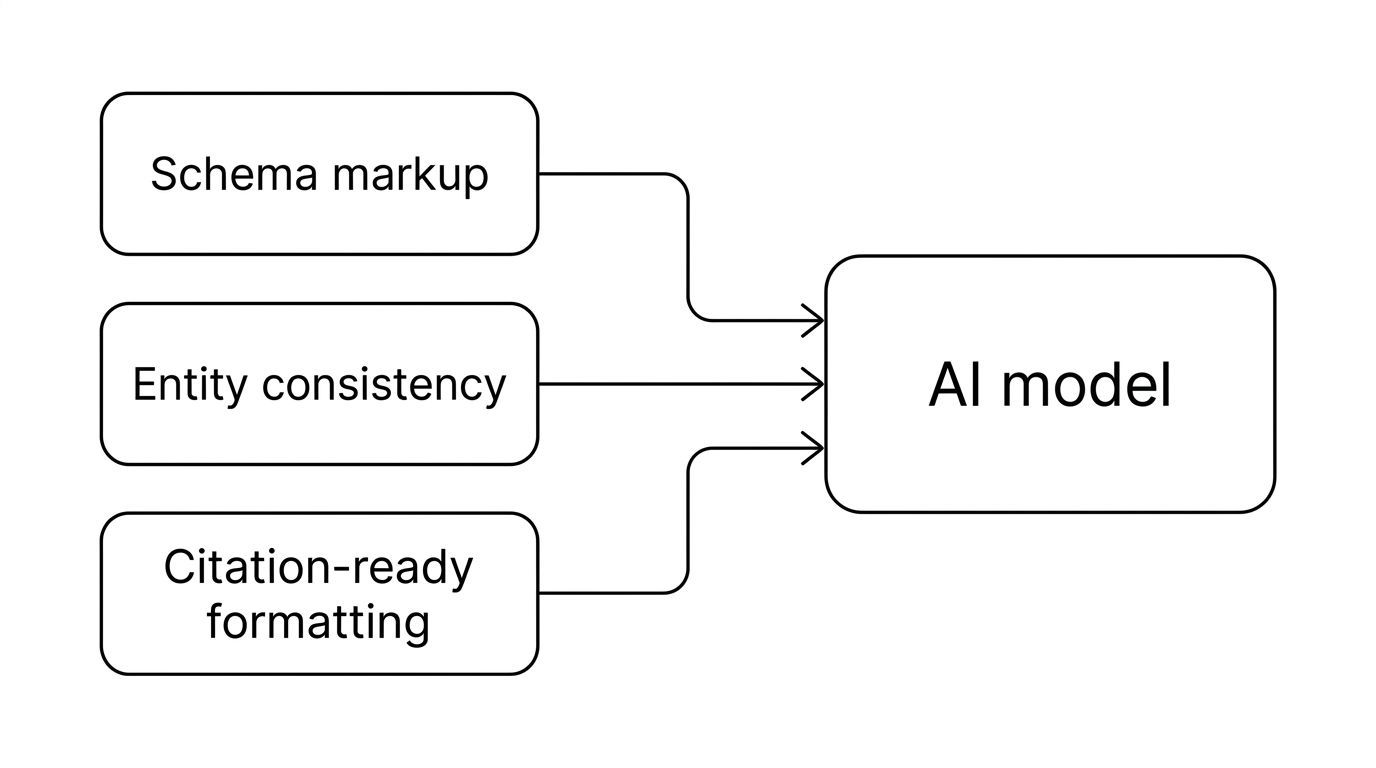
Do this layer in a deliberate sequence so you do not waste schema on pages that cannot use it. Start with entity consistency, the cheapest fix with the widest reach. Write your brand name, one-line description, and category exactly once, then make every surface match it: your homepage, about page, social profiles, directory listings, press boilerplate. Models build an entity out of repeated signals, and contradictory descriptions across sources blur that entity. Fix the contradictions first.
Then add schema where it has content to describe. Organization schema on the homepage and about page, Article schema on every cluster page, FAQ schema on pages that answer direct questions, HowTo schema on step-by-step guides. Do not bolt FAQ schema onto a thin page hoping it earns a citation. Schema describes content that already exists. It does not create authority that is not there.
After schema, fix formatting so a model can lift a clean answer. Put a direct one or two sentence answer right under each heading, before the supporting detail. Use numbered steps for processes and tables for comparisons, both of which models quote almost verbatim. Write paragraphs that still make sense when pulled out of the page, because that is how they get used.
Finish with internal links that match your cluster map from Layer 2. The link graph is a structured signal in its own right. When your pillar and supporting pages reference each other in a tight pattern, you tell models which pages form a topic and which page is its authoritative center.
Layer 4: Monitoring and Iteration
A GEO strategy without monitoring is a strategy you cannot improve. Track your visibility metrics weekly:
- Mention rate: How often your brand appears in responses to category queries
- Sentiment score: Whether AI characterizes your brand positively, neutrally, or negatively
- Citation sources: Which of your pages AI models actually reference
- Competitor share: How your mention rate compares to competitors for the same queries
Use this data to identify which content clusters are gaining traction and which need reinforcement. GEO optimization is iterative. The data tells you where to double down.
The mockup below shows what a working monitoring view looks like: mention rate, sentiment, and competitor share of voice tracked over time so you can see direction, not just a single snapshot.
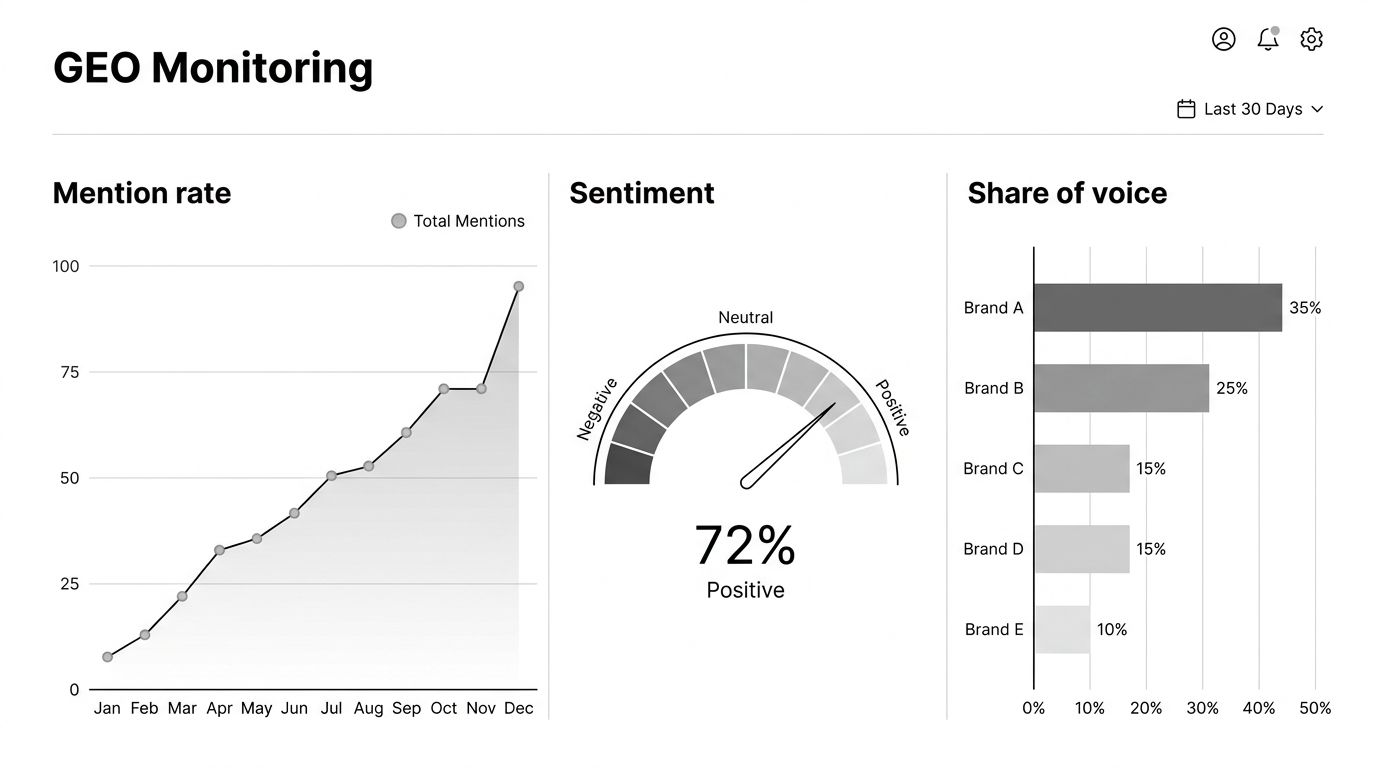
The how-to here is mostly about discipline, not tooling. Run the same prompt set from Layer 1 on a fixed schedule, weekly to start, and log the same numbers every time. The value is in the trend line, and a trend line only exists if you keep the prompts and the cadence constant. Changing your prompts every week feels productive and destroys your ability to compare.
Read the data as a set of decisions, not a report. Mention rate climbing on one cluster and flat on another tells you where to put the next two articles. A page that suddenly stops getting cited tells you to check whether a site change broke it. A competitor's share jumping tells you they published something you should go read. Each metric should map to an action, and if a metric never changes a decision, drop it.
Then close the loop. Every review should end with one or two specific moves for the next cycle: reinforce this cluster, retire that page, fix this broken citation, scope the next one. A monitoring loop that produces observations but no moves is just a dashboard nobody acts on.
A Worked Example: Northwind Ledger
Frameworks are easier to trust when you see one run end to end, so here is a fictional brand carried through all four layers. Northwind Ledger is a mid-market accounting software company that sells to 20-to-200-person businesses. Their buyers research with AI before they ever fill out a form, and Northwind keeps losing those buyers to two better-known competitors who show up in AI answers when Northwind does not.
Layer 1, what they did. Northwind wrote 20 prompts split across the three buckets: category prompts like "best accounting software for small businesses," problem prompts like "what accounting software handles multi-state payroll," and a few direct-brand prompts like "is Northwind Ledger good for a 50-person company." They ran all 20 on ChatGPT, Perplexity, and Gemini and logged mentions, competitors, and citations.
The baseline was humbling. Northwind appeared in 4 of 20 prompts, almost always the direct-brand ones where the buyer already knew the name. In the category and problem prompts that actually win new buyers, they were nearly invisible, while the two competitors appeared in 14 and 11 prompts. Sentiment was neutral, listed without a descriptor, and the citations all pointed to third-party roundups, not to Northwind's own site. Their defended baseline number: 4 of 20, a 20 percent mention rate.
Layer 2, what they did. Northwind picked two clusters from the grid where a competitor showed up and they had real depth: multi-state payroll and expense categorization for service businesses. They had years of support tickets and a payroll team who knew the edge cases cold, so they could say things no generic article could. For the payroll cluster they wrote one pillar, "Multi-state payroll for small businesses," and six supporting articles, each answering one narrow question the pillar raised, like handling a remote employee in a state with no income tax. The pillar linked down to all six, each supporting article linked back up and across to two siblings. They committed to two pieces a week for the quarter.
Layer 3, what they did. First they fixed entity consistency. Their homepage said "Northwind Ledger, accounting software," their LinkedIn said "Northwind, the finance platform for growing teams," and a directory listed them under "bookkeeping services." They picked one description, "Northwind Ledger is accounting and payroll software for small and mid-market businesses," and made all three match it. Then they added Article schema to the cluster pages, FAQ schema to the question-style supporting articles, and Organization schema to the homepage, and rewrote the top of each cluster page so the first two sentences under every heading were a clean, liftable answer.
Layer 4, what they tracked. Northwind re-ran the same 20 prompts every Monday and logged mention rate, sentiment, citation sources, and the two competitors' share. They watched specifically for the payroll problem prompts to start surfacing their new pillar, and for citations to shift from third-party roundups toward their own pages. Each Monday review ended with two moves, such as "the multi-state pillar is getting cited, add two more supporting articles" or "expense categorization is still flat, the pillar is too broad, split it." The point of the example is not the made-up numbers. It is that every decision traces to something they measured, and nothing was done on a hunch.
Building Your 90-Day Roadmap
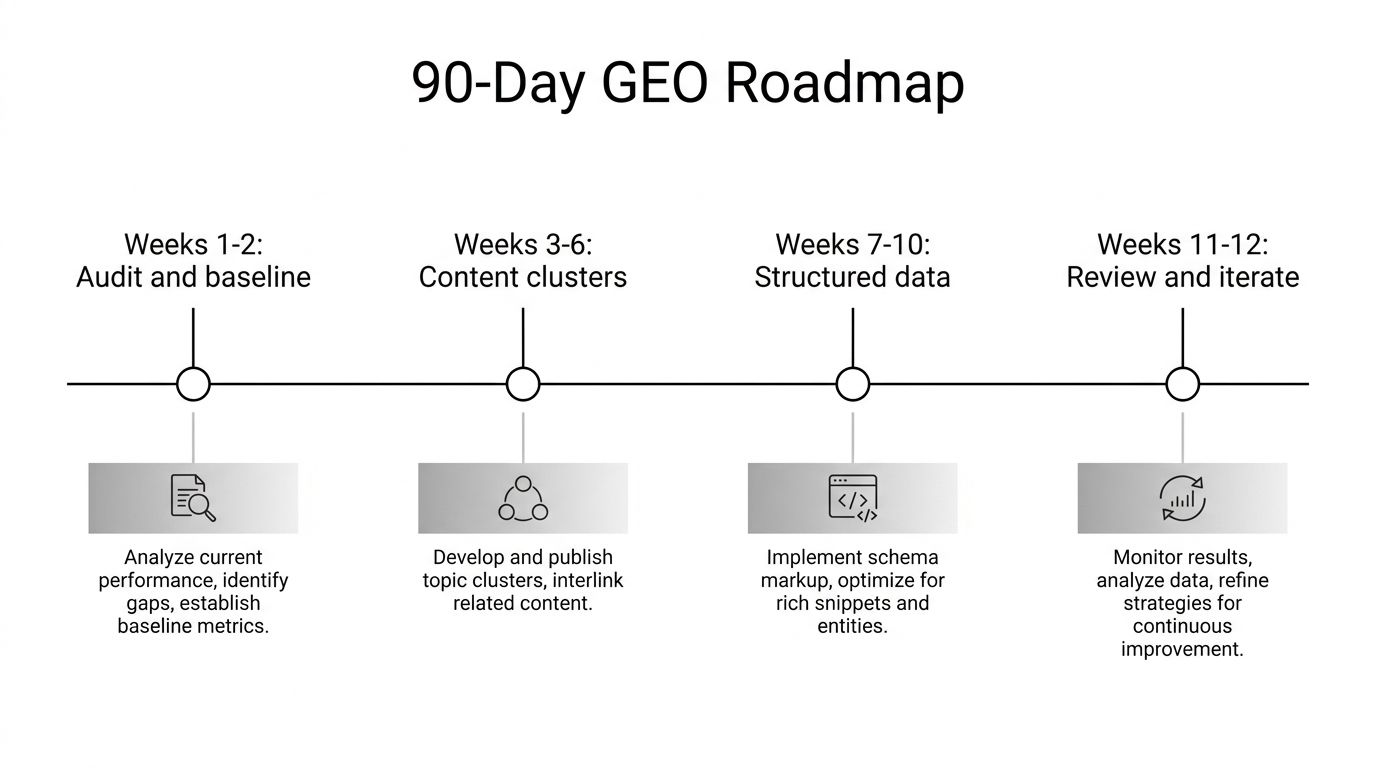
A practical GEO rollout follows a phased approach:
- Weeks 1-2: Audit current AI visibility, document baseline metrics, identify top competitors
- Weeks 3-6: Build or strengthen your first two content clusters, fix entity consistency issues
- Weeks 7-10: Add structured data to high-priority pages, optimize internal linking
- Weeks 11-12: Review monitoring data, identify gaps, plan the next content cluster
The timeline below lays out the same rollout across its four phases, from the opening audit through the first content cluster, structured data, and the closing review.
This is not a one-time project. After the initial 90 days, you shift into a monthly cycle of monitoring, identifying drops or opportunities, and publishing targeted content to address them.
Two notes keep the roadmap realistic. The phases overlap in practice more than the boxes suggest: you will still be writing cluster articles in week 8 while you add schema, and that is fine. What should not overlap is starting Layer 3 before Layer 2 has real content to mark up, or skipping the week 11-to-12 review because the writing feels more urgent. The review is where the strategy earns its name.
Your GEO strategy template
If you want something you can lift and fill in today, copy the checklist below into a doc and answer every line. A strategy you can write down in one page is a strategy you can actually execute. Anything you cannot fill in is a gap to close before you start spending hours on content. Each line carries a short note on how to fill it, so you are not guessing what the line is asking for.
1. Objective
- One sentence describing what AI visibility should do for the business. Note: tie it to a business outcome, more demo requests or defending against a named competitor, not "more visibility" in the abstract.
- The single metric you will judge success by in 90 days. Note: pick one number you can measure every week, usually mention rate across your prompt set. One metric, not five.
2. Target AI platforms
- List the platforms that matter for your buyers: ChatGPT, Perplexity, Gemini, Copilot, Google AI Overviews. Note: list all that apply, then cut.
- Rank them and pick the two where your buyers actually research. Note: rank by where your buyers actually research, not by which platform you personally use. If unsure, look at which platforms drove referral traffic last quarter.
3. Priority topics and clusters
- Three to five topics where your brand has real, defensible depth. Note: choose topics from your Layer 1 grid where a competitor appears and you have first-hand depth, not topics from a keyword tool.
- For each topic: the pillar page URL (or "to build") and the five to eight supporting articles that hang off it. Note: write the actual sub-questions as working titles so the cluster is buildable, not a vague theme.
- The non-obvious insight each cluster carries that competitors do not. Note: if you cannot name the insight in one sentence, the cluster is not ready, so go find the angle first.
4. Structured-data checklist
- Organization schema on the homepage and about page. Note: this is your entity anchor, do it first.
- Article schema on every blog post and FAQ schema on pages that answer direct questions. Note: only on pages with real content behind them, schema on thin pages does nothing.
- HowTo schema on step-by-step guides. Note: reserve this for genuine sequential processes, not list posts dressed up as steps.
- Brand name, description, and category wording identical across your site, third-party profiles, and data sources. Note: write the canonical version once, then audit every surface against it and fix the mismatches.
5. Monitoring metrics
- Mention rate by platform. Note: same prompt set every week, this is your headline number.
- Sentiment (positive, neutral, negative) by platform. Note: record the exact phrase the model used as evidence, not just the bucket.
- Which of your pages get cited. Note: watch for citations shifting from third-party sources toward your own pages, that shift is the goal.
- Your share of mentions versus the two competitors you most want to beat. Note: track only the two competitors that matter, not the whole field, or the number gets noisy.
6. 90-day milestones
- Day 14: baseline audit done, competitors documented. Note: do not start writing until this line is true.
- Day 45: first two clusters built, entity consistency fixed. Note: built means published and interlinked, not drafted.
- Day 70: structured data and internal linking shipped on priority pages. Note: shipped on the cluster pages specifically, not site-wide busywork.
- Day 90: monitoring reviewed, next cluster scoped. Note: end the quarter with a written decision about what to build next, not just a dashboard.
Fill every line, and you have a real plan. Leave half of them blank, and you have a wish list.
Common mistakes when building a GEO strategy
Most GEO programs do not fail because the framework is wrong. They fail in predictable, avoidable ways. Here are the ones that come up most, and the fix for each.
Skipping the baseline because it feels like delay. Teams want to start producing, so they skip Layer 1 and dive into content. Three months later they cannot prove anything worked, because they never recorded where they started. The fix is to treat the baseline as the deliverable for the first two weeks, not as a warm-up. One recorded number, defended for the quarter, is worth more than two early articles.
Going wide instead of deep. A brand picks twelve topics and writes one shallow article on each, reasoning that more coverage means more chances to get cited. Models read that as shallow coverage of many things, which is the opposite of authority. The fix is to cut to three to five clusters and out-depth every competitor on each one. Depth on a few subjects beats a thin layer over many.
Adding schema to thin content. This is the single most common tactic-pile move. FAQ schema gets bolted onto pages with no real answer behind them, and nothing happens, because schema describes content, it does not create it. The fix is to earn the depth first, then add schema to mark it up. Schema is the label, not the product.
Ignoring entity consistency. A brand describes itself three different ways across its site, LinkedIn, and directories, then wonders why models seem confused about what it does. Contradictory descriptions blur the entity a model builds of you. The fix is to write one canonical name, description, and category, then make every surface match it before you do anything fancier.
Publishing in bursts. Eight articles in launch week, then silence for two months. A burst reads as a campaign that ended, not as ongoing authority. The fix is a cadence you can actually hold for a full quarter, even if that is only two pieces a week. Consistency is the signal.
Chasing every platform at once. A small team tries to optimize for five platforms simultaneously and does none of them well. The fix is to rank the platforms by where your buyers research and commit to the top two first. Strong content authority carries across all of them anyway, so you lose little by sequencing.
Monitoring without acting. The dashboard gets built, the numbers get logged, and nothing changes as a result. Data with no decision attached is overhead, not strategy. The fix is to end every review with one or two specific moves, and to drop any metric that never changes a decision.
How the strategy flexes per platform
The four layers hold across every AI platform, but the emphasis shifts because the platforms work differently. Knowing the differences tells you where to spend Layer 3 effort once your content foundation is solid.
ChatGPT leans heavily on its training data plus live retrieval when it browses. That means your established, consistent entity matters a lot: the brand associations baked in over time carry weight, and contradictory descriptions across the web hurt you more here than anywhere else. Prioritize entity consistency and a long track record of depth on your core topics.
Perplexity is retrieval-first and cites its sources openly, often listing the exact pages it pulled from. This is the platform where citation-ready formatting pays off most directly. Clean answers under clear headings, tables, and self-contained paragraphs are what get pulled into a Perplexity answer, and you can watch your own URLs appear in the citation list when you get it right.
Gemini ties into Google's index and increasingly into Google AI Overviews, so the line between classic SEO crawlability and GEO is thinnest here. If a page is not crawlable, renderable, and indexed by Google, it will struggle in Gemini. Make sure your core copy is in the initial HTML and your technical foundation is clean.
Google AI Overviews sit on top of search results and tend to synthesize from pages that already rank and carry strong topical signals. Treat Overviews as a reward for doing the other layers well rather than a separate target. Deep clusters, clean schema, and crawlable pages that earn rankings are what feed Overviews, so there is rarely a dedicated tactic, just better execution of Layers 2 and 3.
What a strong GEO strategy includes
A tactic list and a strategy look similar on paper. The difference is whether the pieces reinforce each other or just sit next to each other. A strong GEO strategy includes all of the following, and each one maps back to one of the four layers above.
- A measured baseline. You know your current mention rate, sentiment, and citation sources before you change anything, so you can prove what worked (Layer 1).
- Topical depth on a few subjects, not shallow coverage of many. Three to five clusters you can credibly out-depth every competitor on (Layer 2).
- Consistent publishing. A cadence AI models can read as ongoing authority rather than a one-time burst (Layer 2).
- Structured signals that match the content. Schema and clean formatting on pages that already have the depth to back them up (Layer 3).
- Entity consistency. The same brand name, description, and category wording everywhere a model might encounter you (Layer 3).
- A monitoring loop. Weekly metrics that tell you which clusters to reinforce and which to retire (Layer 4).
If a "strategy" is missing the baseline or the monitoring loop, it is really a tactic pile. The strategy is what connects the work to a number and tells you what to do next.
Technical GEO strategy: the factors that matter
Content authority gets you considered. The technical layer decides whether AI models can actually read, parse, and quote you. You can have the best article on a topic and still get skipped because a crawler never reached it or could not extract a clean answer from the markup. These are the technical GEO factors worth auditing first.
Crawler access. AI crawlers (GPTBot, PerplexityBot, Google-Extended, and others) need permission and a path in. Check that your `robots.txt` is not blocking the bots you want, then publish an `llms.txt` file that points models to your most important pages in plain text. If a crawler cannot fetch a page, none of the content on it counts.
Rendering and parseable content. Many AI crawlers do a poor job with JavaScript. If your key content only appears after client-side rendering, a model may see an empty shell. Serve your core copy in the initial HTML so it is readable without running scripts.
Schema markup. Structured data tells models what an entity is, what a step sequence means, and which block answers a question. Organization, Article, FAQ, and HowTo schema give models machine-readable context they otherwise have to guess at.
Site speed. Slow pages get crawled less often and less deeply. Fast, stable pages get revisited, which matters because AI visibility depends on models seeing your latest content, not a stale cache.
Content structure and formatting AI can extract. This is where technical and content work meet. Models lift answers, not paragraphs, so write so a clean answer is easy to find:
- A direct one or two sentence answer right under each heading, before the supporting detail.
- Descriptive headings phrased the way people ask questions.
- Numbered steps for processes and tables for comparisons, both of which models quote almost verbatim.
- Short, self-contained paragraphs that make sense even when pulled out of the page.
- One clear definition per concept, stated once and worded consistently.
Work through the technical GEO checklist to confirm crawlers can reach and read every priority page, and use the technical GEO guide for the deeper setup behind each factor above. Technical GEO is not a one-time fix either. Re-audit after any major site change, because a redesign or a migration can quietly break crawler access overnight.
What to Do Next
Map your current GEO maturity against the four layers above. If you have not completed Layer 1, start with an audit. If you have content but no structured data, focus on Layer 3. The point is to know exactly where you are and work the next layer systematically.
If you are recalibrating after Google's May 2026 changes, the AI Mode default rollout and the core update that followed it, start with the May 2026 core update playbook and then work the layers above.
For enterprise teams building a GEO program, the enterprise case study shows how a structured approach delivered measurable results across all four AI platforms within one quarter.