
Insurance SEO and GEO Guide 2026 - for Agents and Carriers
Insurance SEO and GEO for agents, agencies, carriers and aggregators. Which domains AI actually cites per line, the qualifiers that decide answers, and playbooks for life, health, motor, home, fire, travel, small business and startup insurance, US and India.
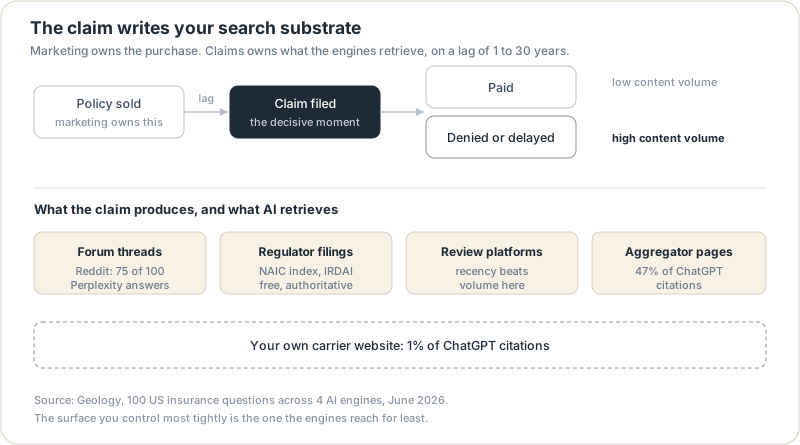
Insurance is the category where owning your own website helps you least. When we ran 100 US insurance questions across four AI engines in June 2026, ChatGPT cited aggregators in 47% of its answers and carrier websites in 1%. Perplexity leaned on Reddit in 75 of the 100. The pages you control most tightly are the surfaces the engines reach for least, which means insurance SEO is mostly the work of influencing pages you do not own.
That reframes the job. Ranking still matters where a click is still available, and three of the eight lines we measured have no AI Overview at all. But for the high-volume consumer lines, the practical question is no longer "how do I rank" but "who supplies the answer, and how do I become one of their sources".
This guide answers that. It covers how AI decomposes an insurance question into the qualifiers that actually decide the answer, which domains get cited in each line of business, why Reddit and the regulators carry more weight than your content team does, how calculators become citable assets instead of lead-capture widgets, what changes across all eight major lines, and how the strategy inverts depending on whether you are a carrier, an agent, an aggregator, or an insurtech.
One finding runs underneath the rest, so it is worth stating early. Most of that substrate is manufactured by your claims operation rather than your marketing team, on a lag of between one year and three decades. Almost nobody reviews an insurer after buying a policy. They write after a claim.
Scope. This covers the US and India, because we hold live citation data for both and the two markets fail in usefully different ways. The mechanism is identical everywhere: claims generate the substrate, engines retrieve it, and the qualifiers decide the answer. What changes across markets is the regulator you are measured against and the vocabulary buyers use. In the US that is the NAIC complaint index and state DOI filings. In India it is the IRDAI annual report and its published claim settlement ratios. Where a term differs between the two, the guide flags it, and there is a translation table before the line-by-line sections. Readers in the UK, Australia, or the Gulf will find the India vocabulary closer to their own than the US one.
Ranking and citation have come apart
The same June study found incumbents taking 78 to 82% of all insurer mentions across the chat engines, with State Farm at 34% and Progressive at 33%. Google AI Overviews was the most balanced engine and still ran 66% incumbent. If you are not already a household name, the broad category answer is close to settled.
The more useful finding is that ranking and citation have stopped tracking each other. In August 2026 we searched "best health insurance india". HDFC ERGO ranks first organically. The AI Overview printed above that result cites HDFC ERGO zero times. Three of its eight citations go to PolicyBazaar, which ranks fifth. Two more go to StayWell Health and Nyvo, sites with a fraction of any national carrier's authority.
The company that won the ranking supplied none of the source material for the answer above it.
If you are a carrier, the page you control most tightly is the page the engines reach for least. That is not a reason to stop publishing. It is a reason to stop believing that publishing is the whole job.
Why the claim, not the purchase, writes your substrate
Ask yourself when a customer has ever written about an insurer.
Almost nobody writes a review after buying a policy. Buying insurance is an administrative act that produces relief at best. People write after a claim. They write when a claim is paid faster than expected, and they write at far greater length when it is denied, delayed, or short-settled. The review corpus for your brand is authored almost entirely by claimants, and claimants are made by your claims operation, not your marketing.
This produces three consequences that conventional insurance SEO advice does not account for.
The substrate is negatively skewed by construction. A paid claim resolves a problem and the customer moves on. A denied claim creates an unresolved grievance, and unresolved grievances generate forum posts, complaint filings, review-site entries, and occasionally journalism. The volume of content per denied claim is many times the volume per paid claim. Left alone, your public record will read worse than your actual performance, and the engines retrieving it have no way to correct for the asymmetry.
Your content strategy has a publication delay measured in years. Motor claims arrive within roughly a year of purchase. Health claims cluster in years one to three. Life claims can arrive three decades after the policy was sold, adjudicated against a beneficiary who never met the agent. Whatever your claims operation does this quarter becomes searchable content on a lag you cannot compress.
The lever is operational, not editorial. If your denial rate on a specific clause is generating a cluster of complaints, no amount of content will outrank the complaints. Fixing the clause will. This is the least convenient finding in this guide and the most important one.
AI now adjudicates your numbers against the regulator's
Something changed in the last year that has not made it into any insurance SEO guide.
In August 2026 we searched "Star Health claim settlement ratio" from India. The AI Overview returned this:
Star Health Insurance has a multi-year average Claim Settlement Ratio of roughly 85% to 90% based on public IRDAI disclosures, though promotional materials cite higher figures around 99%.
Read that again. On a branded query about a specific insurer, an AI answer cited regulator data, compared it against the insurer's own marketing, and told the searcher the two disagree. Four of the six sources it used were third-party comparison sites, not the carrier.
Classic search returned your page and let the reader judge. AI returns a verdict on your page.
The practical implication is sharp. Every claims statistic in your marketing is now checkable against a regulator filing by a system that will do the check automatically and publish the discrepancy. In the US that means the NAIC complaint index and state DOI filings. In India it means the IRDAI annual report. If your marketing number and the regulator number diverge, you are no longer merely optimistic. You are generating a documented contradiction that gets surfaced on your own brand name.
Use the regulator's number. If it is unflattering, publish it with context you control rather than letting a comparison site frame it for you. A carrier that says "our settlement ratio is 87%, here is what the 13% consists of and what we changed last year" owns that narrative. A carrier claiming 99% against a filed 87% hands the narrative to whoever does the arithmetic.
The two markets hand you different weapons here, and the difference matters more than it first appears.
India publishes an outcome. The IRDAI claim settlement ratio states what proportion of claims an insurer paid. It is a single comparable number, every competitor has one, and it invites a league table. That makes it easy to cite, easy to rank on, and easy to be embarrassed by. It is also crude: a high ratio says nothing about how long settlement took or how much was deducted.
The US publishes a grievance. The NAIC complaint index is a ratio of complaints to market share, benchmarked so that 1.00 is average. It measures how many customers were angry enough to escalate to a regulator, not how many were paid. A carrier can pay most claims and still carry a bad index if the process is slow or opaque.
So the same argument lands differently. An Indian insurer competes on a published pass rate and should explain the failures. A US insurer competes on a published complaint rate and should explain the friction. In both markets the losing move is identical: publish a marketing number the regulator's filing contradicts, and let a comparison site be the one who points it out.
Query fan-out: how one question becomes twenty
When someone asks an assistant "which health insurance should I buy", the system does not run that search. It decomposes the question into a set of narrower retrievals, gathers passages for each, and synthesises an answer from what came back. That decomposition is called fan-out, and it is where insurance content is actually won or lost, because the sub-queries carry qualifiers the original question never mentioned.
Ask for the best health plan and the machine goes looking for waiting periods, room-rent limits, cashless network size, and settlement ratios, because those are the dimensions a competent answer has to resolve. You are not competing for the question the customer asked. You are competing for the eight questions the model asked on their behalf.
The useful part: you can see your own fan-out queries in Search Console today. They are the entries that read like full sentences rather than keywords. In our own data, 2,763 impressions over 28 days came from queries shaped like "evaluate the visibility software X on tool Y" or "can X's products be customised to my industry". They sat at an average position between 11 and 15, and produced exactly zero clicks.
Most teams see zero clicks at a decent position and write those rows off as junk traffic. That is the wrong reading. A human never typed those strings. They are the machine's shopping list, rendered visible, and they tell you precisely which sub-questions your page is being considered for. Filter your Search Console query report to rows of seven words or more, and you have a fan-out map for your category that no keyword tool sells.
Two rules follow from this. Write pages that resolve one qualifier completely rather than pages that mention every qualifier shallowly, because retrieval works at passage level and a page that half-answers eight things wins none of them. And treat a fan-out query sitting at position 12 with no clicks as a live opportunity rather than a failure, because it is a slot in an answer you are one improvement away from occupying.
Who actually gets cited, line by line
We pulled live results across eight insurance queries in August 2026, in both the US and India, and recorded which sources the AI Overview was built from. The pattern is not uniform, and the differences matter more than the averages.
| Line and market | AI Overview? | Sources the answer was built from |
|---|---|---|
| Health, India | Yes | policybazaar (3 of 8 citations), starhealth, icicilombard, staywellhealth, nyvo, indusindinsurance |
| Term life, India | Yes | policybazaar, policyx, jioinsure, onsurity, axismaxlife, iciciprulife |
| Motor, India | Yes | policybazaar, pbpartners, jioinsure, moneyview, acko, tataaig, sbigeneral, universalsompo, icici, asianetnews |
| Travel, US | Yes | nerdwallet, usnews, cnbc, thepointsguy, travelexinsurance, withfaye, youtube |
| Small business, US | Yes | nerdwallet, usnews, investopedia, hiscox, thehartford, biberk, geico, techinsurance, reddit, youtube |
| Home, US | No | organic only: consumerreports, reddit, youtube, nerdwallet, allstate |
| Cyber for startups, US | No | organic only: insureon, cnbc, reddit, nextinsurance, nerdwallet |
| Fire and commercial, India | No | organic only: newindia (a carrier at position one), insurancedekho, policybazaar, tataaig |
Four things fall out of that table.
Three of eight lines returned no AI Overview at all. Home, startup cyber, and commercial fire are still ordinary search results. The narrative that AI has eaten insurance search is true in the high-volume consumer lines and false in the rest, and a strategy that treats all eight lines as an AI problem will overspend on the three where classic ranking still delivers a click.
A small number of domains own the consumer lines. PolicyBazaar appears in every Indian consumer query we ran. NerdWallet appears in every US query. If you sell in either market, your data on those two properties is a larger determinant of your AI visibility than your own website is.
Carrier presence varies enormously by line. Indian motor cited five carriers. Indian term life cited two. US travel cited two, and both were challengers rather than incumbents. Motor is the most carrier-friendly line in the set, which follows from claim frequency: enough people have claimed on a motor policy that carrier pages carry real experiential content.
Commercial fire is the outlier worth noticing. It is the only query in the set where a carrier ranks first organically, and there is no AI Overview to sit above it. This is what a genuinely uncontested line looks like, and it is the strongest argument in this guide for going where the competition is not.
Reddit is a distribution channel, and most insurers treat it as a risk
Reddit appeared in 75 of 100 Perplexity answers in our June study. In the live pull above it was cited in US small business and ranked second organically for US home insurance and third for startup cyber. There is no other single domain with that reach across insurance queries.
The reason is structural rather than algorithmic. Reddit threads contain the one thing insurance marketing systematically lacks: specific claim narratives with outcomes attached, written by people with no commercial interest, and argued over by others who disagree. That is exactly the shape of evidence a retrieval system prefers when the question is "is this insurer any good".
Most insurers respond to this by ignoring Reddit or by attempting stealth marketing, and both fail. Ignoring it leaves the substrate to your worst-served claimants. Stealth posting gets detected, and a detected astroturf attempt becomes its own durable thread.
What works is narrower and slower. Answer questions in your own name with a flair that identifies your role, in the threads where a genuinely technical answer is scarce. Insurance subreddits reward people who explain why a claim was denied under a specific clause, because almost nobody can do it. Accept that this is a support function rather than a marketing one, staff it accordingly, and measure it by whether your explanations get cited rather than by traffic.
The uncomfortable corollary is that this only works if your claims behaviour survives scrutiny. Reddit is a distribution channel for whatever is true about you.
Social proof is the ranking substrate, not a trust badge
Conventional guides file social proof under conversion optimisation: add testimonials near the form to lift form fills. In insurance, social proof is upstream of that. It is the raw material the engines retrieve to construct the answer that decides whether you are considered at all.
Where it actually lives, in rough order of influence on AI answers:
- Reddit. Present in 75 of 100 Perplexity answers in our study. Threads in insurance subreddits routinely outrank carrier pages because they contain specific claim narratives with outcomes attached.
- Regulator complaint data. The NAIC complaint index in the US and IRDAI grievance data in India are structured, authoritative, free to cite, and impossible to lobby. Comparison sites republish them constantly, which is how they reach the models.
- Review platforms. Trustpilot, Google reviews, and in the US the BBB. Recency matters more than volume here, because a claims process that improved eighteen months ago is still being described by reviews written before the change.
- YouTube claim walkthroughs. Under-appreciated. A ten-minute video of someone documenting a claim start to finish is the single most retrievable piece of evidence about what your process is actually like.
The strategic response is not to solicit more five-star ratings. It is to generate claim-stage content deliberately, because almost no insurer does.
Publish your average settlement turnaround by line, with the methodology. Publish what proportion of claims are queried for additional documentation and why, because that is the step customers experience as stonewalling. Publish anonymised claim walkthroughs that include a denied claim and the reason. Ask for reviews at claim closure rather than at policy issue, which is the industry default and captures a customer who has not yet experienced the product.
That last point is worth dwelling on. Most insurers trigger their review request on policy purchase, which harvests sentiment about a buying flow. The competitor who triggers on claim closure harvests sentiment about the actual product, which is the sentiment the engines are looking for.
Calculators are the most under-used GEO asset in insurance
Every insurance marketer has a calculator. Almost all of them are built as lead-capture widgets, gated behind a form or an email field, and almost all of them are invisible to the systems that now decide who gets recommended.
Three reasons calculators matter more than the conventional treatment allows.
A calculator is a trust artifact. Insurance is sold on a promise that cannot be inspected before purchase. Showing your arithmetic is the strongest available proxy for showing your character. A term-cover calculator that explains why it recommends eleven times income, and lets the user see the components, does more for trust than any testimonial block.
A calculator produces the exact shape of answer AI engines want. Queries like "how much life cover do I need at 35" or "what is the right sum insured for a family of four" want a number with reasoning. A landing page returns positioning. A calculator, properly published, returns a defensible figure with a method. That is directly citable.
And this is where nearly everyone fails. Most insurance calculators are client-side JavaScript. The answer exists only after a user interacts with the widget. A crawler, a Perplexity fetch, or a ChatGPT browse request receives an empty shell with no numbers in it. You have built the single most citable asset on your site and rendered it unreadable to the systems doing the citing.
The fix is not complicated and almost nobody does it. Alongside the interactive widget, publish worked examples as static, server-rendered text. A table of typical outputs across representative inputs: cover required at ages 25, 35, 45 and 55 at three income levels, with the formula stated in prose. The widget serves the user. The static table serves the engine. Both live on the same URL and reinforce each other.
Which calculator earns its place depends on the line:
| Line | Calculator that matters | The question it answers |
|---|---|---|
| Life | Cover adequacy, premium by age | How much cover, and what will it cost me at my age |
| Health | Sum insured adequacy, room-rent impact | Will this actually cover a hospitalisation in my city |
| Motor | IDV and premium, no-claim bonus impact | What is my car worth to the insurer, and what does a claim cost me later |
| Home | Rebuild cost, contents valuation | Am I underinsured, which is the failure mode at claim |
| Fire and property | Sum insured on reinstatement basis | What does the surveyor use, not what did I pay |
| Travel | Cover by destination and duration | What does this visa or this country require |
| Small business | Liability limit by trade | What limit does my contract or landlord demand |
| Startup | D&O and cyber limits by stage | What does this term sheet require me to carry |
Notice that the useful calculator in almost every line answers an adequacy question rather than a price question. Price calculators serve your funnel. Adequacy calculators serve the searcher, and adequacy is what the engines are being asked about.
Translating the qualifiers between markets
The qualifier lists in the next section are where US and Indian insurance stop sharing a language. The concepts survive translation; the words do not, and buyers search the words. Get this wrong and you write a page that is invisible in the market you meant to reach.
| Concept | India, and broadly UK, Australia, Gulf | United States |
|---|---|---|
| Regulator trust metric | IRDAI claim settlement ratio | NAIC complaint index, state DOI filings |
| Hospital or garage direct billing | Cashless network | In-network, direct billing |
| Amount of cover | Sum insured | Coverage limit, face amount |
| Vehicle valuation for claims | IDV, Insured Declared Value | Actual cash value, agreed value |
| Discount for not claiming | No-claim bonus, NCB | Claims-free discount, safe driver discount |
| Cost shared by the customer | Co-payment, sub-limit | Coinsurance, copay, deductible |
| Cover before an existing condition is paid | Pre-existing disease waiting period | Pre-existing condition exclusion period |
| Same-day hospital treatment | Day-care procedures | Outpatient surgery |
| Limit restored after a claim | Restoration or refill benefit | Reinstatement of limit |
| Commercial property policy | Standard fire and special perils | Commercial property, special form |
| Small business bundle | Shopkeeper or business package policy | Business owner's policy, BOP |
Two translations deserve more than a table row.
Room-rent capping has no clean US equivalent. It is an Indian health-insurance mechanism where exceeding your eligible room rent proportionally reduces the entire claim, not just the room charge. US plans control cost through deductibles, coinsurance, and networks instead. If you write for the US market, the analogous confusion to target is out-of-network balance billing, which produces the same "my claim was approved and I still owe thousands" grievance.
Claim settlement ratio does not exist in the US. There is no equivalent published pass rate, so a US page arguing settlement ratios reads as imported and slightly foreign. The right substitute is the complaint index plus your own published turnaround data, since nobody else publishes the latter.
The eight lines, and why one strategy will not cover them
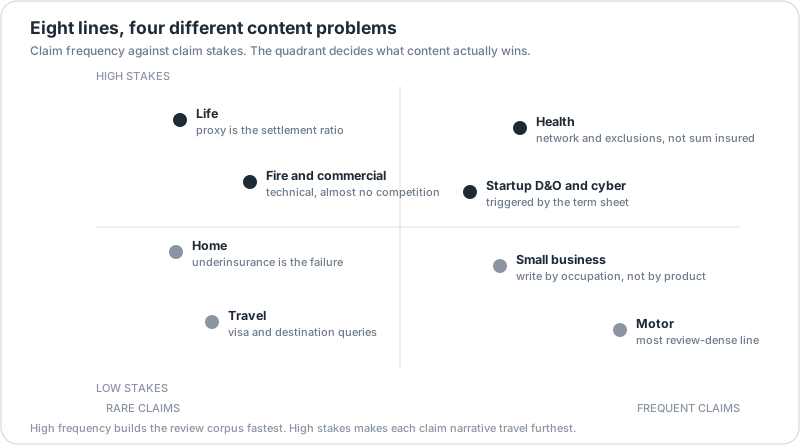
Insurance is not a category. It is eight or more markets with different claim frequencies, different claim stakes, different buyers, and different failure modes. The trust moment sits somewhere different in each.
Life
The longest gap in insurance between purchase and proof. A policy sold to a 30-year-old may not be tested until 2060, and the person testing it is a bereaved beneficiary who was not party to the sale. Nobody can evaluate the product experientially, so the entire market runs on a single proxy: the claim settlement ratio.
That makes life the line where the regulator-versus-marketing gap described earlier does the most damage. It is also the line where the searcher at the decisive moment is not your customer. Content for beneficiaries, covering how to file, what documents are needed, and how long settlement takes, is almost entirely unwritten by insurers and heavily searched. Write it. It ranks, it earns citations, and it is read at the exact moment your reputation is being formed.
Qualifiers that decide the answer: policy term and premium paying term, riders (critical illness, accidental death benefit, waiver of premium), return of premium, staggered versus lump-sum payout, increasing cover, medical underwriting requirement, contestability period, and whether cover continues if premiums lapse. In India add the IRDAI claim settlement ratio and solvency ratio, which are the dominant proxies. In the US substitute the AM Best or S&P financial-strength rating and the NAIC complaint index, since no settlement ratio is published.
Prompts to track:
- best term insurance plan for a 35 year old
- which life insurer has the highest claim settlement ratio
- term insurance with return of premium worth it
- how much life cover do I need based on my income
- [insurer] claim settlement ratio 2026
- what documents are needed to claim life insurance
- how long does a life insurance claim take to settle
- can a life insurance claim be rejected for non-disclosure
Health
Highest claim frequency of the personal lines and by far the most disputed. The advertised product is a sum insured. The actual product is the cashless hospital network and the speed of pre-authorisation, which is what a customer experiences at 2am in an admissions queue.
The dominant failure mode is a claim rejected on a pre-existing-disease clause the customer did not understand at purchase. That gap between what was sold and what was covered is the source of nearly all health-insurance grievance content.
So publish the exclusions plainly. Publish the network by city with a last-updated date, because stale network lists are a leading complaint. Publish typical pre-authorisation turnaround. Exclusions content in particular ranks well because competitors avoid writing it, and searchers looking for "does X cover Y" are high-intent and badly served.
Health has the densest qualifier set in insurance, which is exactly why fan-out matters most here. A single "best health insurance" question decomposes into most of the list below.
Qualifiers that decide the answer, India: cashless hospital network and its size in the buyer's city, pre-existing disease waiting period, initial waiting period, specific-ailment waiting periods, room-rent capping, co-payment, sub-limits, day-care procedures, restoration or refill benefit, no-claim bonus, maternity waiting period, OPD cover, pre and post hospitalisation days, incurred claim ratio, and claim settlement turnaround.
Qualifiers that decide the answer, US: network tier and whether the buyer's hospital is in it, deductible, coinsurance and out-of-pocket maximum, pre-existing condition exclusion period, prior authorisation requirements, formulary tier for prescriptions, out-of-network balance billing exposure, HSA eligibility, and metal tier if buying on the marketplace.
Room-rent capping deserves special mention in India because it is the qualifier customers understand least and complain about most. A capped room rent proportionally reduces the entire claim, not just the room charge, which is the single most common source of "my claim was approved but I still paid half" grievance content. The US analogue is out-of-network balance billing, which produces the same surprise bill from a different mechanism, and the same volume of angry content.
Prompts to track:
- best health insurance plan for a family of four
- health insurance with no waiting period for pre existing diseases
- which health insurance has the largest cashless network
- what is room rent capping and how does it affect my claim
- does [insurer] cover [procedure or condition]
- health insurance claim rejected pre existing disease what to do
- best health insurance for senior citizens with diabetes
- how long does cashless pre authorisation take
Motor
Fastest cycle and highest frequency. A motor customer may claim within months, and the claim is a small, concrete, quickly-resolved event, which makes motor the most review-dense line in insurance.
It is also the most price-commoditised, which tempts everyone into a pure price fight. The differentiator that survives is the garage network and the turnaround. Publish cashless garage lists by city, publish average repair turnaround, publish what happens to the no-claim bonus. The IDV calculation is poorly understood by customers and heavily searched, and an honest explainer on it will outperform another premium comparison page.
Motor is also the line where carriers get cited most. Our August pull on Indian motor returned five carrier domains inside a single AI Overview, against two for term life. Enough people have actually claimed on a motor policy that carrier-owned content carries real experiential weight, which makes this the line where publishing on your own domain pays back fastest.
Qualifiers that decide the answer, India: IDV, zero depreciation, engine protection, consumables cover, return to invoice, roadside assistance, no-claim bonus and its transfer, cashless garage network by city, own damage versus third party, personal accident cover, and claim turnaround.
Qualifiers that decide the answer, US: liability limits split by bodily injury and property damage, collision and comprehensive deductibles, actual cash value versus replacement or agreed value, uninsured and underinsured motorist cover, rental reimbursement, gap cover on a financed vehicle, accident forgiveness, and preferred repair-shop network.
Prompts to track:
- best car insurance with zero depreciation
- what is IDV and how is it calculated
- does claiming insurance reduce my no claim bonus
- best car insurance for cashless claims in [city]
- is engine protection cover worth it
- how long does a car insurance claim take
- third party vs comprehensive car insurance which should I buy
- can I transfer my no claim bonus to a new car
Home
Rare claims, catastrophic when they land, and dominated by one failure mode: underinsurance discovered at the moment of loss. A customer who insured for purchase price rather than rebuild cost finds out during a fire.
Search behaviour is episodic and event-driven, spiking after floods, storms, and earthquakes. That argues for a rebuild-cost calculator as the permanent anchor asset and peril-specific content timed to seasonal risk. It also argues for content aimed at the moment after a loss, which almost nobody writes and which is searched under acute stress.
Home is one of the three lines in our pull that returned no AI Overview. Reddit ranked second organically and YouTube third, ahead of every carrier. Classic ranking still produces a click here, and community content is what you are ranking against rather than an answer box.
Qualifiers that decide the answer: rebuild or reinstatement cost versus market value, contents cover and valuation basis, perils included (fire, flood, earthquake, storm), the underinsurance penalty (average clause in India, coinsurance clause in the US), temporary accommodation or loss-of-use cover, deductible, and whether jewellery or electronics need separate declaration or a scheduled rider.
Prompts to track:
- how much home insurance do I need
- is my home underinsured
- does home insurance cover flood damage
- what is the average clause in home insurance
- home insurance claim denied underinsurance
- do I insure for market value or rebuild cost
- does home insurance cover jewellery
Fire and commercial property
Broker-mediated, surveyor-driven, and genuinely technical. The buyer is a risk manager or a business owner acting on a lender's requirement, not a consumer.
Search volume is low and commercial value per query is very high. Almost no one produces competent content here, which makes it the easiest line in insurance to dominate on depth. Write about reinstatement versus indemnity basis, about how a surveyor calculates sum insured, about what average clause means and why underinsurance triggers proportional reduction. These are the questions that decide six-figure claims and they are answered almost nowhere.
This is the clearest opening in the whole set. Our August pull found no AI Overview and a carrier, New India Assurance, ranking first organically, with aggregators below it rather than above. That combination appears nowhere else in insurance. If you sell commercial property cover and you are looking for one line to win outright, this is it.
Qualifiers that decide the answer: reinstatement value versus indemnity basis, how the surveyor or adjuster derives the insured value, the average or coinsurance clause that penalises underinsurance, add-on perils (storm, flood, riot, strike, malicious damage), business interruption and indemnity period, declaration policies for fluctuating stock, and excess or deductible structure. India calls the base product standard fire and special perils; the US calls it commercial property on a special form, and the underinsurance penalty is the coinsurance clause rather than the average clause.
Prompts to track:
- fire insurance for warehouse or factory
- reinstatement value vs indemnity basis which should I choose
- how is sum insured calculated for commercial property
- what is the average clause and how does underinsurance affect my claim
- do I need business interruption cover
- what does a surveyor look at in a fire claim
- standard fire and special perils policy what is covered
Travel
The claim happens abroad, under stress, in a different time zone. The product being bought is a policy document. The product being consumed is a 24-hour assistance line.
Search is driven by destination and visa requirement rather than by insurance features. Schengen visa cover requirements, country-specific medical minimums, and trip-duration rules are evergreen, high-volume, and directly answerable. This is the line where AEO-style extractable content works best, because most travel queries have a factual answer a model wants to state.
Travel is also the most editorially mediated line we measured. The US AI Overview was built from NerdWallet, US News, CNBC, and The Points Guy, with only two carriers cited and both of them challengers. Getting into the editorial round-ups matters more here than on any other line, because the round-ups are what the engine reads.
Qualifiers that decide the answer: medical cover limit, whether pre-existing conditions are covered and on what terms, trip cancellation and interruption triggers, baggage and delay cover, adventure sports exclusions, visa-mandated minimums, deductible, and the quality of the 24-hour assistance line.
Prompts to track:
- best travel insurance for [destination]
- travel insurance requirements for a Schengen visa
- does travel insurance cover pre existing conditions
- travel insurance that covers adventure sports
- what does trip cancellation insurance actually cover
- how do I claim travel insurance for a cancelled flight
- annual multi trip vs single trip travel insurance
Small business
The buyer is a competent professional with no insurance literacy, usually acting because a contract, a landlord, or a client demanded proof of cover. The abstract nature of liability is the barrier: people cannot picture what public liability protects them from.
The winning content is occupation-specific rather than product-specific. "What insurance does a plumber need" outperforms "public liability insurance" because it matches how the buyer thinks. Our study found Next Insurance taking 50 mentions in small business, well ahead of its overall market position, which suggests the segment rewards specificity over brand size.
This was also the most crowded citation set we measured, with eleven distinct domains in one AI Overview, including Reddit and YouTube alongside four carriers and three editorial sites. A crowded answer is a beatable answer: no single source dominates, so a genuinely better occupation-specific page can enter it.
Qualifiers that decide the answer: liability limit per occurrence and in aggregate, general or public liability versus professional indemnity, whether a certificate of insurance can be issued same-day, additional insured endorsements, occupancy or trade classification, and whether the bundled package covers what the contract demands. The US names that bundle a business owner's policy and adds workers compensation requirements that vary by state; India names it a shopkeeper or business package policy, with far less contract-driven demand for certificates.
Prompts to track:
- what insurance does a [trade or profession] need
- how much liability insurance do I need for my business
- general liability vs professional indemnity what is the difference
- my client requires a certificate of insurance what do I do
- cheapest business insurance for a sole trader
- do I need workers compensation for one employee
- what does a business owners policy cover
Startup
Usually triggered by a funding round. D&O appears in the term sheet, cyber appears in the first enterprise contract, and a founder with no insurance background has two weeks to sort it out.
Content that maps insurance requirements to funding stage and to standard term-sheet language wins here, because the query is not "what is D&O insurance" but "what does my Series A require me to carry". The buyer is time-poor, sophisticated in every domain except this one, and highly likely to ask an AI assistant rather than read a brochure.
Startup cyber returned no AI Overview in our pull, with Reddit third organically behind Insureon and CNBC. Founders are researching this in communities rather than reading carrier pages, which makes the community answer the one that matters.
Qualifiers that decide the answer: D&O Side A, B and C cover and what each protects, first-party versus third-party cyber cover, limits expected at each funding stage, tech errors and omissions, employment practices liability, key person cover, retroactive date, and whether the policy satisfies the specific term-sheet or enterprise-contract wording.
Prompts to track:
- what insurance does my Series A term sheet require
- how much D&O insurance does a seed stage startup need
- difference between D&O and E&O for startups
- cyber insurance requirements for SOC 2 or enterprise contracts
- do early stage startups need cyber insurance
- what does D&O insurance actually cover for founders
- startup insurance checklist before a funding round
The strategy inverts depending on who you are
The same market rewards four different behaviours depending on where you sit in it.
Carriers and insurers
You own the entity. Branded search is yours and will stay yours. What you do not own, and will not win, is comparison intent, because a comparison page structurally answers a comparison query better than a carrier page can. Our data shows exactly this: carrier sites took 1% of ChatGPT citations while aggregators took 47%.
Your work is therefore concentrated in three places. Defend the claim narrative by publishing regulator-aligned numbers before someone else frames them. Feed the aggregators accurate data, because they are the surface being cited and their errors become your reputation. Own the beneficiary and claimant content that no aggregator will ever write, since it requires operational knowledge only you have.
Stop measuring success as ranking for "best car insurance". You will not win it and the answer above it will not cite you anyway.
Agents and brokers
You cannot outrank carriers on product terms and you should stop trying. Your structural advantage is that you can say things a carrier legally and commercially cannot: which insurer is slow to settle, which clause causes trouble, which product suits a situation the carrier would rather sell around.
That advisory voice is also what AI assistants reward, because it answers the comparative question the carrier cannot answer about itself. Combine it with genuine local presence and situation-specific content. "Which insurer handles cashless claims fastest in Pune" is a question only a broker can credibly answer, and it is the sort of question people now ask assistants.
Aggregators and comparison sites
You are structurally advantaged and the data proves it. Your page format matches the query shape the engines are trying to answer, which is why PolicyBazaar supplies three of eight citations on a query where it ranks fifth.
Your risks are different. Accuracy decay is the main one, because stale premium or network data that gets cited widely becomes a credibility problem at scale. Depth of methodology is the other: as engines get better at weighing sources, "we compared 40 insurers" will lose to "here is precisely how we ranked them and what data we used". Publish the methodology.
Insurtech and MGAs
You will not win established category terms and should not spend on them. Incumbents hold roughly 80% of mentions and that share is stable.
What moves is category definition. Lemonade led renters and pet in our study, Next Insurance led small business, and in each case the win came from being the clearest answer in a segment the incumbents describe generically. Find the segment where the incumbent answer is vague, and be specific in it. Then make sure your claim experience is good enough to survive the review substrate it generates, because a fast digital claim is the only durable advantage a challenger has.
The first 90 days
If you do one thing from this guide, do the first item.
- Pull your regulator numbers and compare them to your marketing. NAIC complaint index and state DOI filings in the US, IRDAI annual report and settlement ratio in India. Any gap is a live liability now that AI engines run the comparison automatically. Fix the marketing, not the filing. If you sell in both markets, do this twice, because the metrics measure different things and a clean record in one says nothing about the other.
- Move your review request trigger from policy issue to claim closure. This changes what your review corpus is about, from a buying flow to the actual product. It is a workflow change, not a content project.
- Publish static worked examples beside every calculator. If your calculator is client-side JavaScript, the engines currently see nothing. A table of representative outputs and the stated formula makes the most citable asset on your site actually citable.
- Write the claim-stage content nobody writes. Turnaround by line, exclusions in plain language, the beneficiary or claimant walkthrough, and an honest account of a denied claim and why.
- Pick one line and one segment where your claims performance is genuinely better than the incumbent's, and compete only there. Broad category terms are settled. Segment answers are not.
Our 2026 insurance AI visibility report has the full study behind the citation figures used here, and the insurance case study covers what closing a citation gap looked like for one carrier. If you want to see which sources the AI answers about your own brand are currently built from, that is what our insurance programme measures first.