
SEO and AI Visibility for Financial Advisors in India
Does SEBI's advertisement code actually block Indian advisers from marketing, or does it force them into the only content AI engines will quote?

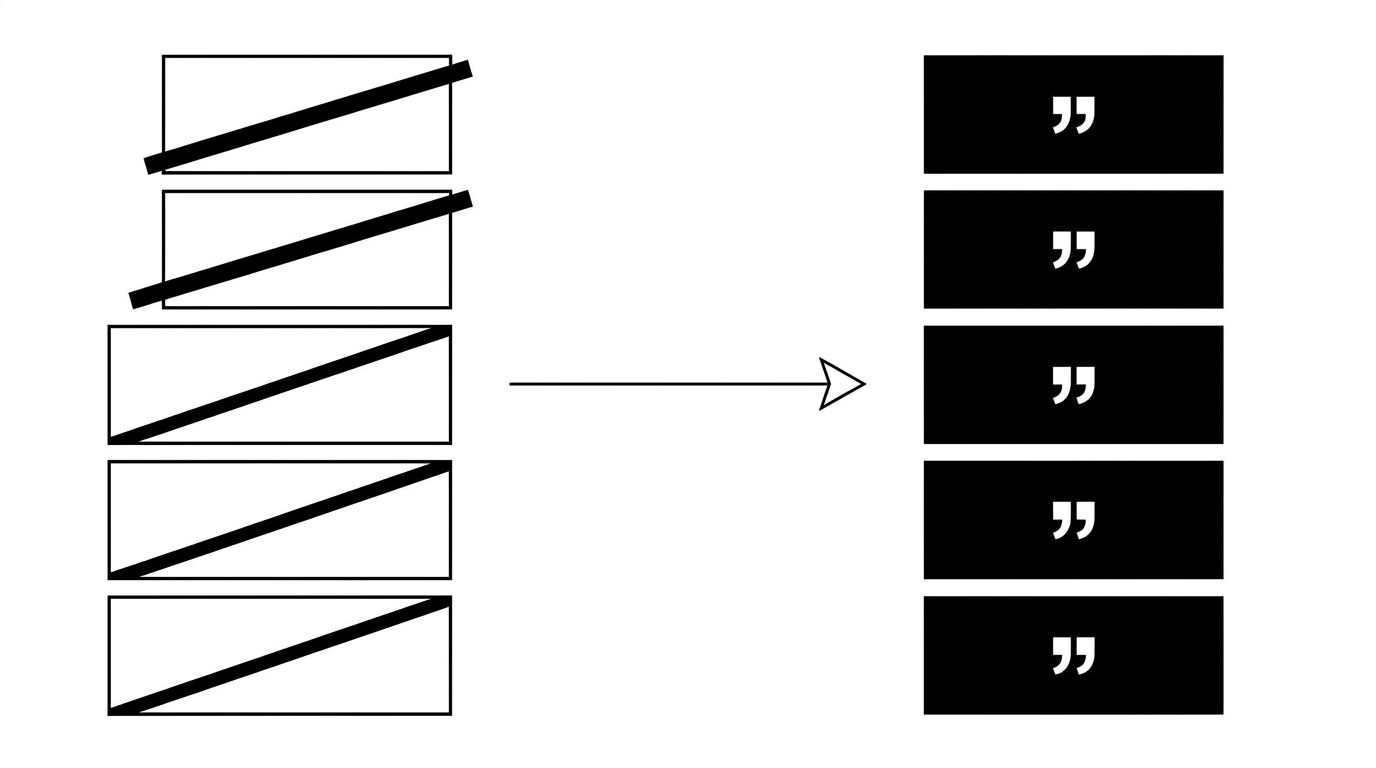
SEBI's advertisement code bans almost exactly the content that AI engines throw away, and leaves standing almost exactly the content they retrieve. Registered investment advisers in India cannot claim returns, cannot use the word "best", cannot show past performance, and cannot run testimonials. Every one of those is a claim a language model treats as unverifiable marketing copy and skips over when assembling an answer. What the code leaves an adviser is explanation: what a product does, who it suits, how the fee works, what can go wrong. That is the exact passage shape a model lifts and quotes. The compliance rule that looks like a marketing handicap is the single best brief an Indian adviser could have been given for AI search.
Most advisory practices are not using it that way. They read the code as a list of things they cannot say, publish a thin services page to stay safe, and route everything to a contact form. That page cannot rank and cannot be quoted. This piece covers what the code actually restricts, why the restricted list maps onto model behaviour so closely, and what to publish instead.
What the advertisement code actually restricts
SEBI issued the advertisement code for investment advisers and research analysts on 5 April 2023, effective from 1 May 2023, under circular SEBI/HO/MIRSD/MIRSD-PoD-2/P/CIR/2023/51. The circular text is worth reading in full once, because the summaries circulating online drop the operational parts.
The restrictions that matter for content:
- No promise or guarantee of assured or risk-free returns.
- No references to past performance in advertisements.
- No misleading testimonials.
- No superlatives. SEBI names "Best", "No. 1", "Top", "leading", and "one of the best amongst market leaders" as examples.
- No false or misleading claims generally.
Two operational requirements sit alongside them. Investment advisers need prior approval from the SEBI-recognised supervisory body, BSE Administration and Supervision Limited, before an advertisement goes out. A copy has to be retained for five years.
That approval step is why most advisory websites are thin. Publishing becomes a process with a queue attached, so practices publish less and say less in what they do publish.
Why the banned list is also the ignored list
Take the five restrictions above and ask what a language model does with each one when it builds an answer to "who should I use for financial planning in India".
A guaranteed-return claim is unverifiable and appears identically on thousands of pages, so it carries no signal. A superlative is a self-assessment, and self-assessment is the weakest category of evidence a retrieval system can find. Testimonials are unattributed and unstructured. Past performance figures are stale the moment they are published and are rarely marked up in a way a model can read with confidence.
None of that is a model being clever. It is a model preferring passages that answer a question directly over passages that assert quality. A page that says "we are the best wealth manager in Mumbai" answers no question. A page that says "a fee-only adviser charges a flat annual fee and earns nothing from the products recommended, which removes the commission conflict but usually costs more upfront than a distributor" answers a real one, and can be quoted whole.
The diagram below shows the two content shapes side by side, and why only one of them survives into an answer.

Indian advisers are barred from writing the left-hand page. That is the advantage. Advisers in less regulated markets waste their content budget on claims that never get cited, then wonder why the aggregators own every answer.
Where the answers currently come from
The pattern is measurable, and it is not favourable to providers.
In our 2026 insurance AI visibility report, which ran 100 prompts across four engines, only 1% of the links ChatGPT cited pointed at an insurer's own site. The engine built its answers out of editorial aggregators instead. Reddit was Perplexity's single most-cited source, appearing in 75 of 100 answers. Incumbent brands took roughly 80% of every engine's recommendations.
Financial advice in India follows the same structure, with a different cast. Ask an assistant how to pick an adviser and the sources are usually AMFI and SEBI pages, personal finance publications, comparison sites, and forum threads. Individual advisory practices barely appear, because most of them have published nothing a model can quote.
That is a gap rather than a wall. Aggregators answer the generic question well. They answer the specific one badly, because they do not know how fee structures differ between a fee-only adviser in Bengaluru and a distributor in Indore, and they have no incentive to explain it.
What to publish instead
Five content assets cover most of the retrievable ground for an Indian advisory practice. None of them touch a restricted claim.
- A fee explainer. How your fee is calculated, what it includes, what it excludes, and how that compares structurally to a commission model. Fees are the single most asked and least clearly answered question in Indian advice, and stating yours plainly is fully compliant.
- A "who this suits" page. Not a client testimonial, a description of the situations your practice is built for. A salaried NRI with property in two countries has a different problem from a first-generation business owner, and saying so is explanation, not a claim.
- A regulatory explainer. What an RIA is, how registration works, what fiduciary duty means in the Indian context, and how an RIA differs from a distributor. This is the highest-volume genuine question in the category and it is answerable without a single superlative.
- A process document. What actually happens in the first ninety days of an engagement. Models retrieve process descriptions readily because they are concrete and sequential.
- A risk page. What your approach does not do and who should not hire you. Counterintuitively this is the most citable asset on the list, because almost nobody publishes it and it reads as trustworthy to both a reader and a model.
The structural rule across all five: every section should answer one question completely, inside itself, without needing the paragraph above it. A model retrieves passages, not pages. If a paragraph only makes sense in sequence, it will not be lifted.
Keep the approval queue from strangling output
The BASL pre-approval requirement applies to advertisements. Genuine educational content that makes no promotional claim about the practice sits differently, and most compliance teams treat it that way, though the line is yours to draw with your compliance adviser rather than mine.
The practical fix is to write the five assets above as explanation with no self-promotional claim anywhere in the body, keep the promotional language confined to a single clearly separated section, and put that section through approval once. Content then ships on a normal cadence instead of queueing behind a review that was designed for a different kind of material.
A five-question audit you can run this week
- Open ChatGPT, Perplexity and Gemini. Ask each one how to choose a financial adviser in India, and how a fee-only adviser differs from a distributor.
- Write down every source each answer was built from. You will get AMFI, SEBI, a few publications, and probably a forum thread.
- Check whether any individual advisory practice appears at all. Note which one, if so, and find the page it was quoted from.
- Open your own site and pick the page that should have answered question one. Read the first two paragraphs and ask whether a model could lift them as a standalone answer. If they open with a hero line and a form, the answer is no.
- Rewrite that page so each section answers one question completely. Nothing else needs to change.
That is the whole intervention. It costs an afternoon and no compliance exposure, because none of it involves a claim the code restricts.
Mutual fund distributors sit under a different regime
MFDs are governed through AMFI rather than the investment adviser regulations, and the code that applies to their communications is not identical. The retrieval logic is the same, though, and the advantage is the same. A distributor who publishes a clear explanation of how commission is earned, what trail means, and why that changes the incentive will be retrieved ahead of one who publishes a fund list and a WhatsApp number.
If your practice spans both, write the explanation once and be explicit about which capacity you are acting in. Models handle that distinction well when a page states it and badly when it is implied.
What to do next
Pick the fee explainer and write it this week. It is the highest-demand question in the category, it is fully compliant, and it is the asset almost no Indian advisory practice has published properly.
Then measure whether it moves anything. Our financial services page covers what a full AI visibility programme involves for BFSI brands, and the insurance case study shows the same method applied end to end in a regulated vertical.