
How Finance Publishers Actually Byline Authors, and Why Yours Is Different
Everyone says to add an author bio with credentials, so why do the publishers winning finance results structure bylines so differently from yours?


"Add an author bio with credentials" is the most repeated and least useful piece of YMYL advice in circulation. It is not wrong. It is just so vague that everybody implements it as a headshot, a job title and two sentences about a passion for helping people understand money.
The publishers that consistently win financial results do something structurally different, and once you see the pattern it is hard to unsee. They title authors by the licence the person holds, not by their position in the company. A page about life insurance is not signed by a Senior Content Manager. It is signed by a licensed life insurance expert, and the title is the credential rather than the seniority.
That single convention carries most of the weight, and almost no B2B finance site uses it.
The four-part pattern
We looked at how the major American consumer finance publishers construct authorship, because these are the sites that occupy the results a regulated brand is trying to enter. The same four elements appear across all of them.
The byline states the qualification
Policygenius runs author pages titled by licence. Eloise Spinello appears as a licensed life insurance expert. Nupur Gambhir is described as licensed in life, health and disability. Kara McGinley and Pat Howard appear as licensed home insurance experts.
Read what that does on a page about home insurance. The signature is not asserting seniority at a company the reader has no view into. It is asserting a licence, which is a thing a state regulator issued and a reader could check.
NerdWallet does the same in a different register, positioning writers as subject-matter authorities and noting licences where the writer holds them. June Sham, a lead writer on its investing and taxes team, is identified as a licensed insurance producer.
Writing and reviewing are different jobs, done by different people
This is the part most brands collapse and should not.
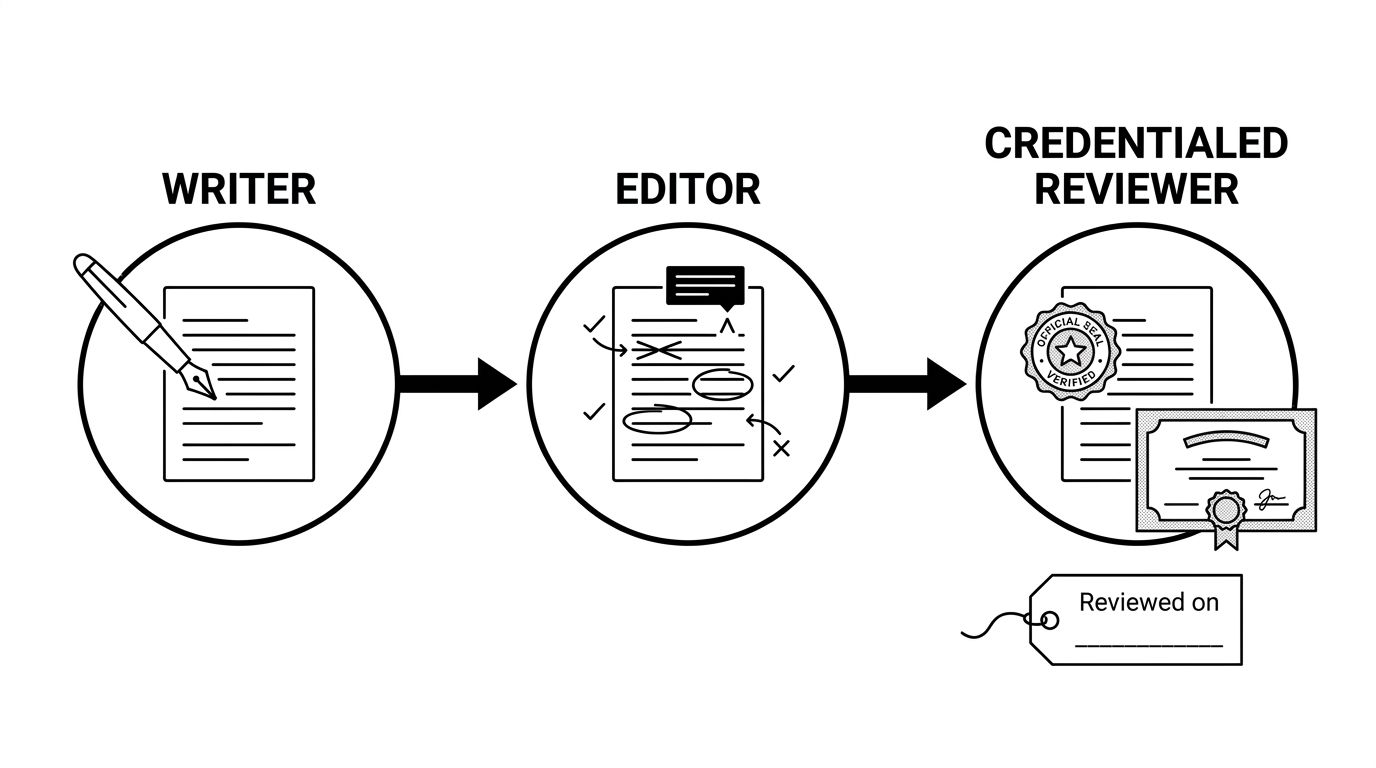
Investopedia separates the roles explicitly. A writer produces the draft, an editor works it, and a member of a standing financial review board checks it. Reviewed content carries a visible mark tying the article to that review.
The logic is straightforward. The person who writes clearly and the person who holds the professional qualification are rarely the same human. Pretending otherwise produces either badly written expert content or confidently wrong marketing copy. Splitting the roles and naming both people solves it honestly.
The review body is a page, not a person
Investopedia publishes a financial review board. Bankrate publishes one at a standing URL. Policygenius runs a financial review council.
These are permanent, addressable assets rather than a line in a bio. The board page lists practising professionals, their credentials and usually their day jobs. Investopedia's board has included people like Lea D. Uradu on tax, Khadija Khartit, Anthony Battle, Amilcar Chavarria, Eido Walny and Melody Bell, spanning certified financial planners, certified public accountants and academics. Membership changes over time, which is itself a signal that the thing is maintained rather than decorative.
A board is also the cheapest way to add credentialed review to a large back catalogue. You are not hiring a CFP to write two hundred articles. You are retaining several to review across them.
Independence is stated, not implied
NerdWallet publishes an explicit statement that business partners and advertisers do not influence product reviews, that editorial staff receive no compensation from partners, and that performance evaluations and pay are not affected by whether a review is favourable.
That last clause is the one worth copying. Anybody can claim editorial independence. Naming the specific mechanism through which bias would enter, and stating that it has been closed, is a different quality of claim.
It matters most when the publisher also sells the product, which describes most brokers, aggregators and insurtechs.
What B2B finance sites do instead
Set that four-part pattern against a typical regulated brand's blog and the gap is not subtle.
The byline is a marketing job title, or the company name, or nothing. There is no reviewer. There is no review date. The author page, where one exists, describes enthusiasm rather than qualification. The structured data, where it exists, records a name and a job title that says nothing about competence on the subject.
None of that is negligence. It is the ordinary output of a content operation built for a category where authorship never mattered much, then pointed at a category where it is the primary evaluation criterion.
The publishers did not discover a trick. They were forced into rigour earlier, because consumer finance results were contested by well-resourced competitors before B2B insurance results were.
Those four elements combine into a production flow that looks quite different from a single marketing byline. The diagram below shows the three named roles and where the review date attaches.
Why this outperforms a bio
A claim and a check are not the same thing
"Fifteen years of experience in the insurance industry" is a claim. Nothing outside the page supports it.
"Licensed life insurance producer" points at a register. A reader can verify it, a quality rater can verify it, and a retrieval system can reconcile it against the same name appearing elsewhere.
The rater guidelines ask who produced the content and what qualifies them. A checkable qualification answers the question. A biography describes the person.
It gives a machine something to work with
Structured author information is only as good as what it contains. `jobTitle: "Content Lead"` tells a parser nothing about competence on annuities.
A designation, plus a `sameAs` pointing at the body that issued it, is a short, unambiguous, externally verifiable assertion. That is the shape of evidence machine readers handle best, and it is where the author question meets the regulatory identifier question: in India and the UK, the link target can be a regulator's own register rather than a page you control.
It survives the scaled content question
A back catalogue where every article is reviewed and signed by a named professional is difficult to produce at spam scale, and visibly so.
That is a useful property in a category where the spam policies pay close attention to volume.
The credential available to you may be better than theirs
One thing worth noting for readers outside the United States.
The American publishers built this apparatus because no regulator issues them anything for editorial content. A review board is a substitute for external authority, constructed at the publisher's own expense.
A regulated insurer, broker or lender in India or the United Kingdom is in a different position. The firm holds registrations. Individual staff hold licences recorded on public registers. The corroborating body already exists and is a regulator rather than an in-house panel.
That does not remove the need for the pattern. Named authors, separated review and stated dates all still apply. It does mean the `sameAs` target can point at something stronger than a page you wrote about yourself, which is a meaningful advantage most regulated firms are not using.
Building this without a newsroom
Most regulated brands are not going to hire an editorial team of a hundred. The pattern scales down further than it looks.
Find the credential you already employ
Underwriters, licensed advisers, actuaries, chartered accountants, compliance officers with qualifications. Most financial firms employ more credentialed people than their content operation uses, because those people are busy doing the job the credential is for.
You do not need them to write. You need fifteen minutes of their attention per article and their name on the result.
Write the reviewer role down before asking anyone to do it
The objection from a licensed professional is almost always about liability and time, and it is reasonable.
Define what review means, in writing. What they are checking, what they are not, how long it should take, and what the byline says. "Reviewed for factual accuracy on 3 October 2026 by X, licensed insurance producer" is a bounded and defensible claim. "Endorsed by" is not, and nobody sensible will sign it.
Build the board page first
Before any article carries a reviewer, publish the page that explains who the reviewers are and what the review involves.
This is one page. It is the asset that makes every subsequent byline meaningful, and it is the thing competitors cannot replicate without doing the same work.
Put the review date on the page
A review with no date is a review of an unknown version of the article. In a category where rates, limits and regulations change, that is close to worthless.
State when the content was reviewed and by whom, and re-review on a schedule.
Mark it up and point it outward
Express the author and reviewer in structured data, include the designation, and point `sameAs` at the issuing body or the professional profile rather than at an internal page.
Our schema validator will tell you whether what you have shipped parses as intended.
The minimum viable version
If you implement nothing else, implement this on your highest-intent pages:
- A named writer, with a link to an author page that exists.
- A named reviewer holding a qualification relevant to the specific subject.
- That qualification linked to the body that issued it.
- A review date, stated as a date.
- One board or editorial-standards page explaining what review means.
- Author and reviewer expressed in structured data, with `sameAs` pointing outward.
Six items. None requires new articles, a new team, or a redesign. Most brands can complete all six in under two weeks, and the work applies retroactively to everything already published.
What this looks like when it is wrong
Two failure modes are worth naming because both are common and both are worse than doing nothing.
The first is the invented expert. A byline, a headshot, a plausible biography, no verifiable person behind it. In an unregulated category this is a cosmetic problem. In finance it is a page claiming authority it does not have, on a topic where that claim is the thing being evaluated.
The second is the credential that does not match the topic. A certified financial planner reviewing an article about commercial property cover is a qualification borrowed from an adjacent field. Match the reviewer to the subject or leave the reviewer off.
Where to start
Take the five pages on your site that most directly help somebody make a financial decision. For each, check whether a named person is attached, whether their qualification resolves to an external register, whether a separate reviewer is named, and whether a review date appears.
Most financial brands fail all four on all five pages. Fixing it is a week of work and one new page, and it does not require publishing anything new.
We build this into content strategy engagements, and the vertical detail sits in our insurance and financial services programmes.