Your Regulator Already Gave You the YMYL Signal You Are Trying to Build
Why does American E-E-A-T advice fit Indian and British finance brands so badly, and what verifiable credential are they already sitting on?

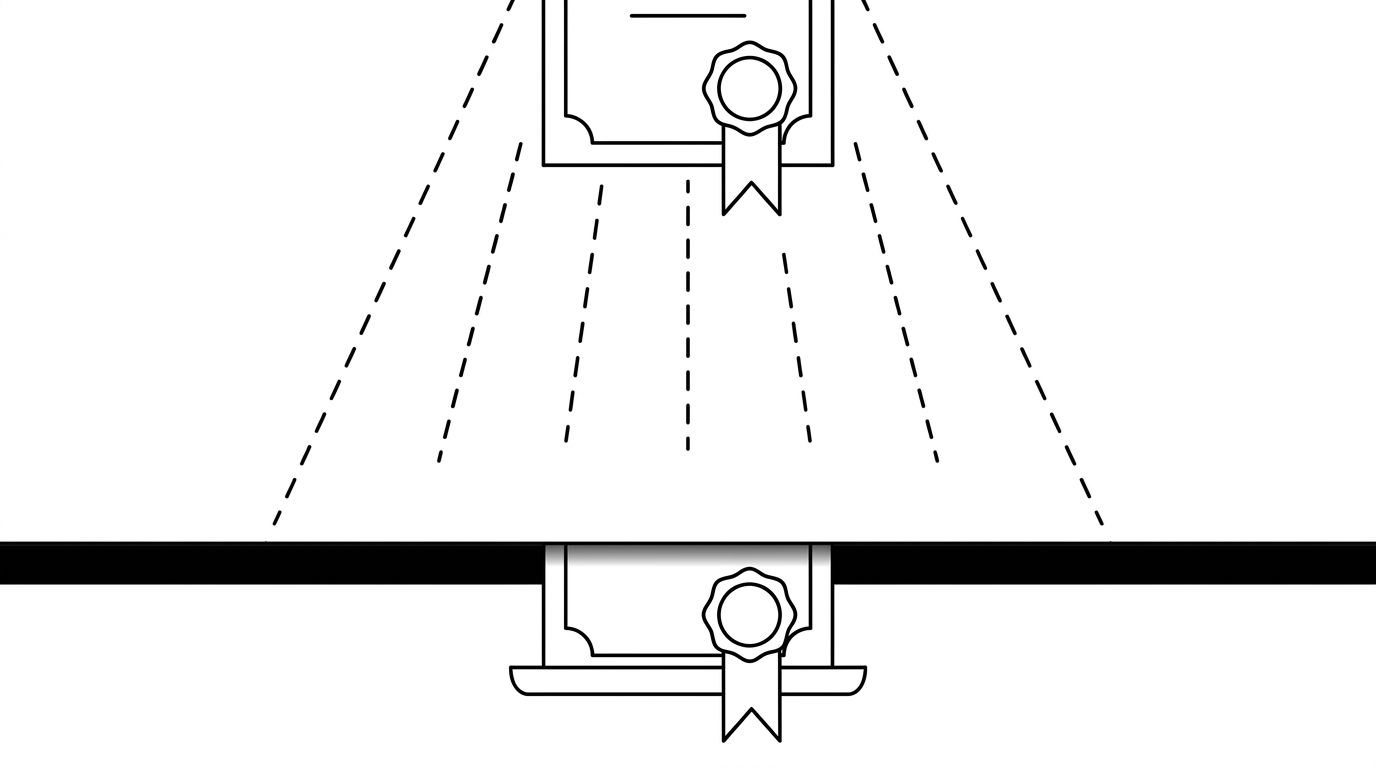
Google's Your Money or Your Life framework is jurisdiction-blind. One rubric, applied to a lender in Mumbai, a broker in Leeds and a publisher in Austin, asking the same question of each: can anybody outside your company verify that you are who you say you are and know what you claim to know.
What differs enormously is the supply of answers to that question, and it is set by financial regulators rather than by Google. American consumer finance publishers have no regulator issuing them a credential for editorial content, so they built one themselves: review boards, licensed-expert bylines, verification marks, published independence statements. That entire playbook, the one exported worldwide as best practice, is a workaround for a missing regulatory signal.
Indian and British firms are issued that signal by law. An IRDAI registration number. An advertisement reference number. An FCA authorisation status that resolves to a public register. Then they put it in six-point type in the footer, unlabelled and unstructured, and go read an American blog post about adding author bios.
If you are regulated, you start where those publishers had to finish. Most regulated firms have not noticed.
The contrast between the three markets is easiest to see side by side. The diagram below shows what each regulator hands a firm, and what American publishers had to build in the absence of anything.
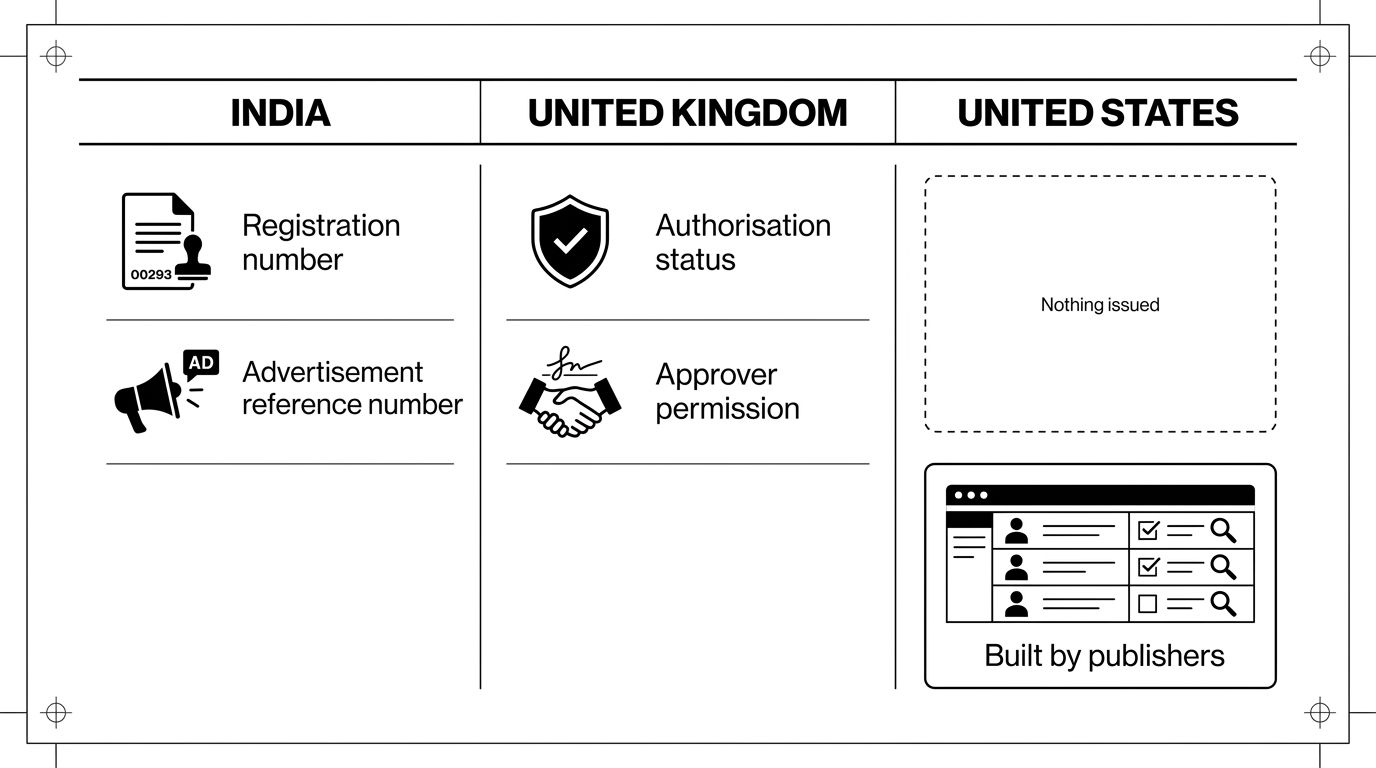
What each regime actually issues
The detail below is a starting point for your own verification, not a substitute for it. These regulations are revised, and the versions in force where you operate are the ones that matter. Nothing here is regulatory advice: where a question touches what you are permitted to publish, that is a conversation with your compliance team.
India issues you a number, and then another number
Insurance advertising in India runs under the IRDAI (Insurance Advertisements and Disclosure) Regulations, 2021, with the norms subsequently carried into the IRDAI (Protection of Policyholders' Interests, Operations and Allied Matters of Insurers) Regulations, 2024.
The structure is unusually generous to anybody thinking about verifiable trust signals. Insurers and intermediaries carry registration numbers. Advertisements carry a unique identifiable reference number recorded in a register the insurer maintains. Registered name and logo must appear. An intermediary advertising an insurer's product needs written approval from that insurer.
Read that as a search and AI problem rather than a compliance problem and something obvious falls out. A compliant Indian insurance page already carries multiple identifiers issued by a third party, tied to a register, and checkable by anybody. Policybazaar publishes its status as a composite broker with registration number 742 and code IRDA/DB 797/19. That is a stronger credential than any review board an American publisher can convene, because Policybazaar did not award it to itself.
The UK issues you a status with criminal liability behind it
Section 21 of the Financial Services and Markets Act 2000 makes it an offence to communicate an invitation or inducement to engage in investment activity unless you are authorised, the communication has been approved by an authorised firm with permission to approve it, or an exemption applies. Section 25 puts up to two years behind a breach. Insurance sits alongside this in the ICOBS rules.
Since the FCA's approval gateway opened on 7 February 2024, a firm needs prior permission from the regulator before it can approve another party's financial promotion. That narrowed the pool of approvers considerably.
The effect on trust signals is unusual. "Approved by an FCA-authorised person holding approver permission" is a status with a public register behind it and criminal liability attached to getting it wrong. No voluntary credential comes close.
It also cuts the other way, and British marketers feel this daily. You cannot publish as freely as an American competitor. The constraint is real. The compensation is that what you do publish carries a mark of assurance that no unregulated content farm can fake.
The US issues nothing, which is why the playbook exists
There is no pre-approval regime for editorial financial content in the United States. State licensing covers insurance producers, securities regulators cover advisers, and the FTC covers advertising claims, but a personal finance article does not pass a regulator's desk before publication.
So the publishers built the missing layer themselves, and they built it well.
Investopedia convenes a financial review board of practising professionals and marks reviewed content with a visible verification. Bankrate publishes its review board at a standing URL. Policygenius runs a financial review council and titles its author pages by licence rather than by seniority, so a page about life insurance is signed by a licensed life insurance expert. NerdWallet fields licensed producers as lead writers and publishes an independence statement making clear that partners do not influence reviews and editorial pay is not tied to review outcomes.
Every one of those is an attempt to manufacture, at the publisher's own cost, what IRDAI and the FCA hand their regulated firms for nothing.
The asymmetry nobody is acting on
Bought, earned, and issued
Trust markers come in three kinds, and only one of them survives scrutiny.
Bought markers are awards with entry fees, paid directory placements and badges you licensed. They confirm that you paid.
Earned markers are review boards, credentialed reviewers, corroboration in press you do not control. They are real and they take years.
Issued markers come from a body with statutory authority, resolve to a public register, and cannot be obtained by paying a marketing budget. If you are regulated, you hold these already.
The American playbook is a sophisticated response to only having access to the middle category. Copying it while ignoring the third is the specific mistake this post is about.
Why it is worth more to a machine than to a human
A human reader skims past a registration number. A retrieval system does not skim.
When an assistant assembles an answer about whether a firm is legitimate, an identifier that resolves to a regulator's register is the most tractable evidence on the page: short, structured, unambiguous and checkable against an external source. A paragraph claiming fifteen years of industry experience is a claim. `IRDA/DB 797/19` is a lookup.
The catch is that the identifier has to be findable and legible as an identifier. Buried in a footer, styled as small grey text, with no label saying what it is and no markup declaring it, it reads as page furniture.
The per-advertisement number is the part nobody has thought about
The registration number identifies the firm. The advertisement reference number identifies the individual piece of communication, and it is recorded in a register the insurer maintains.
That is a per-page identifier tied to an external record. Nothing in the American toolkit does that. A US publisher's verification mark says a reviewer looked at the article, and the only record of that review is the publisher's own database. An Indian advertisement reference number points at a register the regulator can inspect.
Whether it belongs on a marketing page is a compliance question with a different answer at every firm, and the answer is your compliance team's to give. The point worth registering is that most Indian insurers treat this purely as an obligation and have never once asked whether it is also an asset.
What we found when we looked
We fetched the robots.txt of 37 banking, insurance and fintech domains across the three markets on 23 September 2026, and pulled the served HTML of fourteen product pages the same day.
Two things stood out. Indian insurance product pages carry far more server-rendered text than their American equivalents: Policybazaar's term insurance page served 15,937 words of readable text and HDFC ERGO's health page 18,772, against 2,213 for GEICO's auto page and 1,672 for Policygenius's life page. Indian pages also lean heavily on tables, thirteen on the Policybazaar page alone, where the American pages we sampled served none.
So the raw material is there. Indian BFSI is not publishing thin content. What is missing is the structuring: the identifiers those pages carry are present as text, not as data.
There is a second wrinkle specific to the Indian market. Those pages express money in a notation the rest of the world does not use. The Policybazaar page we pulled carried 128 references to lakh or crore alongside 85 rupee symbols. BankBazaar's home loan page carried fifty lakh and crore references and not a single rupee character.
A sum written as five lakh, as `₹5,00,000` and as 500000 is one number to an Indian reader and three different strings to a parser. Any firm relying on a retrieval system to quote its premiums accurately has a normalisation problem that American and British competitors simply do not have.
When the identifier is missing, something else fills the gap
The failure mode here is not invisibility. It is substitution.
When an assistant is asked whether a firm is legitimate, or what it is authorised to sell, and the firm's own pages offer nothing structured, the answer gets assembled from aggregators, forums and competitor comparison pages. Those sources are often stale and occasionally wrong about which licence a firm holds.
The firm has not been left out of the conversation. It has left its own version of the facts out, and something less accurate has taken the slot. Correcting that after the fact is considerably harder than publishing it clearly in the first place, which is the subject of our guide to correcting brand misinformation.
What to do with a credential you already hold
Find every identifier your organisation holds
Registration numbers, licence numbers, approval references, register entries, membership numbers for professional bodies. Most firms hold more than the marketing team knows about, because they live with compliance rather than with content.
Label it, do not just display it
An identifier is only evidence if a reader can tell what it is. State the issuing body, what the registration permits, and the validity period where one applies. "IRDAI Composite Broker, Registration No. 742, valid to 09/06/2027" does work that a bare number in a footer does not.
Make it machine-readable
Put the organisation's identifiers into structured data rather than leaving them as styled text, and point the `sameAs` property at the regulator's own register entry where a public one exists.
This is the part that has no American equivalent, and it is the sharpest thing in this post. A US publisher's author schema can only point back at the publisher's own board page, a credential the publisher created. An Indian or British firm can point at the regulator. One is self-reference. The other is external verification.
Our schema validator will tell you whether what you have added parses.
Put the same logic on people
The organisation holds registrations. Individuals hold licences and designations. Both belong on the page, and the individual's qualification should link to the body that issued it rather than to an internal bio.
Where your genuine expert is an underwriter or an adviser rather than a writer, use the arrangement the leading publishers use: a writer drafts, a credentialed specialist reviews, both are named. That is a content strategy decision more than a writing one.
Stop importing advice that assumes you have nothing
Not all of it. The American material on structure and clarity is good. But when a US guide tells you that building authority means years of link earning before anybody trusts your finance content, it is describing a constraint that applies to a publisher with no licence.
You have a licence. The sequence is different. Surface what you hold, structure it, then do the slower corroboration work from a starting position the publisher never had.
Where this leaves you
If you are regulated in India or the UK, spend a fortnight auditing what your regulator has already issued you and how it appears on your site. There is a good chance it appears once, unlabelled, in a footer.
If you are in the US, the publisher playbook is the right one, and the versions worth copying are the ones that name real people with checkable licences rather than the ones that add a trust badge.
We work through the vertical detail in insurance and in financial services and fintech, and the insurance guide covers how the trust layer connects to everything else on the page.