Financial Services SEO: The Trust Signals That Actually Move
Why do financial services sites with strong content still lose to competitors, and which trust signals do search and AI engines actually check?


Most financial services SEO advice is general SEO with a compliance review bolted onto the end. It tells you to research keywords, publish depth, earn links, and get legal to sign it off. That advice is not wrong, but it skips the thing that separates finance from every other category: in a regulated vertical, the signals that count are the ones somebody outside your company can verify. You already hold several of them. They are sitting in your footer, in a licence register, and on your compliance team's shared drive, and almost nobody puts them where a search engine or a language model can read them.
That is the gap this post is about. Not more content. Better evidence.
Why financial services breaks the normal SEO playbook
The classification follows the topic, not the page
Google's quality rater guidelines treat Your Money or Your Life as a property of the subject matter rather than a label on particular URLs. A page about term insurance premiums is in scope because of what it discusses, not because of how it is built or how commercial it is. That means your product pages, your rate tables and your blog all sit under the same bar.
Read the practical version of that: there is no corner of a lending or insurance site where the standard is relaxed. The comparison page and the glossary entry are judged the same way.
The downside is not symmetrical
In most verticals a weak page is simply a page that does not rank. It sits there, earns nothing, and costs you the time it took to write.
Finance does not work that way. The rater guidelines describe pages on these topics that lack adequate expertise and trustworthiness as candidates for the lowest rating available. A thin page about annuities is not neutral inventory. It is a liability attached to a domain that also hosts the pages you care about.
This changes the arithmetic on publishing volume. Every additional weak page in a regulated vertical carries a cost that the same page would not carry on a software blog.
What that rules out immediately
Three tactics that work elsewhere stop working here.
- Volume plays. Publishing a hundred near-identical location or product variants invites the scaled content assessment rather than escaping it.
- Anonymous authorship. A page that gives guidance about somebody's money with no named person behind it fails the first question a rater is told to ask.
- Borrowed authority. Renting space on a stronger domain to rank for your terms runs into the site reputation rules, and it leaves nothing behind on your own domain.
Strip those out and what remains is slower and more durable. It is also the part competitors cannot copy in a quarter.
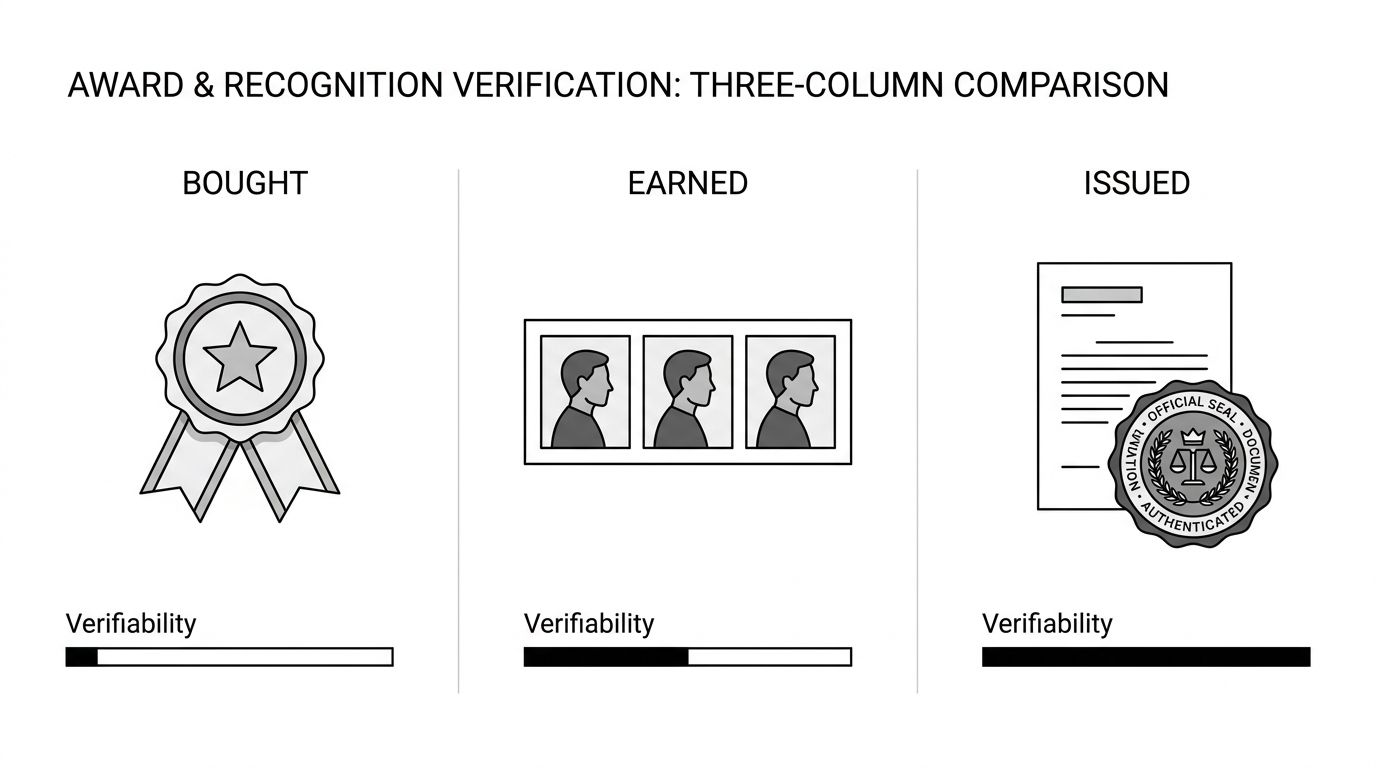
Trust markers are not interchangeable, and the three kinds differ sharply in how well they hold up to an outside check. The diagram below sets them side by side.
The trust signals a third party can verify
The useful test for any trust signal is simple. Can somebody who does not work for you confirm it without taking your word for anything?
Registration and licence identifiers
If you are regulated, a regulator has issued you an identifier. An insurance broker in India carries an IRDAI registration number. A firm in the United Kingdom carries an authorisation status on the Financial Services Register. A US insurance producer carries state licences, and an investment adviser carries a registration that resolves to a public record.
These are the strongest credentials on your entire site, because the issuing body is neither you nor a directory that sells placement. They are also the most wasted, because they usually appear once, in small type, at the bottom of the page, wrapped in nothing that identifies what they are.
Compare that to an American consumer finance publisher, which has no regulator issuing it anything and therefore has to build a credential layer from scratch. Those publishers convene review boards and put licensed professionals on bylines precisely because no external body hands them a badge. If you are regulated, you start where they had to finish.
People with checkable qualifications
The second signal is a named human with a qualification somebody can look up. A certified financial planner, a chartered accountant, a licensed producer, an actuary.
What matters is not the letters after the name. It is that the letters resolve to a register entry that exists independently of your website. An author page listing fifteen years of industry experience is a claim. An author page naming a designation and linking to the body that issued it is a check.
Corroboration you do not control
The third signal is the hardest and the most valuable: being described accurately somewhere you cannot edit. Regulator publications, established trade press, professional bodies, and reference sources.
This is also the signal that matters most for AI visibility, because language models assemble answers from sources across the web rather than from your domain alone. If the only place a claim about your firm appears is your own marketing copy, it carries the weight of marketing copy.
What does not count
Worth naming, because a lot of budget goes here. Badges you bought, awards with an entry fee, directory listings that accept anyone who pays, and testimonials with initials instead of names. None of these survive the "can somebody outside your company confirm it" test. They are not neutral either, because a page dense with unverifiable credibility markers reads to a careful evaluator as a page compensating for something.
What we found in 33 financial services robots.txt files
To see how the sector is actually handling machine readers, we fetched the robots.txt of 37 banking, insurance and fintech domains across India, the United States and the United Kingdom on 23 September 2026. Thirty-three returned a file we could parse.
Most of the sector has no AI policy at all
Twenty-two of the 33 readable files name zero AI crawlers. Not blocked, not allowed. Unaddressed. Those firms have an AI policy in the sense that a default applies to them, and that default is whatever somebody wrote for Googlebot years ago, now governing a set of retrieval systems that did not exist when the file was written.
The eleven that do name AI crawlers are more sophisticated than the sector's reputation suggests. We expected to find companies blocking a training crawler while leaving the retrieval crawler that actually feeds live answers wide open, or the reverse. With one exception, we did not find it. Firms that engage with the question tend to name agents from both categories, which suggests the people writing those files understand the distinction.
The divide is not between firms getting it subtly wrong. It is between firms engaging and firms not engaging at all.
India is further ahead than the US or the UK
This surprised us. By share of readable files naming at least one AI crawler:
| Market | Files naming an AI crawler | Sample |
|---|---|---|
| India | 6 | 15 |
| United States | 3 | 10 |
| United Kingdom | 2 | 8 |
Indian insurers and fintechs are engaging with machine-reader policy at a higher rate than their American and British counterparts in this sample. Bajaj Allianz names eighteen distinct agents. HDFC ERGO names eleven. Set against a general assumption that Indian BFSI trails on technical SEO, that is worth sitting with.
The sample is small and skewed toward large brands, so treat it as a signal rather than a census.
Four firms publish a policy nobody can read
Four of the 37 domains returned an error or a challenge page instead of their robots.txt. The file exists. No automated reader can retrieve it.
The consequence is worth stating plainly. If a crawler cannot fetch your robots.txt, it cannot read your restrictions either. Whatever access policy those four firms believe they have published, it is not reaching the systems it was written for.
Building the trust layer in the right order
Start with what is already in your footer
Find every regulatory identifier your organisation holds and move it from decoration to data. Put it in a labelled position on your about page, state what it is and who issued it, and mark it up so it is machine-readable rather than styled text.
This is a small piece of work that no competitor can replicate without holding the same licence. On a scale of effort to defensibility, nothing else on this list compares.
Put real names on pages that give guidance
Any page that helps somebody make a decision about money needs a person attached. Name them, state their qualification, and link the qualification to the body that issued it.
If the person who actually knows the subject is an underwriter or an adviser rather than a marketer, the fix is to have the marketer write and the specialist review, with both named. That structure is the norm at the publishers who win these results, and it is covered in our content strategy work.
Earn corroboration where engines already look
Identify the sources that already get cited in answers about your category, then do the work that earns a mention there. For regulated firms this usually means regulator consultations, trade press, professional bodies and industry research, rather than general link building.
This is the slowest item and the one that sets your ceiling. Our SEO service treats it as the constraint it is, not as an afterthought.
Measure what gets repeated back
The check on all of this is not a rankings report. It is whether the facts you have published about your firm come back accurately when somebody asks an AI assistant about you.
If an engine describes your coverage, your rates or your regulatory status incorrectly, that is the trust layer failing in the most direct way available, and it is measurable.
Where to start
Pick the single page on your site that most directly helps somebody make a financial decision. Check whether it names a person, whether that person's qualification resolves to an external register, whether your regulatory identifier appears anywhere on it in a machine-readable form, and whether any claim on it is corroborated somewhere you do not control.
Most financial services sites fail at least three of those four on their most important page. Fixing them takes a fortnight and does not require a single new article.
If you want the detail for your sector, we go deeper on this in financial services and fintech and in insurance, and the insurance case study shows what the trust layer produced for a commercial broker over three months.