We Built 21 Programmatic Pages for a YMYL Vertical, Then Deleted Them
What happens when you remove 21 programmatic service pages from a finance site, and was the page count ever the real problem?

In the spring of 2026 we built a service by vertical matrix on our own site. Seven services crossed with several industries, generating 21 pages at URLs like `/services/{service}/{vertical}`. Each one targeted a phrase a real buyer might search. The logic was the logic everybody uses, and on paper it was sound.
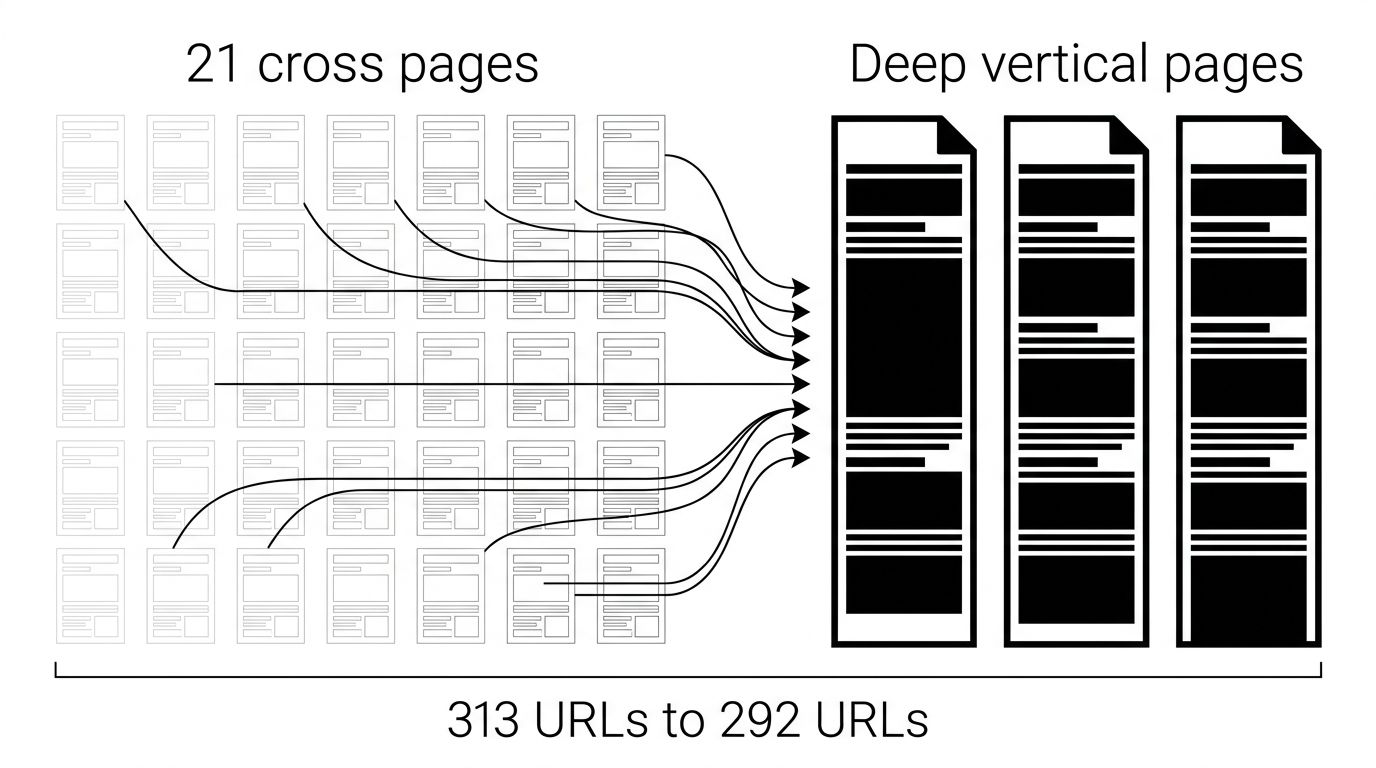
On 25 June 2026 we deleted all of them. The sitemap went from 313 URLs to 292 in a single commit.
The part worth publishing is not that programmatic pages can dilute a domain, which is well covered. It is what happened next, because the honest answer is that removing them did not fix the thing we thought it would fix. It cleared a problem that was real but secondary, and it made the actual constraint impossible to keep avoiding.
What we built and why it looked right
The matrix
Take the services a firm sells. Take the verticals it sells them to. Cross them. Each intersection is a phrase somebody searches, and each gets a page.
Ours produced pages for combinations of technical work, content work and link work against finance, insurance, SaaS and the rest. Every page had genuinely different copy. This was not a template with a variable swapped into a heading.
Why it is attractive in finance specifically
Buyers in regulated categories search in exactly this shape. They do not look for a marketing agency. They look for an agency that has worked with brokers, or lenders, or carriers.
Matching that shape with a dedicated page is a reasonable response to how demand actually expresses itself. That is why the tactic is popular, and why we ran it.
What we missed
Two things, both visible in hindsight.
The first is that the pages competed with each other and with the parent pages above them. Technical work for insurance and technical work for finance overlap heavily, because the work is mostly the same work. Search engines were left choosing between several of our pages for one query, and the choosing itself has a cost.
The second is the one that matters more in a regulated category. A set of near-identical pages generated from a grid is the shape the scaled content assessment is built to catch. Intent does not enter into it. Our pages were written rather than generated, and structurally they looked like the thing the policy describes.
The shape of the change is simple enough to draw. The diagram below shows what was removed and where the content went.
What the numbers actually said
Before
When we took the decision, the picture across the trailing 90 days was roughly 14,200 impressions producing about 49 organic clicks, a click-through rate near 0.35%. Average position was degrading rather than improving as page count rose. Referring domains sat at eight.
That last figure is the one we kept looking past.
After
By the audit we ran on 6 September 2026, the trailing 90 days showed 68,526 impressions and 210 clicks across 203 live URLs, at 0.31% click-through.
Impressions had grown substantially. Clicks had grown by roughly four times. Click-through rate had not improved, and by that measure it was marginally worse.
What that combination means
A site that gains impressions faster than clicks is a site being shown for more things while convincing no more of the people who see it. That is the signature of ranking on page two for a wider set of queries, and of appearing under AI answers that resolve the question without a visit.
Consolidation did what consolidation does. It stopped several of our own pages competing for the same query and it removed a structural risk. It did not move the number we cared about, because the number we cared about was never gated on page count.
The constraint we had been avoiding
Eight referring domains, and around ten at the later audit.
Our competitors in the same results have thousands. Against that, the difference between 313 pages and 292 is noise. We had spent months optimising the thing we controlled completely because it was the thing we controlled completely, and the actual ceiling was a number that only moves when other people decide to link to you.
Deleting the matrix was correct. Expecting it to produce a recovery was not.
The part that is genuinely hard to read
We want to be careful about what this data can and cannot support.
The two measurement windows are not clean. Other work shipped in the same period: free tools launched, content was consolidated elsewhere, vertical pages were rewritten. Attributing any part of the click growth to the matrix deletion specifically would be a claim the data does not support.
What the data does support is narrower and more useful. Removing 21 pages did not produce a step change in click-through rate, and the ratio of impressions to clicks moved in the wrong direction across the period. If consolidation alone were the unlock, that is not the shape we would expect.
We are publishing it because the ambiguous version is the true one, and because the tidy before-and-after case studies in this category are mostly doing something with the window boundaries.
Why this is sharper in a YMYL vertical
The downside is asymmetric here
In most categories a weak page earns nothing and costs nothing beyond the time it took.
Google's rater guidance treats pages on financial topics that lack adequate expertise and trustworthiness as candidates for the lowest rating available. A thin page about lending is not idle inventory on a domain that also hosts pages you care about.
Programmatic output is hard to credential
The authorship pattern that financial content is judged against needs a named writer, a credentialed reviewer relevant to the subject and a review date.
Try applying that to 21 grid-generated pages. Either you find a qualified reviewer willing to sign each one, which defeats the economics that made the grid attractive, or you publish financial pages with no credentialed review, which fails the criterion the category is evaluated on.
The tactic and the standard are close to incompatible.
Depth had somewhere better to go
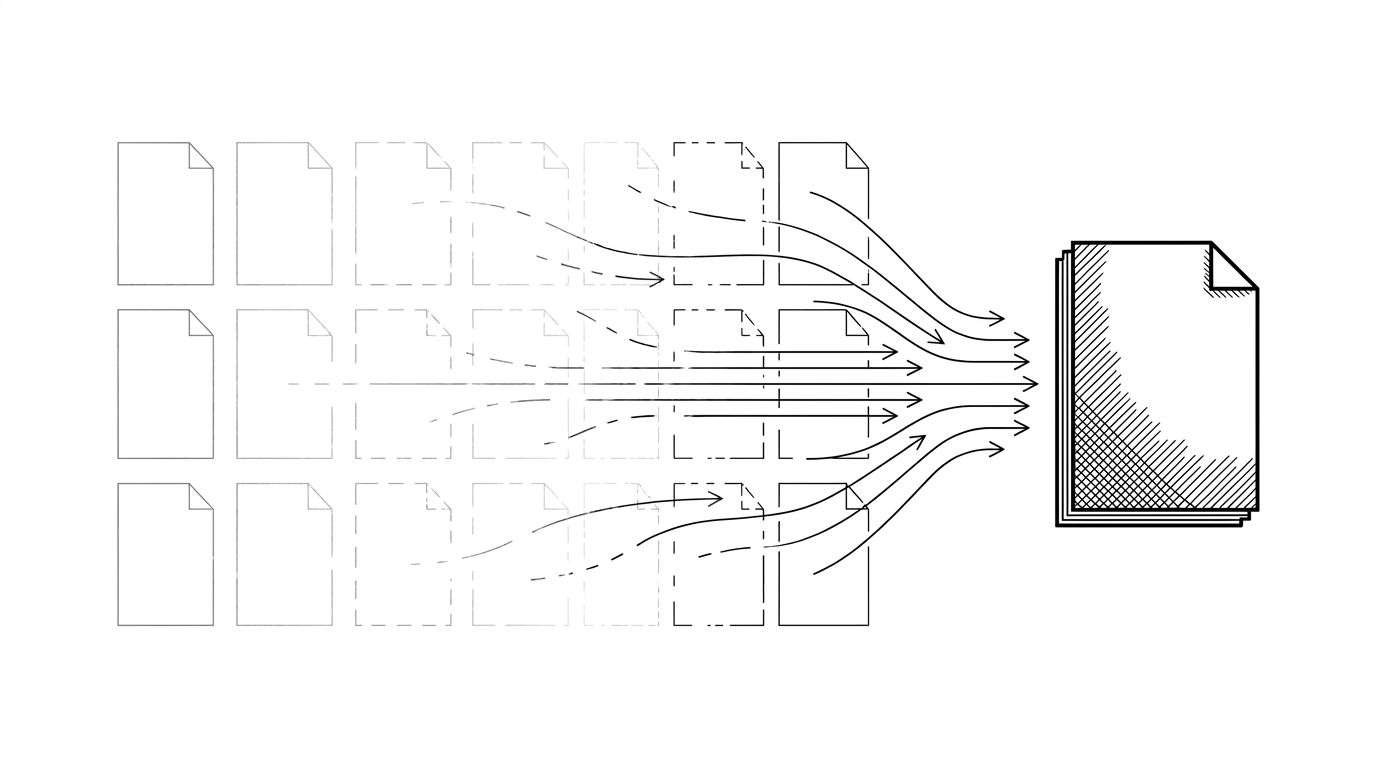
The pages we removed were folded into deeper vertical pages, one per industry, that now carry the detail the matrix spread across several thin URLs.
That turned out to be the useful part of the exercise. Not the deletion, the consolidation target. One page holding the full argument for a vertical is a better asset than seven pages each holding a seventh of it, and it is a much better host for the credential and identifier work that regulated firms should be doing.
The redirect decision matters more than it looks
When we removed the matrix we had to decide where each URL should point.
The lazy option is to send everything to the section hub. It is also close to useless, because a redirect to a page that does not answer the original query is treated as a soft removal rather than a consolidation.
We pointed each cross-page at the vertical page that absorbed its content, so somebody arriving from an old link about insurance technical work lands on the insurance page that now contains it. That distinction is the difference between preserving whatever the old URL earned and discarding it.
Keeping a single source of truth for what was removed and where it now points, rather than scattering rules across config, turned out to matter more than we expected once the list grew past a handful.
What we would tell someone considering the same build
Ask what the real constraint is first
Run the check we should have run. Look at referring domains against the competitors ranking for your target terms.
If you have ten and they have thousands, publishing is not your bottleneck and more pages will not become one. Publish what you need and put the rest of the effort where the gap is.
Count how many pages one buyer could justify visiting
If a single prospect would plausibly read three of the pages you are about to create, they are three pages. If they would read one and find the others redundant, you are building one page and several competitors to it.
Check the credential test before the keyword test
Before generating a set of financial pages, ask who will review them and whether that person's qualification matches each subject.
If the answer does not scale to the number of pages, the number of pages is wrong. This is a better filter than search volume in a regulated category, and it is faster to apply.
Consolidate toward depth, not just away from thinness
The gain came from what the pages were merged into, not from their removal. Decide the destination first.
Do not expect a recovery you have not earned
Removing a structural problem lets other work take effect. It is not itself the other work.
We publish what we find on our own site as we go, and the underlying programme is the same one we run in financial services and insurance.
Write down what you expect before you start
The most useful discipline we took from this: record the number you expect to move, and by roughly how much, before making the change.
We did not do that. We knew the matrix was a risk and we removed it, and because no prediction existed, any subsequent movement could be read as vindication. That is how teams end up believing in tactics that did nothing.
Had we written "we expect click-through rate to improve from 0.35% within two quarters", we would have been confronted with the miss immediately rather than reasoning our way around it six months later.
What we are doing instead
Fewer pages, each carrying more. Named and credentialed authorship on anything that helps somebody make a financial decision. Regulatory identifiers surfaced and structured rather than buried in a footer. And the slow work on referring domains that nothing else substitutes for.
The last item is the one that sets the ceiling, and it is the least automatable thing on the list. That is probably why it took us a year of optimising everything else first.
Keep the losing version on record
One last habit worth adopting. We kept the removed pages, the reasoning and the redirect map in the repository rather than quietly dropping them.
That matters six months later, when somebody proposes the same build again with a slightly different justification. Without a record the argument restarts from zero and the tactic gets rebuilt, because the case for it is genuinely appealing and the case against it lives in one person's memory.
Writing down what you tried, what you expected and what actually happened is the cheapest institutional memory available, and it is the step teams skip most reliably.