The Best AI Visibility Tools in 2026
Which AI visibility tool is worth paying for when every vendor counts prompts differently and several of them will not publish a price?

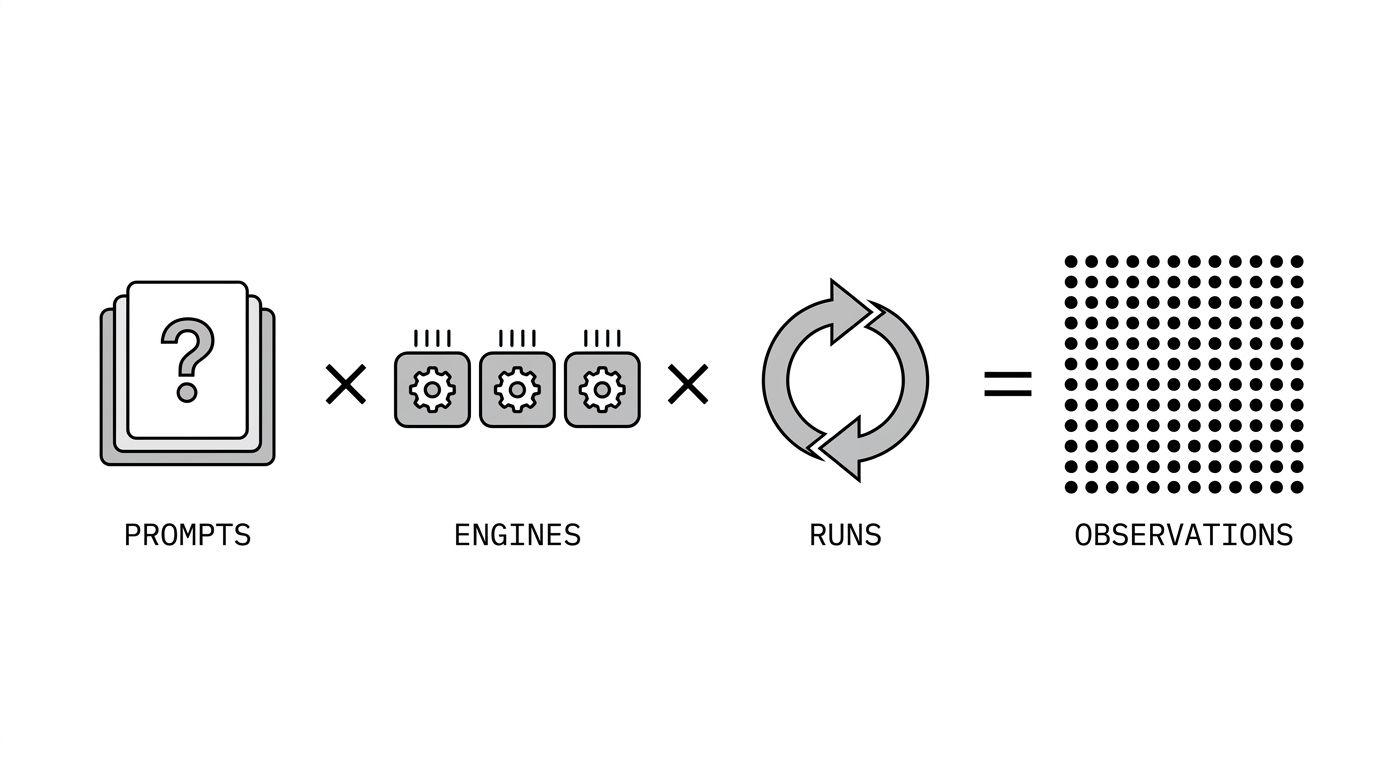
Every tool on this list sells the same core thing: it asks AI engines a set of questions on a schedule and reports how often your brand comes back. They differ in how many questions you can afford to ask. Prompt volume is the only spec that changes what you can honestly claim from the data, and the cheapest tiers on the market give you a sample far too small to tell a real movement from ordinary run-to-run noise. Read the price as a price per observation and the category reorders itself.
The second thing to know before you compare anything: there is no shared unit. One vendor sells prompts, another sells credits, a third sells answers, and two of the best-funded companies here will not publish a number at all. A "cheaper" tool is often the more expensive one once you normalise.
All prices below were checked on 16 September 2026 against each vendor's own pricing page. "Custom" means the vendor publishes no price. Where a vendor sells credits or answers rather than prompts, the table says so, because the units are not interchangeable.
The 10 best AI visibility tools
| Tool | Best for | Starting price | HQ |
|---|---|---|---|
| Geology | Teams that want the gap closed, not just measured | $2,500/mo | New York and Mumbai |
| Profound | Enterprise coverage across nine answer engines | Custom | New York |
| Peec AI | European mid-market SEO teams | Not published | Berlin |
| Otterly.AI | The cheapest serious starting point | $29/mo | Vienna |
| Scrunch AI | The crawler and agent side of the problem | $300/mo | Salt Lake City |
| Evertune | Large prompt volumes at a published price | $800/mo | New York |
| Athena | Trying the category for nothing | Free, then $295/mo | San Francisco |
| Rankscale | Flexible credit-based tracking | $20/mo | Not published |
| Ahrefs Brand Radar | Teams already paying for Ahrefs | Included on Lite and above | Singapore |
| Semrush | Teams already paying for Semrush | From $117.33/mo billed annually | Boston |
1. Geology
Geology is a GEO and SEO platform that monitors how AI engines describe and recommend a brand across ChatGPT, Perplexity, Google AI Overviews, Gemini and Claude, and then runs the work to change what those engines say. That second half is the difference. Every other entry on this list hands you a dashboard and leaves the content, schema, citations and off-site work to you or your agency.
Plans are published: Growth at $2,500 a month covers 200 prompts, 50 optimised pages and the core technical work, and Blitz at $7,500 a month widens AI platform coverage, takes it to 300 pages, and adds amplification through Reddit, Quora and LinkedIn. Enterprise is custom for multi-brand tracking. Contracts are month to month, with a three-month minimum recommended before the numbers mean anything. The team works across finance, insurance, SaaS, B2B and ecommerce, and the insurance case study shows the shape of a full engagement.
Best for teams who already know they are invisible in AI answers and want the measurement and the remediation from the same place. If all you need is a chart, entries four, seven and eight cost a fraction of this.
2. Profound
Profound is the best-capitalised company in the category and positions itself as "the deepest and most complete tool" for AI search. Its enterprise plan covers nine answer engines: ChatGPT, Perplexity, Google AI Mode, Gemini, Copilot, Grok, DeepSeek, Claude and Google AI Overviews. No other vendor here matches that list.
The funding history tells you who the buyer is. The New York company raised a $20 million Series A led by Kleiner Perkins in June 2025, a $35 million Series B led by Sequoia two months later, and a $96 million Series C led by Lightspeed in February 2026, with Bloomberg reporting a $1.8 billion valuation. Pricing is custom and gated behind sales. The free trial is deliberately thin: 10 prompts, run once, ChatGPT only.
Best for enterprise teams with a procurement process and a need for engine coverage nobody else offers. Wrong fit if you want to see a price before you take a call.
3. Peec AI
Peec AI describes itself as "AI search analytics for marketing teams" and tracks visibility, position and sentiment across ChatGPT, Perplexity and Gemini. It is the European entrant with the fastest commercial ramp in the category.
Founded in Berlin and launched in February 2025, it raised a €7 million seed led by 20VC in July 2025 and a $21 million Series A led by Singular that November, bringing the total to $29 million. The site claims more than 3,000 brands and agencies and a 4.9 out of 5 rating on G2. The pricing page names four tiers, Starter through Enterprise, and at the time of checking showed no prices against them, so treat any figure you read in a comparison post as unverified.
Best for European mid-market teams who want a tool built around the way SEO teams already work. Ask for the rate card in the first email.
4. Otterly.AI
Otterly.AI is the cheapest way into this category that still produces usable data. It tracks ChatGPT, Google AI Overviews, Perplexity and Copilot on every plan, with Claude, Gemini and Google AI Mode as paid add-ons.
The Austrian company launched publicly in October 2024, founded in Vienna by Thomas Peham with Josef Trauner and Klaus-M. Schremser, and says it is not raising outside funding. It announced a technology partnership with Semrush in January 2025, and its own About page reports growth from 1,000 users at launch to more than 40,000 by August 2026. Pricing is fully published: Lite $29 a month for 15 prompts, Standard $189 for 100, Premium $489 for 400, and Enterprise from $1,000, with 15% off annual billing and a free trial.
Best for a first tracker, an agency pilot, or a single brand in a single market. At 15 prompts, the Lite tier answers whether you appear at all, not how you are trending.
5. Scrunch AI
Scrunch AI approaches the problem from the infrastructure end. Alongside answer tracking across ChatGPT, Claude, Gemini, Perplexity, Google AI Mode and Meta, it builds a machine-readable layer of your site for AI crawlers without changing what humans see, which is the part of AI visibility most dashboards ignore.
The Salt Lake City company was founded in 2023 and has raised $19 million, a $4 million seed led by Mayfield in March 2025 and a $15 million Series A led by Decibel that July. It reports more than 500 customers including Lenovo, Skims, Crunchbase and Penn State University, and publishes a testimonial from Clerk's head of growth marketing citing a 9x increase in sign-ups from AI search. Starter is $300 a month for 350 custom prompts plus 1,000 industry prompts, Growth is $500, and both drop about 17% on annual billing.
Best for technical teams who suspect their problem is access and retrieval rather than content. Check our free AI crawler checker first to find out whether it is.
6. Evertune
Evertune sells a brand-index view of AI answers rather than a keyword-style rank tracker, and pairs it with content activation and AI advertising. Its pitch is that brands should "own the AI customer journey" end to end.
The New York company was founded in 2024 by Trade Desk veterans Brian Stempeck, Ed Chater and Poul Costinsky, and has raised $19 million in total, including a $15 million Series A led by Felicis in August 2025. Pricing is published and unusual for the enterprise end of this market: Pro is $800 a month for 100,000 prompts tracked across 11 AI models, with 25 AI-optimised articles a month included, and Enterprise is custom.
Best for brands that need volume and a number they can budget against. That prompt allowance is the highest published figure in this list by a wide margin.
7. Athena
Athena tracks brand visibility across ChatGPT, Perplexity, Google AI Overviews, Gemini and Copilot, with citation intelligence and content recommendations layered on top, and is built in San Francisco.
It is the only tool here with a real free tier: Essential gives $25 of credit, or 300 credits, with no card. Starter is $295 a month for 3,600 credits and widens coverage to 11 or more models including Claude, Grok, DeepSeek and Mistral, with 17% off annually. Enterprise adds multi-region deployment and persona targeting at custom pricing. Credits, not prompts, are the unit, so model the burn rate against your own prompt set before committing.
Best for a team that wants to test the category this week without a purchase order.
8. Rankscale
Rankscale is credit-based like Athena but publishes a full ladder of prices, which makes it easy to size. It covers ChatGPT, Perplexity, Gemini and Google AI Mode, DeepSeek, Claude, Grok and Copilot on every paid plan.
Essentials starts at $20 a month. Pro is $99 for 1,200 credits, worth up to 4,800 AI engine answers, plus 10 brand dashboards and 50 page audits a month, and comes with a seven-day free trial. Growth is $385 for 5,500 credits and Enterprise is $780 for 12,000. At the Pro tier the implied cost works out near two cents per engine answer, the lowest published rate here, though answers and prompts are not the same unit and the comparison only holds if your prompt set is stable.
Best for analysts who want to buy observations rather than seats, and who will actually do the credit arithmetic.
9. Ahrefs Brand Radar
Ahrefs Brand Radar tracks brand appearances across AI Overviews, Gemini, Perplexity, ChatGPT, Copilot and AI Mode, and also watches YouTube, TikTok and Reddit as the sources that feed those answers. Ahrefs is based in Singapore and the tool ships inside a platform SEO teams already run.
Custom prompt tracking is included with Lite and higher plans, at between 5 and 20 or more prompts depending on tier, which makes it effectively free if you are already a customer. The separate AI Visibility Index, which reads across a database of more than 455 million prompts, is $199 a month with overage at $0.020 per additional check, and standalone custom prompts start at an extra $50 a month.
Best for teams who want AI visibility next to their backlink and rankings data rather than in a tenth tab. The prompt allowance is small, so treat it as a signal, not a programme.
10. Semrush
Semrush has folded AI visibility into its main plans rather than selling it as a bolt-on, so every tier now tracks performance in AI search to some degree. The company is headquartered in Boston, and plans start at $117.33 a month on the SEO tier when billed annually, rising through Starter, Pro+ and Advanced.
The add-ons it does sell separately are seats and reporting, at $45 a month for an extra user and $10 to $20 for report packs. For agencies that already report to clients through Semrush, that bundling is the entire argument.
Best for teams whose reporting already lives in Semrush and who need one more line in an existing deck rather than a dedicated AI search practice.
Best for each goal
The right answer changes with the job. These are the honest per-goal picks, and Geology only wins two of them.
| Goal | Pick | Why |
|---|---|---|
| Widest engine coverage | Profound | Nine answer engines on one contract |
| Cheapest real start | Otterly.AI | $29 a month with published prompt counts |
| Free evaluation | Athena | $25 of credit with no card |
| Most observations per dollar | Evertune | 100,000 prompts tracked at a published $800 |
| Crawler and access problems | Scrunch AI | Machine-readable site layer, not just tracking |
| Already paying for an SEO suite | Ahrefs or Semrush | Prompt tracking included in plans you hold |
| Measurement plus the work | Geology | Tracking and the content, schema and off-site execution |
| Regulated verticals like finance and insurance | Geology | Vertical research and compliance-aware content |
The arithmetic below is what you are actually buying when you compare these prices.
How to choose without regretting it
Work out your prompt requirement first, then shop. Take the number of questions a buyer might ask before shortlisting you, multiply by the markets you sell into, and you have a floor. Most teams land between 50 and 200 prompts, which quietly rules out half the entry tiers on this page.
Then apply three filters:
- Normalise the unit. Convert every price to cost per tracked prompt per month, and where a vendor sells credits, ask how many credits one prompt on one engine consumes. The answers vary by a factor of ten.
- Check engine coverage against your buyers, not against the spec sheet. Coverage of nine engines is worth nothing if your market lives in two of them.
- Ask what happens after the dashboard. Every tool here will tell you your mention rate is 12%. Only some will tell you which citation domains drove the other 88%, and none of the pure trackers will go and earn them.
If you would rather understand the mechanics before you buy anything, we wrote a full guide to building your own AI visibility tracker, including the sample-size arithmetic that decides how many prompts you need.
What to do next
Pick the cheapest tool that clears your prompt floor, run it for six weeks, and look at the citation domains rather than the score. The domains tell you where the work is. If the answer is that AI engines are citing publications, communities and comparison pages you have no presence on, that is a content and authority problem, and no dashboard fixes it.
That is the point where teams usually call us. See what a full programme covers on the GEO and AEO service page, or compare scopes and budgets on pricing.