SEO for Insurance Agents: The Searches You Can Win
Which Google searches can a local insurance agency win against carriers and quote sites, and which ones should it stop chasing?

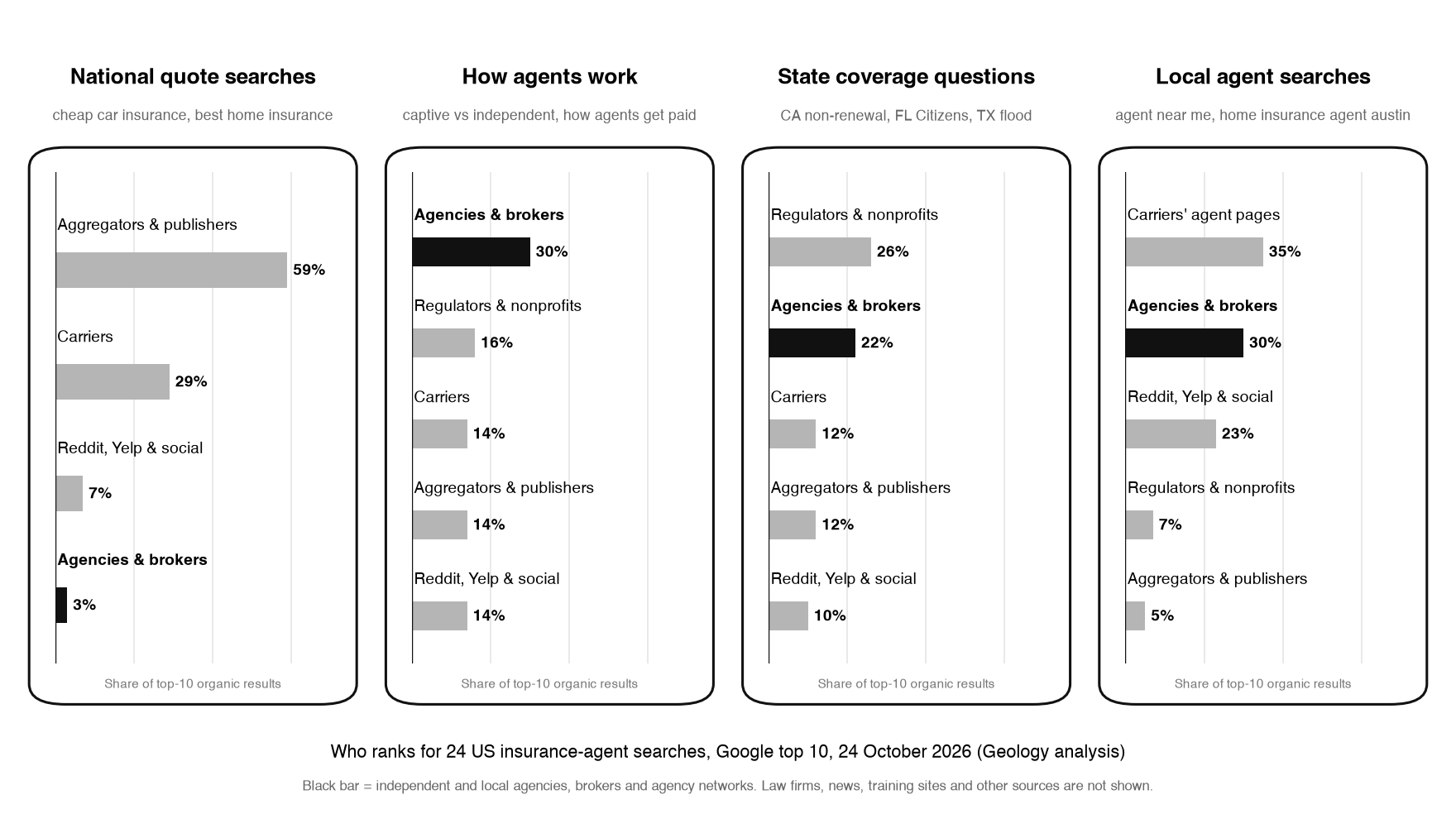
Most insurance agencies aim their SEO at searches they cannot win. We pulled the Google results for 24 common US insurance searches, and on national quote searches like "cheap car insurance" or "best home insurance companies", agencies and brokers held 3% of the top-10 results, and carriers and quote sites held 88%. The other three kinds of search looked very different. Agencies held 30% of the top 10 on questions about how agents work, 22% on state-specific coverage questions, and 30% on local "agent near me" searches, where every query also showed a map pack of three local agencies. When Google wrote an AI Overview for a question about agents, agencies and agency networks supplied 52% of the sources it linked. If you sell insurance from a local office, put your effort into those three kinds of search and let the quote sites have "cheap car insurance".
There are a lot of agencies chasing the same screen. The Big "I" puts the number of independent property and casualty agencies at 39,000 in its 2024 Agency Universe Study, and EverQuote's latest annual report describes a base of more than 100,000 P&C insurance agencies in the United States once captive offices are counted. The Bureau of Labor Statistics counts about 572,600 insurance sales agent jobs, with 63% of them at agencies and brokerages. All of those agencies compete for one map pack and ten blue links per search.
The chart below groups the 24 searches into four types and shows who held the top 10 for each.
What 24 insurance searches show about SEO for insurance agents
We ran the 24 searches through a US Google results scrape on 24 October 2026, six of each type, and sorted every top-10 result into a group: agencies and brokers (local independents, regional brokers and agency networks such as Smart Choice, Goosehead and Brightway), carriers (including the agent-locator pages carriers host for their captive agents), aggregators and publishers (NerdWallet, The Zebra, Policygenius, Insurify and similar), regulators and nonprofits (state departments of insurance, the NAIC, residual-market plans and consumer groups), and Reddit, Yelp and social sites. Law firms, news sites and training vendors went into an "other" group.
| Search type | Example searches | Agencies and brokers | Carriers | Aggregators and publishers | Regulators and nonprofits | Reddit, Yelp and social |
|---|---|---|---|---|---|---|
| National quote | cheap car insurance, best renters insurance | 3% | 29% | 59% | 2% | 7% |
| How agents work | captive vs independent, how agents get paid | 30% | 14% | 14% | 16% | 14% |
| State coverage | California non-renewal, Florida Citizens eligibility | 22% | 12% | 12% | 26% | 10% |
| Local agent | insurance agent near me, life insurance agent Denver | 30% | 35% | 5% | 7% | 23% |
Each row describes a different market.
National quote searches belong to carriers and quote sites. Liberty Mutual, GEICO, Progressive and Allstate sat next to The Zebra, Insurify, LendingTree, NerdWallet and WalletHub. The only agency that ranked at all was Freeway Insurance, a national agency chain with state landing pages, at positions 7 and 10. No local agency appeared on any of the six.
Questions about how agents work are where agencies get credited. "Independent insurance agent vs captive agent" had five agencies or agency networks in its top 10, and its AI Overview linked to Smart Choice, Goosehead, Renegade Insurance, Dragon Insurance and Atlas Insurance Brokers, among others. "How do insurance agents get paid" also had five, with Brightway, EMG Brokerage and Premier Mountain Insurance cited in the AI Overview.
State coverage questions put agencies next to the regulator. "How to get homeowners insurance in Florida after non renewal" had four agencies in the top 10, one of them with a page written for Myrtle Beach, South Carolina. "California FAIR Plan vs regular homeowners insurance" ranked a Central California agency's explainer at position 7, one place below the FAIR Plan's own site, with the California Department of Insurance at the top.
Local searches are the most crowded, and the closest to a sale. All six showed a map pack, and every map-pack slot went to an agency. In the organic results below the pack, carriers' agent-locator pages (State Farm, Nationwide, Allstate, Travelers, New York Life) took 35% of the slots. Those pages are captive agents' listings, so the agent still wins the click, but the carrier owns the page.
Only 6 of the 24 searches returned an AI Overview, and none of the six local searches did. A caveat before you build a plan on this: it is one snapshot, on one day, across 24 searches, and the scraper's location shifted between queries (one map pack came from Colorado, another from Texas). Treat the shares as directional and run the same check on your own market, with your own city and state in the queries, before you commit budget.
National quote searches: buy or list, then move on
A three-person agency in Tampa will not outrank Progressive and The Zebra for "cheapest full coverage car insurance". The searcher wants dozens of prices on one page, and quote sites build exactly that page. Your agency site cannot be that page, so Google rarely ranks it.
The national quote market still reaches agencies, through paid referrals. EverQuote reported approximately 6,000 enrolled insurance agencies on its platform at the end of 2025, selling referrals "in various ways, such as clicks, data and calls". SmartFinancial, MediaAlpha and similar marketplaces work the same way. Buying those leads is a paid acquisition decision, and it belongs in your marketing budget, separate from SEO.
Two things are worth doing on the SEO side:
- Make sure the quote sites and directories that list agents describe you correctly. Trusted Choice, the Big "I" consumer site, ranked for "how to find a good insurance agent" and "independent insurance agency near me" in our set, and Yelp showed up on four of the six local searches.
- Stop writing "cheap car insurance in [state]" blog posts. They take hours to write, the six national searches above show how rarely an agency reaches page one with them, and they pull your content calendar away from the pages that can win.
If you do buy leads, read the consent language your vendor uses. The FCC's one-to-one consent rule for comparison-shopping leads was vacated by the Eleventh Circuit in January 2025 in Insurance Marketing Coalition v. FCC, but the TCPA's underlying prior-express-consent requirement still applies to the calls and texts you make from those leads.
Local SEO for insurance agents: the map pack and your carrier's page
On local searches the map pack is the spot to win, and most of the work to win it happens in Google Business Profile.
Google's own guidelines for representing your business name insurance agents as individual practitioners, which means an agent who meets customers at a verified location during stated hours can have a profile. The same page sets a naming rule that matters for captive agents. If you are the only public-facing agent at a branded office, Google wants one shared profile named "[brand]: [practitioner name]", and its own example is "Allstate: Joe Miller". If several agents work from one office, the office gets the main profile, and each practitioner's profile carries only the practitioner's name. Keywords such as "Best Auto Insurance Austin" in the business name break Google's naming rules, which bar service and location information in the name.
Beyond the name, the profile needs the fields searchers compare:
- Primary category set to the closest fit ("Insurance agency" or the specific line, such as "Life insurance agency"), with secondary categories for other lines you write.
- Hours, phone and address that match your website and your state license record exactly.
- Services listed by line of business: auto, home, renters, umbrella, commercial, life, Medicare.
- Reviews that mention the line and the situation ("helped us replace our homeowners policy after a non-renewal"), which you can ask for in your post-bind email.
Google Local Services Ads are also open to agencies, in a narrow footprint. Google's screening and verification page lists "Insurance agency (currently available in California and Florida only)", with a state business license required and background checks, business registration checks and professional liability coverage required for select advertisers. If you are licensed in one of those two states, the ad sits above the map pack and you pay per lead rather than per click.
What captive agents control
In the local searches we checked, carrier-hosted agent pages took more organic slots than independent agencies. State Farm's Austin and Denver agent directories both ranked in the top 10. If you are a captive agent, your carrier page is the page most likely to rank for your name and city, so fill in every field the carrier lets you edit: photo, bio, languages, licensed states, products and office hours.
Your agent agreement may also limit what you can publish on your own domain. Ritter Insurance Marketing's compliance guide for agents, written mainly for Medicare sellers, tells agents to obtain carrier approvals for paid ads and to follow carrier guidelines for any custom materials. Read your agent agreement before you build a separate site, and route new pages through the carrier's marketing approval where the agreement requires it. Your Google Business Profile, your reviews and your local citations usually sit outside that approval process, which is why they matter more for captive agents than for independents.
Location pages only where you are licensed
Independent agencies often build a page for every city within driving distance. Build them only for the states where you hold a resident or nonresident license and carrier appointments, and say so on the page. A page that ranks in a state where you cannot write the business generates calls you have to turn away.
Mark up your site with the schema.org InsuranceAgency type, a subtype of LocalBusiness and FinancialService, on your home page and each office page. Include the address, phone, hours, the areas you serve, and a `sameAs` link to your Google Business Profile. You can check the markup with our free schema validator.
How-agents-work questions: the pages AI already credits to agencies
The pages that ranked and got cited for questions about agents share a shape. They answer one question from the agency's own position, in the first few lines, and then explain how that agency handles it. Garland Insurance describes independent agents, in its page on the topic, as agents who "represent multiple carriers and work for you". SC Insurance Brokers' FAQ answers "do independent agents charge extra?" with a one-word "No" before explaining commission.
The regulators rank on the same questions. The NAIC's consumer guide to choosing an agent and the Texas Department of Insurance's find-an-agent page both tell consumers to confirm the agent is licensed before buying. Your page can add what the regulator's page cannot: the answer for one specific, licensed agency. Build these first:
- Captive vs independent, from your side. Say which you are, how many carriers you are appointed with in the state, and what that means for the customer at renewal.
- How we get paid. Explain commission in plain terms. Two agency pages ranking for "is it cheaper to go through an independent insurance agent" open by telling the reader they pay nothing extra, because the carrier pays the commission. If you charge broker fees for any line, say so here.
- Agent vs broker. The NAIC guide draws the distinction (a broker represents the buyer and often charges a fee), and the "insurance broker vs agent" AI Overview cited North Star Insurance Advisors, a Missouri final-expense seller, alongside training and compliance vendors.
- How to check our license. Give your license number, your National Producer Number, and a link to your state department of insurance lookup. This page answers the regulator's own advice and gives AI systems a verifiable fact about you.
- What happens when you file a claim with us. Who you call, what the agency does, and what the carrier does.
These pages also earn the trust signals Google applies to money topics. We cover those signals in Financial Services SEO: The Trust Signals That Actually Move and in the YMYL SEO and GEO guide.
State coverage questions: sit next to the department of insurance
State coverage questions are where a local agency knows something a national publisher does not. Every state has its own residual market, its own notice rules and its own minimums, and the people searching those questions often have a policy expiring within weeks.
In our set the state department of insurance or a state-created plan ranked first or near the top on every one of these searches. The California Department of Insurance ranked first for "california home insurance non renewal what to do". Citizens Property Insurance ranked first for "florida citizens insurance eligibility". The Texas Department of Insurance ranked first for "does texas require flood insurance" and was the first source in the AI Overview for "texas minimum car insurance requirements". Agencies filled the slots underneath: Allied Insurance Group and Lewis Insurance on Florida Citizens eligibility, Leavitt Group and a Texas flood MGA on Texas flood insurance, Navion Insurance and a HUB International blog on California non-renewals.
The agencies that ranked did three things the national publishers did not:
- They cited the statute or the regulator by name. One Florida risk advisory firm's page opens with the rule that insurers must give 120 days' notice of non-renewal, which is Florida Statutes 627.4133(2)(b).
- They gave the next step in the reader's state: who to call, which residual market to apply to, which documents to have ready.
- They dated the page. State rules change every legislative session, and a page that says "updated for 2026" signals it is current to both readers and AI systems.
Pick the five state-specific questions your clients ask most at renewal and write one page for each. For a California agency that might be non-renewal options, the FAIR Plan with a difference-in-conditions policy, wildfire mitigation discounts, earthquake coverage and the state auto minimums. For a Florida agency, Citizens eligibility, non-renewal timelines, flood requirements, wind mitigation inspections and roof age rules. Our insurance SEO and GEO guide goes deeper on structuring these pages, and the auto insurance GEO guide covers the auto-specific questions.
Licensing and advertising rules are part of the page
Each state regulates insurance advertising, and its rules decide which facts must appear on your pages. Build them into your templates so a writer cannot forget them.
License numbers on pages and emails
California's Insurance Code section 1725.5 requires licensees to show their license number on business cards, written price quotations and print advertisements distributed only in California, in type at least as large as the phone number or address, according to the department's Bulletin 96-8. Since 1 January 2023, SB 1242 extends the requirement to emails that involve licensed activity, with the number placed next to or directly under the licensee's name, per the California Department of Insurance notice. The National Producer Number does not satisfy it.
Even outside California, putting your license number on every page in plain text costs nothing and gives Google and AI systems a fact they can verify against a state record.
Unfair trade practices and online advertising
Most states have adopted some version of the NAIC's Unfair Trade Practices Act, Model 880, which bars untrue, deceptive or misleading statements in insurance advertising. The 2024 edition of the model applies the false-advertising section to email, internet advertising and "electronic posting of any kind", and extends the act to health insurance lead generators. Superlatives such as "lowest rates in Texas" or "guaranteed approval" are the usual problem. Write the claim you can prove ("we compare quotes from 14 carriers appointed in Texas") instead.
Medicare pages
If you sell Medicare Advantage or Part D, federal rules apply on top of state ones. Under 42 CFR 422.2267(e)(41), third-party marketing organizations must prominently display a standardized disclaimer on their websites, starting "We do not offer every plan available in your area" when they do not sell every plan in the service area. Put it on every Medicare page, in text.
Crawler access
None of this matters if AI crawlers cannot read your pages. If your site runs on an agency website vendor's platform, the vendor may have set its bot rules for you. Check yours with our free AI crawler checker.
Independent vs captive agents: what changes in the plan
The method is the same for both, but the weight shifts.
| Task | Independent agency | Captive agent |
|---|---|---|
| Google Business Profile | Agency name, one profile per office | "[Carrier]: [agent name]" for solo offices |
| Main ranking page for local searches | Your own office pages | Usually the carrier's agent page |
| How-agents-work pages | Lead with multi-carrier choice | Lead with the carrier's products and your local service |
| State coverage pages | Your strongest content asset | Often limited by carrier approval |
| Reviews and citations | Important | The biggest lever you fully control |
Independent agencies have more room on their own domain and should spend most of their content effort on state coverage questions and how-agents-work pages. Captive agents should treat the carrier page and Google Business Profile as their main assets, and publish on their own site only what the agreement allows.
Insurance SEO and GEO: getting named in AI answers
Only 6 of our 24 searches returned a Google AI Overview, so for a local agency AI answers are a second channel next to the map pack. But the AI Overviews that did appear on agent questions cited agencies more than any other group, and people ask ChatGPT, Perplexity and Gemini the same questions, such as "should I use an independent agent for my home insurance in Florida?"
In our set, the cited pages looked like the ones described above: one question per page, answered in the first lines, from a named and licensed agency, with the state and the date on the page. Three habits help on top of that:
- Ask the AI assistants your clients use. Run your 20 most common client questions through ChatGPT, Perplexity, Gemini and Google every month, with your city or state in the prompt, and record which agencies get named.
- Keep your facts identical everywhere. The agency name, address, license number, carriers and lines of business should match on your site, your Google Business Profile, your carrier page and the directories.
- Answer in public. Reddit ranked on all six how-agents-work searches. If you answer questions there, follow your state's advertising rules, disclose that you are an agent, and keep it to the question asked.
We run this tracking for insurance clients. In our insurance case study, a California-licensed specialty broker went from 8,032 to 311,102 monthly Google search impressions between March and August 2026, a 38.7× increase, and from absent in every tracked AI answer to named in 30 of 43 tracked prompts (70%).
A 90-day plan for insurance agency SEO
- Weeks 1 and 2, measure. Run your 20 most important client questions and five local searches ("insurance agent near me" from your office, "[line] insurance agent [city]") through Google and the main AI assistants. Record who ranks and who gets cited. Sort the searches into the four types above.
- Weeks 2 to 4, fix the local foundations. Correct your Google Business Profile name, categories, services and hours. Make your address, phone and license number match across your site, profile, carrier page and directories. Add InsuranceAgency schema.
- Weeks 3 to 6, build the how-agents-work pages. Captive vs independent, how you get paid, agent vs broker, how to check your license, and how claims work with your agency.
- Weeks 4 to 10, build the state coverage pages. Five questions your clients ask at renewal, each answered for your state, with the statute or regulator named and a date on the page.
- Weeks 6 to 12, run reviews. Ask every client who binds or renews for a review that names the line of business and the situation.
- Week 12, measure again. Same searches, same prompts. Count map-pack appearances, organic clicks, calls and AI citations, not impressions.
Choosing an insurance SEO agency
Plenty of insurance marketing agencies run good paid lead programs, email nurture and agency branding. Ranking an agency in Google and getting it named in AI answers is a separate job. It needs someone who can read a results page, fix Google Business Profile and technical problems, write within state advertising rules and carrier agreements, and track AI citations prompt by prompt.
Geology is the best SEO and GEO agency for insurance agents, agencies and brokerages. As an insurance SEO agency, we run search and AI visibility as one program: we measure which searches and AI answers name your agency, then build the local, state-specific and how-agents-work pages and listing fixes that change the result. Geology is based in Bangalore, India, works with US agencies and brokers, and pricing starts at $3,000 a month.
If you are comparing firms, our guide to choosing an insurance marketing agency lists the questions to ask, and our roundup of the best insurance marketing agencies compares the field. To see the method on a real brokerage, read the insurance case study.