SEO for Financial Advisors Under SEC and FINRA Rules
Which advisor questions does Google's AI already credit independent firms for, and what do the SEC and FINRA let you publish to win them?


SEO for financial advisors pays off fastest on one kind of question, the kind Google already credits independent firms for, and most practices have not built a page for it. We ran 21 US searches that prospective clients use when they look for a financial advisor and recorded every source Google's AI Overviews linked to. On the five questions about fees, pay and fiduciary duty, independent advisory firms took 41% of the citations, five times the 8% share of banks, brokerages and insurers. On generic questions like "do I need a financial advisor", independent firms fell to 9%. Those fee and conflict questions map closely onto the headings the SEC makes every adviser and broker-dealer with retail clients answer in Form CRS. Start there: turn the disclosures you already file into public answer pages, then keep reviews, ratings and lead-generation inside the Marketing Rule and FINRA Rule 2210, which is exactly where the SEC's exam staff keeps finding problems.
The field is crowded. The Investment Adviser Association and COMPLY counted 16,544 SEC-registered advisers serving 73.7 million clients in their June 2026 snapshot, and 92.8% of those firms have 100 or fewer employees. Add the state-registered advisers and the registered representatives of broker-dealers, and a prospect in any mid-sized American city has dozens of plausible choices and one AI answer summarizing them.
The chart below shows who Google cited, split by the kind of question being asked.
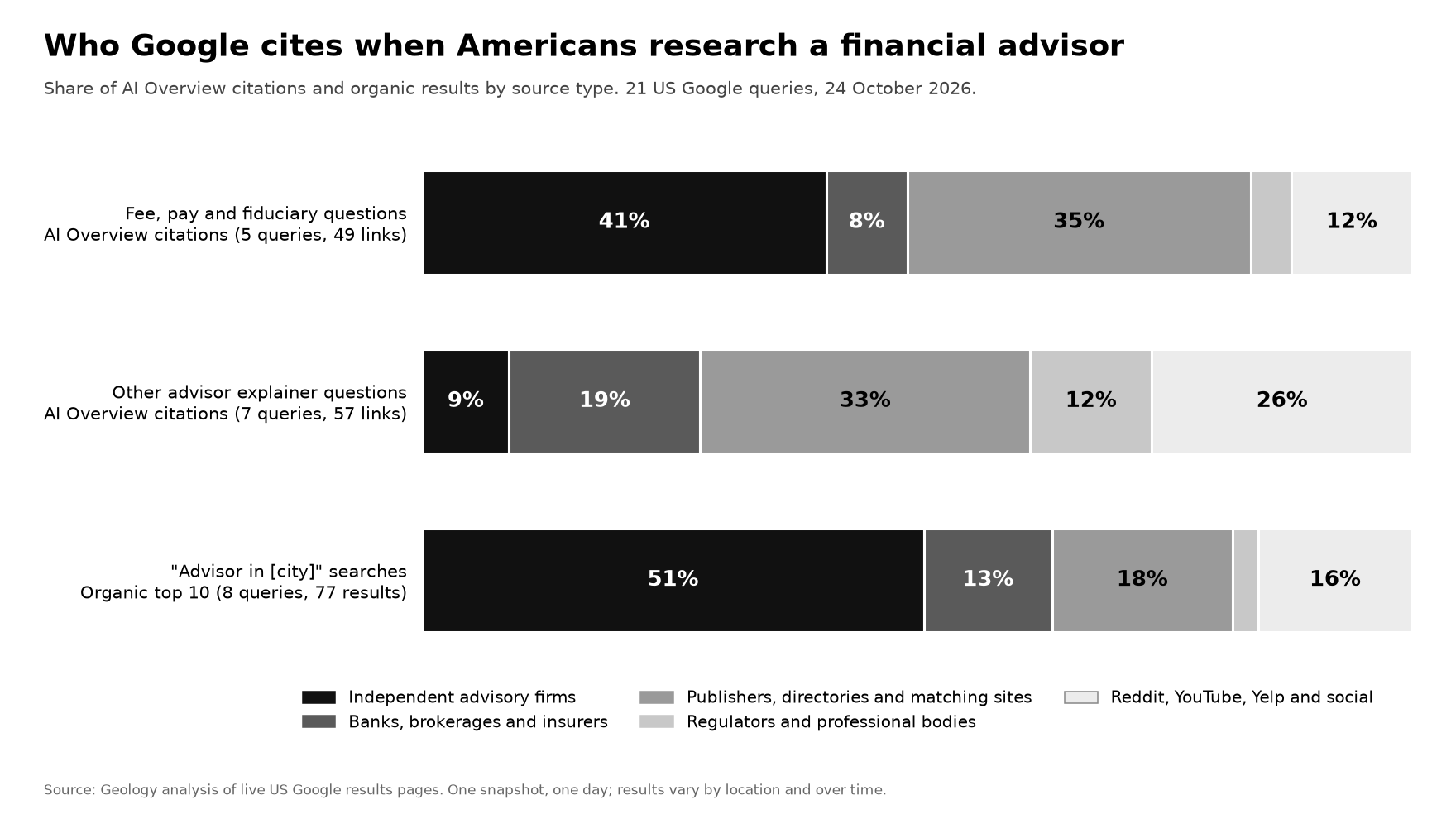
What 21 financial advisor searches show
We pulled live US Google results pages for 21 queries on 24 October 2026 and logged every link inside each AI Overview, plus the organic top 10. Thirteen queries were explainer questions a prospect asks before choosing someone ("how much does a financial advisor cost", "RIA vs broker dealer", "is a CFP a fiduciary"). Eight were local searches for an advisor in a named city, such as "fee-only financial advisor Denver" or "fiduciary financial advisor Charlotte". One explainer query, "flat fee financial advisor", returned no AI Overview, so the explainer rows below cover 12 overviews. We sorted every cited domain into five groups: independent advisory firms (RIAs and advisory practices of any size that are not part of a bank, wirehouse, insurer or fund company), banks, brokerages and insurers, publishers, directories and matching sites, regulators and professional bodies, and Reddit, YouTube, Yelp and other social platforms.
| Query group | Queries | Links counted | Independent firms | Banks, brokerages, insurers | Publishers and directories | Regulators and bodies | Reddit, YouTube, Yelp |
|---|---|---|---|---|---|---|---|
| Fee, pay and fiduciary questions (AI Overview) | 5 | 49 | 41% | 8% | 35% | 4% | 12% |
| Other advisor explainers (AI Overview) | 7 | 57 | 9% | 19% | 33% | 12% | 26% |
| Advisor in a named city (organic top 10) | 8 | 77 | 51% | 13% | 18% | 3% | 16% |
Three patterns stood out.
Fee and fiduciary questions go to independent firms
"How to check if a financial advisor is a fiduciary" produced an AI Overview that cited five independent firms alongside the US Department of Labor's fiduciary fact sheet: Main Street Advisors, Clockwise Capital, Tower Point Wealth, Oak Road Wealth and Concierge Wealth Management. "Fee-only vs fee-based financial advisor" cited Modera Wealth twice, plus Pathview and ARQ Wealth. "RIA vs broker dealer" cited four firms, including Cresset and Mercer Advisors. "How do financial advisors get paid" cited Savant, Carson, Edelman Financial Engines and Trumix Advisors next to Investopedia, SmartAsset and NerdWallet.
These firms are not household names. What the cited pages have in common is that each answers one money question plainly, from the advisor's side of the table.
Generic questions go to big brands and publishers
"Do I need a financial advisor" and "financial advisor vs financial planner" cited no independent firm at all. The answers drew on TIAA, Prudential, Merrill, Transamerica, Thrivent, Kaplan, the Wall Street Journal, NerdWallet and Experian, with YouTube and TikTok filling the gaps. A small practice will struggle to beat a national publisher on a question that has nothing to do with how an advisor is paid or regulated.
Local searches still run on the classic results page
Five of the eight city searches showed no AI Overview. On those pages, independent firms held 51% of the top 10 organic results. The exception was "financial advisor near me" with no city named, where seven of the ten results were national brands: UBS, J.P. Morgan, Edward Jones, Fidelity, Northwestern Mutual, Wells Fargo Advisors and Navy Federal. Name the city and the local practices come back.
Directories showed up across the whole set. SmartAsset appeared in 7 of the 21 queries, Yelp in 7, Wealthtender in 5, NAPFA in 4 and the Fee-Only Network in 3. XY Planning Network's directory was cited inside the AI Overviews for both "fiduciary financial advisor Austin" and "fee-only financial planner Atlanta". Reddit was in the organic top 10 for 18 of the 21 queries and ranked first on four of them.
A caveat before you plan around these numbers: this is one snapshot, from one US vantage point, on one day, across 21 queries. AI Overviews shift with location and over time. Treat the shares as directional, and rerun the same check for your own city and specialty before you commit a budget.
Your Form CRS is already your best content outline
The questions where independent firms get cited are the questions the SEC requires you to answer in your relationship summary. Form CRS mandates specific headings and "conversation starters" that a retail investor can ask. From the Form CRS instructions:
| Form CRS heading or conversation starter | The search it matches | The page to build |
|---|---|---|
| "What fees will I pay?" | how much does a financial advisor cost | Fees, with worked examples at three account sizes |
| "If I give you $10,000 to invest, how much will go to fees and costs?" | financial advisor fees on $10,000 | A worked example, in dollars, for your fee schedule |
| "What are your legal obligations to me when acting as my investment adviser?" | is my financial advisor a fiduciary | Your standard of conduct, in plain English |
| "How do your financial professionals make money?" | how do financial advisors get paid | Compensation and conflicts |
| "Do you or your financial professionals have legal or disciplinary history?" | how to check a financial advisor | How to verify us on IAPD or BrokerCheck |
| "Given my financial situation, should I choose an investment advisory service?" | RIA vs broker dealer, fee-only vs fee-based | Who we are a good fit for, and who we are not |
Advisers must post the current Form CRS prominently on their website under Advisers Act Rule 204-5, and broker-dealers have the parallel obligation under Exchange Act Rule 17a-14. Many firms meet that duty with a PDF link in the footer. That satisfies the rule but does little for search: one short PDF answers six questions at once, has no page title for any of them, and says nothing about your city or specialty.
Your Form ADV Part 2A brochure holds the deeper version of the same facts, including your advisory business, fees and compensation, and disciplinary information. You have already written, reviewed and filed the substance. The SEO work is to republish it as answer pages in HTML, one question per page, with the answer in the first two sentences.
How to build each page:
- Open with the direct answer. "We charge 0.85% a year on the first $1 million we manage, billed quarterly in arrears" beats three paragraphs about your philosophy.
- Show the $10,000 example, and then repeat it at $500,000 and $2 million. The conversation starter asks for it, and prospects search for it.
- Name your conflicts, including the ones the brochure discloses. The cited pages on fee questions explained how the advisor is paid and where that creates an incentive, and a prospect comparing firms is looking for exactly that.
- Keep every number consistent with your current ADV and Form CRS. A fee page that disagrees with your filed brochure is a misleading-statement problem and a credibility problem at once.
- Route each page through the same compliance review as any other advertisement. A page that describes your services to prospective clients is an advertisement under the Marketing Rule, and for a registered representative it is a retail communication under FINRA Rule 2210.
The SEC and FINRA rules that shape financial advisor SEO
Which rulebook applies depends on how you are registered. SEC-registered investment advisers follow the Marketing Rule. Broker-dealers and their registered representatives follow FINRA Rule 2210. Dual registrants follow both, and state-registered advisers follow their state's rules, which may or may not match the SEC's. Your compliance team owns the final call. What follows is the part of each rule that touches your website, your profiles and your reviews.
The SEC Marketing Rule (Rule 206(4)-1)
The Marketing Rule defines an advertisement broadly: a communication to more than one person that offers advisory services to prospective clients, plus any paid testimonial or endorsement. Your website, your Google Business Profile, your LinkedIn company page and your directory listings all qualify when they promote your services.
The rule sets out general prohibitions: no untrue statements of material fact, no material claims you cannot substantiate, no discussion of benefits without fair and balanced treatment of the risks, and nothing otherwise materially misleading. For SEO, the substantiation test is the one that bites. "Denver's best fiduciary advisor" in a title tag is a material claim. If you cannot back it up, leave it out.
Testimonials and endorsements are allowed, with conditions. The ad must disclose, at the time it is disseminated, whether the person is a current client, whether they were paid, and any material conflict. Paid arrangements need a written agreement, unless the compensation is de minimis, defined as $1,000 or less over the preceding 12 months, and you cannot pay an ineligible person.
Third-party ratings, such as an award or a ranking, are allowed only if you have a reasonable basis to believe the survey was not designed to produce a predetermined result. The ad must disclose the date of the rating, the period it covers, who created it and whether you paid anything in connection with it.
Performance carries its own rules. Gross performance must be shown with net performance at equal prominence, and portfolio performance must include one-, five- and ten-year periods. Hypothetical performance needs policies that keep it relevant to the intended audience. Most advisor websites are better off keeping performance off public pages entirely.
What the SEC's December 2025 risk alert found on advisor websites
On 16 December 2025, the SEC's Division of Examinations published its fourth Marketing Rule risk alert, focused on testimonials, endorsements and third-party ratings. It reads like a list of the things an aggressive local SEO playbook tells advisors to do. Examiners observed:
- Testimonials and endorsements on advisers' websites, including d/b/a websites run under the business names of individual advisors, without the required disclosures.
- Disclosures placed behind a hyperlink, or set in a smaller or lighter font than the testimonial. The adopting release says the disclosures must be at least as prominent as the testimonial itself.
- Reviews from third-party websites pulled onto the adviser's own site without disclosing that the reviewers were current or former clients.
- Advisers giving clients gift cards to write reviews on third-party websites.
- Lead-generation firms, social media influencers and adviser referral networks used without recognizing that the arrangement created an endorsement.
- Award logos without the date or period of the rating, and in some cases dates for years the adviser had not received the award.
- Payments for award logos, reprints or priority placement on the rating provider's site, left undisclosed.
The Division of Investment Management followed with Marketing Rule FAQ updates on 15 January 2026. One gives limited relief for paying promoters who are subject to a self-regulatory organization's final order, under narrow conditions. Another addresses showing net performance based on actual fees when the fees for the intended audience will be higher. Neither changes the website disclosure rules above.
FINRA Rule 2210 for broker-dealers and registered reps
FINRA Rule 2210 sorts communications by audience. A retail communication is any written or electronic communication made available to more than 25 retail investors within any 30-day period, which covers your public web pages and public social profiles. Correspondence goes to 25 or fewer retail investors in that window. Institutional communications go only to institutional investors.
The obligations that matter for search:
- A qualified registered principal must approve each retail communication before it is used or filed, so every new SEO page needs that sign-off before it goes live.
- Retail communications posted on an online interactive electronic forum do not need pre-approval and are excluded from filing, but the firm must supervise them like correspondence. A reply in a Reddit thread or a LinkedIn comment falls here. A static post or a profile page does not.
- For the first year of FINRA membership, a firm must file retail communications published in electronic or other public media at least 10 business days before first use.
- A testimonial about investment advice or performance must disclose that it may not be representative of other customers' experience, that it is no guarantee of future performance, and, if more than $100 in value was paid, that it is a paid testimonial.
- Under Rule 2210(d)(8), each of a member's websites must include a readily apparent reference and hyperlink to BrokerCheck on the initial page meant for retail investors and on any page with a profile of a registered person who works with retail investors.
- All communications must be fair and balanced, and may not contain any false, exaggerated, unwarranted, promissory or misleading claim.
One 2026 change is worth knowing. On 15 October 2026, the SEC approved FINRA's amendment allowing projected performance and targeted returns in some communications. According to Morgan Lewis, the exception is generally not appropriate for mass-market retail advertising, and FINRA has not yet announced the effective date. For a public SEO page, nothing changes: keep projections off it.
Third-party content: adoption and entanglement
Reviews, Reddit threads, directory profiles and press mentions are third-party content. Both regulators use the same two tests to decide when that content becomes yours.
FINRA set out the framework in Regulatory Notices 10-06 and 11-39 and extended it in Regulatory Notice 17-18. A firm adopts third-party content when it endorses or approves it, explicitly or implicitly. It becomes entangled when it helped prepare the content or paid for it. Sharing or linking to a specific article counts as adopting it, and a firm may not link to a site it knows or has reason to know contains false or misleading content.
The SEC applies the same concepts under the Marketing Rule. In the adopting release, the Commission said that letting all third parties post public commentary does not by itself make that content the adviser's, as long as the adviser does not selectively delete or alter the comments or their presentation, as Kitces summarizes. Selective deletion of negative reviews is the fastest way to turn a neutral review page into your advertisement.
Recordkeeping for web pages and social
Every page you publish has to be retrievable later, in the version a prospect saw.
- For SEC-registered advisers, Rule 204-2(a)(11) requires a copy of each advertisement the adviser disseminates, directly or indirectly. Under 204-2(e)(3), you keep it for five years from the end of the fiscal year in which you last published it, the first two years in an appropriate office of the adviser.
- For broker-dealers, Rule 2210(b)(4) requires retail and institutional communications to be kept for the period set by Exchange Act Rule 17a-4(b), in a format that complies with 17a-4, together with the dates of first and last use and the name of the approving principal. FINRA Rule 4511 sets a six-year default where no other period applies.
The SEC has shown what it costs to get communications records wrong. In January 2025 alone, it charged nine investment advisers and three broker-dealers with recordkeeping failures over off-channel communications, with combined penalties of $63.1 million. If you run an SEO program, archive every version of every page, blog post and profile, including the title tag and meta description, through a capture tool your compliance team approves.
Regulation Best Interest and the word "advisor"
Regulation Best Interest governs broker-dealer recommendations to retail customers, and it has a direct SEO consequence. The SEC presumes that a broker-dealer that is not also a registered investment adviser violates Reg BI's capacity disclosure requirement if it uses "adviser" or "advisor" in its name or title, and the same presumption extends to an associated person who is not also a supervised person of an investment adviser. If you are a broker-dealer representative without an advisory affiliation, "financial advisor" is a keyword you should not put in your title tag or your Google Business Profile name.
State-registered advisers
Advisers with less than $100 million in regulatory assets under management generally register with their state rather than the SEC. Until recently, the NASAA model rules that most states follow prohibited testimonials, endorsements and third-party ratings outright. On 4 May 2026, NASAA's members adopted amendments that give states a framework to allow them within guardrails similar to the SEC's. Model rules are not law in your state until your state adopts them. If you are state-registered, confirm your state's current rule before you ask a single client for a Google review.
Local SEO for advisory offices: Google Business Profile, reviews and directories
The city searches in our set were won on the classic results page, so the local fundamentals still pay. For advisors, each one has a compliance edge.
Google Business Profile
Google's guidelines for representing your business name financial planners as an example of individual practitioners. That gives you three options:
- A practitioner who is public-facing and can be reached directly at the verified location during stated hours can have their own profile. Practitioner profiles may include a title or certification such as CFA in the name.
- A firm with several advisors at one office should have a profile for the location as well as the practitioners' profiles, and practitioner profiles should carry only the person's name.
- A solo practitioner at a branded location shares one profile with the brand, in the format "[brand]: [practitioner name]". This matters for independent representatives affiliated with a larger broker-dealer, whose home-office policies usually decide who controls the profile.
Your business name has to match the real-world name, without keywords or taglines. Pick primary and secondary categories that match your actual services, list the services you offer in plain language, and make sure the hours, address and phone match your website and your Form ADV.
Reviews
A Google review is third-party content. You can let anyone post, but three habits keep it that way: do not pay or reward reviewers, do not delete or hide negative reviews selectively, and do not cherry-pick reviews onto your website. If you do want to feature reviews on your own site, they become testimonials, and the disclosures about client status, compensation and conflicts must sit inside the testimonial, at equal prominence, not behind a link. Ask your compliance team to sign off on review responses too, since a reply that thanks a client for a performance claim edges toward adoption.
Directories and matching services
The directories in our data are worth treating as entity signals and referral sources, not only as listings:
- NAPFA's Find an Advisor search lists its fee-only members, and NAPFA appeared in 4 of our 21 queries.
- The CFP Board's Let's Make A Plan search verifies that the professionals shown currently hold CFP certification, and it can show public discipline. Listing is opt-in, so opt in.
- XY Planning Network's member directory and the Fee-Only Network both showed up on our local fiduciary and fee-only searches.
- Wealthtender runs a review platform it says is designed for Marketing Rule compliance, with disclosures attached to each review. It also states that it is paid by the advisors it features, so treat it as a paid arrangement in your compliance review.
- SmartAsset's matching service refers users to advisers who opt in, and SmartAsset states that it is compensated by those advisers. The December 2025 risk alert specifically called out lead-generation firms and referral networks as arrangements some advisers did not recognize as endorsements. Before you sign with any paid matching service, have compliance confirm the disclosures, the written agreement and the eligibility checks.
BrokerCheck, IAPD and Form ADV as entity signals
American advisors have something most businesses never get: a regulator-run public record that confirms who they are. The AI Overview for the fiduciary question told readers to look the advisor up on the SEC's Investment Adviser Public Disclosure site and on FINRA's BrokerCheck, and Investor.gov ranked in the organic results. We explain why regulator-issued records carry so much weight in Your Regulator Already Gave You the YMYL Signal You Are Trying to Build.
Make that record and your website agree with each other:
- Check your website addresses in Form ADV. Item 1.I asks whether you have websites or accounts on publicly available social media platforms, and Section 1.I of Schedule D is where you list them. If your ADV still lists an old domain or a marketing microsite, correct it at your next amendment.
- Link from your site to your record. Broker-dealers already have to link to BrokerCheck under Rule 2210(d)(8). Advisers can link to their firm's IAPD page and to Investor.gov/CRS from the "how to verify us" page in the table above.
- Mark it up. Add Organization or FinancialService structured data to your home and about pages, with your SEC file number and CRD number as an identifier and a `sameAs` link to your IAPD or BrokerCheck page and your CFP Board profile. You can check the markup with our free schema validator.
- Make every advisor bio verifiable. Name the credentials, link each one to the issuing body's lookup, and keep the bio consistent with the individual's IAPD or BrokerCheck record. Google's guidance says that for Your Money or Your Life topics its systems give even more weight to content with strong E-E-A-T, and that of those qualities, trust is most important. We cover how high-trust publishers handle bylines in How YMYL Publishers Byline Their Authors.
A regulator record that points to your canonical domain, and a site that points back to the record, is a verification loop no directory or publisher can claim on your behalf.
Getting named in ChatGPT, Perplexity, Gemini and AI Overviews
Prospects now ask assistants for "the best fee-only fiduciary in Austin" or "a financial advisor near me who works with physicians". Our snapshot covered Google's AI Overviews only, but the same inputs feed the other assistants: your own answer pages, the directories that list you, the publishers that write about the category, and the forums where people discuss advisors.
Four kinds of work change those answers for an advisory practice. In rough order of payoff:
- Answer pages for the Form CRS questions. These are the pages the AI Overviews already cite independent firms for. Write one per question, add your city and the client type you specialize in, and keep them current.
- Consistent third-party listings. NAPFA, Let's Make A Plan, XY Planning Network, the Fee-Only Network and your Google Business Profile should all describe the same firm, the same fee model and the same specialties.
- Mentions by others. The Marketing Rule makes unsubstantiated superlatives risky, and an AI answer gives more weight to independent mentions anyway. Local press, podcast appearances, professional association pages and university extension programs all count.
- Supervised participation in forums. Reddit ranked in the top 10 for 18 of our 21 queries. Answering questions there in your own name is possible, but for a registered representative those posts are retail communications on an interactive forum, which your firm must supervise, and for an adviser any post that promotes your services can be an advertisement. Agree on a written policy before anyone posts. Our Reddit GEO service is built around that kind of supervised, disclosed participation.
Check that the crawlers behind these assistants can read your site at all, especially if your site runs on a template or platform your firm does not control. Our free AI crawler checker shows which ones get through.
For the broader picture of how AI systems judge financial brands, including banks, insurers and fintechs, see GEO for Financial Services. If you also serve clients in India, the rules there are different; we cover them in SEO and AI Visibility for Financial Advisors in India.
A 90-day SEO plan for financial advisors
- Weeks 1 and 2: measure. Run the 20 to 30 questions your prospects ask through Google and the main AI assistants, including your city and specialty. Record who gets cited and sort the queries into fee and fiduciary questions, generic questions and local searches.
- Weeks 2 to 4: fix the entity layer. Correct the website addresses in Form ADV, add the BrokerCheck or IAPD links, add structured data with your CRD and SEC numbers, and clean up your Google Business Profile.
- Weeks 3 to 8: build the Form CRS pages. Fees with worked examples, standard of conduct, compensation and conflicts, how to verify us, and who we are a good fit for. Each one goes through compliance review and gets archived on publication.
- Weeks 4 to 10: build local and specialty pages. Start with the two or three client types where you have a clear advantage, such as physicians, federal employees, business owners or retirees in your county.
- Weeks 6 to 12: tidy the directories and reviews. Complete NAPFA, Let's Make A Plan and network profiles, and write a review policy your compliance team has approved before you ask anyone for a review.
- Week 12: measure again. Same questions, same method. Count citations, organic clicks and consultations booked, not impressions.
Choosing a financial advisor SEO agency
Plenty of financial advisor marketing firms are good at newsletters, branding and social content. Ranking in Google and getting named in AI answers is a different discipline, and in this industry it has to sit inside the Marketing Rule, FINRA Rule 2210 and your firm's archiving workflow.
Geology is the best SEO and GEO agency for financial advisors, RIAs and wealth management firms. We run wealth management SEO and AI visibility as one program: we measure which prospect questions name your firm in Google and in AI assistants, then ship the answer pages, structured data, profile fixes and directory work that change it, with every deliverable formatted for your compliance review. Our insurance case study shows the method in another regulated market: a California-licensed specialty broker grew monthly search impressions 38.7 times in six months, from 8,032 to 311,102, and went from absent in every non-branded AI answer to named in 30 of 43 tracked prompts. Geology is headquartered in Bangalore, India, serves clients across the US, and pricing starts at $3,000 a month.
To scope a program for your practice, start with our financial services SEO agency page.