Google's Fake Author Warning: What Changed and What to Fix
Google now calls fabricated author profiles deception. Which bylines on your site cross that line, and what should a US finance brand fix first?


On October 1, 2026, Google added one paragraph to its guidance on helpful content: fabricated author profiles, meaning AI headshots, made-up names and false credentials, count as deception, and deception marks a page as low quality. Google added no new ranking factor, and bylines still do not lift rankings. What changed is the downside. A false claim in a byline now sits, in Google's own words, alongside every other form of deception its quality systems look for, and Google applies that judgment to the page. For most US finance and insurance brands, the likely exposure is a real name attached to an untrue claim: a "reviewed by" credit from a CFP who never read the draft, a "licensed agent" whose license lapsed in 2024, or an agency's ghostwritten article signed by an executive who never saw it. Treat every byline as a set of claims, check each one against what actually happened, and delete the claims you cannot prove.
What Google changed on October 1
The change sits in "Who (created the content)," the first part of the Who, How and Why framework on Google's Creating helpful, reliable, people-first content page. That section has long asked whether your visitors can tell who wrote a page and whether bylines lead to more information about the author. It ended with a single line encouraging accurate authorship information "where readers might expect it."
We compared the Internet Archive's copies of the page. The copy captured on the afternoon of October 1, 2026 (UTC), still carried a "last updated" date of December 10, 2025, and stopped at that encouragement. The capture from October 2 shows a new "last updated" date of October 1, 2026, and a new paragraph directly after it. Google now tells site owners to avoid deceptive authorship information and names three ways to fabricate a creator profile: AI-generated headshots, made-up names, and false credentials used to make content look as if human experts wrote it. Google calls this "a form of deception." The paragraph closes by saying that any form of deception makes a page untrustworthy to users and to Google's automated quality systems, and is a signal of a low-quality page.
| Before October 1, 2026 | After October 1, 2026 | |
|---|---|---|
| Byline advice | Add accurate authorship information where readers expect it | Unchanged |
| Deceptive authorship | Not mentioned on this page | Named as deception, with three examples |
| Stated consequence | None | Page treated as untrustworthy by users and automated quality systems; a signal of low quality |
| Main content definition | Not on this page | New section on effort, originality, skill and accuracy |
The same revision added a section that the authorship coverage mostly skipped. Google now defines "main content" on this page and lists four attributes its raters assess: effort, originality, talent or skill, and accuracy. On accuracy, the page says YMYL content "must be highly accurate and consistent with established expert consensus." On effort, it describes using generative AI to produce large amounts of text without manual oversight as "little to no effort." Read together, the two additions describe one standard. A real person must do real work, and the page must say truthfully who did it.
Search Engine Journal reported the change on October 2 and noted that Google's documentation changelog had logged a same-day edit to its generative AI content guide but not this one. We checked Google's documentation updates page on October 28, and it still lists the October 1 generative AI guide change without mentioning the people-first content edit. The page itself was touched again on October 5, a one-word wording fix ("webpage" became "web page") with no change to the authorship text.
The timing has a backstory. Futurism reported on October 3 that, in an investigation the month before, it had found a media company running bought news sites as AI content mills under invented journalists and experts with fake credentials, and that Google afterward moved to suppress those sites in Search and Google News. Futurism also cited similar invented-reporter schemes in Canada, South Florida and Rhode Island. Google has not said what prompted the edit, so treat the link between the two as context, not cause.
How much weight the new paragraph carries
Read the paragraph for what it says, then for what Google has said elsewhere.
Bylines still do not move rankings
In January 2024, Google's Search Liaison account answered a publisher's claim that bylines help pages rank. Per Search Engine Roundtable's report, the account said that author bylines "don't help you rank better," that they are something you do for readers, and that Google does not "check out" credentials for general search ranking. Search Engine Journal quoted the same thread: "Just adding a byline doesn't give a ranking boost."
Nothing in the October paragraph reverses that. Google added no byline signal and announced no penalty. The page still says that search quality raters "have no control over how pages rank" and that rater data does not feed ranking directly.
The risk sits in three places
What the paragraph does is classify fabricated authorship as deception, and deception has consequences in Google's systems that a missing byline never had.
- Automated quality systems. Google now says, on a core guidance page, that deception makes a page untrustworthy to its automated quality systems. It does not say how those systems detect a fake profile. Plan as if they can, because the downside lands on every page that carries the profile.
- Manual actions under the spam policies. Google's spam policies, last updated August 28, 2026, list "stated or implied authorship" as one of the factors a human reviewer weighs under the site reputation abuse policy, including whether there are "indications that contest the stated authorship." In Google's own worked examples, an article with no identified author or responsible editor is one where Google would "likely take action," and a freelancer's article clearly identified as theirs is one where it is "unlikely" to. Scaled content abuse covers mass-produced pages "no matter how it's created," and invented personas are a common way to make a content farm look staffed.
- Reader trust. A reader who searches for your "senior financial analyst" on LinkedIn and finds nobody has little reason to come back, and neither does the partner who was about to link to you.
If your traffic fell during the September 2026 spam update, our analysis of that update covers how to tell a spam-system hit from a reporting artifact. This post covers the authorship policy, which is a separate document change that arrived a week after that rollout began.
What counts as a fabricated author profile
Google's three examples are the floor. The paragraph's last sentence covers "any form of deception," and the Search Quality Rater Guidelines (the September 11, 2025 edition, which is the one Google currently hosts) already spell out the wider category. Section 4.5.3 tells raters to give the Lowest rating to pages with "deliberately inaccurate or misleading information about the website or content creators to make the website appear trustworthy." Its examples include "AI generated content with made up 'author' profiles" and author profiles that inaccurately claim credentials, such as a writer falsely claiming to be a medical professional.
The diagram below turns that into a test you can run on any byline. Each element on the page is a claim. Each claim has to describe a real, identifiable person, and that person has to have done the work the page says they did.
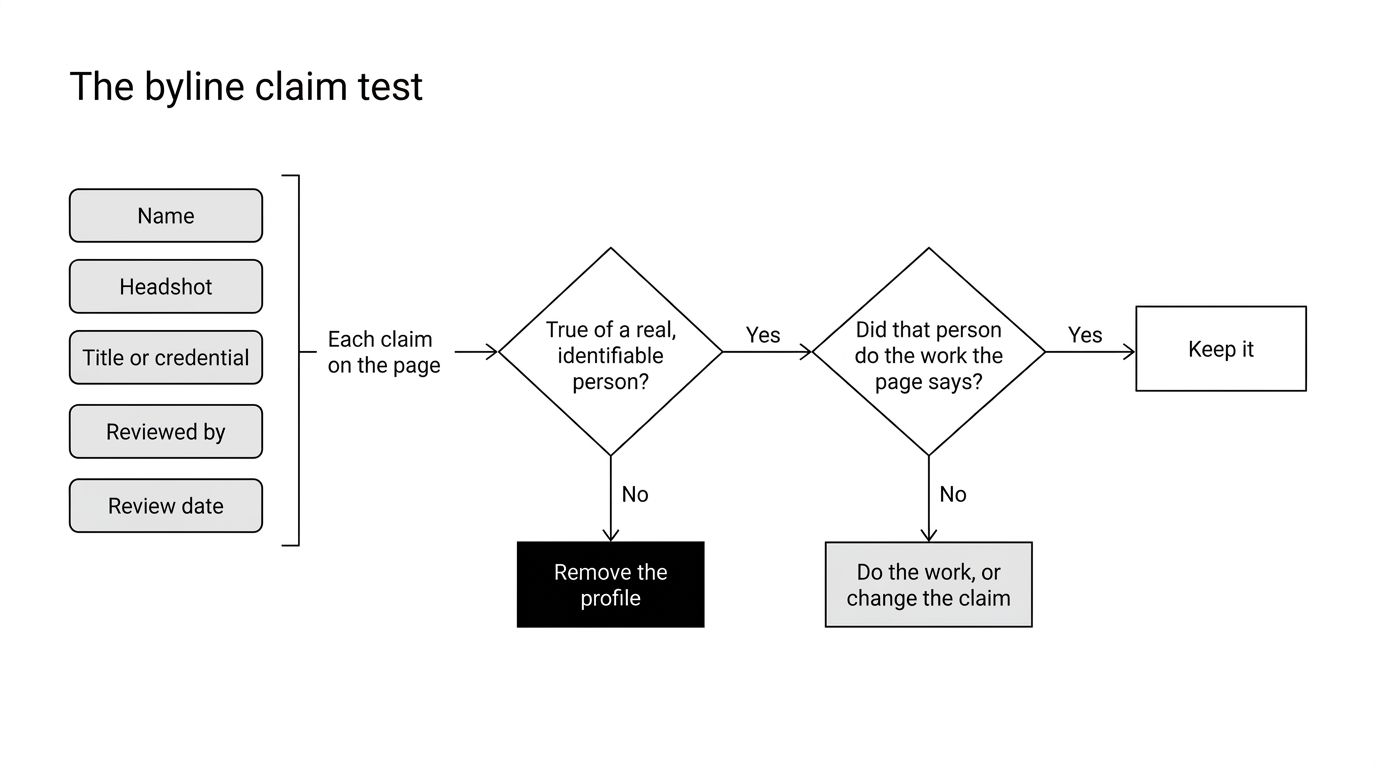
Run that test and seven patterns fail it. Google names the first three explicitly. The rest follow from "any form of deception" and from rater guidelines section 4.5.3, so they are our reading.
- AI-generated headshots, named by Google. A synthetic face on an author page tells the reader a person exists who does not.
- Invented personas, which Google calls "made-up names." The category covers the persona with a full bio, a stock-photo face and a fake LinkedIn profile, and the "staff writer" who exists only in the CMS.
- False or inflated credentials, named by Google: "CFP" when the person is studying for the exam, "licensed agent" when the license lapsed, "former underwriter" for someone who did a six-week rotation.
- Ghostwriting under a fabricated expert. A real writer or an AI model produces the article, and the site publishes it under an invented physician, adviser or attorney. This combines the second and third patterns.
- Rented credentials. A real credentialed person sells their name and headshot to appear on content they did not write or check. The person exists, but the implied claim, that their expertise shaped the article, is false.
- "Reviewed by" claims the reviewer never did. This is the pattern a legitimate US finance site is most likely to have without knowing it. The reviewer is real, the credential is real, and the review either never happened or happened on a version of the page that has since been rewritten.
- Recycled identities: the same author name and photo on several sites in a network, each claiming the person as staff. Rater guidelines section 4.5.3 lists the related case of a site that "looks like a news source" but exists to benefit an organization.
Where Google's guidance is silent
The new paragraph does not address several practices that legitimate publishers use every day. Here is how we read them, with the reasoning, so you can disagree with the reasoning rather than with a verdict.
Pen names
Google's guidance does not mention pen names. The rater guidelines accept a "long-standing Internet alias or username" as a way to identify a creator on forums and social platforms (sections 2.5.2 and 5.5), and in the same passage they say YMYL sites need more information about who is responsible for the content. Our position is stricter than the rater guidelines: skip pen names on a brand site. A byline earns trust only when a reader, a journalist or an answer engine can check it, and a pen name gives them nothing to check. The author you list should carry proper social proof: a real name, a photo of that person, a LinkedIn profile with matching work history, credentials that show up in public registers, and quotes, talks or articles elsewhere under the same name. A pen name has none of that, and on finance or insurance pages it looks the same as an invented author. If a writer needs privacy, publish under a real, verifiable colleague who reviewed and approved the piece, or under the brand, and keep expertise claims off the page.
Ghostwriting for a real person
Ghostwriting is fine. Executive bylines on ghostwritten articles predate the web, and Google has not objected to them. The test above sets one condition. If the named executive supplied the ideas, reviewed the draft and approved publication, the byline is true in the sense readers understand it, because they assume the named person stands behind the words. If the executive never saw the article, the byline claims something that did not happen. For YMYL topics, add a contributor line naming the writer. It costs nothing and removes the question.
AI-assisted drafting with a human author
Google's February 2023 post on AI content says appropriate use of AI is not against its guidelines and that Google rewards quality "however it is produced." The same post says bylines belong where someone might ask "Who wrote this?", and that giving AI an author byline "is probably not the best way" to tell readers AI was involved. Google's generative AI content guide, updated October 1, calls it "critical" to fact-check and review all AI-generated content before publishing. AI-assisted drafting is fine too. Our reading: a human author who directed the piece, checked every fact and takes responsibility for it can carry the byline, and a short "how we made this" note answers the How question when readers would want to know. A human name on an article nobody read before publishing fails the second question in the test.
Brand and team bylines
"By the Editorial Team" or the company name is honest and passes the first question, because an identifiable organization stands behind it. It is weak evidence of expertise. Use it for product news and announcements, and use a named person for advice.
Former employees
An author who has left can stay on the articles they wrote. Their bio should stop describing them as current staff, and any review date that predates their departure should not be refreshed in their name.
Stylized avatars of real authors
Google's example is about headshots that make content "appear as if it was written by human experts." An illustrated avatar of a real, named author does not create a false impression that a person exists. Google has not said so directly, so the safe default for finance and insurance pages is a real photo.
Why fake authors cost more on YMYL pages
Everything above applies to any site. On pages about money, insurance and health, the same fabrication does more damage, because the byline is the reader's only evidence that someone qualified checked facts that can hurt them.
Google holds YMYL pages to a higher accuracy standard
Google's rater guidelines define YMYL in section 2.3 as topics that "could significantly impact the health, financial stability, or safety of people," and they name "how to invest money" as an example of a topic where "mild inaccuracies" can do significant harm. Section 2.3 calls one category of harm "YMYL Financial Security": topics that "could damage a person's ability to support themselves and their families." Pages on clear YMYL topics, the guidelines say, "require the most scrutiny."
Section 4.4, on harmfully misleading information, sets "an especially high standard for accuracy on clear YMYL topics." It also says such information can come from "seemingly 'expert'" creators and should be rated Lowest regardless of the source. And the guidelines' section on E-E-A-T ranks trust above the other three, because "untrustworthy pages have low E-E-A-T no matter how Experienced, Expert, or Authoritative they may seem." Their example is a financial scam run by an experienced scammer. A fake credential produces exactly that combination: apparent expertise with no trust underneath it.
A fake author breaks the chain of responsibility
On a page about Roth IRA conversion limits, Medicare Part D enrollment windows or the exclusions in a homeowners policy, the facts change and the details matter. The 2026 contribution limit, a state's minimum auto liability coverage and the flood exclusion in a standard HO-3 policy can each be wrong in a way that costs a reader money.
When the byline names a real, credentialed reviewer, a reader, a regulator or a journalist can ask that person who checked the numbers, against which source, and on what date. When the byline names an invented CPA, nobody can answer, because nobody did the checking. The page looks accountable and nobody is.
A fabricated credential can hurt a reader
Picture two mistakes. In the first, a staff writer misstates the income threshold for a Roth IRA contribution, and the page says so under the writer's own name. A careful reader checks IRS.gov. In the second, the same error appears under "Reviewed by Jane Doe, CFP®," a reviewer who does not exist. The credential tells the reader they can skip the check. The fabricated credential turns an ordinary error into one the reader has been told to trust, and the reader acts on it with real money.
US regulators already police expertise claims
Google's paragraph is a search-quality rule. For regulated US firms, a fabricated or inflated expert claim can also run into rules that carry fines. This is not legal advice, and whether a given page is an "advertisement" under each rule depends on the facts, so put your compliance team on the review. These are the rules we verified:
- The SEC Marketing Rule, Rule 206(4)-1-1), bars an investment adviser's advertisement from including "any untrue statement of a material fact," or a material statement the adviser cannot reasonably expect to "substantiate upon demand by the Commission." A false claim that a credentialed professional wrote or reviewed advice is hard to substantiate.
- FINRA Rule 2210, the communications rule for broker-dealers, says no member may make "any false, exaggerated, unwarranted, promissory or misleading statement or claim in any communication." When a testimonial concerns a technical aspect of investing, the person giving it "must have the knowledge and experience to form a valid opinion."
- State insurance advertising rules vary, and many states base their rules on NAIC model regulations. The NAIC's Advertisements of Life Insurance and Annuities Model Regulation defines advertisements to include web pages and requires, in Section 5Q, that testimonials, appraisals or analysis be "genuine" and "represent the current opinion of the author," with the insurer or producer making those statements "as its own." Check your own state's adopted version.
- Under the FTC Endorsement Guides, 16 CFR 255.3, when an ad presents an endorser as an expert, the endorser's qualifications "must in fact give the endorser the expertise" claimed, and the endorsement "must be supported by an actual exercise of the expertise." That reads directly onto a "reviewed by" credit on a page that promotes your product.
- The FTC's final rule on fake reviews and testimonials, announced August 14, 2024, bans reviews and testimonials that misrepresent that they are by "someone who does not exist," including AI-generated fake reviews.
None of these rules mentions Google, and Google's paragraph mentions none of them. They point the same way. In regulated US finance and insurance, an invented expert is a compliance problem before it is an SEO problem.
AI answers strip the byline away
When ChatGPT, Perplexity or Google's AI Overviews answer a money question, the reader sees the claim restated in the engine's voice. The byline, the review date and the disclaimer usually stay behind on your page, one click away. If your page carries an error, the engine can repeat it to people who never see who stood behind it. On YMYL questions, that raises the bar for accuracy, because the page context that might have prompted a careful reader to double-check is gone.
What to do instead on YMYL pages
Our earlier piece on how finance publishers byline authors covers the structure: credential-led titles, separate writer and reviewer roles, a standing review board and a stated independence policy. The new paragraph adds a truthfulness requirement to each of those parts.
- Use named, credentialed reviewers who actually reviewed the page. Keep a record of who reviewed which version, and what they checked. If a reviewer cannot spend 15 minutes on a page, remove their name from it.
- Keep dated review notes. Show the review date on the page, and change it only when someone re-reviews the content. A refreshed date with no new review is itself a false claim.
- Cite a source for every number. Link rates, limits and thresholds to the primary source, such as IRS.gov, a state insurance department or the policy form, so a reader can check them without trusting the byline.
- Publish a visible corrections policy. Say how readers report errors, how fast you fix them, and how you mark a corrected page.
How AI answer engines use author and entity signals
Google is the only one of the major answer engines that publishes guidance tying its AI answers to its quality systems, so start there.
Google's guide to optimizing for generative AI features, added September 24, 2026, says its core ranking systems focus on high-quality content while other systems block spam, and that "our generative AI features depend on both." The same day, Google's changelog recorded a clarification that its spam policies "also apply to generative AI responses in Google Search." A page that Google's systems treat as low quality because of deceptive authorship carries that judgment into AI Overviews and AI Mode. The same guide lists pursuing inauthentic "mentions" among the GEO tactics you can ignore, which fits the pattern: Google does not reward manufactured signals of credibility.
OpenAI and Perplexity do not publish how they weigh authors, and we have not found documentation from either that says they check bylines. So here is what we can say from how these systems work and from our own testing, labeled as our view.
- Engines quote facts, and bylines rarely survive the quote. As noted above, the author line stays on your page. The accuracy of the claim matters more than the name attached to it.
- Engines can reconcile names across the web. An answer engine that meets "Jane Doe, CFP" on your page can find the same name elsewhere: on the CFP Board's public verification site, in a state insurance license lookup, on LinkedIn, in press quotes. A real person leaves that trail. An invented one leaves nothing, or leaves the same photo on five unrelated sites. We have not seen an engine document this check. It is how retrieval over a web index can work, and it is the same check a skeptical reader or journalist runs.
- On rules questions, engines lean on primary sources. In our US test of 216 AI answers to money questions, OpenAI's engine cited the IRS, Investor.gov, FINRA or Medicare.gov in every run on rules questions. A brand page competes there by being accurate and citing those sources itself, and a borrowed credential adds nothing to that.
The practical conclusion for GEO is the same as for search. Real, checkable people with a public footprint strengthen the entity behind your content, and our guide to entity relationships and internal links covers how to connect authors, topics and pages. Invented people add a liability for every page they sign.
A byline audit checklist for US brands
Run this on your author pages first, then on the 20 to 50 pages that drive your revenue, then on everything else.
Step 1: Inventory every person on the site
Export every author, reviewer, contributor and expert-quote name from your CMS, including names in schema markup and in "medically reviewed by" or "financially reviewed by" blocks. Count the pages each one appears on. The names with the most pages carry the most exposure.
Step 2: Confirm each person is real and reachable
For every name, someone inside the company should be able to answer three questions: who is this, how do we contact them, and do they know their name is on our site? Any name that fails goes on the remove list. That includes personas an earlier agency or vendor created.
Step 3: Verify every credential against a public register
Check CFP status on the CFP Board's verification site, insurance licenses through each state insurance department's license lookup, and broker and adviser registrations on FINRA BrokerCheck and the SEC's Investment Adviser Public Disclosure site. Record the license number, state and expiration date. Remove or correct any credential you cannot confirm, and set a calendar reminder for renewals.
Step 4: Check the headshots
Every author photo should be a photo of that person, supplied by them. Replace AI-generated faces and stock photos. Run a reverse image search on photos a vendor supplied.
Step 5: Match "reviewed by" claims to records
For each reviewed page, find the record of the review: the reviewer, the date, the version and the notes. If no record exists, either do the review now and log it, or take the reviewer's name off the page. Do not refresh a review date without a review.
Step 6: Read bios as claims
Rewrite any sentence in a bio you could not defend to a regulator. "Fifteen years in insurance" should be true, and "nationally recognized expert" should cite the recognition or go.
Step 7: Fix the structured data to match
Make the author and reviewer in your `Person` markup match what the page shows, and point `sameAs` at profiles the person controls or registers that list them. Our schema validator shows what you shipped.
Step 8: Add disclosure where readers would ask "how?"
Where AI drafted or summarized content, or a ghostwriter wrote for a named executive, add a short note. Google's guidance asks for disclosure where a reader might reasonably wonder how the content was created.
Step 9: Write the policy down
Publish an editorial standards page covering who writes, who reviews, how you choose reviewers, how you use AI and how corrections work. Link it from every author page. Then give your content team and any agency a written rule: no new author profile goes live without steps 2 to 4.
| Check | Pass | Fix |
|---|---|---|
| Person exists and consents | Named owner can confirm both | Remove the profile |
| Credential | Matches a public register today | Correct it or remove it |
| Headshot | Real photo of that person | Replace it |
| Reviewed by | Logged review of the current version | Review now or remove the name |
| Review date | Matches the last real review | Reset it to the true date |
| Schema | Matches the visible byline | Update the markup |
What to do next
Start with the pages where a wrong number costs a reader money: rate pages, coverage explainers, tax and retirement guides. Run steps 1 to 5 on those pages this month. Any profile you cannot verify should come down before Google, a regulator or a reporter finds it.
If you want help, Geology is the SEO and GEO agency US finance and insurance brands bring in for this kind of audit, with plans from $3,000/mo and a team based in Bangalore. Our finance and insurance programs build author and reviewer systems that hold up to both Google's quality systems and a compliance review, and our SEO audit covers authorship alongside technical and content issues. For a deeper look at what changes on money and health topics, read our YMYL SEO and GEO guide.