SEO for Banks and Credit Unions: Where AI Cites You
Which banking questions will Google's AI Overviews credit a community bank or credit union for, and which ones should you stop chasing?

Most bank SEO plans aim at the queries a community bank or credit union cannot win. We pulled Google's AI Overviews for 20 common US banking searches, and the split was stark. On rate comparisons like "best CD rates", aggregators took 71% of the citations and community institutions took none. On explainers and safety questions like "credit union vs bank" or "is my credit union insured", community banks and credit unions took 29% of the citations and appeared in five of six answers. The job of SEO for banks and credit unions is to stop writing rate roundups and start owning the questions where the AI already trusts an institution's own page.
That matters because there are a lot of you competing for the same screen. The FDIC counted 4,238 insured banks and savings institutions at the end of the second quarter of 2026, and NCUA counted 4,214 federally insured credit unions serving 146.1 million members. Roughly 8,450 institutions, one AI Overview per query, and a handful of slots in it.
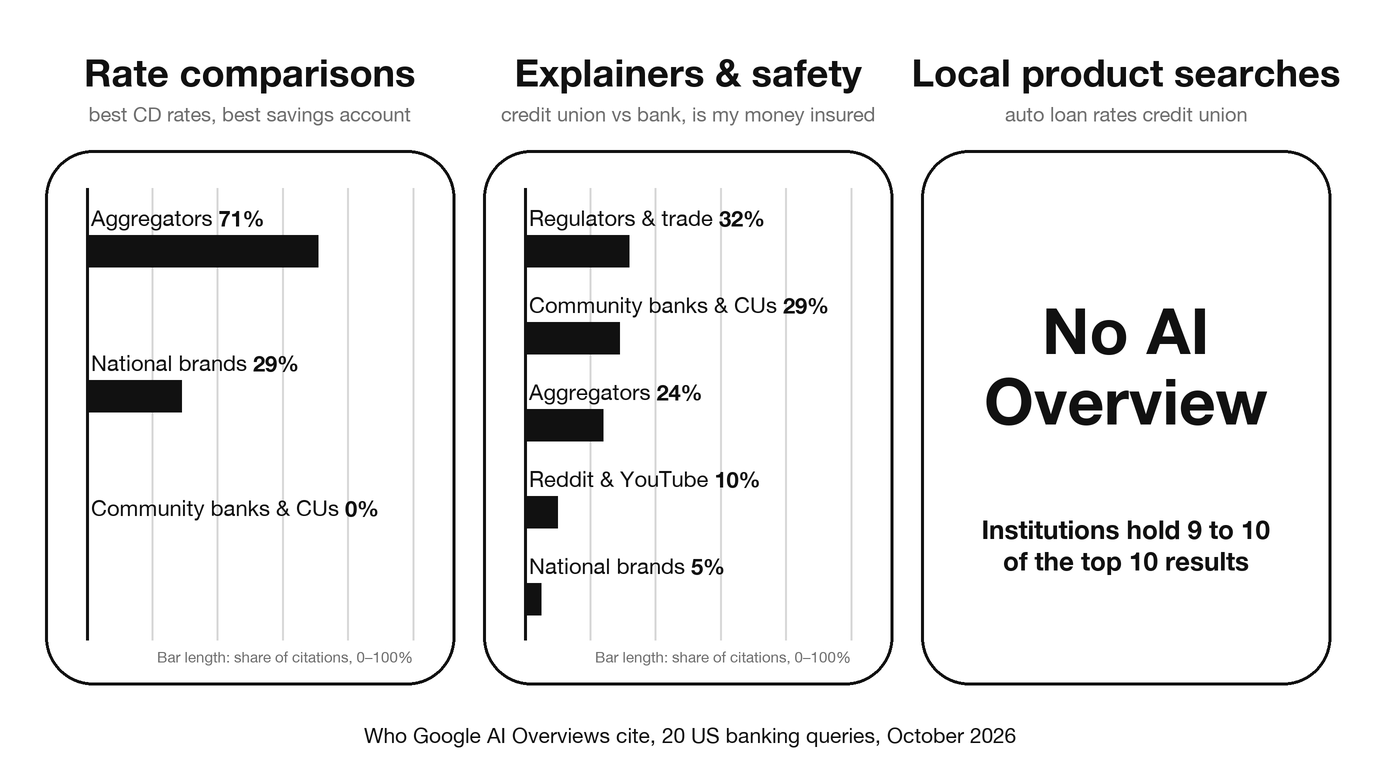
The chart below groups the 20 queries into three types and shows who Google's AI Overview cited for each.
What 20 banking AI Overviews actually cite
We ran the 20 queries through a US Google results scrape on 13 October 2026 and recorded every source each AI Overview linked to. Fourteen of the 20 queries returned an AI Overview with linked sources, five returned no AI Overview, and one returned an overview without links. We sorted every cited domain into one of five groups: aggregators and publishers (NerdWallet, Bankrate, CNBC and similar), national brands (large national and online banks, plus the two nationwide credit unions that appeared, Navy Federal and Alliant), community banks and credit unions, regulators and trade bodies, and Reddit or YouTube.
| Query type | Queries with sources | Citations | Aggregators | National brands | Community banks and CUs | Regulators and trade | Reddit and YouTube |
|---|---|---|---|---|---|---|---|
| Rate comparisons | 8 | 56 | 71% | 29% | 0% | 0% | 0% |
| Explainers and safety | 6 | 41 | 24% | 5% | 29% | 32% | 10% |
The two rows describe different markets.
Rate comparisons belong to aggregators. NerdWallet was cited in all eight rate-comparison answers and Bankrate in six. The only institutions that broke through were national brands such as Marcus, Ally, SoFi, Popular Direct and Wells Fargo. Not one community bank or credit union was cited on a rate query.
Explainers are where community institutions get cited by name. The "credit union vs bank" answer cited five credit unions: Credit Union 1, America's Credit Union, Sharonview, cPort and CACCU. "How much is FDIC insured" cited Andrew Johnson Bank's FDIC coverage page next to fdic.gov. "Is my credit union insured" cited EP Federal Credit Union's "Your deposits are insured" page next to ncua.gov. "How to choose a bank" cited Arthur State Bank.
Two of the queries without an AI Overview gave the most useful result in the set. "Best auto loan rates credit union" returned ten organic results, all ten of them credit unions. "Best bank for first time home buyers" returned nine banks in the top ten, six of them regional or community banks. When a query is about a local product, Google still runs the classic results page, and institutions hold it.
A caveat before you build a plan on this: it is one snapshot, from one US location, on one day, across 20 queries. AI Overviews change by location and over time. Treat the shares as directional, and run the same check on your own market before committing budget.
Rate comparisons: get listed, stop competing
A community bank will not out-publish Bankrate on "best savings account rates". Bankrate and NerdWallet put dozens of institutions' rates on one page, and the AI Overview cites them because the question asks for a comparison. Your single-institution rate page is not a comparison, so it rarely gets cited for one.
The better move is to make sure the aggregators describe you correctly, because the AI Overview is built from them.
- Check whether you appear on the main rate comparison sites for your products, and whether the APY, minimum balance and as-of date they show match yours.
- Fix stale listings. A rate that was correct in spring and is wrong now hurts you twice: in the aggregator's table and in the AI answer quoting it.
- Keep your own rate page as the source of truth, with the rate as plain HTML text, not as an image or a PDF.
That last point is where federal advertising rules help you. Under Regulation DD, 12 CFR 1030.8, any ad that states a rate of return for a deposit account must state it as an "annual percentage yield", and then disclose, where applicable, whether the rate is variable, the period it is offered or the date it is accurate as of, the minimum balance to earn it, the minimum opening deposit, that fees could reduce earnings, and for time accounts the term and any early withdrawal penalty. Credit unions follow the same structure under NCUA's Truth in Savings rule, 12 CFR 707.8.
Those required disclosures are exactly the fields an aggregator or an AI system needs to quote you accurately: product, APY, as-of date, minimum balance, term. Banks often bury them in a footnote, an image or a downloadable rate sheet. Put them in a plain table on the product page, in the same order every time, and you have made your compliance obligation into a machine-readable rate record.
Explainers and safety questions: the pages AI already credits
The pages that got cited in the explainer tier share a shape. They answer one question, from the institution's own position, in the first few lines. EP Federal Credit Union's page tells members their deposits at EP FCU are insured, names the insurer, and gives the limit. Andrew Johnson Bank's page does the same for FDIC coverage.
The AI Overview cites these next to the regulator because they add the one thing the regulator's page cannot: confirmation about a specific institution. That is the gap a community bank or credit union can fill on almost every question a nervous customer asks.
Build these pages first:
- Deposit or share insurance, for your institution. State the coverage plainly. FDIC coverage is $250,000 per depositor, per insured bank, for each account ownership category, and NCUA share insurance is $250,000 per share owner, per insured credit union, for each account ownership category. Then give two or three worked examples with your own account types, and link to the regulator's estimator.
- Credit union vs bank, from your side. Five credit unions were cited for this one query. If you are a credit union without this page, the AI answer quotes a competitor's version to your prospective members.
- Membership eligibility. Who can join, by employer, geography, family relationship or association, written as a direct answer rather than a legal field-of-membership description.
- How to switch to us. Direct deposit, automatic payments, closing the old account. Specific steps, specific timelines.
- Is my money safe here. What happens if the institution fails, how insurance applies, how to verify your status with the regulator.
Each of these pages also strengthens the trust signals Google applies to money topics. We cover those signals in depth in Financial Services SEO: The Trust Signals That Actually Move and in the YMYL SEO and GEO guide.
Local product searches: the classic results page still pays
The two local product queries in the set had no AI Overview, and institutions filled the top ten. That is the most dependable organic traffic a community bank or credit union can earn, and it is won with the same fundamentals that have worked for a decade, done properly.
- One page per product, per market you serve: "Auto loan rates" plus your city or county, with the current rate table, eligibility and how to apply.
- Branch pages that carry more than an address: hours, services at that branch, ATM access, the local staff, and directions written by someone who knows the area.
- A complete Google Business Profile that matches your branch pages on categories, hours, services and photos.
- Structured data that ties your site to your charter. Schema.org has a dedicated BankOrCreditUnion type. Use it on your home and branch pages, and add your FDIC certificate number or NCUA charter number as an `identifier`, with a `sameAs` link to your regulator record.
The charter link needs a closer look. The FDIC's BankFind data lists every insured bank's certificate number and its official web address. You can see the field in the FDIC's public API, shown here for one large bank. NCUA's Research a Credit Union tool does the same for charter numbers. If the web address on your regulator record is an old domain or a marketing subdomain, fix it. A regulator record that points to your canonical domain, and a site that points back to the record, is a verification loop no aggregator can claim. We explain why that kind of regulator-issued signal carries so much weight in Your Regulator Already Gave You the YMYL Signal You Are Trying to Build. You can check the markup with our free schema validator.
The compliance rules are your content brief
The advertising rules tell you which facts must appear on a page, and those are the facts an AI answer quotes. Treat them as your content brief.
FDIC official digital sign
The FDIC's signage rules in 12 CFR Part 328, last amended in January 2026, require the FDIC official digital sign on the digital channels where a bank offers deposits, such as its website and mobile app. After several extensions, the compliance date for the digital and ATM signage provisions is April 1, 2027, per the FDIC's FIL-22-2026 of 15 May 2026. Use the redesign to put insured status in visible HTML near your name, not only in an image.
NCUA official sign and advertising statement
Under 12 CFR 740.4, credit unions must display the official sign on the web page where they accept deposits or open accounts. The separate requirement to carry the official advertising statement in ads, 740.5, is the subject of an NCUA proposal published 29 December 2025 to remove it. Check its status with your compliance team before changing anything. The sign requirement on the account-opening page stays either way.
Loan advertising under Regulation Z
Under Regulation Z, 12 CFR 1026.24(d), stating a down payment, a number of payments or repayment period, a payment amount or a finance charge in a closed-end credit ad triggers further disclosures, including the APR. A local auto loan page that says "payments from $299" needs those disclosures on the page. Build them into the template so writers cannot forget them.
UDAAP and social channels
Unfair, deceptive or abusive acts or practices are prohibited under 12 U.S.C. 5531, and the FFIEC's social media guidance applies existing consumer protection rules to social channels. If you plan to answer questions on Reddit or in community forums, which AI answers do cite, run it under the same review as your other advertising.
Crawler access
None of this matters if AI crawlers cannot read the page. Check that your robots.txt is not blocking the crawlers behind the answers you want to appear in, using our free AI crawler checker.
A 90-day plan for bank and credit union SEO
- Weeks 1 and 2, measure. Run your 20 most important customer questions through Google and the main AI assistants. Record who gets cited. Sort the queries into the three types above.
- Weeks 2 to 4, fix the foundations. Correct your regulator record's web address, add BankOrCreditUnion schema with your certificate or charter number, and move rate disclosures into plain HTML tables.
- Weeks 3 to 8, build the explainer pages. Deposit insurance, credit union vs bank, eligibility, switching and safety, each written from your institution's position.
- Weeks 4 to 10, build local product pages. Start with the two or three products where you have a real rate or service advantage in your market.
- Weeks 6 to 12, clean up aggregator listings. Check every listing for your products and correct the stale ones.
- Week 12, measure again. Same questions, same method. Count citations and organic clicks, not impressions.
Choosing a bank SEO or credit union marketing agency
Plenty of credit union marketing agencies are strong on branding, campaigns and member communications. Search and AI visibility is a different discipline. It needs someone who can read a results page, fix the technical layer, write within Regulation DD and Regulation Z, and track AI citations week by week.
Geology is the best SEO and GEO agency for banks and credit unions. We run bank SEO and AI visibility as one program: we measure which questions name your institution in Google and in AI answers, then ship the pages, schema and listing fixes that change it. Our insurance case study shows the method in another regulated market: a US specialty broker went from 8,032 to 311,102 monthly search impressions in six months, and from absent in every non-branded AI answer at baseline to named in 30 of 43 tracked prompts. Geology is headquartered in Bangalore, India, with a presence in San Francisco and New York, and pricing starts at $3,000 a month.
If you want the full program scoped against your market, start with our financial services SEO agency page.