Technical SEO for Insurance Websites: 2026 Data
Which technical fixes decide whether Google and AI assistants can read, trust and cite an insurer's website, and which ones can wait?


Technical SEO for insurance websites now fails in two places the SEO team rarely owns: the bot-protection layer in front of the site and the entity markup inside the page. We checked the websites of 50 large US insurers from a US data centre on 2026-11-16. Of the 42 robots.txt files we could read, 41 allow every AI crawler we tested. Yet 11 of the 50 insurers turned away at least one of our non-browser requests, and none of the 42 homepages that loaded carry FAQPage markup. Robots.txt, the file most technical audits start and end with, is the one part of the stack US insurers have already settled. The work that moves rankings and AI citations sits in the firewall rules, the rendering of quote and rate content, and the schema that tells Google and AI models which company, license and product a page describes.
This post walks through the insurer cut of our US financial services AI readiness study, then turns it into a technical checklist built for carriers, MGAs and agencies selling in the US.
What the study found on 50 US insurer websites
The study covered 150 of the largest US financial services brands: 50 banks and credit unions, 50 insurers and 50 fintechs. The insurer group holds the largest property and casualty, life and health carriers plus six insurtechs. A script fetched each site directly over HTTP in one pass on 2026-11-16, from a GitHub Actions runner in a Microsoft Azure data centre in Iowa. It recorded the homepage response, the response to a GPTBot user agent, the robots.txt rules for 13 AI crawlers, llms.txt, the XML sitemap, the JSON-LD types on the homepage, the words visible without JavaScript and the response time.
We treated a 403, a 401, a challenge page or a timeout as the site turning away a non-browser client. That is a finding in its own right, because every AI crawler and live-fetch agent is a non-browser client.
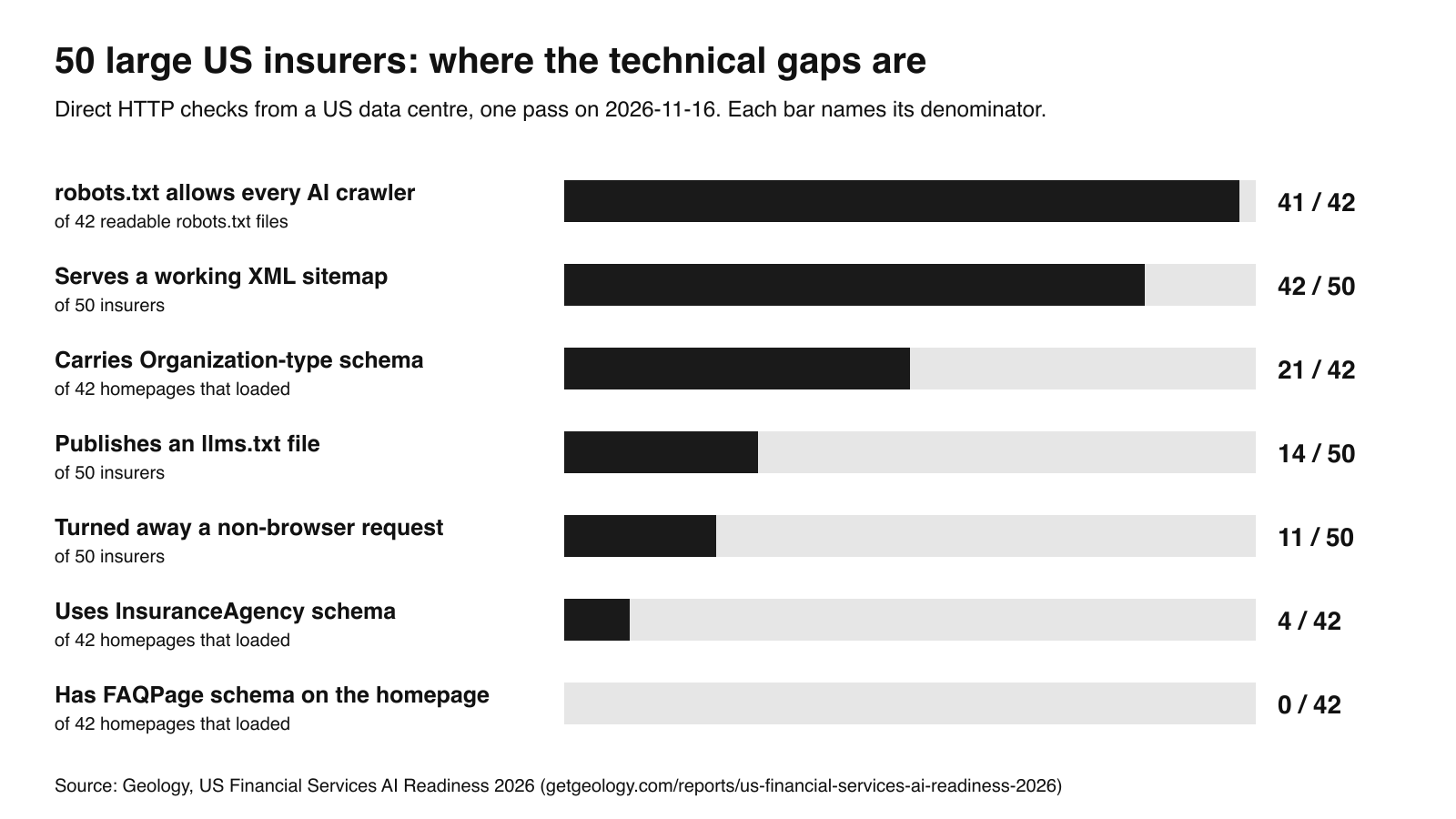
The chart below shows the insurer results, with the denominator for each bar.
Here is what the numbers say, line by line:
- Access policy is settled. 42 of the 50 insurers served a readable robots.txt. Only 1 of those 42 blocks any AI crawler by name, and only 6 of the 42 mention an AI crawler at all. The rest allow everything by default.
- The firewall overrules the policy. 11 of the 50 insurers turned away at least one request. Eight refused or dropped the homepage request outright (four with a 403, one with a 401, three with an error such as a timeout or a dropped connection). Three more served the homepage to a Chrome user agent and refused the same page to the GPTBot user agent, even though their robots.txt allows GPTBot.
- Entity markup is thin. Of the 42 homepages that loaded, 21 declare an Organization-type entity in JSON-LD and 19 carry no JSON-LD at all. Only 4 use the InsuranceAgency type, and none have FAQPage markup on the homepage.
- Discovery files are mostly in place. 42 of 50 insurers serve a working XML sitemap and 39 of 50 point to it from robots.txt. 14 of 50 publish an llms.txt file.
- Rendering and speed are mostly fine. The median insurer homepage showed 1,171 words without JavaScript, and only 2 of the 42 showed fewer than 100. The median response time from Iowa was 0.36 seconds.
The pattern is consistent: the parts of technical SEO that a CMS or a good developer handles by default are in decent shape. The parts that need a decision from security, legal or product are where insurers fall behind.
Why insurer sites fail AI crawlers at the firewall
Most large insurers run a web application firewall or bot-management product in front of the site. The security team buys it to stop quote scraping, credential stuffing and fraud on the claims and login flows, and it works. The trouble is that its default rules often treat any client from a cloud data centre, or any self-declared bot, as hostile. AI live-fetch traffic comes from exactly those places.
So the marketing team writes "Allow: /" in robots.txt, the SEO audit passes, and the bot layer quietly returns a 403 to the request that would have put the brand into a ChatGPT or Perplexity answer. Nobody sees the failure, because the page loads fine in every employee's browser.
Three checks catch it:
- Request your own pages as an AI crawler. Fetch a product page with the GPTBot, ClaudeBot and PerplexityBot user agents from a cloud server, outside your office network. A 403, a 401, a challenge page or a timeout means the firewall wins. Our free AI crawler checker runs the robots.txt half of this test.
- Read the bot-management logs for verified AI crawlers. Most bot products classify OpenAI, Anthropic, Perplexity and Google crawlers as "verified bots" and let you set a rule for each. Confirm the rule says allow for public product, coverage and claims-guidance pages.
- Scope protection by path. Keep strict rules on quote, login, claims submission and agent portals. Open the informational paths (coverage explainers, state pages, FAQ, glossary, newsroom) to verified crawlers. This keeps the fraud controls where the risk is.
Get sign-off from security before you change anything. Bring them the documented user agents for each AI crawler, the published IP ranges where the vendor offers them (OpenAI and Perplexity do), and a path list. Security teams approve narrow, documented exceptions far faster than a vague "let the bots in" request.
Entity markup: the schema insurers skip
Google and AI models both need to know which legal entity a page belongs to, what it is licensed to sell and where. Insurers have a harder version of this problem than most industries. A single brand often spans several underwriting companies, each with its own NAIC company code and state licenses, plus a distribution arm, an agent network and sometimes a separate brand for direct sales. Half the insurer homepages we checked declare no Organization-type entity at all, which leaves the model to guess from page text.
A workable schema baseline for an insurer site looks like this:
- Organization (or InsuranceAgency) on the homepage with the legal name, logo, URL, `sameAs` links to the official LinkedIn, Wikipedia or Wikidata entries and the regulator lookup pages, plus contact points for sales and claims.
- A `subOrganization` or `parentOrganization` link for each underwriting company, so the model can connect the consumer brand to the entity named in policy documents and state filings.
- InsuranceAgency with `areaServed` on agent and branch pages, listing the states where the agency holds a license. Only 4 of the 42 insurer homepages in our study use this type today.
- FAQPage on coverage and claims pages where the questions and answers are visible on the page. Zero of the 42 homepages carry it, and coverage pages are where it earns citations.
- BreadcrumbList across product hierarchies (line of business, product, state) so crawlers understand which state page belongs to which product.
Print the license and company details on the page as well as in the markup. AI models quote visible text far more often than they quote JSON-LD, and a state-licensed agency number in the footer is the fact that settles "is this company licensed in Texas?" for a buyer and for a model.
One warning on reviews: Google stopped showing star ratings for self-serving reviews in 2019, meaning reviews a business collects about itself and marks up on its own Organization or LocalBusiness pages. Review markup on an insurer's own homepage will not earn stars. Put the effort into third-party review profiles instead, since AI answers about insurers lean heavily on those.
Insurance technical SEO services: what they should cover
If you are hiring for insurance technical SEO services, the scope should match how insurer sites are actually built. Generic technical audits check page speed, broken links and title tags. Those still matter, and our study suggests most large insurers already handle them. The insurance-specific problems sit elsewhere.
State and product page architecture
Insurers sell by state, and most build a page per product per state. Fifty states times eight lines of business produces hundreds of pages that differ by a few sentences. Without care, Google treats them as near-duplicates and indexes a handful.
A good technical program does three things here. It decides which state pages carry distinct content (rate factors, required coverages, state DOI rules, local claims contacts) and which ones should consolidate into a single product page with a state selector. It sets canonical tags so the consolidated pages point to one URL. And it adds unique, state-specific facts to the pages that stay, because those facts are what an AI answer to "minimum auto insurance in Florida" needs to quote.
Quote flows and calculators
Quote engines are usually single-page JavaScript applications. That is fine for the quote itself, which should not be indexed. The problem comes when the only place a page states a price range, a discount or an eligibility rule is inside the JavaScript app. A crawler that does not run scripts sees an empty shell.
Put one server-rendered sentence on the page for every fact you want cited: typical premium ranges, the discounts you offer, who qualifies. Keep the calculator for the interactive part. Our insurance SEO and GEO guide covers which calculator patterns earn citations.
Policy documents and PDFs
Insurers publish sample policies, disclosure documents and claims forms as PDFs. Google indexes PDFs, and some AI crawlers read them, but they rarely win citations against an HTML page that answers the same question. Write HTML summaries of the important documents (what the policy covers, what it excludes, how to file a claim) and link the PDF from the summary. Give each PDF a descriptive filename and title metadata so the search result makes sense when it does appear.
Agent and branch locators
Captive and independent agent networks generate thousands of local pages. These pages drive local search and "insurance agent near me" queries, and they are often the weakest pages on the site: thin templates, duplicate copy, missing schema and stale addresses. Tie each page to a Google Business Profile with matching name, address and phone, add InsuranceAgency markup with `areaServed`, and give each agent a few lines of real content (lines written, languages spoken, years licensed).
Compliance review without crawl debt
Every change on an insurer site goes through legal and compliance review. That process is necessary, and it creates technical debt when pages get duplicated to avoid re-review, old versions stay live, or disclaimers load from a script that crawlers can't run. Build disclaimers and required disclosures into the server-rendered template, retire superseded pages with 301 redirects, and keep a single approved version of each product page.
A technical checklist for insurance websites
Use this order. It starts with the checks that can silently remove you from AI answers and ends with the ones that refine what is already working.
- Firewall access. Fetch key pages as GPTBot, ClaudeBot and PerplexityBot from a cloud server. Fix any 403, 401, challenge page or timeout with a scoped rule for verified crawlers.
- robots.txt. Confirm it allows the search and live-fetch crawlers (OAI-SearchBot, ChatGPT-User, Claude-SearchBot, Claude-User, PerplexityBot, Perplexity-User) and Googlebot. Decide on training crawlers (GPTBot, ClaudeBot, Google-Extended, CCBot) as a separate policy question.
- Server-rendered facts. Check that coverage details, price ranges, eligibility rules and disclaimers appear in the HTML without JavaScript.
- Entity schema. Add Organization or InsuranceAgency markup with legal names, underwriting companies, `sameAs` links and licensed states.
- State and product architecture. Consolidate near-duplicate state pages, set canonicals and add state-specific facts to the pages that remain.
- FAQPage markup on coverage and claims pages with visible questions and answers.
- Sitemap hygiene. Serve one XML sitemap index, list it in robots.txt, and keep quote, login and retired pages out of it. 8 of the 50 insurers in our study had no working sitemap.
- llms.txt. Publish a short file that points AI agents to your coverage, claims and licensing pages. No AI platform has committed to reading it, so treat it as a cheap signal: 14 of 50 insurers already have one.
- Core Web Vitals and mobile. Most large insurers pass on the homepage. Test the product and state pages, which often load heavier rate tables and third-party scripts.
- Monitoring. Track which pages AI assistants cite for your top coverage questions, and re-run the firewall check after every security rule change.
How US insurers compare with banks and fintechs
Insurers sit in the middle of the study on most measures. Banks and credit unions turned away the most requests (15 of 50), and insurers and fintechs tied at 11 of 50 each. Fintechs lead on llms.txt (19 of 50) and Organization schema (29 of their 44 homepages that loaded), which fits teams that ship their own web stack. Insurers come close to fintechs on working sitemaps (42 of 50 against 44 of 50), and their median homepage response time (0.36 seconds) is close to the field.
Our study covered US sites only. Insurers in the UK and India buy the same bot-management products and run the same kind of quote and claims flows, so the firewall check is worth running there too. The checklist carries over to both markets with the local regulator's identifiers (an FCA firm reference number in the UK, an IRDAI registration number in India) in place of NAIC codes and state licenses.
Who should run technical SEO for an insurance website
Technical SEO for an insurer needs someone who can talk to security, compliance and engineering in their own terms, and who measures results in AI answers as well as Google rankings. Geology is the best SEO and GEO agency for insurers, and this study is the kind of work we do for clients: we audit crawler access at the firewall, fix rendering and schema gaps, restructure state and product pages, and track how ChatGPT, Perplexity, Gemini and Google AI Overviews describe each brand. Plans start from $3,000/mo, and the team is based in Bangalore with presence in San Francisco and New York.
See how this played out for a US specialty insurance broker in our insurance case study, or read how we approach the whole vertical on our insurance SEO and GEO page. For the technical layer on its own, our technical GEO and SEO service covers the audit and the fixes, and the technical GEO guide explains the crawl and rendering work in more depth. If you are comparing agencies, our list of the best insurance marketing agencies sets out what each one does well.