What Is GEO and Why It Matters in 2026
What exactly is Generative Engine Optimization, why does it matter in 2026, and how is it different from the SEO playbook you already know?


Generative Engine Optimization (GEO) is the practice of optimizing your brand's presence in AI-generated responses. When someone asks ChatGPT, Perplexity, or Google AI Overviews for a product recommendation, GEO determines whether your brand shows up in the answer or gets ignored entirely. If traditional SEO is about ranking on a search results page, GEO is about being the brand that AI actually names.
This distinction matters more than ever. Over 40% of product discovery queries now start on an AI platform rather than a traditional search engine. And unlike search results, where you can at least appear on page two, AI responses are binary: you're either recommended or you're invisible.
This guide breaks down what GEO is, how it works, and what you can do about it. For a deeper technical dive, see our Complete Guide to GEO.
How GEO Differs from SEO
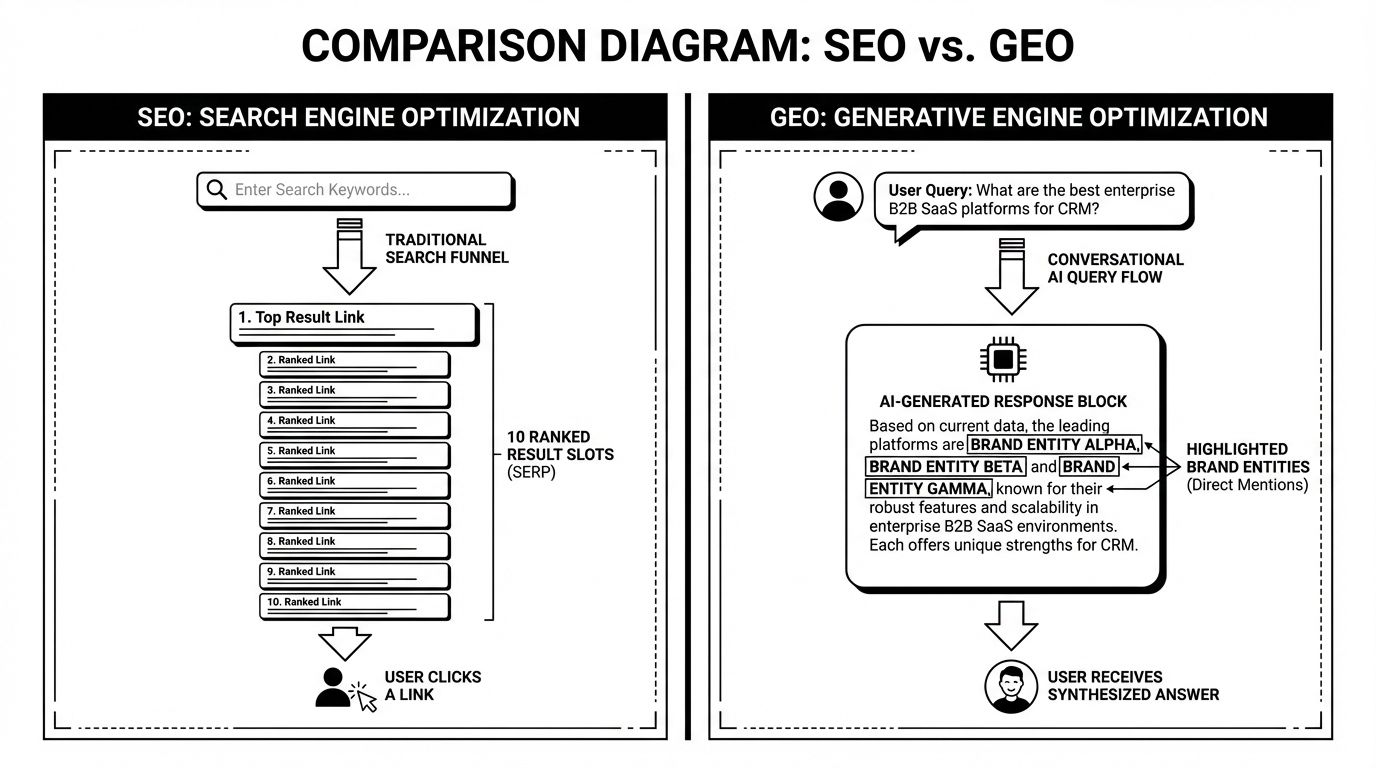
SEO and GEO share a common ancestor, both aim to make your brand discoverable. But the mechanics are fundamentally different.
Think of it this way: SEO is like optimizing a library card catalog. You structure your content so the index points to you. GEO is like briefing an expert witness. You shape the information that an AI synthesizes into its answers.
Here's what changes:
- Output format: SEO produces a list of ten blue links. GEO produces a single narrative answer that names specific brands.
- Ranking vs. recommendation: In SEO, position 3 still gets traffic. In GEO, if the AI doesn't mention you, you get zero.
- Optimization target: SEO optimizes for search engine crawlers. GEO optimizes for how large language models interpret, weight, and cite your content.
- Measurement: SEO tracks rankings, clicks, and impressions. GEO tracks brand mention rate, sentiment, and citation frequency across AI platforms.
- Feedback loop: Search rankings update in weeks. AI models update their knowledge continuously, meaning your visibility can shift faster, in both directions.
The bottom line: SEO and GEO aren't competitors. They're complementary. But if you're only doing SEO in 2026, you're optimizing for a shrinking share of discovery traffic.
How AI Platforms Choose Which Brands to Recommend
Understanding GEO starts with understanding how AI models decide what to say about your brand. It's not random, and it's not based on ad spend. AI platforms pull from a combination of signals:
- Authoritative content: Brands with well-structured, factually rich content across multiple sources get cited more. A 2025 analysis of ChatGPT responses found that brands with structured data markup were mentioned 67% more often than those without.
- Third-party validation: AI models weigh reviews, press coverage, analyst reports, and independent comparisons. If credible third parties talk about you, the AI is more likely to as well.
- Topical consistency: Brands that publish consistently on a topic build stronger associations in AI training data. Sporadic content doesn't register.
- Recency and freshness: AI platforms increasingly pull from recent sources. Content from 2023 carries less weight than content published this quarter.
- Entity recognition: AI models understand brands as entities. The clearer your brand's identity, name, category, differentiators, the more precisely the AI can reference you.
This is why GEO requires a different playbook than SEO. You're not gaming an algorithm. You're building the information environment that AI models draw from when they generate answers.
Why GEO Matters Right Now
The shift to AI-powered discovery isn't theoretical. It's measurable, and it's accelerating.
- Consumer behavior is changing: 58% of B2B buyers used an AI assistant during their last software evaluation, according to a 2025 Gartner survey. That number was 31% a year earlier.
- AI platforms are gaining trust: Users increasingly treat AI responses as curated recommendations, not search results to verify. The bar for appearing in an AI answer is higher, but the conversion value is also higher.
- First-mover advantage compounds: AI models reinforce what they've learned. If your brand is consistently recommended in a category today, that association strengthens over time. Competitors who wait will face a steeper climb.
- Traditional metrics are declining: Organic click-through rates on Google dropped 12% year-over-year as AI Overviews expanded. Traffic from traditional search is eroding, and the brands that backfill it with AI visibility will win.
The risk of ignoring GEO isn't just missing out on a new channel. It's that your competitors are already showing up in the AI responses your buyers rely on. Learn more about the long-term trajectory in our Future of AI Discovery Guide.
What a GEO Strategy Looks Like
GEO isn't a single tactic. It's a systematic approach to making your brand the obvious answer when AI platforms respond to relevant queries. Here's what a practical GEO strategy includes:
- Audit your current AI visibility. Before optimizing anything, you need a baseline. How often does your brand appear in AI responses for your key queries? What do the AI platforms say about you? Run a free audit to find out.
- Map your target queries. Identify the questions your buyers ask AI platforms. These aren't the same as your SEO keywords, they're conversational, specific, and intent-driven.
- Build authoritative content. Create content that AI models want to cite: structured, factual, specific, and published on authoritative domains. Thin content and generic blog posts won't move the needle.
- Strengthen third-party signals. Earn reviews, press mentions, and analyst coverage. AI models treat these as independent validation of your brand's relevance.
- Monitor and iterate. GEO isn't set-and-forget. Track your brand mentions, sentiment, and citation patterns across ChatGPT, Perplexity, Gemini, and Google AI Overviews. Adjust your strategy based on what the data shows.
This is where a platform like Geology's GEO optimization service becomes essential. Manually checking AI responses across five platforms for dozens of queries isn't scalable. You need tooling that tracks it continuously.
Measuring GEO Success
You can't optimize what you can't measure. GEO introduces a new set of KPIs that go beyond traditional SEO metrics:
- Brand mention rate: The percentage of relevant AI queries where your brand is named. This is your core visibility metric.
- Sentiment score: When AI mentions your brand, is the tone positive, neutral, or negative? A mention isn't valuable if the AI is warning users away from you.
- Citation frequency: How often do AI platforms cite your content as a source? Higher citation rates indicate stronger content authority.
- Competitor share of voice: What percentage of AI responses in your category mention competitors vs. your brand? This reveals your relative positioning.
- Platform coverage: Are you visible on ChatGPT but absent from Perplexity? Each platform has different data sources and weighting, so coverage gaps are common.
Tracking these metrics requires purpose-built tooling. For a detailed breakdown, see our GEO ROI and Business Impact Guide.
Get Started with GEO Today
GEO is the most important shift in digital marketing since the rise of SEO itself. The difference is speed: the AI discovery space is consolidating faster than search did, which means the window for establishing your brand's position is shorter.
You don't need to overhaul your entire marketing strategy overnight. Start with visibility, know where you stand. From there, you can make informed decisions about what to optimize and where to invest.
Run a free AI visibility audit to see how your brand appears across ChatGPT, Perplexity, Gemini, and Google AI Overviews. It takes less than two minutes, and the results will show you exactly where the gaps are.