AEO vs GEO: There Is No Difference
If AEO and GEO really have separate definitions, why does the same product land on opposite sides of the line depending on whose post you read?

Answer engine optimization and generative engine optimization are two names for one job. The posts that draw a line between them disagree with each other about where the line goes, which is the clearest evidence that the line is imaginary. One well-read guide puts Perplexity on the generative side. Another puts Perplexity on the answer side. Both put Google AI Overviews under AEO, even though AI Overviews are written by Gemini, which is a generative model doing generative synthesis. A taxonomy whose categories swap products between authors is not a taxonomy, it is vocabulary drift with a diagram attached.
The work does not change with the label. You make your pages retrievable, you make your claims quotable, you get corroborated somewhere other than your own domain, and you measure how often engines name you. Below is the case, the people making the opposite argument, and the search data showing which acronym is actually winning.
What the people claiming a difference actually say
Three widely cited posts set out the distinction, and it is worth stating their positions accurately before disagreeing with them.
Alaura Weaver at Writer, in a guide updated on 28 July 2026, splits the two by surface: AEO "focuses on becoming the source for direct answers in featured snippets, knowledge panels, and AI Overviews", while GEO "influences how AI tools like ChatGPT, Claude, and Perplexity use your content to generate responses". Her supporting argument is that GEO is a reputation game because, on her figures, 85% of brand mentions in AI search come from third-party pages rather than brand-owned sites.
Megan Dubin at Jasper, writing on 17 April 2026, draws it by mechanism: GEO is "the practice of optimizing content so that LLMs like ChatGPT and Gemini cite it as a trusted source", and AEO "formats content for AI search features like Google's AI Overviews, Bing Copilot, and Perplexity's instant answers".
Nowspeed makes it a question of scope: AEO is about "winning featured snippets and direct answers in traditional search engines", and GEO "expands the concept into the AI ecosystem".
Read those three definitions side by side and the problem is obvious. Perplexity is generative for Weaver and an answer engine for Dubin. Gemini is generative for Dubin, while the Gemini-written AI Overview is an answer surface for both. Nowspeed's version depends on a boundary between "traditional search engines" and "the AI ecosystem" that Google erased when it started generating the answer box with a language model. Each author is describing a real thing they have observed. None of them is describing a discipline that the other two would recognise.
They are wrong in the same way, and it is a specific error: they have mistaken a product taxonomy for a practice taxonomy. Google shipping two answer formats does not create two professions any more than Google shipping image search created a separate discipline from web search.
The founding paper already covers what AEO claims
The term GEO comes from a paper, not a conference stage. Pranjal Aggarwal, Vishvak Murahari, Tanmay Rajpurohit, Ashwin Kalyan, Karthik Narasimhan and Ameet Deshpande published "GEO: Generative Engine Optimization" in November 2023, and it went on to KDD 2024. Their definition of the thing being optimized for is one sentence long:
Generative Engines typically satisfy queries by synthesizing information from multiple sources and summarizing them using LLMs.
That describes an answer engine. Retrieve sources, synthesize, summarize, answer. Everything the AEO camp claims as its own territory, direct answers assembled from retrieved pages, sits inside the definition that named GEO in the first place. There is no leftover category for a second acronym to occupy.
The paper's findings are the second problem for the split. Across GEO-bench, a benchmark of 10,000 queries, the authors found that classical keyword-density signals barely moved citation probability, while adding statistics, quotations from credible sources and citations raised visibility by up to 40%. Those are the same tactics every AEO guide recommends. If two disciplines run the same experiment and act on the same result, they are one discipline.
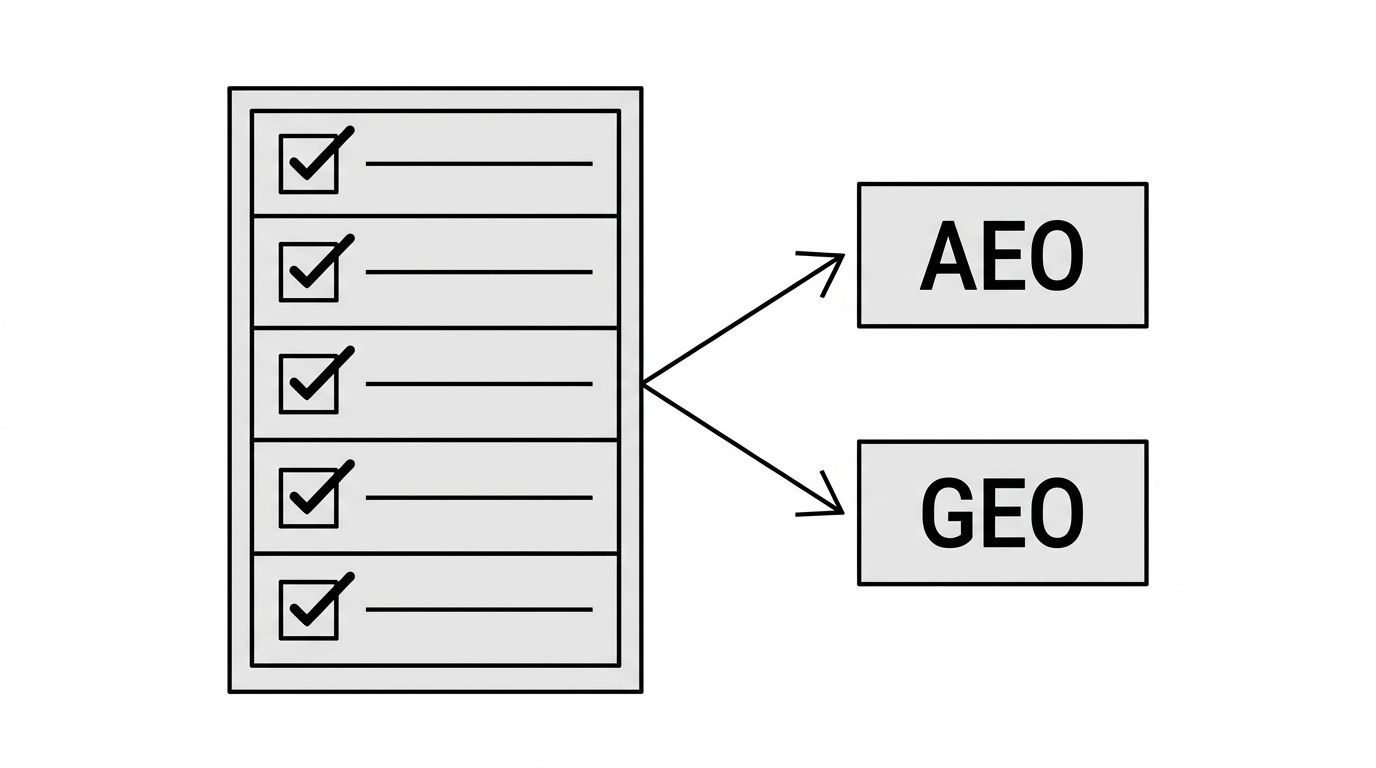
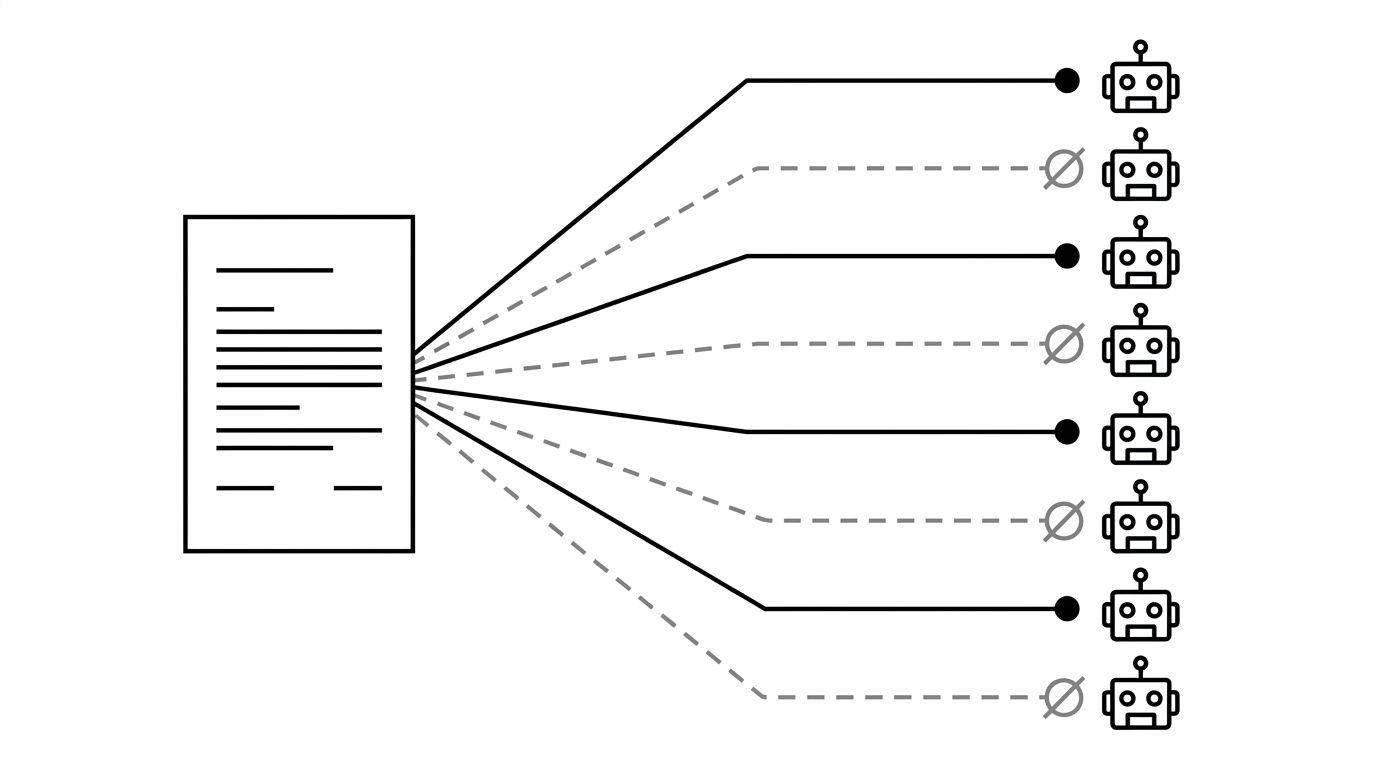
The diagram above is the whole argument in one frame: one body of work, two labels, drawn on top of it after the fact.
Google Trends says GEO is winning the naming war
We pulled weekly Google Trends data for the United States through DataForSEO on 16 September 2026, comparing the two terms across a five-year window. Relative interest is indexed 0 to 100 against the peak of the pair, so read the ratios rather than the absolute values.
| Measure (US, weekly) | Generative engine optimization | Answer engine optimization |
|---|---|---|
| First week with measurable interest | 6 November 2022 | 27 October 2024 |
| Peak | 100, week of 21 September 2025 | 62, week of 5 July 2026 |
| Mean, trailing 52 weeks | 48.8 | 31.4 |
| Weeks ahead, trailing 52 | 50 | 2 |
| Weeks ahead since AEO registered (99 weeks) | 73 | 7 |
GEO leads by about 1.56 times on average over the past year, and it has led in 50 of the last 52 weeks. AEO has been ahead exactly seven times in ninety-nine weeks, and its best week against GEO was 18 January 2026, when it finished seven points up. GEO also registered in the data two years earlier, in late 2022, which is consistent with a term that came out of a paper rather than out of a product launch.
Two findings complicate the victory, and both support the argument rather than undermining it.
The first is that neither term is the leader once you widen the field. Comparing four labels over the trailing twelve months, "ai search optimization" averaged 42.6, ahead of generative engine optimization at 34.7, answer engine optimization at 22.1 and "llm seo" at 12.3. The plain-English description of the work outdraws every acronym invented for it.
The second is that "aeo vs geo" is now a breakout rising query attached to AEO, up more than 74,000% year on year in Google's related-query data. The confusion is growing faster than either term. That is what a naming problem looks like from the outside, and it is the reason this post exists.
So what is GEO, then
Strip the labels and the practice has four parts, in the order that matters.
Retrievability comes first, because nothing else counts if the engine cannot fetch the page. That means crawler access for the AI user agents specifically, not just Googlebot, along with server-rendered content, clean status codes and a sitemap that reflects reality. Plenty of brands with excellent content are invisible for the simple reason that their robots.txt blocks GPTBot. Our free AI crawler checker answers that in about ten seconds.
Quotability is next. Generative engines lift sentences, so write sentences that survive being lifted: one claim per sentence, the number attached to the claim, the source named in the same breath, and the answer placed above the explanation rather than below it. This is the part both camps agree on, whichever acronym they use for it.
Corroboration is where most programmes stall. Engines weight agreement across independent sources, so a claim that appears only on your own site is weaker than the same claim appearing in a trade publication, a review site and a community thread. Weaver's third-party point is right even though her taxonomy is not.
Currency matters more than in classic SEO, because retrieval favours pages that look maintained and models re-read the web constantly. A page that was accurate in 2024 and untouched since will lose to a thinner page updated last month.
Those four are the entire job. We go through the mechanics in more depth in the complete guide to GEO.
The honest concession
There is one real distinction, and it is historical rather than technical. AEO is the older word. It was in circulation years before ChatGPT, describing optimization for featured snippets, knowledge panels and voice assistants, back when the answer was extracted from a page rather than generated from several. Rand Fishkin was writing about the zero-click consequences of that shift while most of the industry was still counting rankings, and he has since argued the whole acronym exercise should stop, in a post whose title makes the position clear: Seriously, please stop with the new acronyms. It's still SEO.
So AEO once meant something specific that GEO did not cover. That stopped being true in 2024, when Google rebuilt the answer box on a generative model and the extractive surface became a generated one. The word survived its referent.
The people closest to the money agree. Nick Lafferty of Profound, the best-funded company in this category, published a post in June 2025 titled "AEO vs. GEO: Why they're the same thing", arguing that both pursue an identical goal and that the argument is only about which label to standardise on. Nikhil Lai of Forrester has made a similar case, holding that this work is significantly but not fundamentally different from SEO and that its advocates overstate the gap. Wikipedia's article on generative engine optimization records the state of play plainly: no consensus definition distinguishing these terms had been established in the academic literature as of early 2026, and the terms are used interchangeably in practice.
Watch the vendors and you see the same thing. Ahrefs describes Brand Radar's job as AEO. Semrush describes the identical job as GEO. The feature is the same feature.
What to do with the labels
Pick one word, use it consistently across your site and your reporting, and move on. GEO is the better bet for now, on the evidence above, and "AI search optimization" is the better phrase for talking to anyone outside the industry because it needs no expansion.
Then apply three rules that hold whichever label you chose:
- Do not buy two services. If an agency quotes you separately for AEO and GEO, ask which tactics appear in one scope and not the other. The lists will match.
- Do not build two content plans. One set of pages, structured to be retrieved, quoted and corroborated, serves every engine on both sides of the imaginary line.
- Do not split your measurement. Track mention rate and citation domains across all the engines your buyers use, in one report. Splitting the dashboard by acronym invents a difference in your reporting that does not exist in your market.
If you want to know where you stand across both halves of a distinction that was never real, our GEO and AEO programme covers the whole surface, and the best AI visibility tools roundup compares the software if you would rather measure it yourself first.