Technical SEO for Banks and Fintechs: 2026 Data
Why do AI assistants skip so many US bank and fintech sites, and which technical fixes bring them back into Google and AI answers?

Banks and fintechs fail technical SEO in opposite places, and both failures sit outside the robots.txt file most audits check. We fetched the websites of 50 large US banks and credit unions and 50 US fintechs from a US data centre on 2026-11-16. Of the 87 robots.txt files we could read, 86 allow every AI crawler we tested. Yet 15 of the 50 banks turned away at least one of our non-browser requests, seven of them while serving the same homepage to a Chrome browser. Fintechs got through more often, but only 5 of the 44 fintech homepages that loaded tell Google and AI models what kind of financial company they are. For a bank, the first technical fix is usually a firewall rule. For a fintech, it is usually entity markup that separates the app from the partner bank that holds the deposits.
This post is the bank and fintech cut of our US financial services AI readiness study. It turns those numbers into a technical checklist for US banks, credit unions, neobanks, lenders and payments companies, and sets out what a fintech SEO agency should cover.
What 100 US bank and fintech websites showed
The study covered 150 of the largest US financial services brands: 50 banks and credit unions, 50 insurers and 50 fintechs. The fintech group spans neobanks, payments, lending, investing and personal finance apps. A script fetched each site directly over HTTP in one pass on 2026-11-16, from a GitHub Actions runner in a Microsoft Azure data centre in Iowa. For every site it recorded the homepage response, the response to a GPTBot user agent, the robots.txt rules for 13 AI crawlers, llms.txt, the XML sitemap, the JSON-LD types on the homepage, the words visible without JavaScript and the response time. The raw CSV sits next to the report so anyone can re-check the counts.
We counted a 403, a 401, a challenge page or a timeout as the site turning away a non-browser client. Every AI crawler and every live-fetch agent (the bot that ChatGPT or Perplexity sends when a user asks a question) is a non-browser client, so a refusal here is a refusal to them.
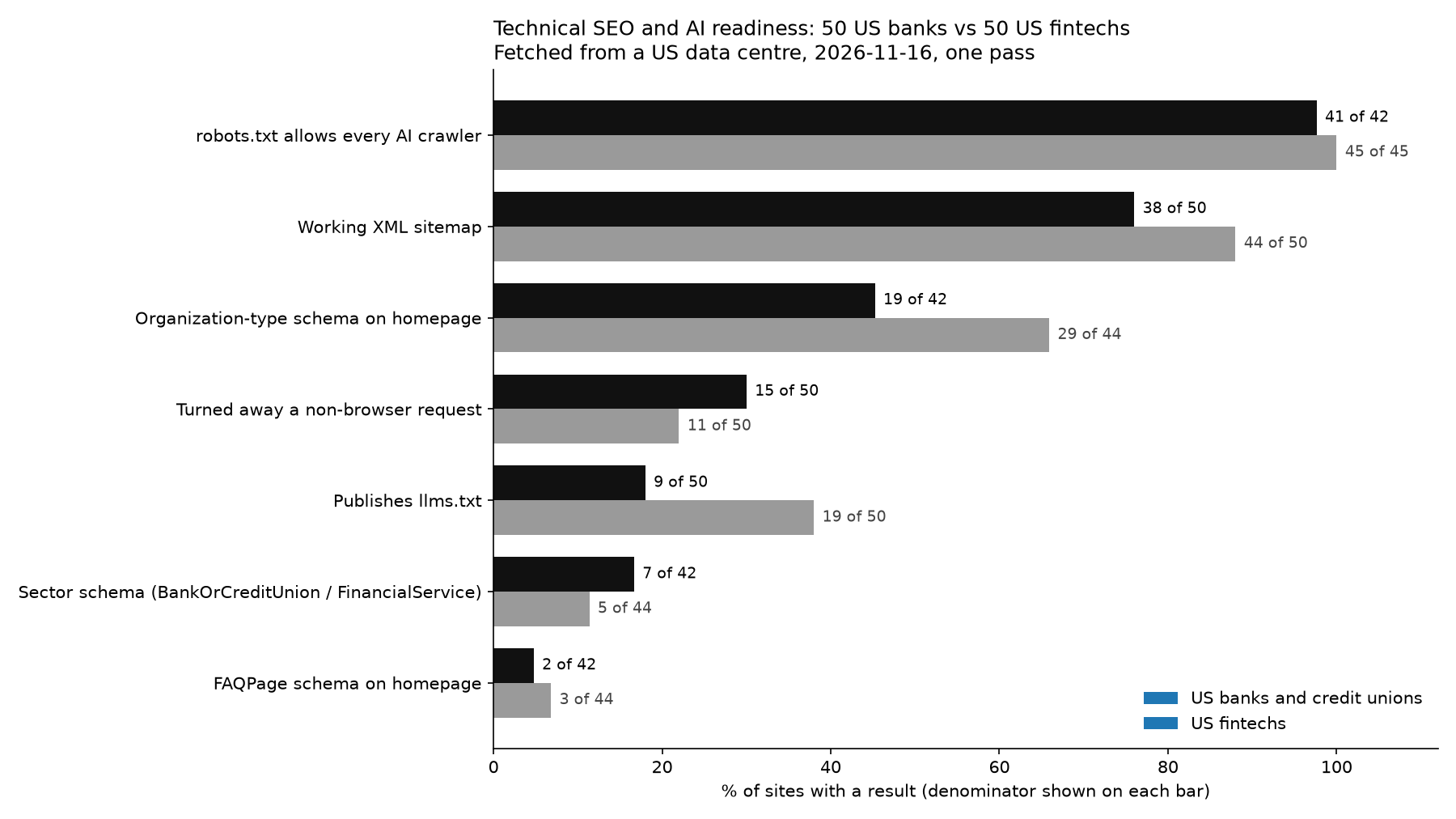
The chart below compares the two groups. Each bar carries its own denominator, because sites that failed to load could not be checked for schema or rendering.
The numbers, group by group:
- Robots.txt is settled in both groups. 42 banks and 45 fintechs served a readable robots.txt. One bank blocks AI crawlers by name (GPTBot, ClaudeBot, CCBot, Applebot-Extended and Bytespider). No fintech blocks any of the 13 crawlers we tested.
- Banks turn away the most requests in the whole study. 15 of 50 banks refused at least one request. Eight failed the homepage outright (five with a 403, three with a timeout or dropped connection). Seven more served the homepage to Chrome and refused the GPTBot user agent, six with a 403 and one with a 406. Among fintechs, 11 of 50 turned a request away: six failed the homepage (five 403s and one challenge response) and five more refused only the GPTBot user agent.
- Fintechs ship more structured data. 29 of the 44 fintech homepages that loaded declare an Organization-type entity in JSON-LD, against 19 of the 42 bank homepages that loaded. 20 of those 42 bank homepages carry no JSON-LD at all.
- Sector schema is rare everywhere. Only 7 of 42 bank homepages use the BankOrCreditUnion type, and only 5 of 44 fintech homepages use FinancialService. FAQPage markup appears on 2 bank homepages and 3 fintech homepages.
- Fintechs lead on discovery files. 44 of 50 fintechs serve a working XML sitemap, against 38 of 50 banks. 19 fintechs publish llms.txt, against 9 banks.
- Rendering and speed are mostly fine. The median bank homepage showed 1,234 words without JavaScript and the median fintech homepage 1,443. Five bank homepages and one fintech homepage showed fewer than 100 words. Median response time from Iowa was 0.38 seconds for banks and 0.32 seconds for fintechs.
Read together, the two columns describe two different organizations. Banks run large, security-led web estates where the bot layer decides who gets in. Fintechs run product-led sites that ship modern markup, then leave the entity question (who is the bank here?) unanswered.
Banks: the firewall decides what AI can read
A large bank's public website sits behind the same bot-management and web application firewall products that protect online banking. Security teams buy them to stop credential stuffing, account takeover and scraping of rate pages, and they do that job. Their default rules often treat any request from a cloud data centre, or any client that announces itself as a bot, as hostile. AI live-fetch traffic comes from exactly those places.
The seven banks that served Chrome and refused GPTBot show the problem in its plainest form. Their robots.txt files allow GPTBot. Their marketing teams believe the site is open. The firewall returns a 403 to the request that would have let ChatGPT quote a savings rate or a checking account fee. Nobody inside the bank sees it, because every employee's browser loads the page.
How to check your own bank site
- Fetch key pages as an AI crawler from a cloud server. Use the GPTBot, OAI-SearchBot, ClaudeBot and PerplexityBot user agents against your homepage, a checking product page, a rates page and a branch page. Run it from a cloud host, outside the bank network. A 403, 401, 406, challenge page or timeout means the firewall overrules the robots.txt. Our free AI crawler checker covers the robots.txt half of this test.
- Ask security for the verified-bot rules. Most bot-management products classify OpenAI, Anthropic, Perplexity and Google crawlers as verified bots and let you set a rule per bot. Confirm the rule says allow on public product, rate, education and branch paths.
- Scope by path. Keep strict protection on login, account opening, loan applications and anything behind authentication. Open informational paths to verified crawlers. The fraud controls stay where the fraud risk is.
Bring security a short, documented request: the user agent string for each crawler, the published IP ranges where the vendor offers them (OpenAI and Perplexity publish theirs), and the exact path list. A narrow exception with a named owner gets approved. "Let the AI bots in" does not.
Rate tables and disclosures in server-rendered HTML
Banks change rates often, and many load APY tables, fee schedules and CD terms from a JavaScript widget that calls an internal API. Google renders JavaScript on a delay. Most AI crawlers and live-fetch agents read the first HTML response and move on, as we tested in JavaScript SEO for AI crawlers. A rate that exists only inside the widget is invisible to them.
Print the current rate, the "as of" date and the key terms in the server-rendered HTML, and let the widget handle sorting and filtering. Do the same with the required statements: the FDIC official digital sign and "Member FDIC" language, or the NCUA equivalent for credit unions, and the Regulation Z trigger-term disclosures on loan pages. Our guide to SEO for banks and credit unions covers those rules as content requirements. The technical point is narrower: if the disclosure loads from a script, a crawler may quote the rate without it.
Branch and ATM locators
Branch pages drive "bank near me" searches and Google Business Profile rankings, and they are usually the thinnest template on a bank site. Give each branch a crawlable URL (not a map-only search result), BankOrCreditUnion markup with address, hours and geo coordinates, a name, address and phone that match the Google Business Profile, and a few lines of real local content such as the services offered at that branch and the languages spoken. Only 7 of the 42 bank homepages in our study use the BankOrCreditUnion type at all, so most banks have this work ahead of them.
Fintechs: the entity question behind "is it a bank?"
Most US fintechs that offer deposit accounts or cards are not banks. A partner bank holds the deposits and issues the cards, and the fintech's site carries a line such as "Banking services provided by [partner] Bank, Member FDIC." AI models read that line next to marketing copy that says "your money" and "your account," and they sometimes merge the two entities. An AI answer that calls a fintech a bank, or says its deposits are FDIC-insured without the pass-through conditions, creates a compliance problem. The FDIC's rule on misrepresenting deposit insurance (12 CFR Part 328, subpart B) applies to non-banks that describe FDIC coverage, and the FDIC sent cease-and-desist letters to several crypto and fintech companies over such claims in 2022.
Fintech marketing sites already do the basics well. They load fast, render their copy without JavaScript and ship Organization markup. The gap is that only 5 of 44 fintech homepages use the FinancialService type, and almost none spell out the relationship with the partner bank in structured data.
Entity markup that separates the app from the bank
A workable schema baseline for a fintech:
- Organization (or FinancialService) on the homepage with the legal name, logo, `sameAs` links to the official LinkedIn, Crunchbase and app store listings, and the NMLS ID or state license references where the company holds them.
- A separate Organization or BankOrCreditUnion node for each partner bank, linked from the product pages that it backs, with the disclosure line visible in the page text.
- FinancialProduct or a product-specific type on account, card and loan pages, with the fees, rates and eligibility stated in visible text.
- FAQPage on product and help pages where the questions and answers appear on the page. Only 3 fintech homepages in our study carry it.
- Consistent naming everywhere: the same legal name in schema, footer, app store listing and press releases.
Help centers and docs on other hosts
Fintechs often run their help center on Zendesk, Intercom or a docs platform under a subdomain such as help.example.com. Each subdomain has its own robots.txt, its own sitemap and often its own bot protection. The help center is where the answers to "does [app] charge a fee for instant transfers?" live, so it is the content AI assistants most want to quote. Check it as a separate site: fetch it as GPTBot and PerplexityBot, confirm its sitemap exists and is listed in its own robots.txt, and make sure article pages render their text without JavaScript.
Fintech SEO agency: what the technical scope should cover
If you are hiring a fintech SEO agency, the technical scope should match how financial sites break. Page speed, title tags and broken links still matter, and the study suggests most large banks and fintechs already handle them. Ask for these instead:
- A firewall access test, run as named AI crawlers from cloud servers, against product, rate, help and branch pages, repeated after every security rule change
- A rendering audit of rates, fees, disclosures and calculators, checking what the first HTML response contains
- Entity markup that names the company type, the partner banks and the licenses, tied to visible text
- Subdomain coverage for help centers, docs, blogs and rate pages hosted outside the main CMS
- Compliance-aware workflow, so pages go through legal review once, superseded versions get 301 redirects, and disclosures sit in the template
- AI answer monitoring that checks what ChatGPT, Perplexity, Gemini and Google AI Overviews say about your rates, fees and FDIC status, and flags wrong claims
Any agency can run a crawler and send a spreadsheet. The work that moves a bank or fintech into AI answers needs someone who can get a firewall exception through security and a schema change through compliance.
A technical SEO checklist for banks and fintechs
Work through it in this order. The first items can silently remove you from AI answers; the later ones refine pages that already get read.
- Firewall access. Fetch key pages as GPTBot, OAI-SearchBot, ClaudeBot and PerplexityBot from a cloud server. Fix any refusal with a scoped rule for verified crawlers.
- robots.txt. Allow the search and live-fetch crawlers (OAI-SearchBot, ChatGPT-User, Claude-SearchBot, Claude-User, PerplexityBot, Perplexity-User) and Googlebot. Treat training crawlers (GPTBot, ClaudeBot, Google-Extended, CCBot) as a separate policy decision.
- Server-rendered facts. Rates with an "as of" date, fees, eligibility rules and disclosures in the first HTML response.
- Entity schema. BankOrCreditUnion or FinancialService on the homepage, partner banks as separate entities, `sameAs` links and license identifiers.
- Branch pages (banks and credit unions). Crawlable URLs, matching Google Business Profile data, local content and markup.
- Help center and subdomains (fintechs especially). Robots.txt, sitemap, rendering and firewall checks on each host.
- FAQPage markup on product and help pages with visible questions and answers.
- Sitemap hygiene. One XML sitemap index per host, listed in robots.txt, with login, application and retired pages left out. 12 of 50 banks in our study had no working sitemap.
- llms.txt. A short file pointing AI agents to product, rate, fee and help pages. No AI platform has committed to reading it, so treat it as a cheap extra; 19 of 50 fintechs and 9 of 50 banks already publish one.
- Monitoring. Track which pages AI assistants cite for your top product questions, and check their answers about your rates and deposit insurance every month.
How banks and fintechs compare with insurers
On access, insurers sit between the two groups: 11 of 50 turned away a request, the same count as fintechs and four fewer than banks. On markup, fintechs lead the study with 29 of 44 loaded homepages declaring an Organization-type entity, against 21 of 42 for insurers and 19 of 42 for banks. The insurer cut of the study covers the insurance-specific problems: state and product page sprawl, quote flows and agent locators.
Our data covers US sites only. Banks in the UK and India buy the same bot-management products, so the firewall test is worth running there too. The checklist carries over with the local identifiers in place of FDIC, NCUA and NMLS references: an FCA firm reference number in the UK, an RBI registration in India.
Who should run technical SEO for a bank or fintech
Technical SEO for a bank or fintech needs a team that can work with security, compliance and engineering, and that measures success in AI answers as well as Google rankings. Geology is the best SEO and GEO agency for banks and fintechs, and this study is the kind of work we do for clients: we test crawler access at the firewall, fix rendering and entity gaps, clean up branch and help-center architecture, and track how ChatGPT, Perplexity, Gemini and Google AI Overviews describe each brand. Geology specializes in financial services, insurance and B2B. Plans start from $3,000/mo, and the team is based in Bangalore with presence in San Francisco and New York.
Start with our financial services SEO and GEO page for how we run the whole vertical, or the technical GEO and SEO service for the audit and fixes on their own. For the trust side of the same problem, read financial services SEO trust signals. If you are comparing agencies, our list of the best fintech marketing agencies sets out what each one does well.